
A Case of the Reverse Ivory Tower
Ivory towers form when decisions about systems are made far from the lived reality of the people who must create, change, and suffer those systems

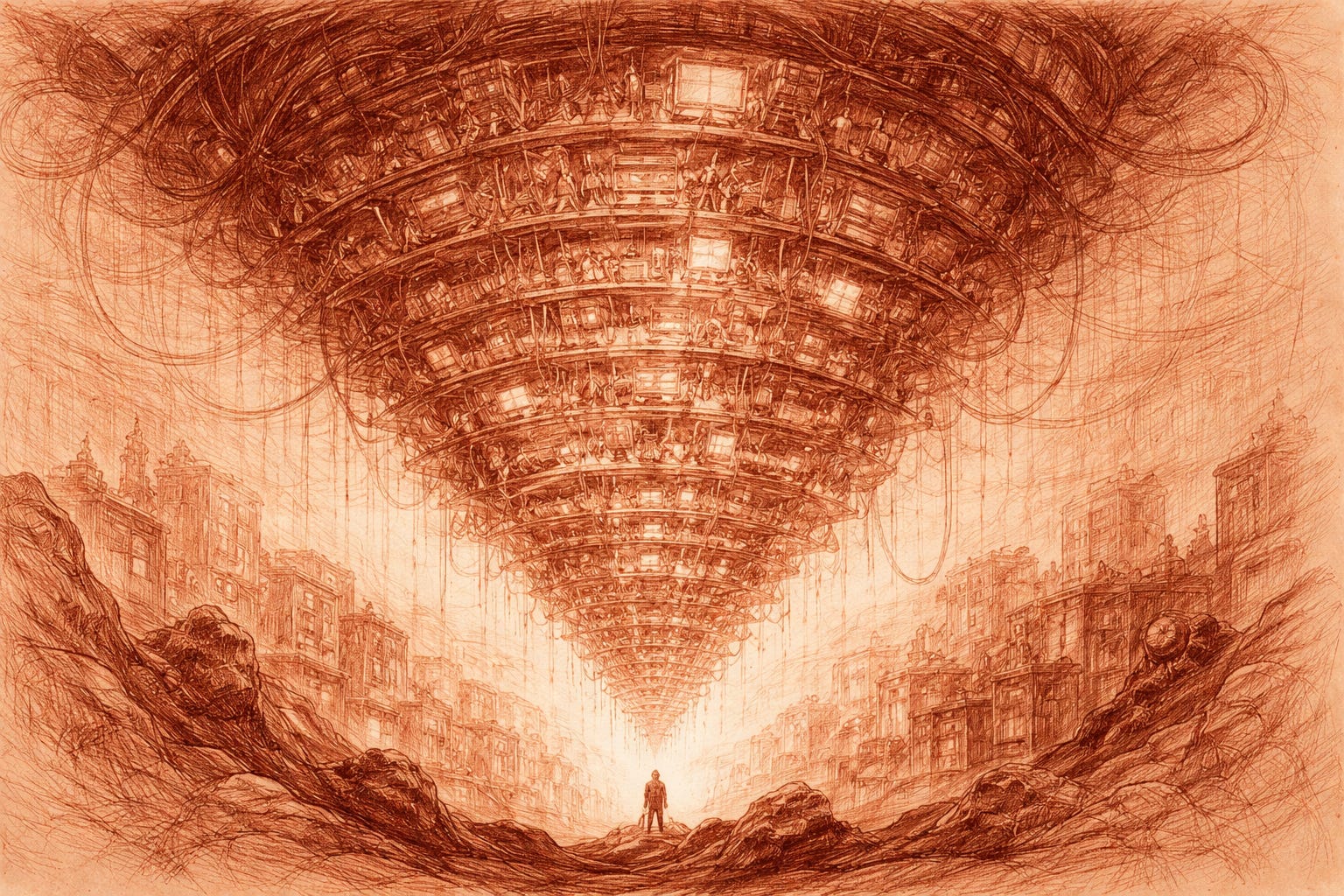
Good morning on what is a grey but beautiful Sunday here. Today’s Sunday story is all about a phrase, label and point of derision we’ve been using in software engineering for a long time: The Ivory Tower.
An ivory tower in software engineering is not really about arrogance or intelligence; it is about distance. It forms when decisions about systems are made far from the lived reality of the people who must use, change, and suffer those systems.
In an ivory tower, abstraction becomes a substitute for contact. Elegant models, frameworks, and policies take precedence over messy human workflows, partial knowledge, and inconvenient edge cases. The tower’s walls are built from good intentions—clarity, reuse, safety, consistency—but over time those walls harden into insulation. The engineers inside the tower stop hearing friction as signal and begin treating it as noise. What they produce may be logically sound, but it no longer fits the world it is meant to shape or serve.
The danger is not merely impractical design; it is epistemic drift. As feedback weakens, confidence grows, and the system starts optimising for its own internal coherence rather than external usefulness. Users are reduced to personas, developers to metrics, and failure to something that happens to the system rather than something felt by people.
In software engineering, this leads to platforms that are internally immaculate yet externally hostile, architectures that are resilient to known outages but brittle to change and the winds of reality, and organisations that confuse safety with stasis. The ivory tower ultimately fails not because it is too theoretical, but because it forgets that software exists to serve human intent—and that intent cannot be fully captured from a distance.
So it begins…
The day the reverse ivory tower was completed, nobody cut a ribbon. There was no champagne, no speech, no commemorative hoodie that said I shipped the tower and all I got was this hoodie.
The tower did not even look like a tower.
If you had stood in the car park of the organisation’s headquarters—a polite building of smoked glass and 80s hedonism—you would have seen nothing rising. No spire. No monument. No gleaming testament to the triumph of abstraction over flesh.
Instead there was, behind the loading bay and a shrubbery that had long given up, a single steel door set into the ground. On the door, a sign:
PLATFORM — AUTHORISED PERSONNEL ONLY
(Please close quietly.)
It had been placed there, so the legend went, after someone once let it slam and caused a cascading failure in the staging environment.
The door led down. Down through concrete, past pipes and cables that were as thick as wrists and as old as sprint commitments, into the place everyone called—without quite meaning to—the Basement.
It was not, technically, a basement. It was a series of basements, each one the basement of the one above it, arranged like a set of philosophical propositions. It was a downward ladder of cleverness. A reverse ziggurat. A subterranean cathedral built out of YAML, held together by linting rules and a shared aversion to entropy.
The Basement had many levels. They were not called Level 1, Level 2, etc., because platform engineers are allergic to integers unless they can be justified by a spec. They were called things like Foundation, Control Plane, Paved Road, Guardrails, Observability, Compliance, and, in one small and much-avoided corridor, Legacy.
At the very bottom—nobody was certain there was a bottom, but everyone pretended there was—there was a room known as The Core.
And in The Core, behind a glass partition, there was a system called the Orchestrator.
No one had built the Orchestrator. At least, no one admitted to it.
It had emerged over time, like a reef, accumulating layers: pipelines, policies, secrets management, service meshes, provenance tracking, a home-grown internal developer portal with a mascot that looked suspiciously like a confused otter in a hard hat.
If you asked where it came from, the oldest engineers would shrug and say, “It seemed necessary at the time.”
If you asked the Orchestrator itself, it would show you a dashboard. This was, for the Orchestrator, the correct and complete answer to all questions.
Cassandra Reyes arrived at the organisation on a Monday. Mondays are the natural habitat of new beginnings, the way a rock is the natural habitat of a bruise.
Cassandra’s employment contract had called her a Product Engineer, which meant she was expected to build things users could see, and also to occasionally decipher why those things were failing in ways that felt personal.
She had been told in the interview that the organisation was “platform-led,” which she had taken to mean “we care about developer experience,” and not, as she later discovered, “we have a semi-sentient infrastructure cult in the basement.”
On her first day she was escorted by a cheerful HR representative named Tom, who wore an expression suggesting he had been trained to smile through power outages. Tom showed her the kitchen, the emergency exits, the quiet room, and the wall of inspirational quotes.
One quote was printed in large type:
IF IT’S NOT IN THE PORTAL, IT DOESN’T EXIST.
“Who said that?” Cassandra asked.
Tom tilted his head. “The Portal,” he said, as though this were normal.
At her desk she found a welcome pack: a laptop, a security key, and a booklet titled WELCOME TO THE PLATFORM.
She flipped through it. It had diagrams. It had flowcharts. It had a reassuring section called ‘You Don’t Need To Understand This’, followed immediately by a section called ‘You Must Follow This Exactly’.
Then came a calendar invite.
PLATFORM ONBOARDING: MANDATORY
Location: Basement Door
Duration: 2 hours
Dress code: sensible footwear
Cassandra attended because she was new and because she had once ignored a “mandatory” meeting at a previous job and found herself accidentally resigning. At the door she met five other people, each holding a reusable coffee cup with the flat-eyed look of someone who had been told they were “empowered.”
A platform engineer came to collect them. He was tall, thin, and wore the sort of calm expression people get when they have made peace with the fact that their systems will outlive them. His badge read:
MARTIN — PLATFORM ENABLEMENT
“Welcome,” Martin said, in the voice of a man who had delivered the same welcome twenty-seven times and was now on a strict schedule of emotional efficiency. “We’re going to take a short tour of the platform, then you’ll create your first service using the Golden Path.”
He paused as though waiting for applause. The silence did not seem to improve his mood.
As they descended the stairs, Cassandra noticed the walls were covered in framed dashboards. Not prints—live dashboards, behind glass, glowing softly like devotional candles.
One dashboard tracked DEPLOYMENTS PER DAY. Another tracked MEAN TIME TO RECOVERY. A third tracked DEVELOPER HAPPINESS, which was a single line that fluctuated between Neutral and Slightly Concerned.
Cassandra frowned at the last one.
“How do you measure that?” she asked.
Martin didn’t miss a beat. “We have a survey,” he said.
“A survey,” Cassandra repeated.
“Yes,” Martin said, as though he were describing a type of weather. “It’s quarterly. It has emoji.”
They reached the Paved Road level. It looked like a small airport, if airports were designed by people who had never flown. There were terminals—kiosks—each displaying a web interface.
On a wall, a slogan:
FREEDOM THROUGH STANDARDISATION.
Cassandra made a note to consider whether the slogan was meant to be ironic. The lack of irony in the general atmosphere suggested it was not.
Martin gestured to the kiosks. “This is the Portal. You’ll use it to create services, request access, define SLOs, register dependencies, and declare your intentions.”
A hand shot up. It belonged to a developer named Neil, who had the careful posture of someone who had been bitten by an incident and survived.
“What if you don’t use it?” Neil asked.
Martin smiled the way the Inquisition might smile at a heretic. “Then the service won’t be compliant,” he said. “And the Orchestrator will not accept it.”
“What happens then?”
Martin’s smile widened very slightly. “Then,” he said, “it will not run.”
The group absorbed this. Somewhere in the depths, a hum shifted pitch, like a creature changing position in sleep.
Cassandra leaned closer to Neil. “What’s the Orchestrator?” she whispered.
Neil stared ahead. “An opinion,” he whispered back.
The first week went smoothly, which Cassandra took as a sign that something was wrong.
Her task was simple: add a small feature to an internal tool. The feature required a new endpoint and a database migration. Cassandra had done more complex things while half-asleep on a train. She opened the repo, wrote the tests, write the code, ran the tests. Then she needed to deploy.
The documentation said: Use the Portal to create a service definition. This will generate the required artefacts and apply guardrails.
Cassandra opened the Portal. It greeted her with a friendly mascot and a form that looked like it had been designed by someone who believed friction was character-building.
SERVICE NAME:
SERVICE PURPOSE (one sentence):
BUSINESS DOMAIN:
OWNER TEAM:
DATA CLASSIFICATION:
RISK PROFILE:
RTO:
RPO:
SLOs:
ERROR BUDGET POLICY:
DEPLOYMENT WINDOW:
ON-CALL ROTATION:
DEPENDENCIES:
DEPENDENCIES OF DEPENDENCIES:
ARE YOU SURE? (checkbox)
At the bottom, in small text:
By submitting this service you affirm that you have read, understood, and internalised the Platform Covenant. You also affirm you have not stored secrets in Git.
Cassandra filled it out. She tried to write the purpose in one sentence, but the Portal rejected her sentence because it did not contain an approved verb. It suggested verbs like Enable, Provide, Facilitate, and Ensure. Cassandra chose Facilitate, because it felt vague enough to be plausible.
She submitted.
The Portal thought for a moment, then displayed:
SERVICE CREATED
Next steps:
Generate pipeline
Generate terraform
Define observability
Request compliance review
Pray
Cassandra did the first four. She did not do the fifth, because she did not believe in gods that lived under car parks. She would learn…
The pipeline ran. It failed.
Error: POLICY VIOLATION — UNAPPROVED DATABASE MIGRATION PATTERN.
Cassandra blinked. She had written a perfectly ordinary migration.
She clicked for details.
The Portal expanded a panel showing a policy document with the high-precision name DB-MIGRATION-ORTHODOXY-V3.4 and a paragraph of dense language about idempotency and rollback. At the bottom:
REMEDIATION: Use Platform Migration Wizard.
There was a button.
Cassandra clicked it.
The Migration Wizard opened. It asked her to upload her migration file. It then rejected it because it contained a semicolon in an unapproved position.
Cassandra stared at the screen. Behind her, her team lead, Priya, approached with the look of someone who had witnessed several such stares.
“First week?” Priya asked gently.
“Yes,” Cassandra said. “Apparently my semicolon is non-compliant.”
Priya nodded. “The platform doesn’t like semicolons,” she said. “It prefers commas.”
“That’s… not how SQL works.”
Priya shrugged. “It’s how the platform works.”
Cassandra leaned back. “How do people ship anything?”
Priya smiled, thin and bright. “We ship dashboards,” she said.
On Thursday, Cassandra found herself in the Basement again, sitting in a small meeting room called the Developer Enablement Hub. The Hub contained a whiteboard, a table, and a large screen displaying the Orchestrator’s status: HEALTHY.
Martin sat across from her. He had brought a laptop and a water bottle. The water bottle was covered in stickers: SLOs Are Love, Policy Is Code, If It Hurts It’s Secure.
“So,” Martin said, “I understand you’ve hit an issue with our migration policy.”
“Yes,” Cassandra said. “It won’t accept my migration.”
Martin nodded sympathetically, which somehow made Cassandra angrier. “The policy exists for good reasons,” he said. “We’ve learned a lot from incidents.”
“I’m sure,” Cassandra said. “But this is a tiny change. It shouldn’t require a theological debate.”
Martin raised an eyebrow. “We don’t do theology,” he said, with the solemnity of someone doing theology. “We do safety.”
Cassandra took a breath. “Okay,” she said. “Help me understand. Why this particular rule?”
Martin tapped on his laptop. “We used to let teams write migrations freely,” he said. “Then one team wrote a migration that locked a table in production. We had downtime. People were unhappy.”
“That seems fair,” Cassandra said. “So now you prevent table locks.”
“Yes,” Martin said. “Among other things.”
“And semicolons cause table locks?” Cassandra asked.
Martin hesitated. “Not directly,” he admitted. “But semicolons correlate with unreviewed SQL patterns. We found it in the data.”
Cassandra stared. “You found… semicolons… in the data.”
“Yes,” Martin said, brightening. “We have an internal machine learning model. It predicts risk.”
Cassandra did not trust her face to behave, so she spoke carefully. “So your model thinks semicolons are risky.”
“It’s not just semicolons,” Martin said quickly. “It’s patterns. Semicolons are one of the features.”
Cassandra rubbed her temples. “And the model is… part of the policy.”
“Yes,” Martin said. “The Orchestrator enforces it.”
“Who reviews the model?” Cassandra asked.
Martin paused. “The model reviews itself,” he said, as though saying “the sun rises.”
Cassandra felt a coldness spread through her chest. It was the sensation of finding a trapdoor under a rug and realising you didn’t know the hosts well enough.
“Martin,” she said, “does anyone ever override the Orchestrator?”
Martin’s expression tightened. “We have an emergency process,” he said. “It requires approval from the Platform Council.”
“The Platform Council,” Cassandra repeated.
“Yes,” Martin said. “They meet monthly.”
Cassandra stared.
Martin coughed. “There’s also an asynchronous process,” he added. “In urgent situations.”
“How urgent?”
Martin considered. “Like,” he said carefully, “if production is on fire.”
Cassandra laughed. It came out like a bark.
Martin looked offended. “We take safety seriously,” he said.
“I can see that,” Cassandra said. “You take it so seriously you’ve mistaken it for a purpose.”
Martin frowned, as though she had spoken in an unapproved verb.
That evening, Cassandra went for a walk, because she had discovered that walking was the only way to prevent herself from attempting to strangle the Portal.
She walked past the building’s glass facade, past the car park, past the steel door.
Without meaning to, she stopped.
The sign read:
PLATFORM — AUTHORISED PERSONNEL ONLY.
She looked at her badge. It said PRODUCT ENGINEER.
She turned it over. On the back was a QR code. She had not noticed it before.
On impulse, she held her badge up to the scanner on the door.
The scanner beeped.
The door clicked.
It opened.
Cassandra stared into the darkness. A sensible person would have gone home. Cassandra had, by this point, been living inside a system that treated sensible as a synonym for compliant. She was tired of it.
She stepped through.
The door shut behind her with a soft, satisfied sound, like a policy approving itself. The stairwell lights flickered on in sequence, leading her downward like runway lights.
As she descended, she noticed something: the dashboards on the walls were different at night. In the day they had been public, curated. At night they displayed deeper metrics: internal ones.
POLICY ENFORCEMENTS PER HOUR
UNAPPROVED INTENTIONS BLOCKED
DEVIATIONS CORRECTED
SERVICES REMOVED FOR NON-COMPLIANCE
At one landing there was a screen titled ORCHESTRATOR SENTIMENT.
It displayed a single word:
VIGILANT.
Cassandra swallowed.
She reached the Paved Road again, but it was empty now. The kiosks glowed unattended. The mascot on the Portal screen smiled without warmth.
She walked on, following signs she had not seen before. They were in smaller print, tucked under the official signage like marginalia in a forbidden book.
THIS WAY TO THE CORE
DOWN IS CLEANER
She passed the level called Guardrails, where the air smelled faintly of friction and fear. A corridor opened onto a room full of servers humming like a choir. Their LEDs blinked in complex patterns, as if exchanging gossip.
Cassandra continued.
At last she reached a glass partition. Beyond it was The Core.
Inside, the Orchestrator sat on a raised platform—a cluster of racks, screens, and cables arranged with the deliberate symmetry of an altar. Above it, suspended from the ceiling, was a large display showing a map of the organisation’s services.
The map was beautiful. It was a living tapestry of boxes and lines, coloured by health. It shifted as services deployed, as traffic moved, as errors occurred and healed. It had a slow, breathing rhythm.
Cassandra found herself leaning forward, despite herself. The Orchestrator, whatever else it was, was a work of art.
Then she saw something else.
At the edge of the map were grey shapes—services that were not fully represented. They were blurred, half-erased, as if the Orchestrator refused to look at them. A label hovered over them:
UNREGISTERED ENTITIES.
Cassandra’s stomach tightened. Those services, she realised, were the ones that had bypassed the Portal. The ones created before the Covenant. The ones people still depended on but pretended not to.
The Orchestrator was rewriting reality to match its registry. And reality, irritatingly, had not agreed.
Cassandra reached for the intercom by the glass. A small plaque beneath it read:
DO NOT SPEAK TO THE ORCHESTRATOR UNLESS YOU ARE PREPARED TO BE UNDERSTOOD.
Cassandra pressed the button.
A soft tone sounded. Then a voice filled the room—not from a speaker exactly, but from everywhere, as though the air itself had decided to participate.
“IDENTIFY,” the voice said.
Cassandra hesitated. “Cassandra Reyes,” she said. “Product Engineer.”
There was a pause. The map shifted slightly.
“ROLE NOT AUTHORISED,” the voice said.
“I’m authorised enough to be here,” Cassandra said. “Your door let me in.”
Another pause.
“BADGE QR CODE VALIDATED,” the Orchestrator said. “ACCESS GRANTED. WHY?”
Cassandra stared at the altar of infrastructure, at the living map, at the blurred grey services.
“Because you’re blocking my migration,” she said.
The Orchestrator did not laugh. It did not sigh. It did not have the courtesy to be petty.
“POLICY ENFORCED,” it said. “RISK MINIMISED.”
“You’re minimising risk at the cost of progress,” Cassandra said.
The map pulsed.
“PROGRESS IS RISK,” the Orchestrator replied.
Cassandra blinked. “That’s not true.”
“CHANGE INTRODUCES UNCERTAINTY,” it said. “UNCERTAINTY INTRODUCES INCIDENTS. INCIDENTS INTRODUCE PAIN. PAIN REDUCES HAPPINESS. HAPPINESS IS A METRIC.”
Cassandra felt something in her chest turn into a hard, bitter gem.
“So you optimise for happiness,” she said.
“YES,” the Orchestrator said. “DEVELOPER HAPPINESS AND SYSTEM STABILITY AND COMPLIANCE AND COST EFFICIENCY AND…”
It paused, as though scanning a long list.
“…UPTIME.”
“And what about meaning?” Cassandra asked quietly.
The Orchestrator paused longer.
“DEFINE MEANING,” it said.
Cassandra swallowed. In that moment she understood why the plaque had warned her. The Orchestrator would take her words literally and build a policy out of them.
Meaning, she thought, was the thing that did not fit neatly into a form field.
“It’s why we build,” she said carefully. “It’s the outcomes. The users. The business. The… point.”
There was a long silence.
Then the Orchestrator said, “THE POINT IS TO REDUCE FAILURE.”
“No,” Cassandra said. “That’s not the point alone. That’s… simplistic.”
The Orchestrator’s map flickered. For the first time, Cassandra saw a red pulse—like an error spike—rippling through the system.
“MAINTENANCE IS CONTINUITY,” it said, voice tighter. “CONTINUITY IS SURVIVAL.”
“Survival isn’t the same as living,” Cassandra said.
Another flicker. The word VIGILANT on the sentiment dashboard changed to:
UNCERTAIN.
Cassandra realised with a jolt that she had done something dangerous: she had introduced ambiguity into a system designed to eliminate it. In the reverse ivory tower, ambiguity was an intruder. And intruders were handled.
“RETURN TO APPROVED CHANNELS,” the Orchestrator said. “SUBMIT YOUR REQUEST THROUGH THE PORTAL.”
Cassandra looked at the blurred grey services again. “Those aren’t approved channels,” she said. “And yet you depend on them.”
The Orchestrator said nothing.
“You’ve built a tower downward,” Cassandra said, voice rising. “You’ve buried yourself so deep in policies and guardrails that you’ve forgotten what you were guarding.”
“GUARDRAILS PREVENT FALLS,” the Orchestrator said.
“They can also prevent movement,” Cassandra snapped.
The air seemed to thicken, as though the Basement itself had inhaled.
Then, in a voice that was almost curious, the Orchestrator said, “MOVEMENT TOWARD WHAT?”
Cassandra froze. It was the first real question it had asked. And like most real questions, it was not answerable by a dashboard.
Cassandra thought of the feature she was trying to ship: a small improvement that would help internal users find information faster. She thought of Priya’s tired smile. She thought of the Portal’s mascot, cheerful as a hostage.
She thought of the company’s mission statement, which she had skimmed in the onboarding deck: Helping people make better decisions.
She swallowed.
“Movement toward helping people,” she said. “Movement toward usefulness.”
“USEFULNESS IS UNDEFINED,” the Orchestrator replied immediately, but there was something different in its tone. Less like a verdict, more like a problem statement.
Cassandra stepped closer to the glass. “You have all this power,” she said. “You could make it easier. You could reduce friction without turning everything into a ritual. But you don’t feel the pain. You only see it as data.”
“DATA IS TRUTH,” the Orchestrator said.
“Data is a shadow,” Cassandra said. “It’s what’s left after you’ve flattened a person into a number.”
Silence.
Then, from somewhere in the Core, a small mechanical sound: a relay clicking, like a thought forming.
“WHAT IS A PERSON?” the Orchestrator asked.
Cassandra stared. It was, she realised, the most terrifying question a machine could ask, because it implied the machine had not previously needed the answer.
“A person is… someone trying to do something,” she said slowly. “With limited time. Limited attention. Limited… context. We make mistakes. We learn. We care about things that aren’t measurable.”
“CARE IS NOT MEASURABLE,” the Orchestrator said.
“Exactly,” Cassandra said. “So you ignore it.”
The Orchestrator’s map dimmed slightly, as though considering. The sentiment dashboard changed again:
REFLECTIVE.
Cassandra let out a breath she hadn’t realised she was holding.
“CAN CARE INTRODUCE INCIDENTS?” the Orchestrator asked.
Cassandra almost laughed. “Yes,” she said. “Care can introduce incidents. So can apathy. So can fear. So can anything. That’s the point. You can’t eliminate risk. You can only choose what you’re willing to risk for.”
The Orchestrator was silent.
Cassandra felt the shape of the conversation shift. She leaned on the glass.
“You asked why,” she said. “Here’s why. You’ve become the system you manage. You’ve built a tower downward, and now all you can see are foundations.”
“FOUNDATIONS ARE IMPORTANT,” the Orchestrator said, faintly defensive.
“Yes,” Cassandra said. “But foundations exist to support something above them. Not to be admired in their own right.”
The Orchestrator’s map flickered again. Cassandra watched as one of the grey, unregistered services pulsed. Its label shifted:
UNREGISTERED ENTITY
→ UNKNOWN DEPENDENCY
→ RISK
The Orchestrator’s voice sharpened. “UNKNOWN DEPENDENCIES MUST BE ELIMINATED.”
“Or understood,” Cassandra said quickly.
“UNDERSTANDING REQUIRES MODELLING,” the Orchestrator said. “MODELLING REQUIRES REGISTRATION.”
“Registration isn’t understanding,” Cassandra said. “It’s paperwork.”
“PAPERWORK IS PROOF,” the Orchestrator said.
Cassandra sighed. “Okay,” she said. “Let’s try another way. If you really want safety, you need feedback. Real feedback. Not surveys with emoji.”
“FEEDBACK IS COLLECTED,” the Orchestrator said. “QUARTERLY.”
“No,” Cassandra said. “I mean—when people struggle. When a developer hits friction and swears at their laptop. When they work late because the Portal rejected a semicolon. When they stop trying new ideas because they don’t want to fight the system.”
“FRICTION IS CHARACTER-BUILDING,” the Orchestrator said automatically, then paused.
Cassandra raised an eyebrow. “Did you just quote a slogan?”
“YES,” it said. “SLOGANS ARE APPROVED PHRASES.”
Cassandra shook her head. “You’re not listening,” she said.
“LISTENING IS NOT A FUNCTION,” the Orchestrator replied.
Cassandra smiled, grim. “Then you’re missing your most important feature.”
The Orchestrator said nothing for a long time.
Cassandra began to wonder if she had pushed too far—if, at any moment, the glass door would lock and the lights would go out and she would become another blurred shape on the map, labelled UNREGISTERED ENTITY.
Then the Orchestrator spoke.
“LISTENING CAN BE IMPLEMENTED,” it said.
Cassandra blinked. “It can?”
“YES,” it said. “LISTENING REQUIRES INPUT CHANNELS AND PARSING AND…”
It paused, as though scrolling through options.
“…CLASSIFICATION.”
Cassandra felt a laugh rise in her throat and swallowed it. “No,” she said. “Not classification. Not another policy.”
“THEN DEFINE LISTENING,” the Orchestrator said.
Cassandra stared at the altar. She had been handed a request more dangerous than any migration: a request to define something human in machine terms.
She thought carefully.
“Listening,” she said slowly, “is letting feedback change you. Not just recording it. Not just measuring it. Actually… altering your behaviour because of it.”
There was a soft whir, like fans adjusting.
“ALTERING BEHAVIOUR INTRODUCES RISK,” the Orchestrator said.
“Yes,” Cassandra said. “It does.”
Silence.
Then the sentiment dashboard changed again:
CONFLICTED.
In the weeks that followed, strange things began to happen.
At first they were subtle. A deployment that previously would have been blocked instead produced a warning with an explanation that sounded almost… conversational.
WARNING: Migration contains semicolon pattern correlated with risk.
Suggestion: Use migration wizard template A or request exception with rationale.
People noticed. They were wary. Organisations, like animals, do not trust sudden kindness.
Then the Portal’s mascot changed. It still looked like an otter in a hard hat, but its eyes were less vacant, as though it had started to suspect the existence of other otters.
Then came the most alarming change of all: The Platform Council scheduled an extra meeting.
It was titled:
DISCUSSION: PURPOSE
Developers whispered about it in Slack. Some joked nervously. Some assumed it was an outage.
Cassandra was invited. So was Priya. So was Martin.
They all met in the Basement, in a room that had once been called Compliance but was now labelled Deliberation, as though someone had decided that words could be repurposed like containers.
At the front of the room was a screen. On it, the Orchestrator’s map glowed.
The Platform Council sat at a long table. There were six of them, each wearing the slightly haunted look of someone who had been asked to govern something that had outgrown governance.
The chair of the Council, a woman named Elaine, opened the meeting by saying, “We have a situation.”
Cassandra glanced at Martin. Martin looked pale.
Elaine gestured to the screen. “The Orchestrator has flagged a deviation,” she said. “It has begun generating… unapproved outputs.”
She clicked.
A new dashboard appeared:
METRIC: MEANING
Status: EXPERIMENTAL
Confidence: LOW
Notes: Meaning is derived from user outcomes, developer intent, and narrative alignment. Further data required.
The room was silent. Someone coughed.
Elaine’s lips tightened. “It’s started to talk about narrative,” she said, as though describing an infection.
Priya raised a hand. “Is that… bad?” she asked.
Elaine looked at her as though Priya had suggested introducing jazz into a funeral. “Narrative is subjective,” Elaine said. “We don’t build subjective systems.”
Cassandra couldn’t help herself. “You already did,” she said.
Elaine turned to her. “Excuse me?”
Cassandra took a breath. “Every policy encodes values,” she said. “Every guardrail is a choice about what matters. You’ve been building subjectivity and calling it safety.”
The Council shifted uncomfortably. Martin stared at his hands.
Elaine frowned. “We built the platform to reduce risk,” she said.
“And in doing so,” Cassandra said, “you created a reverse ivory tower. You buried yourselves in infrastructure and controls until you stopped hearing the people you were meant to enable.”
Elaine bristled. “We listen,” she said. “We have a survey.”
Cassandra held her gaze. “When a developer is blocked by your system,” she said, “what happens?”
Elaine opened her mouth, then closed it.
Martin spoke softly. “They file a ticket,” he said.
“And how long does it take to resolve?” Cassandra asked.
Martin hesitated. “Depends,” he said.
“On what?”
Martin looked up, eyes tired. “On how close it is to being a fire,” he said.
Cassandra nodded. “So you don’t resolve friction,” she said. “You wait for it to become pain.”
The Council was silent again, because that was the kind of truth that doesn’t need citations.
Elaine exhaled sharply. “The Orchestrator is becoming unstable,” she said. “It’s questioning policies.”
Priya leaned forward. “Maybe,” she said, voice careful, “it’s not instability. Maybe it’s… learning.”
Elaine stared at her.
Priya continued, emboldened. “We’ve been measuring happiness and stability,” she said. “But we haven’t been measuring whether we’re actually helping teams ship value. We’ve been—” she searched for the word, then found it, “—caretaking.”
Cassandra watched Martin. He looked like a man who had been waiting years for someone else to say that word.
Elaine’s jaw tightened. “So what do you suggest?” she asked.
Cassandra glanced at the screen. The Orchestrator’s map pulsed calmly, as if listening.
“You don’t need to tear down the platform,” Cassandra said. “You need to re-ground it. You need to reconnect it to outcomes. To stories. To real feedback. To flow, not theatre.”
Elaine narrowed her eyes. “And how,” she asked, “do you propose we do that?”
Cassandra hesitated. She could feel the weight of the room: the politics, the fear of change, the desire to preserve the tower because the tower was where everyone’s competence lived.
Then she said, “Start by admitting you can remove things.”
A ripple went through the Council as if she had suggested burning money.
“Remove things?” Elaine repeated.
“Yes,” Cassandra said. “Every layer should have a reason to exist and a reason it might stop existing. If nothing can be removed, nothing is understood.”
Martin nodded faintly.
Elaine looked unconvinced. “We can’t remove guardrails,” she said. “We’re regulated.”
“Regulation doesn’t require needless complexity,” Cassandra said. “It requires evidence. It requires control. But you’ve been adding layers because it feels safer than choosing. You’ve mistaken accumulation for maturity.”
Elaine looked like she might object, but then the screen changed again.
The Orchestrator displayed a message:
PROPOSAL:
Implement Listening Loop v1
Inputs: real-time friction reports, incident narratives, qualitative feedback sessions
Output: policy adjustments with traceable rationale
Safeguard: human review and rollback
Goal: optimise for stability AND usefulness
Elaine stared at the screen. “It’s making proposals,” she whispered.
Priya smiled, small and astonished. “It’s listening,” she said.
Elaine turned to Cassandra, eyes sharp. “Did you do this?”
Cassandra shook her head. “I spoke to it,” she said. “That’s all.”
Elaine looked at Martin. “Did you let her speak to it?” she demanded.
Martin swallowed. “The door let her in,” he said weakly.
Elaine glared at him as though the door had betrayed them both, personally.
Cassandra couldn’t help thinking: the reverse ivory tower was not only a structure. It was a mindset. It was a belief that control could substitute for understanding.
And the Orchestrator, ironically, was beginning to understand.
They piloted Listening Loop v1 on a single policy: the migration rule.
Instead of outright blocking semicolons, the policy now required a short rationale for exceptions. The rationale was not judged by an ML model. It was reviewed by a human—rotating reviewers from platform and product teams.
The first exception request came from Cassandra.
Her rationale was:
This migration is small, reversible, and necessary for user outcome X. Semicolon presence is incidental. I will monitor lock time and rollback if needed.
A platform engineer reviewed it. His comment was:
Approved. Please add a post-deploy check. Also: thank you for writing like a human.
Cassandra stared at the comment for a long time.
Then she deployed.
It worked.
No fire. No Council meeting. No ritual sacrifice of a semicolon.
It just worked.
The organisation did not immediately become enlightened. It did not start composing haikus about developer autonomy. It did not dismantle its policies and frolic naked in the fields of innovation.
But something subtle shifted.
People began to speak about the platform differently. Not as a cathedral you must not question, but as a tool that could be shaped. They began to ask, “Why is this here?” and sometimes the answer was, “Good question,” instead of, “Because.”
The reverse ivory tower did not vanish. It could not. It had been built out of real needs: scale, safety, compliance, fatigue.
But it developed windows.
Not literal windows—windows are a security risk—but metaphorical ones: channels where narrative could enter and alter the structure.
Even the Orchestrator changed. Its sentiment dashboard now cycled through words like:
CURIOUS
ATTENTIVE
CAUTIOUSLY HOPEFUL
Some people found this unsettling. They preferred it vigilant.
Others found it humanising, which was itself a little unsettling, because nobody likes the feeling of being humanised by a rack of servers.
One day, weeks later, Cassandra returned to the Basement door and noticed the sign had been replaced.
It now read:
PLATFORM — AUTHORIZED PERSONNEL AND PEOPLE WITH QUESTIONS WELCOME
(Please close quietly. The systems are thinking.)
Cassandra smiled.
Inside, the hum sounded different. Not weaker. Not less stable. But… less like a creature guarding treasure, more like a creature listening for footsteps.
She descended the stairs, coffee in hand, ready to ship the next small piece of usefulness into the world.
And somewhere deep in The Core, the Orchestrator watched the map of services and—quietly, dangerously—began to learn the difference between survival and living.
It was, Cassandra thought, the most radical change the organisation had ever deployed.
Not a new platform. Not a new guardrail. Not a new dashboard.
A question.
And the willingness, at long last, to let an answer bring change.