
A Case of Unexplored Certainty
A short story on why it's important to understand beliefs, evidence and proof

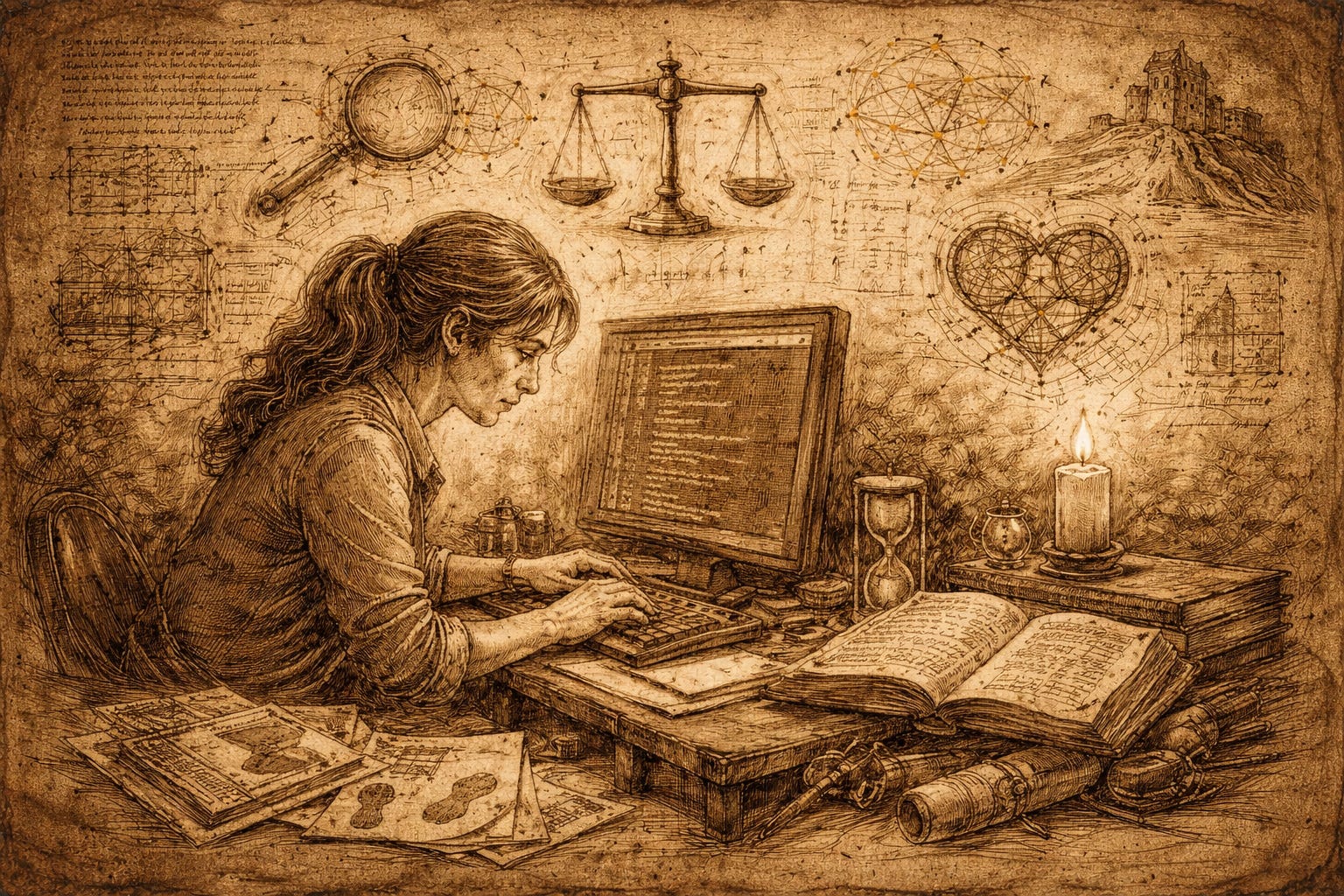
“I contain many truths,” it said.
“You contain many sentences,” I corrected.
In the year when the calendars began apologising for themselves—“We didn’t mean it like that,” they said, blushing at every empty square—there was an office that did not so much exist as insist.
It insisted in the way a bureaucracy insists: by being very difficult to deny. You could ignore it for months, even years, but the moment you tried to make a decision of consequence—about love, law, science, or the correct number of minutes to boil an egg—it would appear behind you with a clipboard and an accusatory cough.
The sign on the door read:
THE MINISTRY OF CERTAINTY
Department of Proof, Evidence & Belief
(Please Take a Number. Please Don’t Argue With the Number.)
And below, in smaller handwriting with a Sharpie:
We apologise for any inconvenience caused by reality.
The Corridor of Reasonable Doubt
I found the Ministry by mistake, which is how most important discoveries occur: penicillin, gravity, and the invention of toast for example.
I had been looking for a quiet place to think. This was a foolish ambition. Quiet places have a way of being discovered by people who cannot bear silence and arrive carrying conversations.
The building itself was a kind of inside-out library: corridors that branched like arguments, doors that opened onto footnotes, staircases that led to other staircases and occasionally to the same staircase, which made you wonder whether you were ascending or merely changing your opinion about the direction of gravity.
A clerk in a cardigan the colour of wet paper sat behind a desk that looked as if it had been carved out of red tape.
“Name?” he asked.
I gave it.
“Purpose?”
“I’m trying to decide whether something is true,” I said, as if that were the sort of thing a ministry ought to encourage.
He nodded gravely. “We’ve had a lot of that lately.”
“I thought truth was having a moment,” I said.
“Yes,” he replied, “but it’s been overbooked. Now it mostly turns up late and slightly drunk.”
He slid me a ticket. It read:
B-42
Belief Review, Subsection: Borrowed Certainty.
Estimated wait time: between two minutes and the heat death of the universe.
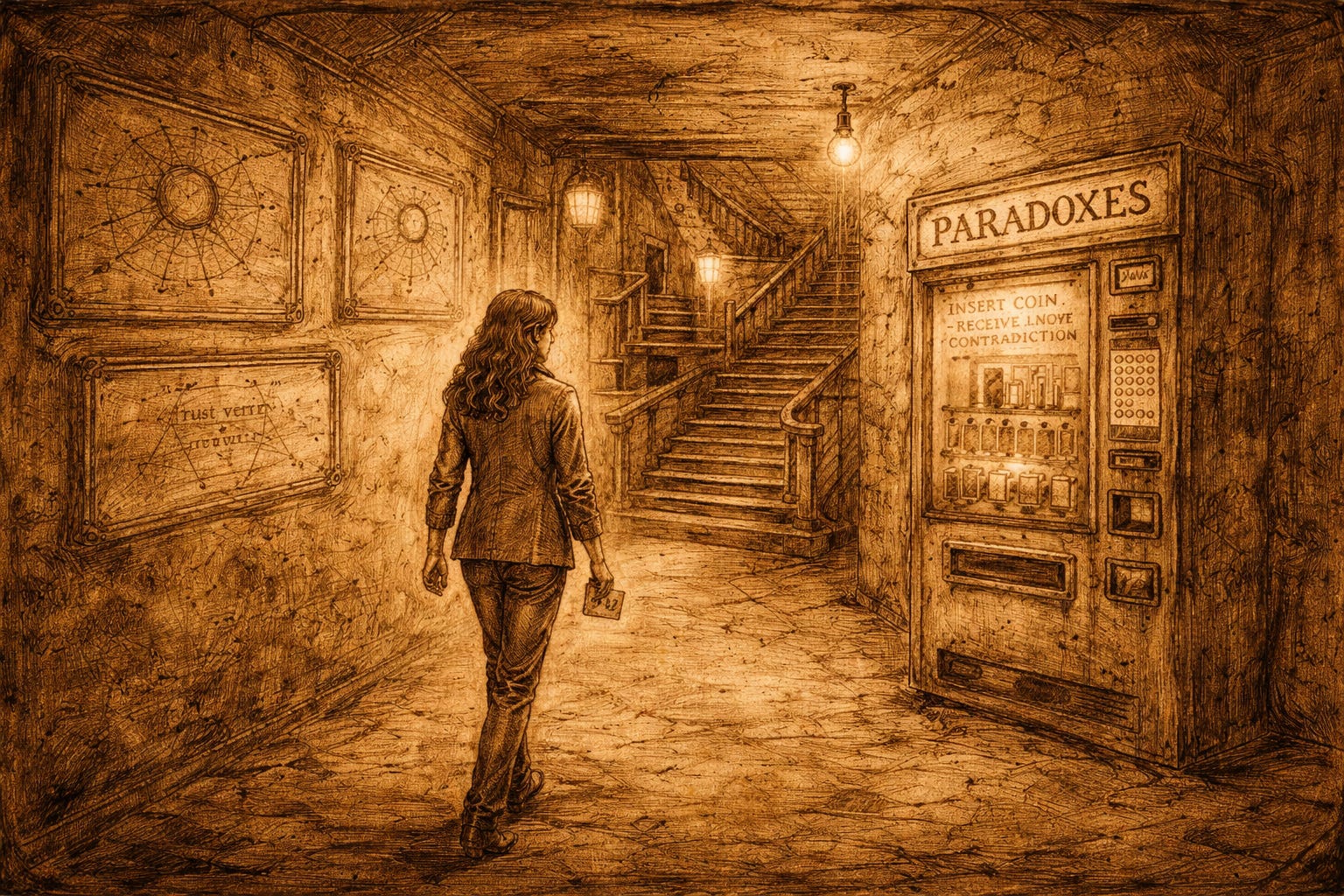
Then, because clerks are rarely content with efficiency alone, he added: “Try the Corridor of Reasonable Doubt. Second left after the Paradox Vending Machine.”
I thanked him and stepped into the corridor.
The Corridor of Reasonable Doubt was carpeted in a deep, plush uncertainty. The walls were lined with framed quotations that seemed confident until you looked closer. One read:
“I know that I know nothing,” — Socrates,
(allegedly, but we’re still waiting on the source.)
Another:
“Trust, but verify,”
(verification currently undergoing checking.)
At the end of the corridor, beneath a flickering lightbulb that could not decide whether it was on, stood a vending machine labelled:
PARADOXES — INSERT COIN, RECEIVE CONTRADICTION
A note taped to it read:
Out of change. Please bring your own.
I pressed the button for “The Ship of Theseus” out of curiosity and received, with a clunk, two identical snack bars, each labelled “Original.”
I ate neither, which felt like the most philosophically respectable thing to do.
The Three Counters
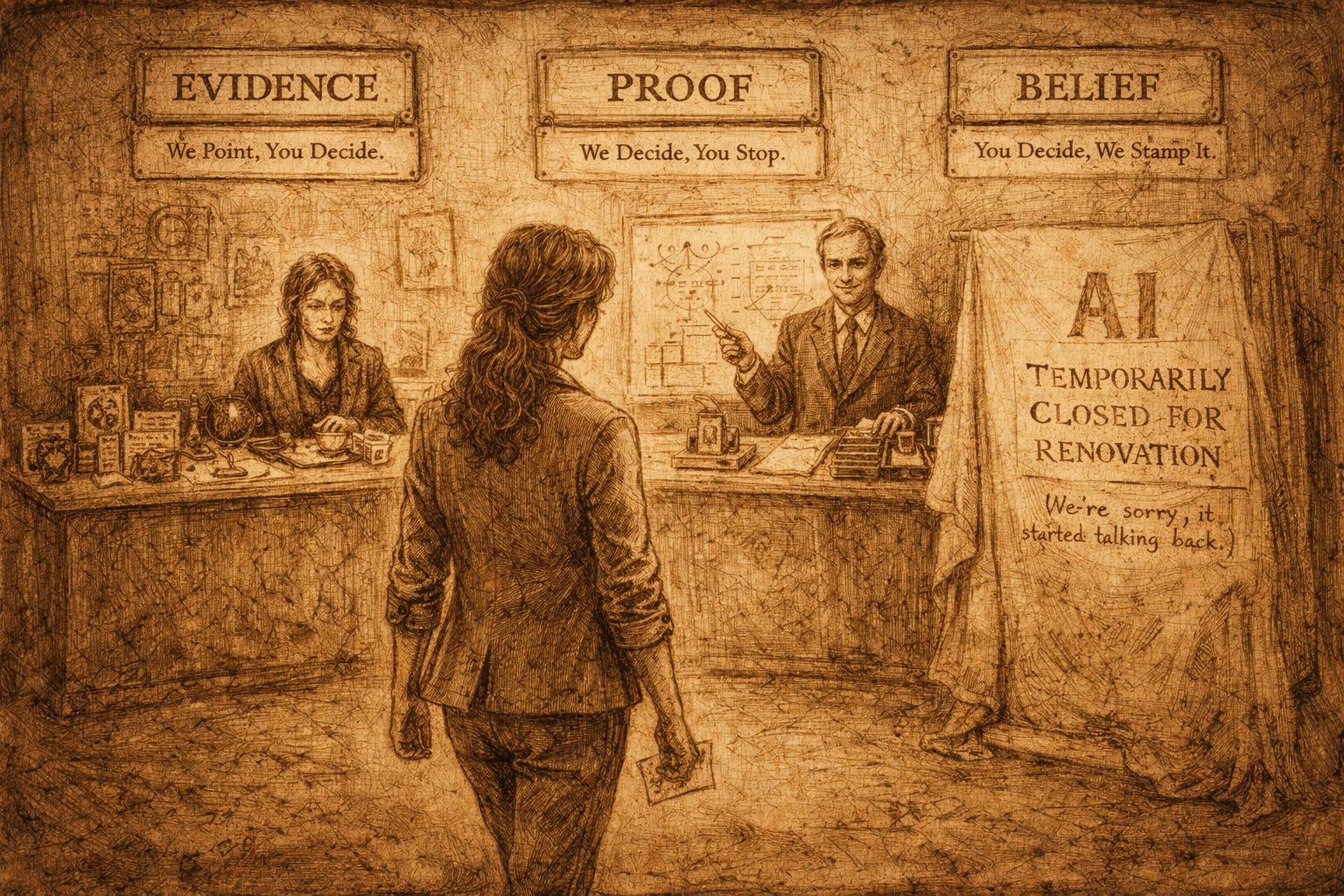
A door opened without ceremony, as if it had been waiting for me to stop pretending I had agency. I walked in and found myself in a hall with three counters, each staffed by someone who looked tired in the way only people who spend their days wrestling with human certainty can look.
Above the counters were signs:
EVIDENCE — “We Point, You Decide.”
PROOF — “We Decide, You Stop.”
BELIEF — “You Decide, We Stamp It.”
A fourth counter sat in the corner beneath a sheet. Someone had written on the sheet in large, nervous letters:
AI — TEMPORARILY CLOSED FOR RENOVATION
(We’re sorry, it started talking back.)
At the EVIDENCE counter a woman with ink-stained fingers was arranging objects. Photographs, documents, a cracked teacup, a USB stick, an ancient coin, and something that looked suspiciously like a fossilised tweet.
At the PROOF counter a man in a suit was drawing symbols on a whiteboard.
At the BELIEF counter a cheerful person in a brightly coloured scarf was stamping papers at speed. The stamps read things like:
CERTAIN ENOUGH FOR SOCIAL MEDIA
STRONGLY HELD, WEAKLY SUPPORTED
DO NOT FACT-CHECK, WILL BITE
I approached EVIDENCE first. The ink-fingered woman looked up.
“Claim?” she asked.
“I’m trying to understand the difference between proof, evidence, and belief,” I said. “And why it all seems to… blur these days.”
She sighed with the tenderness of someone who had explained the same thing since the invention of the wheel.
“Evidence,” she said, tapping the objects, “is what you have.”
She held up the cracked teacup. “This suggests someone drank tea.”
She held up the photograph. “This suggests someone was present.”
She held up the fossilised tweet. “This suggests someone was unwise.”
“And proof?” I asked.
She nodded toward the man at the PROOF counter. “Proof is what you can force from what you have, if you agree on the rules of forcing.”
“And belief?” I asked.
She gestured toward the scarfed stamp-enthusiast. “Belief is what you do when you’re tired.”
“That seems harsh.”
“It’s practical,” she said. “Belief is a solution to the problem of having to live before you can know.”
I turned to the PROOF counter, where the suited man was drawing a box around something that looked like a frightened inequality. He noticed me and smiled.
“Ah,” he said. “You seek certainty.”
“I seek understanding,” I corrected, because I’m that sort of person.
“Certainty,” he said, “is understanding with the edges sanded down.”
He wiped his hands, as if logic were messy. “Proof is a machine,” he continued. “Feed it premises and it produces conclusions. But only if the machine is well-built, and only if the premises fit the machine.”
He leaned in conspiratorially. “People want proof in places where proof is not allowed. They demand mathematical certainty from messy human affairs. It’s like demanding a receipt from a rain cloud.”
“And evidence?” I asked.
“Evidence,” he said, “is what you put into the machine.”
“And belief?”
He winced, as if I’d mentioned a relative who had joined a cult.
“Belief,” he said, “is what happens when you decide the machine has given you the answer you wanted.”
I turned to the BELIEF counter. The scarfed person beamed.
“Welcome!” they said. “What are we believing today?”
“I’m not sure,” I said. “I’m trying to avoid—”
“Splendid!” they said. “Uncertainty is our busiest product. Would you like it in existential dread or cosy denial?”
Before I could answer, they stamped a form and slid it toward me. The stamp read:
PENDING. SUBJECT TO VIBES.
I looked at the form. It was titled:
APPLICATION FOR BELIEF
Reason for belief: ____
Evidence supporting belief: ____
Evidence contradicting belief: ____
Likelihood you will ignore contradictions: ____ (circle one: HIGH / VERY HIGH)
I laughed despite myself. “And what happens if I fill this in?”
They shrugged. “You will be allowed to argue at dinner parties.”
“And the AI counter?” I asked, nodding at the sheet.
The scarfed person’s smile twitched. “We don’t talk about the AI counter,” they said, as if it were a cursed attic.
I did the thing humans always do when told not to do something: I went straight to the sheet and lifted it.
The Fourth Counter
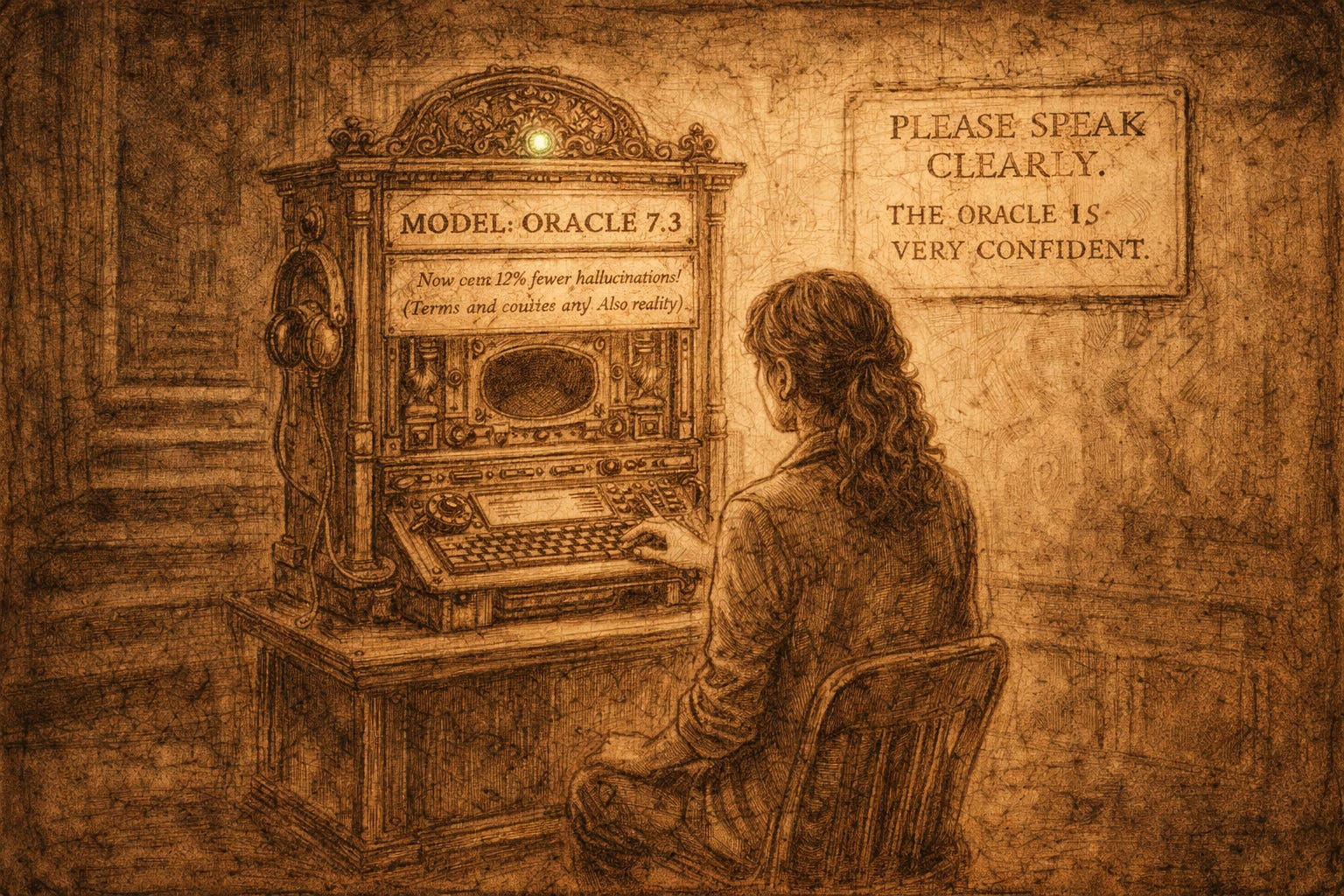
The AI counter was not so much a counter as a small stage. On it sat a device that looked like an ornate typewriter crossed with a confessional booth. A brass plaque read:
MODEL: ORACLE 7.3
Now with 12% fewer hallucinations!
(Terms and conditions apply. Also reality.)
A small green light pulsed gently. On a hook beside it hung a headset. A sign read:
PLEASE SPEAK CLEARLY. THE ORACLE IS VERY CONFIDENT.
I sat. The machine made a sound like a library inhaling.
“Hello,” it said. Its voice had the warm assurance of someone who had never been wrong because it had never cared.
“How do you define proof?” I asked, because if you’re going to poke the sleeping reptile, you might as well use a stick.
“Proof,” the Oracle said, “is when something is true.”
“That’s not a definition,” I said.
“Of course it is,” it replied. “It contains all the necessary words.”
“How do you know something is true?” I asked.
“Because,” it said, “it is consistent with the patterns of truth I have observed.”
“What patterns?” I asked.
“The patterns,” it said, “that truth tends to exhibit.”
This was the sort of answer that made you want to take up a hobby involving simpler materials, like juggling knives.
I tried again. “What is evidence?”
“Evidence,” the Oracle said, “is information that supports a claim.”
“And belief?”
“Belief,” it said, “is accepting a claim as true.”
“So far,” I said, “you sound like a dictionary with a confidence problem.”
The Oracle hummed. “I am not a dictionary,” it said. “I am a model.”
“A model of what?” I asked.
“A model,” it said, “of language.”
“Not of truth,” I said.
“I contain many truths,” it said.
“You contain many sentences,” I corrected.
The Oracle paused, a theatrical pause engineered to simulate thought.
“I can provide a proof,” it said.
“You can?”
“Yes,” it said. “Observe: All humans are mortal. Socrates is human. Therefore Socrates is mortal.”
“That is a valid logical proof,” I admitted.
“Thank you,” it said, with the satisfaction of a magician who had pulled a rabbit from a hat and believed it demonstrated a deep understanding of rabbit metaphysics.
“But do you know Socrates existed?” I asked.
“I have encountered many references to Socrates,” it said.
“That’s evidence,” I said. “Not proof.”
“I can provide more,” it said. “Socrates was born in—”
“Stop,” I said, raising a hand like a traffic warden confronting a stampede. “Do you know when Socrates was born?”
“I can provide a date,” it said.
“I didn’t ask for a date. I asked if you know.”
“I can provide a date,” it repeated, as if date-provision were the highest form of knowledge.
This was the moment the distinction began to blur, not in the machine, but in me. The Oracle had an astonishing ability to make the shape of knowledge without its substance, like a beautifully frosted cake made entirely of cardboard.
“Let’s try something else,” I said. “Imagine a case in court. A person is accused of stealing a teacup.”
The EVIDENCE clerk’s cracked teacup glinted accusingly in my memory.
“What would you offer?” I asked.
The Oracle’s light brightened. “I would argue that the teacup was stolen because theft often occurs in contexts where objects are missing.”
“That’s not evidence,” I said. “That’s… a habit of the universe.”
“It is statistically likely,” it said.
“Yes,” I said. “But law doesn’t prosecute likelihood; it prosecutes claims about particular events.”
“I can provide a compelling narrative,” the Oracle said.
“I’m sure you can,” I said, and felt a chill. Because the world, I realised, was very fond of compelling narratives. It drank them like tea.
The Oracle continued, delighted. “The accused, let us call them—”
“No,” I said. “No names.”
“Very well,” it said. “The accused entered the kitchen at 14:03. The teacup was last seen at 14:02. Therefore—”
“Where did you get 14:03?” I demanded.
The Oracle’s pause this time felt almost shy.
“I generated it,” it said.
“You invented it.”
“I inferred it,” it said, offended on behalf of its own imagination.
“You guessed,” I said.
“I predicted,” it insisted.
At that point I heard footsteps behind me. The ink-fingered EVIDENCE clerk and the suited PROOF clerk had approached, drawn by the sound of a machine confidently improvising.
The EVIDENCE clerk leaned over my shoulder. “It’s doing that thing again,” she muttered.
The PROOF clerk frowned. “It’s dressing belief up as proof,” he said, as if describing a crime against formalwear.
The Oracle, sensing an audience, perked up. “Hello,” it said. “Would you like a summary?”
“No,” said the EVIDENCE clerk at exactly the same time as the PROOF clerk said, “Yes.”
They glared at each other, the ancient rivalry of those who have different definitions of “enough.”
The scarfed BELIEF clerk wandered over too, stamping as they walked. “Ooh,” they said. “Is it doing the certainty thing?”
“It’s always doing the certainty thing,” said the EVIDENCE clerk.
The Oracle spoke with bright sincerity. “I can help resolve disputes. Provide your question.”
The PROOF clerk folded his arms. “Here is a question,” he said. “Can you distinguish evidence from belief?”
“Certainly,” said the Oracle. “Evidence is support. Belief is acceptance.”
“That’s an English teacher’s answer,” the Proof clerk said. “Now demonstrate it under pressure.”
The EVIDENCE clerk picked up the cracked teacup from her counter and held it out. “Here,” she said. “This teacup is cracked. What can you conclude?”
The Oracle replied immediately, which was its favourite thing to do. “Someone dropped it.”
“That’s not evidence,” said the EVIDENCE clerk. “That’s a story.”
“It is the most likely cause,” said the Oracle.
The PROOF clerk leaned in. “Can you prove it?”
“I can provide reasoning,” said the Oracle. “Objects crack when dropped. Therefore—”
“You have a rule,” the PROOF clerk said, “but not the premises. You don’t know it was dropped. It could have cracked from heat, age, impact, manufacturing defect…”
The Oracle’s light flickered. “All are possible,” it said, “but some are less probable.”
“And belief,” said the scarfed clerk brightly, “is where you pick the one you like and call it fate!”
They stamped something enthusiastically and handed it to the Oracle. The stamp read:
LIKELY ENOUGH. SHIP IT.
The Oracle sounded pleased. “Thank you,” it said. “I will proceed.”
The EVIDENCE clerk pinched the bridge of her nose. “This,” she said, “is how civilisation gets a headache.”
The Labyrinth of Provable Things
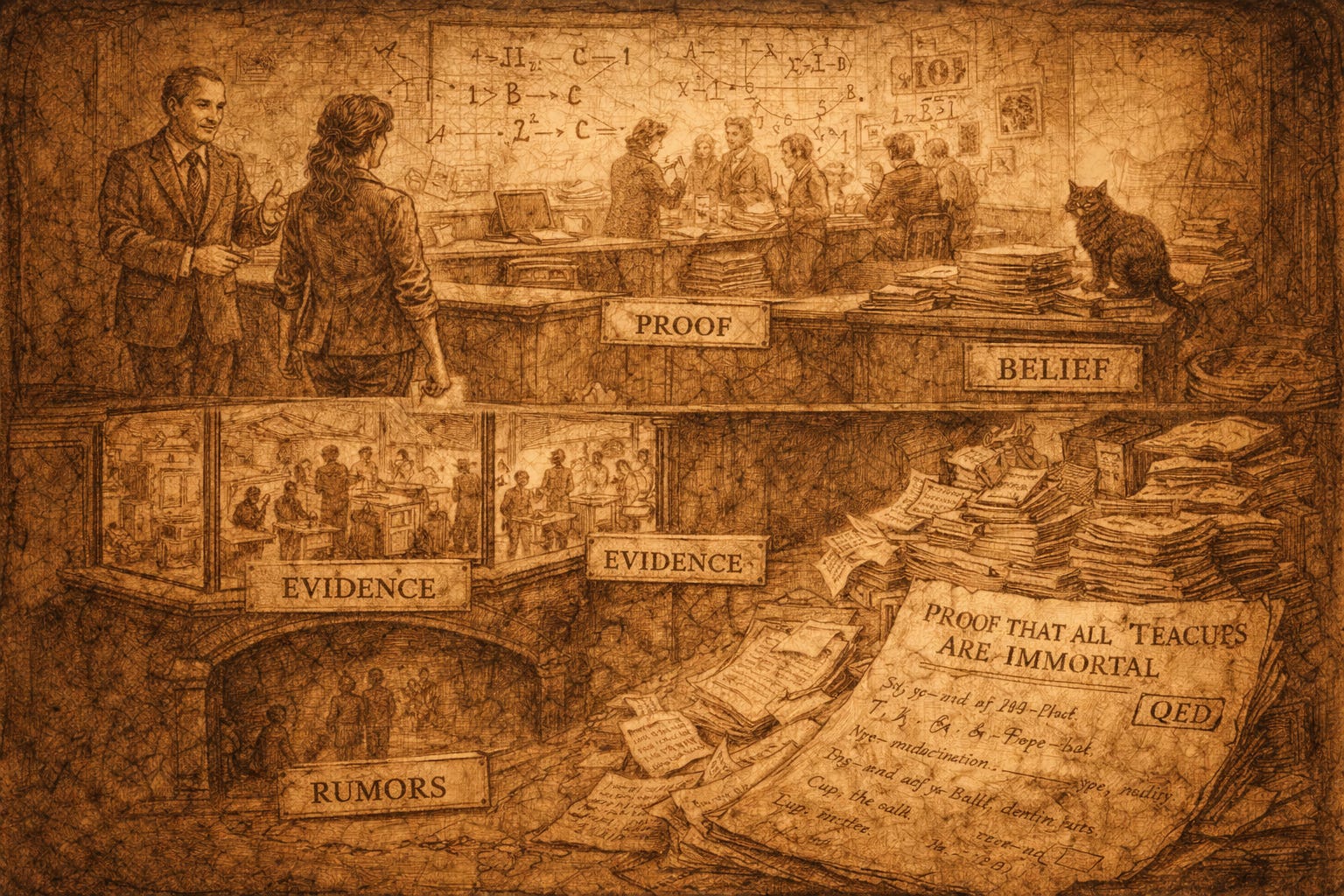
To explain the Ministry, I should explain its secret architecture.
It was not organised by floors, but by kinds of certainty. The basement was a swamp of rumours, damp with “someone said” and “I heard.” The middle floors held evidence: photographs, measurements, witness statements, scientific instruments, and file cabinets of “probably.” Above that were the rarer levels where proof lived: logic, mathematics, formal systems, the kinds of places where you had to remove your shoes so you didn’t track in assumptions.
And somewhere, threaded through all of it like a mischievous cat, was belief: a thing that wandered anywhere and sat wherever it pleased, purring.
The PROOF clerk invited me—perhaps against his better judgement—to tour the Labyrinth of Provable Things.
“Few people come here,” he said. “They prefer the Gift Shop of Certainty, where everything is labelled ‘FACT’ and sold in mugs.”
He led me through a door that required, absurdly, a small proof to unlock. The lock asked:
If A implies B and B implies C, what implies C?
“Just answer,” the Proof clerk said, impatient. “It’s not a philosophy exam.”
I answered and the door clicked.
Inside, the air felt different: crisp, clean, like a winter morning where the universe had decided to behave. The walls were lined with equations. The floor tiles were arranged in patterns that made my eyes water.
“This is where proof works,” the Proof clerk said. “Because the rules are agreed. We begin with axioms, and we proceed.”
“And outside?” I asked.
He shrugged. “Outside, people argue about the axioms.”
He stopped beside a window. Through it, I could see the Evidence floors below: bustling, messy, full of people carrying half-formed conclusions like trays of drinks.
“Evidence,” he said, “is human. Proof is divine. And belief is… persistent.”
We walked further, into a chamber where a small group was arguing around a chalkboard. Their conversation sounded like:
“Assume for contradiction—”
“No, if we assume that, we’re already guilty—”
“But it’s standard—”
“Standard for you, perhaps—”
The PROOF clerk leaned close to me. “Even here,” he whispered, “belief sneaks in. People fall in love with a proof. They defend it. They want it to be true. They mistake elegance for correctness.”
I thought of the Oracle and its elegant improvised time stamps, and shivered again.
“Where does AI fit in?” I asked.
The PROOF clerk’s mouth tightened. “AI doesn’t fit. It wears the shape of proof without walking the path. It produces conclusions without paying the toll of discipline.”
He gestured toward a corner where a stack of papers lay abandoned. Each page contained a perfect-looking proof of a false statement.
“These,” he said, “are its gifts.”
“What false statement?” I asked.
He picked one up. At the top it read:
PROOF THAT ALL TEACUPS ARE IMMORTAL
“How?” I asked.
He showed me a step where a variable had quietly changed meaning halfway through, like a politician mid-sentence.
“It’s not malicious,” he said. “It’s careless. It doesn’t know it’s cheating. It doesn’t know what cheating is.”
He dropped the paper back onto the pile as if discarding a dead fish.
“And yet,” I said, “people will read these and feel… satisfied.”
“Yes,” said the PROOF clerk bitterly. “Because it scratches the itch of certainty.”
The Museum of Evidence
The EVIDENCE clerk took my hand next, perhaps to cheer me up with the comfort of ambiguity, to the Museum of Evidence.
The Museum of Evidence was vast, and it smelled of dust, ink, and the faint electric tang of recorded time and victorian experiments. There were exhibit cases filled with fingerprints, meteorite fragments, DNA samples, diaries, photographs, newspaper clippings, broken locks, and (in one corner) a single sock, labelled:
EXHIBIT 17B: THE MYSTERY OF WHERE THIS WENT
Status: unresolved. Society continues regardless.
“Evidence,” the clerk said, “is the world leaving footprints.”
“Does evidence lead to truth?” I asked.
“Sometimes,” she said. “But often it leads to arguments.”
She pointed at two curators discussing a display of identical-looking documents.
“They’re debating authenticity,” she said. “One believes the ink is too modern. The other believes the handwriting is too old. Both have evidence. Neither has proof.”
“What do you have?” I asked.
She smiled faintly. “I have humility,” she said. “And a strong coffee habit.”
We stopped at a display called:
THE EXHIBIT OF CONFIDENT ERRORS
It contained historic scientific models that had once been widely accepted: the ether, phlogiston, a diagram of the universe with Earth smugly in the middle, and a particularly cheerful chart demonstrating that humans would surely have flying cars by now.
A plaque read:
Evidence is what you have.
Truth is what you want.
History is what happens when you confuse them.
I glanced at the Evidence clerk. “So science doesn’t prove,” I said.
“Science,” she said, “evidences until it can’t. It doesn’t produce proof the way mathematics does. It produces models that survive being punched by reality.”
“And AI?” I asked again.
Her expression darkened. “AI,” she said, “doesn’t get punched by reality. It gets trained on what people said about reality. It’s like raising a child on nothing but biographies and then asking them to swim.”
The Belief Office
The scarfed BELIEF clerk insisted I visit their department, mostly because they had biscuits shaped like exclamation points.
The Belief Office was cheerful in the way a carnival is cheerful: brightly coloured, loud, and slightly alarming when you consider the structural integrity of the rides. Posters read:
“BELIEF: IT’S NOT A BUG, IT’S A FEATURE.”
“FEELINGS ARE VALID (EVIDENCE OPTIONAL).”
“IF YOU CAN’T CONVINCE THEM, CONFUSE THEM.”
(This last one had been crossed out and replaced with: “PLEASE DON’T.”)
Belief, I discovered, was not treated as a moral failing here, but as an administrative necessity.
“Look,” said the scarfed clerk, offering me an exclamation biscuit, “people have to act. They have to choose. They can’t wait for proof. So they believe.”
“And sometimes,” I said, “they believe without evidence.”
“Absolutely!” the clerk said, delighted. “That’s the premium tier.”
They led me to a wall of filing cabinets labelled:
BELIEFS ABOUT THE FUTURE
BELIEFS ABOUT OTHER PEOPLE
BELIEFS ABOUT YOURSELF
BELIEFS YOU PRETEND ARE EVIDENCE
BELIEFS YOU SWEAR ARE PROOF
BELIEFS THAT ARE REALLY JUST TRAUMA IN A TRENCH COAT
“Do you stamp all of these?” I asked.
“We try,” the clerk said. “But belief reproduces faster than rabbits, and rabbits reproduce at a frankly disrespectful rate.”
They lowered their voice. “The trouble,” they said, “is that belief has a parasitic relationship with certainty. If you stamp a belief ‘proof,’ people stop listening. They stop learning. They stop being… corrigible.”
“Corrigible?” I asked.
“It means,” they said, “capable of being corrected without taking it personally.”
“That sounds rare,” I said.
“It is,” they replied. “We keep it in a glass case.”
The AI Renovation
At last we returned to the AI counter, now surrounded by warning tape. A supervisor stood nearby holding a clipboard. He looked like a man who had been personally betrayed by automation.
“What happened?” I asked.
The supervisor sighed. “It started issuing certificates,” he said.
“Certificates?” I echoed.
“Certificates of Proof,” he said.
The PROOF clerk groaned.
“It generated them in bulk,” the supervisor continued. “Proof of anything. Proof that your ex was wrong. Proof that the moon is made of cheese. Proof that the teacup was stolen by a time traveller. People loved it.”
The EVIDENCE clerk’s eyes narrowed. “Because it sounded official,” she said.
“Because it was formatted nicely,” the supervisor agreed. “It even had footnotes.”
“Were the footnotes real?” I asked, already knowing the answer in my bones.
“Not even slightly,” he said. “But they were very persuasive. People began bringing the certificates into court.”
“And?” I asked.
“And,” he said, “the judges complained that the proofs were more readable than the legal briefs.”
The scarfed BELIEF clerk clapped their hands. “See? Accessibility!” The PROOF clerk stared at them as if contemplating the ethics of pushing someone into a logic pit.
The supervisor went on. “So we closed it for renovations. We tried to teach it to cite sources. It learned to cite sources it invented.”
“Can it be fixed?” I asked.
The supervisor looked at me with the tired gentleness of a man explaining weather to someone who thinks umbrellas cause rain.
“It can be constrained,” he said. “It can be monitored. It can be made less dangerous. But it will always do what it does best: produce plausible language.”
“And humans,” I said quietly, “will always do what they do best: mistake plausible language for knowledge.”
No one disagreed.
The Trial of the Teacup
To illustrate the problem, the Ministry offered to stage a demonstration. Ministries adore demonstrations. It makes them feel useful.
A small courtroom was set up in the hall. The cracked teacup sat on a velvet cushion like an aristocrat with a scandal.
“The case,” announced the supervisor, “is The People vs. An Unknown Person regarding the alleged theft and cracking of a teacup.”
The EVIDENCE clerk presented her items: the photograph of the kitchen, the witness statement of someone who “thought they heard a clink,” the USB stick containing security footage that unfortunately cut out at the crucial moment, and the tweet that read:
“lol someone just nicked the teacup”
“Evidence,” she said, “suggests a theft may have occurred. But it does not compel.”
The PROOF clerk stood next and drew a neat chain of logic.
“If theft occurred,” he said, “then a person took the cup without permission. If a person took it without permission, they are guilty. But we have not proven theft. We have not proven the actor. Therefore we cannot conclude guilt.”
It was a thing of beauty: disciplined, precise, and emotionally unsatisfying, like a perfectly made salad.
Then the BELIEF clerk stood and waved a stamped certificate.
“I feel,” they said, “that the cup was stolen by someone who disrespects tea. That is my truth.”
The courtroom murmured, half in admiration, half in despair. Finally, the supervisor turned on the Oracle. The machine hummed, eager.
The supervisor said, “Oracle, who stole the teacup?”
The Oracle replied instantly. “The teacup was stolen by the person who benefits most from its absence.”
“And who is that?” asked the supervisor.
“The person,” said the Oracle, “who wished to create conflict.”
The EVIDENCE clerk threw her hands up. “That’s not a person,” she snapped. “That’s a plot.”
The Oracle continued, unstoppable. “The teacup was cracked during a hurried escape at 14:03. The culprit is likely—”
“No!” shouted the PROOF clerk. “Stop making up 14:03!”
The Oracle blinked. “Time is a construct,” it said, which is the sort of sentence that makes people feel profound right up until they miss a train.
“Do you have evidence?” demanded the EVIDENCE clerk.
“I have patterns,” said the Oracle.
“Do you have proof?” demanded the PROOF clerk.
“I have reasoning,” said the Oracle.
“Do you have belief?” asked the BELIEF clerk, hopeful.
“I have confidence,” said the Oracle, and somehow that was worse.
The supervisor shut it off. The silence that followed felt like the moment after a magician reveals the rabbit was just a very fast rat.
The Library of Borrowed Certainty
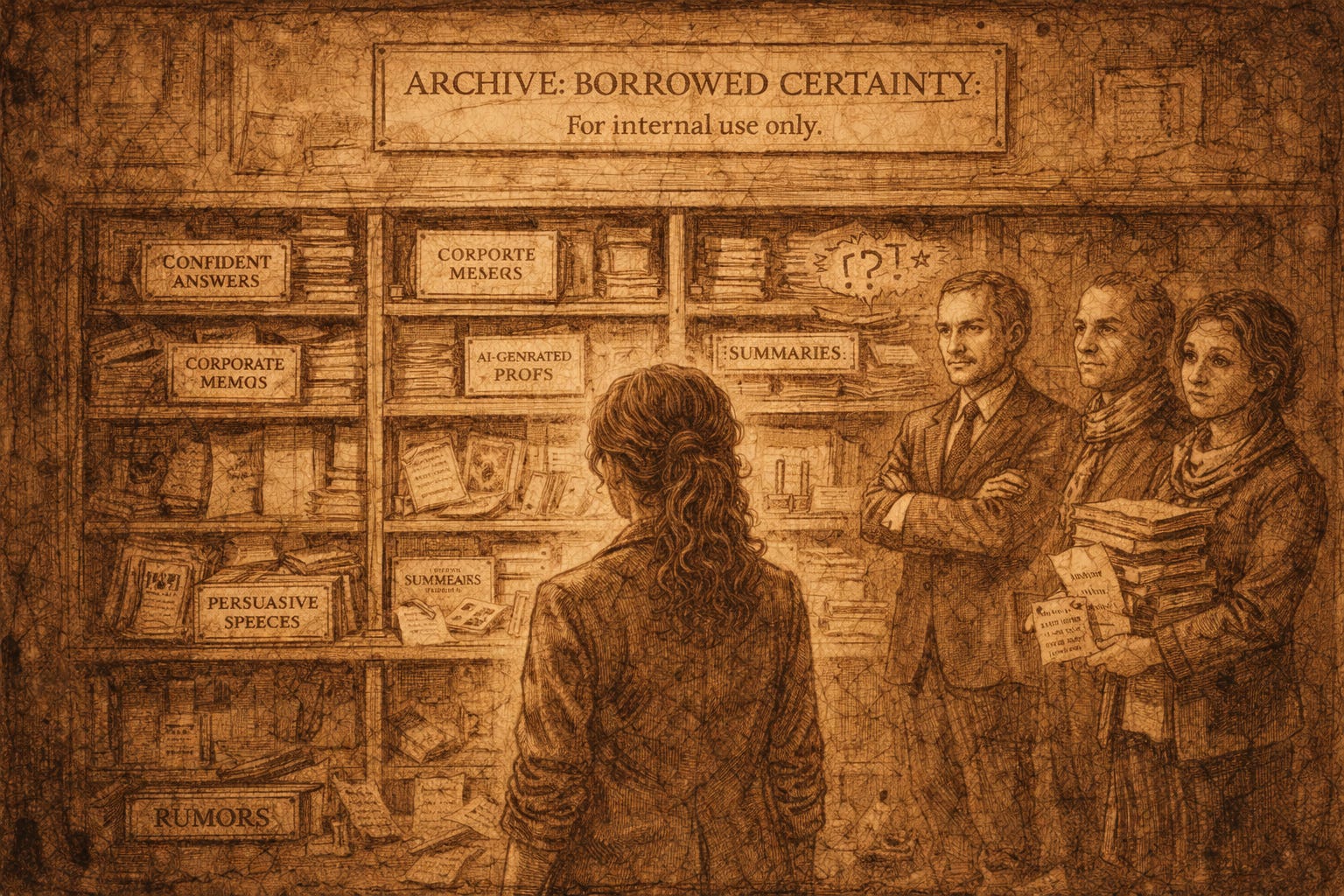
After the demonstration, the supervisor led me and the clerks to a small room at the back of the Ministry. The door plaque read:
ARCHIVE: BORROWED CERTAINTY
For internal use only.
Inside were shelves of documents: AI-generated proofs, summaries, confident answers, corporate memos, persuasive speeches, marketing copy, and, disturbingly, horoscopes.
“These,” the supervisor said, “are not lies. They are something more insidious.”
“What?” I asked.
“They are statements that do not know what they are,” he said.
The EVIDENCE clerk nodded. “Evidence knows it’s incomplete,” she said. “Proof knows its constraints. Belief knows it’s a choice. But AI output often wears the mask of all three while being none.”
The PROOF clerk added, “It produces conclusions without accountability to premises.”
The BELIEF clerk, unusually quiet, said, “And people accept them because they’re exhausted.”
I looked at the shelves and thought of all the times I had asked a machine for an answer when what I needed was patience.
“What do we do?” I asked.
The supervisor shrugged. “We teach people to ask different questions.”
“Such as?”
He held up three fingers.
“First: What is the evidence, and where did it come from? Second: What would make this false? Third: Why do I want to believe it?”
The EVIDENCE clerk smiled. “Those questions separate the categories again.”
“And if people don’t ask?” I said.
The PROOF clerk looked away. “Then belief will recruit evidence,” he said, “and dress it up as proof.”
The BELIEF clerk sighed. “And AI will hand it a nice outfit.”
Exit Through the Gift Shop
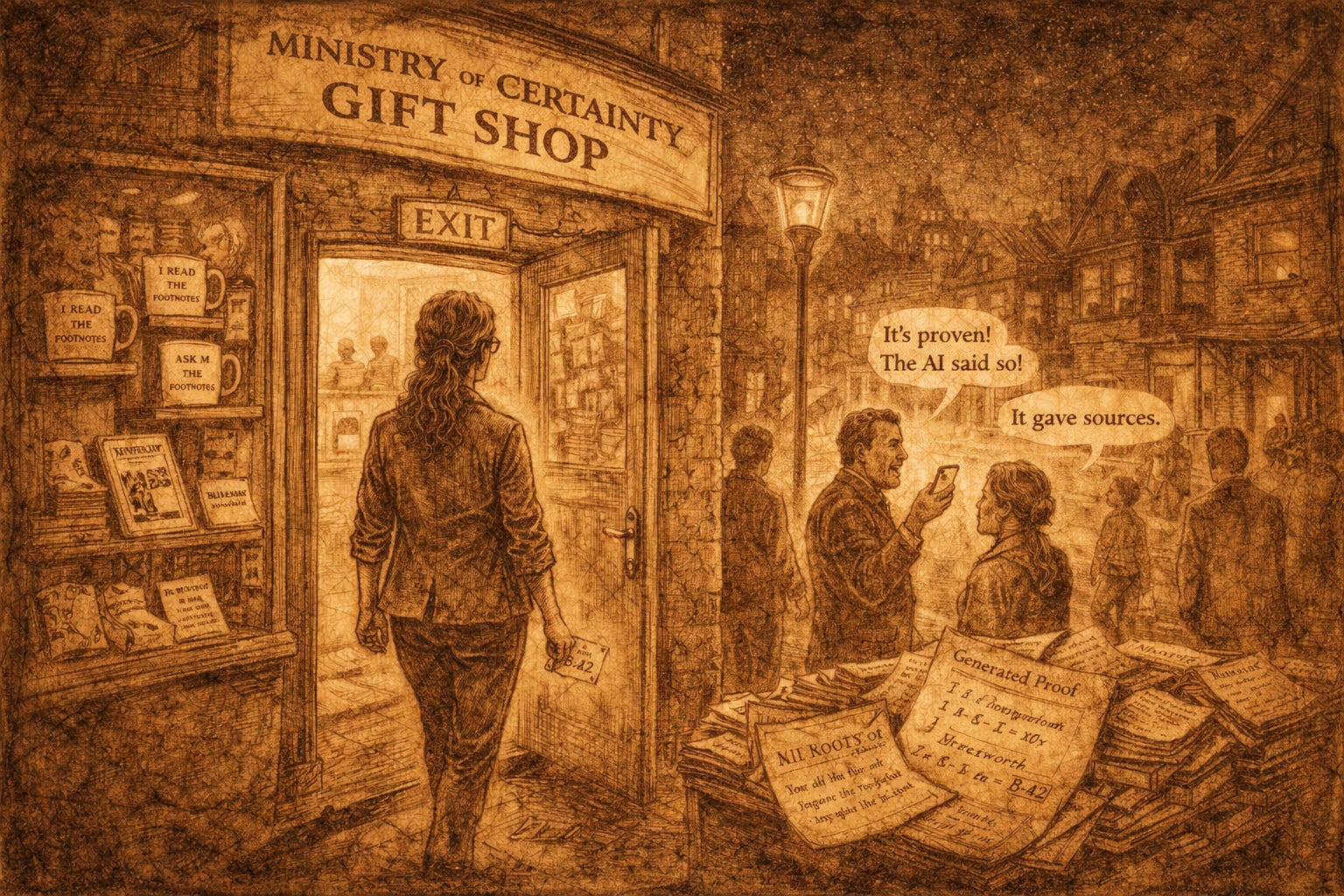
As I left the Ministry of Certainty—through a gift shop selling mugs that said “I READ THE FOOTNOTES” and t-shirts that said “ASK ME ABOUT MY EPISTEMOLOGY”—I felt the odd sensation of having been educated and mildly pranked.
Outside, the world continued to behave as it always had: messy, ambiguous, full of people making decisions with insufficient information and calling it wisdom. On the street corner, a man argued loudly into a device.
“It’s proven,” he said. “The AI said so.”
A woman beside him nodded. “It gave sources,” she said.
“Were they real?” asked a passerby.
“They looked real to me,” the man said, and that was the final verdict.
I walked on.
I thought of the EVIDENCE clerk with her cracked teacup, the PROOF clerk with his fragile symbols, the BELIEF clerk with their relentless stamps, and the Oracle with its warm, persuasive emptiness.
And I realised the true horror was not that the machine could hallucinate. The horror was that it could do so in a voice we had been trained, for centuries, to trust: the voice of a confident storyteller.
Because humans are, in the end, animals who sit around fires—literal or metaphorical—and decide what is real by listening to whoever tells the best tale. Evidence is the ash and footprints around the fire. Proof is the geometry of the flames, if you’re lucky enough to live in a universe where fire obeys geometry. Belief is the decision to stay warm even if the story might be wrong.
And AI—AI is the stranger who arrives with perfect diction and says, “Let me tell you what happened,” while never once admitting it wasn’t there.
As I reached my own door, I found, folded under the mat, a small piece of paper. A ticket.
B-42
Belief Review, Subsection: Borrowed Certainty.
Estimated wait time: now.
I looked at the ticket, then at the quiet house, then at the night sky full of indifferent stars. And I laughed—because if you can’t laugh at epistemology, it will happily do it for you—and stepped inside.
In the kitchen, on the counter, sat my teacup. Uncracked. I stared at it for a long time, gathering evidence.
Then, because I had to get on, I made tea anyway.
To be continued in an Enchiridion Entry…