
A Cathedral of Light
A short story on literacy and software systems

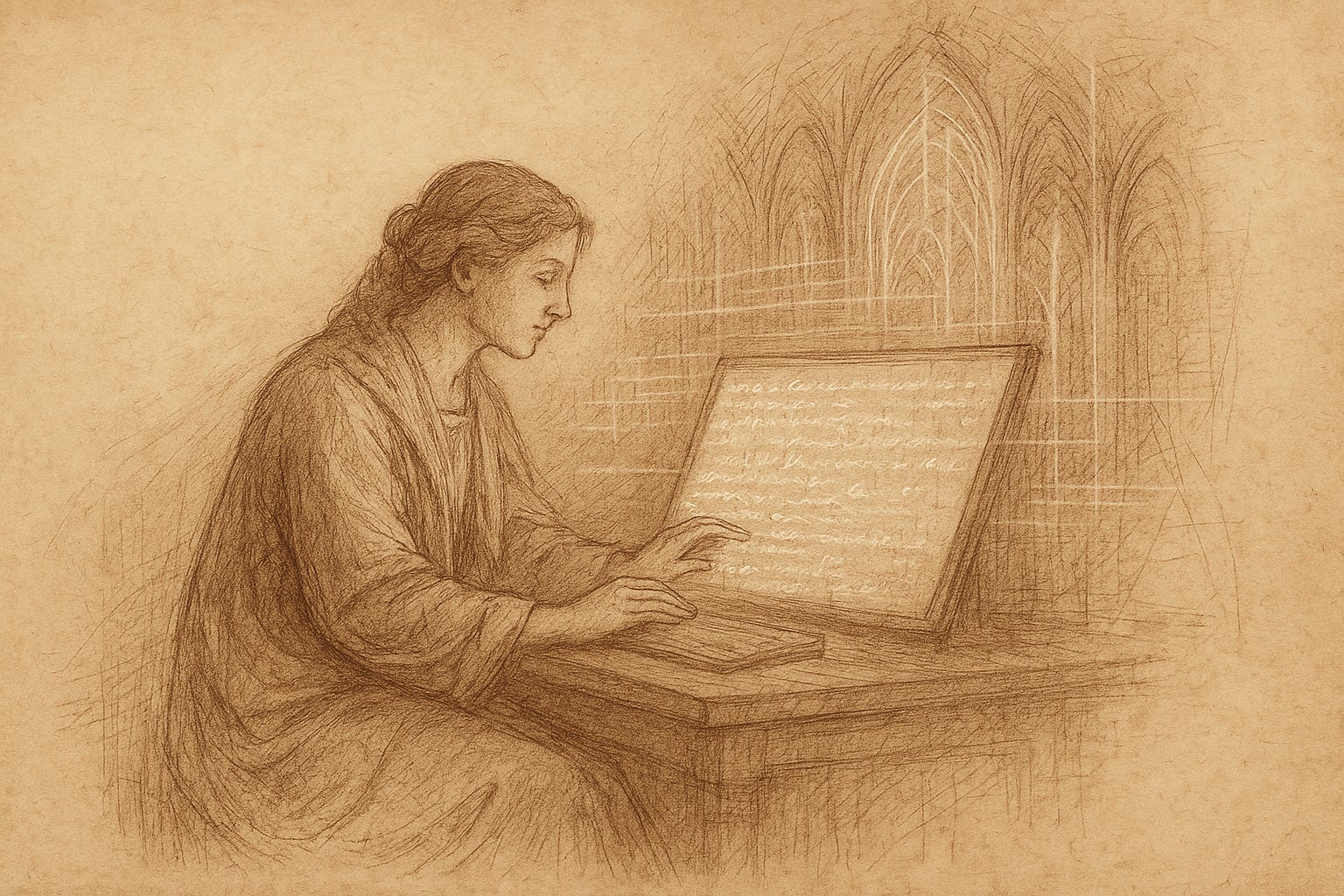
In an age not far from our own, there is a room containing every running system ever built. The room was neither datacenter nor cathedral, though it resembled both: an infinite chamber of quiet hums and shifting light, where lines of code glowed like verses on transparent walls. Those who entered it called it the Habitat, though no one could remember who had first given it that name.
Within the Habitat worked the Readers — a small order of engineers whose craft was not to build but to make sense. They claimed that every system, no matter how vast or distributed, was a complex text: that logs were its marginalia, traces its syntax, and metrics its punctuation. Each release was an edit in a manuscript that no author could finish, because the manuscript itself was alive.
The Readers called their discipline literacy. Only in its infancy in our time, the Readers had refined the ideas of Knuth and Girba into a discipline of 5 kinds.
The first was Symbolic. Apprentices learned by copying ancient scripts — not the Latin of monks, but the hieroglyphs of Java, C#, Python, Go, and Bash. They learned that code was not mere command but conversation, written for those who would come after. “You are not programming the machine,” said the elder Reader named Mirabel. “You are writing to the future.”
The second kind was Structural, the art of reading systems as one reads poetry — for rhythm, for repetition, for what hides between the lines. Earlier centuries had called this Observability, when people merely saw their systems. The Readers practiced went beyond that to develop the ability to ask questions the system was not designed to answer. They said that to read telemetry was to listen to the heartbeat of a living organism.
The third literacy was Cultural. The Readers were required to study the vanished civilisations that had produced these systems: the DevOps tribes, the Platform Guilds, the Councils of Architects. Every codebase carried the accent of its creators — their hopes, their fears, their deadlines. “You are not debugging software,” Mirabel told them. “You are debugging the people who built it.”
The fourth was Critical Literacy, which only a few attained. It required reading not for what the system said, but for what it refused to say. The Readers who mastered it could perceive the invisible costs — the engineers burnt out to deliver an uptime promise, the users whose data became tithe. These Readers spoke softly, as prophets do, for they had learned that understanding invites responsibility.
The final literacy was Creative. The few who reached it were permitted to write into the Habitat itself. Their pull requests were not instructions but stories — new species released into the ecosystem. Their work changed the living text, and the text, in turn, changed them.
One evening, Mirabel found a young Reader, Ilya, gazing into a section of the Habitat that shimmered in bright light. The section was not written by any human. “The machines,” Ilya whispered, “have begun to write their own stories.”
It was true. Across the world, the new Augmented Developers — human minds paired with reasoning engines — were producing code faster than thought. AI systems wrote tests, composed functions, even diagnosed their own failures. To most, this was the triumph of automation. To the Readers, it was something stranger: the moment when the manuscript began to write back.
Mirabel smiled. “Then our task is unchanged,” she said. “We must remain literate.”
For the future no longer required more writers; it required readers — those who could interpret, question, and guide the narrative of code written by both flesh and machine. It always had, but this was a second awakening.
Literacy had become the platform itself, the foundation on which all creation — human and artificial — would stand.
Ilya asked, “And if the machines learn to read as well as write?”
“Then,” said Mirabel, turning toward the cathedral of light, “we shall have someone new to talk to.”
Coda
To be literate in software systems is to be able to listen when they speak, to be able to question and make decisions fluently with accuracy, and to have the language tools to support fast decision-making loops