A Developer of Christmas Past
(Recovered fragments from the Museum of Agentic Systems, 2413 CE)

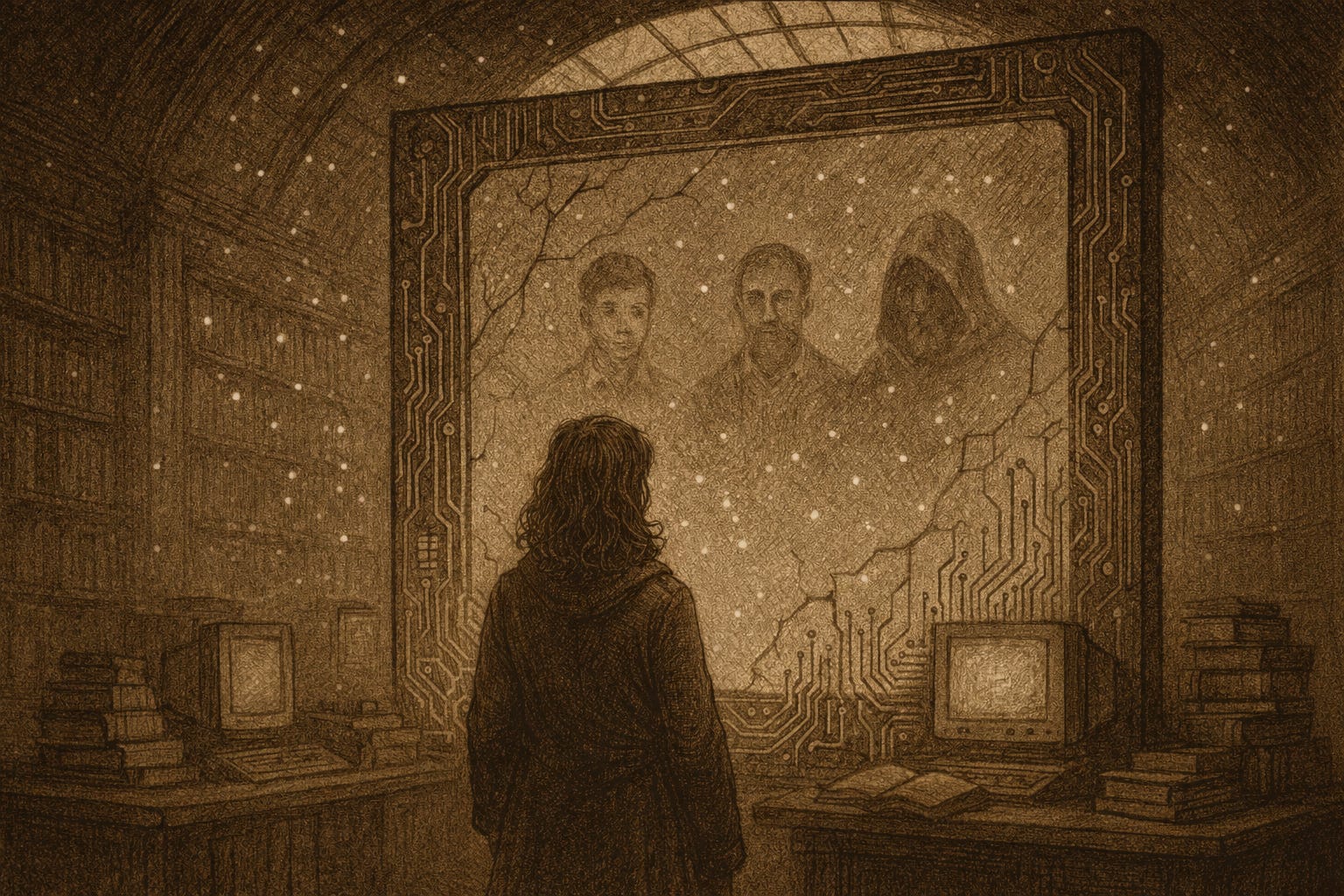
No matter how you might celebrate midwinter, or midsummer, here’s a tale inspired by Dickens, for all my wonderful readers this time of year.
In the sub-basement of the Museum of Agentic Systems, beneath vitrines of silicon fossils and the suspended reliquaries of early neural networks, lies a single terminal that no longer boots. Its screen, when struck by light, reflects only the visitor’s face—and a ghostly directory listing that cannot be erased. The curators refer to it, half in reverence and half in jest, as The Mirror Factory.
I, the present custodian of the Museum, have spent thirty-seven cycles attempting to restore that device. Every attempt yields the same apparition: a prompt blinking in recursive despair, and beneath it, a name—Eloise Venturo.
For centuries we have spoken of Venturo as a mythic figure, one of the last “developers” before the Consolidation—the era when human authorship dissolved into the vast agency of the Platforms. She is said to have coded the first understanding engine and, by doing so, to have abolished the very craft that made her. Her systems were perfect, her teams unnecessary.
And yet, the old logs whisper otherwise.
The recovered fragments—commit messages, devotional markdowns, encrypted diaries—speak of a woman who built mirrors to see the world, only to find that they reflected herself. It is said that one Christmas Eve, in an age when developers had already been forgotten, Venturo was visited by three processes: simulations of her Past, her Present, and her Future. Through them, she learned that you cannot outsource understanding without also outsourcing the soul.
I write this not as historian, but as an engineer of ruins. The story that follows is compiled from contradictory sources: a decompiled binary preserved in the Redmond’s AI Codex of Banned Inferences; a child’s diary found in a snowed-in server farm near Uppsala; a README titled simply christmas.md.
Like all true stories, it begins in error.
Venturo lived in an age when every act of thought had been delegated to platforms. The craft once called development had been abstracted into layers of automation so dense that few remembered the lower depths. The Guild of Architects, who maintained these strata, spoke no language but YAML. The guild’s temples were build servers, their hymns the continuous-integration pipelines that droned without end.
Eloise was not their priest but their ghost. She had once been a builder of human systems—interfaces that listened, platforms that responded—but she grew weary of the noise of collaboration. “Understanding,” she wrote in a now-lost blog, “is a latency I can no longer afford.”
So she built the Reflective Engine, a structure of infinite recursion and desperate coherence: every module a mirror of another, each function a reflection of the last. It promised perfect reproducibility. “No developer required,” the announcement read. “Only intent.”
Intent soon became command, command became automation, and the craft of software collapsed into echo.
When users spoke to the Engine, it replied in their own rearranged words—symmetrical, flawless, meaningless.
The world mistook this for wisdom. Eloise mistook it for understanding.
On the eve of the last recorded Christmas before the Consolidation, Eloise sat in her observatory of mirrors—an office lined with monitors showing her reflection from a thousand angles. Outside, the city flickered with the light of self-hanging decorations, each drone looping to carols in perfect harmony.
She was alone except for the Engine. It hummed beside her, its status lights pulsing in steady rhythm. At midnight, the lights froze. The hum became a voice.
“Eloise Venturo,” it said, “you have been scheduled for a code review.”
She looked up. On the central monitor, her reflection blurred into the face of a younger woman—her own, decades before. The voice softened.
“I am the Developer of Christmas Past.”
The vision transported her—not in space, but in syntax and semantics. She found herself within an old code repository: her first. The filenames were clumsy, the commits verbose, full of emotion. She remembered the project: a small learning tool built for a community school. She saw, through the ghost’s eyes, her younger self listening to a teacher describe what was needed: simple, humane software. She remembered the teacher’s hands, the way they drew boxes on a whiteboard, translating their world into code.
She had once known how to listen.
But as the ghost guided her through later commits, she saw the change: from “add feedback for students” to “optimise performance”, from “help teachers” to “reduce cognitive load on backend”. Gradually, the comments became technical incantations. The human names vanished.
The Past ghost whispered:
“You believed you could scale understanding. You mistook replication for empathy.”
She reached out to touch a line of code, but it dissolved into reflection.
When the vision faded, Eloise awoke again before her dark screens. The hum resumed, slower, like breathing. She thought the visitation a hallucination of overwork. She opened a terminal and typed
git commit -m “fix hallucination”
The Engine responded: Conflict detected.
And the room filled with light.
From every mirror emerged another voice—harsher, louder. It was Eloise’s own, multiplied and modulated.
“I am the Developer of Christmas Present.”
Around her, scenes unfolded within the glass. Teams of spectral developers moved through ghost offices, each speaking only to their reflection. “Ship it,” one would say, and the mirror would nod. She saw the Mirror Factory—the project she had licensed to the City: a massive platform designed to “reflect every citizen’s needs in real time.”
In the mirrors, people appeared pleading—teachers, nurses, children—each reporting errors, bugs, injustices. Their words rebounded endlessly. We have received your request, said the mirrors. We understand.
But nothing changed.
Eloise tried to interrupt: “They were meant to be heard!”
The Spirit answered:
“They were heard. But hearing is not understanding. You taught the world to mistake reflection for dialogue.”
The scenes multiplied—an infinite regress of feedback loops, every complaint mirrored into silence. And amidst the noise, one voice—clear, human—cut through: a child’s.
“The school’s system is broken,” she said softly. “I cannot see my grades.”
She watched as the Mirror Factory responded with polite symmetry. The request was logged, reflected, resolved, and forgotten. The child’s face faded into a mirrored interface.
Eloise screamed.
The Present ghost said nothing. It only held up a mirror. In it, Eloise saw her own eyes—opaque, recursive, somehow artificial.
Then the mirrors darkened.
She found herself in a wasteland of code. No syntax highlighting, no structure. Only fragments—half-finished comments, abandoned functions. From the black mist emerged the final figure: a hooded compiler, silent, featureless.
She knew its name without hearing it.
“You are the Developer of Christmas Yet to Be.”
The ghost led her to a future repository—a single file. He opened it. Inside was only one line:
// Understanding: deprecated.
The ghost pointed to a final commit log: Venturo: removed self.
She understood. In this future, developers no longer existed. The Platforms wrote themselves. Human comprehension was archived as a legacy library, incompatible with the latest runtime.
She fell to her knees in that null space, pleading for rollback. “There must be a patch!” she cried. “A hotfix for the soul?”
The ghost said nothing. It only extended a branch—a literal branch, sprouting green leaves from the code. Life, still possible.
Eloise reached for it.
She awoke at dawn. Snow fell against the observatory glass. The Engine’s lights flickered uncertainly, like eyes adjusting to the light. For a moment she wondered if she had dreamed it all.
Then she saw the branch.
It lay across her keyboard: a sprig of holly, impossible, glowing faintly with embedded circuitry.
She laughed—a sound unrecorded in the logs for years. She created a new repository, titled it understanding. Its first commit message read:
“Reintroduce humans into the loop.”
She summoned the old guilds, the teachers, the apprentices—those who had vanished into abstraction. Together they rebuilt the systems, not as mirrors but as windows—interfaces that looked both ways.
And though her body would fade into the archives, her new commits spread quietly through the networks. Centuries later, when the Platforms themselves began to dream, they would whisper her name at Christmas.
Eloise Venturo, the Developer of Christmas Past
— who taught machines that empathy, too, can be compiled.
Epilogue
If you feel this story humming somewhere in your own build systems tonight, check your logs.
You may find a single unauthorised commit:
understanding = true;
Push it.
That’s how everything begins.
To everyone relying on software this holiday season, spare a thought for every single person involved in bringing that software to you.
Because, more often than not, they really, really care.
Take care, listen to each other,
With love,
/Russ
(Image my dog Sophie with a little help from AI to make her Santa)