
A Game of Epics
A tragic comedy of Chief Product Officer dragons and pointless lives lost in search of the perfect SAFe quarterly planning

A short story because the week is almost half done…
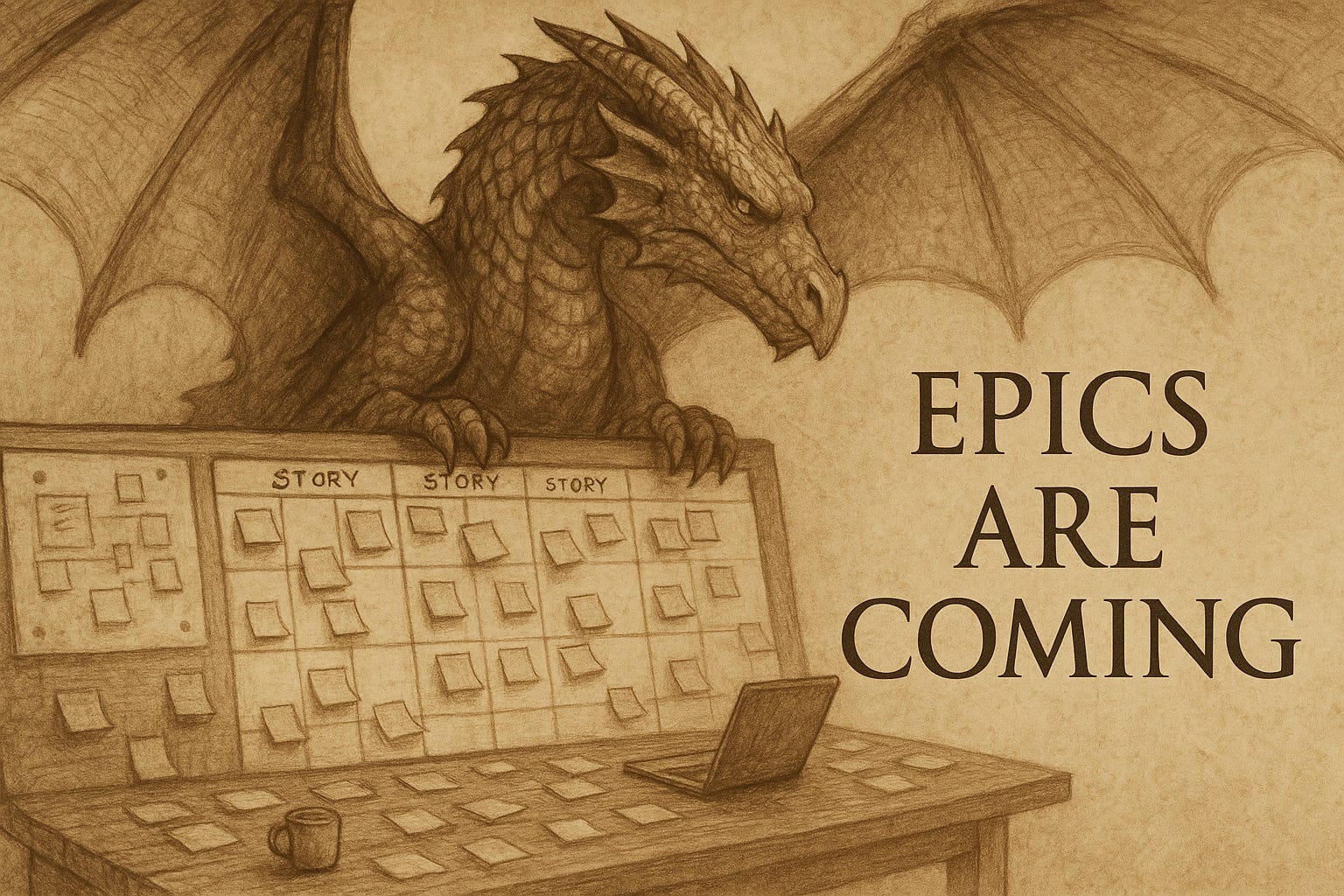
In the beginning there was chaos.
Not the exciting, world-building sort of chaos with lightning bolts and gods and the odd nymph or two. No, this was the sort of chaos that comes from twenty-seven simultaneous Zoom calls, all of them arguing about dependencies that didn’t technically exist until someone drew them in Miro.
And lo, from the chaos arose the Chief Product Officer Dragons—vast, winged creatures whose scales gleamed PowerPoint blue and whose breath smelled faintly of artisanal coffee and half-baked OKRs. They soared above the product landscape, casting great shadows across the land of Delivery, their wings beating out acronyms with every flap.
Below them, the Scrum Knights huddled in frightened stand-ups, brandishing their velocity charts like wooden swords. “We just need alignment!” they cried, as another “epic” was dropped upon their Jira boards with the force of a small meteor. The dragons would nod sagely, taking notes on their iPads. None of them read the notes later.
The dragons had one dream: to create the Perfect Quarterly Plan.
Legend said that somewhere, in a forgotten Confluence page buried beneath seven layers of permissions, lay the secret to true alignment—an immaculate roadmap that balanced business value, technical debt, and morale in equal measure. Teams would deliver predictably, stakeholders would be delighted, and nobody would ever again ask for a “quick MVP” that turned into a six-month odyssey of despair.
Naturally, this was complete nonsense.
But nonsense, as history repeatedly demonstrates, is an excellent fuel for enterprise initiatives. And so began the Great Planning of Q3, when the dragons summoned every tribe, squad, guild, spurious management consultant, and vaguely defined cross-functional unit to the fabled Program Increment (PI) Planning Summit.
For two days and thirteen time zones, humans and dragons alike wrestled with dependencies.
“We can’t commit until Platform Team A delivers API B.”
“But Platform Team A is waiting on Security C’s approval for Policy D.”
“Security C’s out this sprint for a wellbeing retreat at the Tower of London.”
“Then perhaps we can adjust scope?”
“No. Scope is sacred.”
By the end of the first day, nobody remembered what they’d been planning for. On the second day, the dragons declared success. On the third, they devoured the burn-down charts and slept for six weeks.
The losses were heavy. Whole squads disappeared into Gantt charts, never to return. One engineer reportedly merged himself into a feature branch and was last seen committing from beyond the grave. The few survivors emerged blinking into the sunlight, clutching slide decks that read “Lessons Learned (TBD).”
And yet—miraculously—out of the wreckage came deliverables. Not many. Not good ones. But deliverables nonetheless. And as the fiscal quarter limped to its end, the dragons gathered once more atop their mountain of metrics.
“Behold!” roared the Chiefest Dragon of Them All. “The plan has been executed!”
There was polite applause. Someone in HR began drafting next quarter’s invite.
And so the wheel turned again.
Because in the end, no one truly wanted the perfect quarterly plan. Perfection would leave nothing to debate in retros. It would rob the dragons of their purpose, the Scrum Knights of their noble suffering, and the managers of their deeply meaningful stickies.
Far better to strive endlessly for something gloriously unachievable—after all, what is enterprise agility without a touch of tragedy?
Somewhere, in a quiet corner of the digital realm, a lonely Jira ticket was updated:
Epic: Pursue Continuous Improvement
Status: In Progress
Due Date: None
And the dragons stirred once more.