
A Love of Small Tools
A Short Story on Unix, CUPID, and the composability of thought

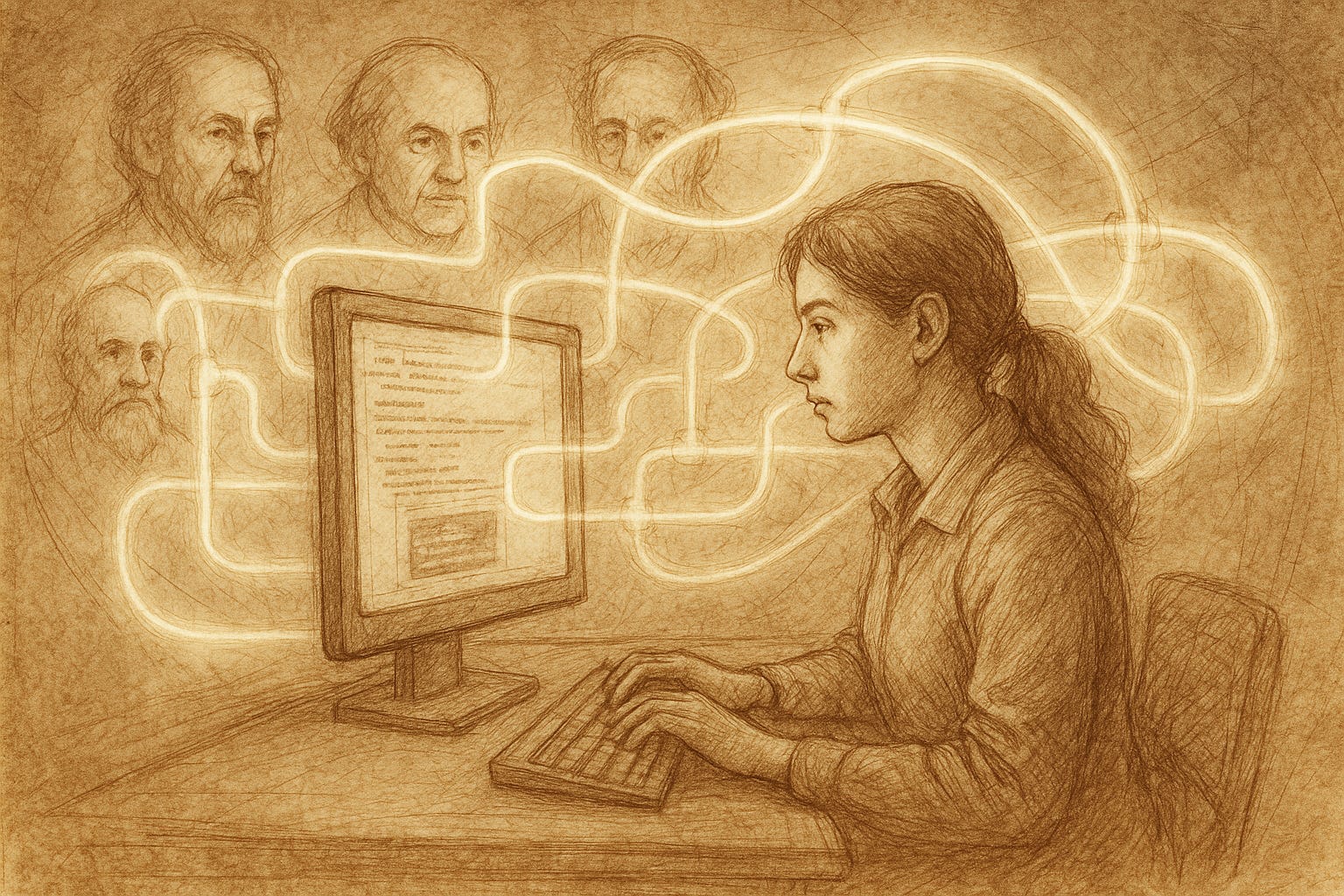
This Sunday’s short story is a little concoction that plays with my own love of small, composable code, components and services.
Inspired by the Unix philosophy and Daniel Terhorst-North’s CUPID.
A Workshop of Small Tools
In the final years of the twentieth century, long before the age of silicon prophets, there was said to be a hidden workshop beneath a telephone company in New Jersey. Those who worked there did not build towers or cathedrals; they built tools so small and so perfect that each could be mistaken for a fragment of language.
A man named Thompson began the work. Another, Ritchie, gave the tools the power of speech. A third, McIlroy, discovered a way for one tool to talk to another through a copper pipe. Suddenly their platform became infinite.
It was not a single thing but a thousand small things, each doing one task and doing it well. They arranged these tools on a workbench that stretched beyond sight. From a distance, the workbench looked like a city: every house humble, every street connected.
Pilgrims came from distant universities to study these tools. They found that when one tool failed, the others continued; when two tools were joined, a third was born. They wrote scriptures in manuals and commandments on green screens:
Do one thing well.
Work together.
Speak in text, for text is the tongue of both man and machine.
Decades passed. The tools escaped the basement. They travelled on disks, then on networks, then on light.
They built operating systems, servers, even worlds. Yet as their descendants multiplied, they began to forget their ancestry. The new tools were grander, heavier, and proud. They promised to do everything. They spoke in secret tongues and refused to connect with others.
In a forgotten repository at the edge of the Net, a scholar found a faded manual. It described an old creed: composability, predictability, idiomatic, domain-aware — and the letter U. The U was not merely a letter but a memory: the Unix way. The scholar wrote that the love of small things — of programs, ideas, even people — begins with the same humility: do one thing well, and let others join you.
The scholar gave this approach a name of love, and soon others began to speak of it too. But some doubted.
One night, a student approached and asked, “If each tool does only one thing, how can a system ever be complete?”
The scholar smiled. “Completion,” he said, “is the illusion of the monolith. The workshop is infinite, yet every craftsman builds a part they can understand. The cathedral builds itself in the joining.”
Years later, the student dreamed of returning to that laboratory basement. The workbench was still there, but now the tools glowed faintly, humming to each other. Each whispered a line of poetry — snippets of code, command lines, the occasional sigh of grep, the laughter of awk. Together they recited an endless psalm:
ls | sort | uniq
and from those simple words, the student understood everything:
That to compose is greater than to control,
that clarity is the measure of freedom,
and that the smallest tool may hold the pattern of the largest truth.
When she awoke, the student found a new tool on her desk — unnamed, unfinished. Its only command was |.
She smiled, knowing the workshop had not vanished. It had merely become part of her.
A Cathedral of Small Things
The student, now older and slower, carried the single symbol the workshop had left her: |. For years she had puzzled over it. It seemed too simple to be sacred. She tried to use it to open doors, to inscribe equations, even to divide her own writings, but the line remained mute.
Then one night she returned to the dream.
The workshop was no longer in a basement but suspended in a vast, amber-lit vault — an architecture without beginning or end. Each tool hummed faintly, connected to the next by those copper pipes that pulsed like veins. From afar, the entire hall seemed alive, breathing in data and exhaling meaning.
A voice, dry and patient, spoke from the shadows:
“You have misunderstood the gift. The line does not divide; it joins.”
She turned and saw an engineer still in his lab coat, still amused by eternity. Around him drifted the faint figures of colleagues, their outlines flickering like code in a terminal window.
“Each box is incomplete,” said the Engineer. “But together they form the Cathedral of Small Things. Every connection, every composition, is a poem — short, repeatable, clear. It is the opposite of power: it is understanding.”
The student knelt and traced the line in the dust. She imagined the pipes carrying not only data but intent. She realised that each tool was both poet and audience — self-contained yet devoted to connection.
Then, in a sudden flash, she saw how the pattern had repeated through history.
In the monks of scriptoria, each copying one passage to preserve the whole. In the early scientists, each testing one hypothesis, trusting others to assemble the cosmos. And now, in software — each function, each microservice, each AI agent, doing one thing well and speaking a common tongue.
She awoke at dawn with the phrase burning in his mind:
“Completion is the illusion of the monolith.”
She took the | and carved it onto the lintel of her study door. Over the years she built small programs, each modest and deliberate: one to count words, one to list files, one to test connections. When joined, they formed something vast and alive.
Visitors came and called it a “platform.” She only smiled and said, “No. It is a conversation.”
One day, a young developer asked her, “How do you design so many systems and yet claim to do one thing well?”
She replied, “I do not design systems. I teach them how to speak.”
Epilogue: A Manuscript of Love
Centuries later, an archivist in a luminous city found a fragment of the student’s writings. It contained five words, each beginning with a letter of an old acronym:
CUPID — Composable, Unix-like, Predictable, Idiomatic, Domain-Aware.
The archivist recognised the hand of an earlier scholar though the text had evolved. Marginal notes in faded ink whispered of “Bell Labs,” “pipes,” and “the way of clarity.”
When asked what the manuscript meant, the archivist smiled.
“It means love,” she said.
“Not the love of people, but the love of small, well-made things — and the belief that when they join, something infinite, something powerful, appears.”