
A Platform is a Place more than a Product
Or why you could build the perfect thing, but miss what will make people love it

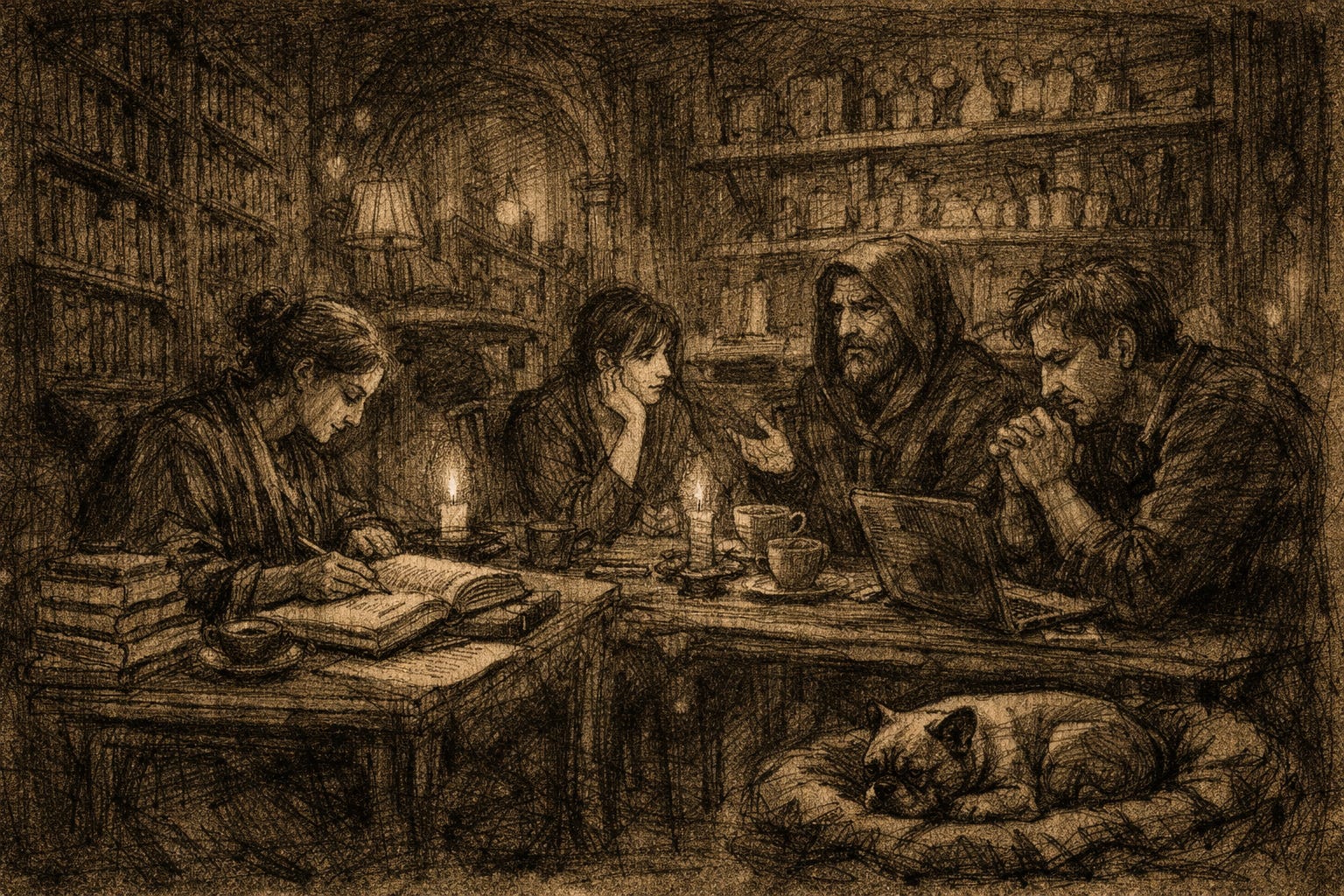
There are cafés that serve coffee, and there are cafés that serve as corrective lenses for categories that have been allowed to go feral.
Le Bon Mot, on this particular evening, was operating in the latter capacity.
The rain had been at the windows for most of the afternoon in the patient, doctrinal manner peculiar to coastal towns. It did not batter so much as insist. Outside, the street lamps had begun their early apprenticeship to darkness, each halo forming a small republic of gold in the wet air. Inside, the lamps of Le Bon Mot had settled into their usual disagreement with chronology. The candle on the third table near the long shelf of travel memoirs burned as though it belonged to the seventeenth century. The brass sconces by the counter suggested the late nineteenth. The laptop open in the corner emitted the pallid, administrative glow of now, or perhaps five minutes from now, which is not always the same thing.
Sophie, the French bulldog, was asleep in a basket that had once held onions and now held only inherited authority. She made the sort of occasional breathing noise that sounds like a philosophical objection raised by a very small accordion. Madame Beauregard was polishing cups with the concentrated benevolence of someone who believed, not without reason, that a clean cup was a moral proposition.
Case was reading.
This, in itself, was unremarkable. Case was often reading. She read in the same way some people hold opinions: with elegance, suspicion, and a readiness to abandon both without ceremony if better evidence appeared. Tonight the book in front of her was Michael Pollan’s A World Appears, though the volume was so marked with slips of paper, underlining, and the small angular symbols of a private taxonomy that it looked less like a book and more like the archaeological record of an ongoing dispute.
The Librarian arrived carrying two coffees and the expression of a man who had just discovered, in the bottom of a biscuit tin, the precise conversation required for the hour.
“Your cortado,” he said, placing one cup before her. “And for me, something black enough to qualify as an ethical stance.”
Case looked up. “You’ve found a new way to make coffee sound disappointed in civilisation.”
“It saves time. Civilisation rarely notices the disappointment until after lunch.”
He sat opposite her and glanced at the open pages. “Pollan again?”
Case nodded. “I was revisiting the chapters on consciousness and feeling.”
“Cheerful.”
“It is, in its own way.”
The Librarian leaned back. “That depends on whether one finds it cheering that the universe may be built on feeling rather than intellect.”
“I do.”
“Of course you do.”
Case turned the book around slightly, as if the angle might better align the thought. “He keeps returning to the idea that we’ve mistaken the order of things. We think cognition is central and feeling decorative. He suggests feeling may be primary. That the sense of what matters arrives before the account of why.”
The Librarian sipped his coffee. “Useful for love. Less obviously useful for quarterly planning.”
“Only because quarterly planning has spent years pretending not to be emotional.”
From behind the counter, Madame Beauregard made a noise that indicated agreement with this statement, though whether with respect to planning or love was unclear.
The bell above the door rang in its usual tone of mild scandal, and a man came in carrying a laptop bag with the posture of someone who had been losing arguments with software since breakfast.
He was in his late thirties, though the particular compression of brow and jaw associated with platform work made him appear intermittently younger and older, as if time had been forced to route around a bottleneck somewhere behind his eyes. He wore a navy raincoat, expensive enough to suggest aspiration, crumpled enough to suggest reality. His hair had given up negotiating with the weather some time before he reached the door. He paused, scanned the room with the solemnity of a surveyor about to classify a disputed territory, and chose the table beside Case’s.
“Evening, Tom,” said the Librarian.
Tom looked up, startled to be known. “Oh. Right. Evening.”
“You came in last month,” said the Librarian. “You spent three hours muttering about identity providers and then thanked the sugar bowl for its patience.”
Tom considered this. “That does sound like me.”
“Coffee?”
“Yes. Strong, please.”
“Emotionally or chemically?”
Tom gave the tired half-laugh of a man whose inner life had recently been converted into a Kanban board. “Either.”
The Librarian stood. “Then I shall bring something that has survived a difficult childhood.”
When he had gone to the counter, Case returned to her book. Tom opened his laptop, stared at it, closed it again, then stared at the closed laptop as if hoping the problem might simplify itself when denied oxygen.
He noticed the title on her book.
“Pollan,” he said. “I’ve heard of that. The consciousness one?”
Case looked up. “It is.”
He nodded. “I haven’t read it. I’ve been reading books with titles like Winning Internal Product Strategy and Frictionless Developer Experience at Scale.”
There was a pause in which one could almost hear the rain reposition itself outside.
Case smiled faintly. “A man in trouble.”
Tom rubbed his face. “A man in platform engineering.”
“Which is another way of saying it.”
He seemed to take comfort in being recognised by type. “I’ve built what everyone told me to build. That’s the problem.”
The Librarian returned with his coffee and set it down.
“Ah,” he said. “One of the better-known opening lines in modern tragedy.”
Tom looked from one to the other, uncertain whether he had stepped into mockery or mercy and not yet sure which he preferred.
“I’m serious,” he said.
“So are we,” said Case.
Tom wrapped both hands around the cup as if testing whether it was warm enough to count as company. “I’ve spent two years leading our internal platform effort. We did the whole thing properly. Or what I thought properly was. Product discovery, stakeholder interviews, roadmap, naming, branding, service catalogue, portal, paved roads, golden paths, platform team charter, adoption metrics, office hours, launch comms. We called it Foundry.”
The Librarian winced. “A little industrial, perhaps.”
“We’re a bank.”
“So you gave it a furnace.”
“It tested well.”
“Among whom?”
Tom hesitated. “Leadership.”
“Ah,” said the Librarian. “The only user group that never has to live in the neighbourhood.”
Tom frowned, though only briefly. The remark had landed too near the bone to be dismissed.
“We treated it as a product,” he continued. “That was the advice. Platform as a product. Know your users, build services, reduce friction, manage the roadmap, demonstrate value. And we did all of it. The portal is good. The templates are good. Provisioning is faster. Compliance checks are built in. Teams can get environments in minutes. We’ve got telemetry. Satisfaction scores are decent. Adoption is rising.”
“And yet,” said Case.
“And yet,” Tom said, “people still seem tired in it.”
The room, which had until then merely contained the conversation, now leaned into it.
Tom seemed to realise he had said something he had not fully understood until it left his mouth.
“They use it,” he said slowly. “But they don’t thrive in it. The teams with the highest adoption aren’t calmer. They’re just more dependent. They ship a bit faster, maybe, but they ask for help constantly. The golden path has become… not a prison, exactly, but a town where every house has the same floor plan and nobody knows where to put the piano. People follow the workflow, but they still seem disoriented. New teams onboard quickly, but six months later they’re no more confident than when they arrived. We’ve reduced toil in obvious places, but the general background level of strain hasn’t gone down. If anything, it’s become more polite.”
The Librarian nodded as though hearing a familiar diagnosis in a slightly novel accent.
“And you are discovering,” he said, “that a product is not the same thing as a place.”
Tom looked at him sharply. “That’s almost exactly what I’m worried about.”
Case closed her book, keeping one finger between the pages. “Tell me about Foundry.”
Tom exhaled. The request, simple as it was, seemed to invite a different kind of description than he was used to giving.
“It’s a portal,” he began. “And a set of workflows. Templates, services, CI/CD pipelines, policy checks, deployment paths, documentation, scorecards. Standardised patterns. Guardrails. Approved ways to do common things. Self-service where possible. Humans where necessary.”
“That is what it contains,” said Case. “Not what it is.”
Tom looked irritated, though less with her than with the direction in which reality had chosen to bend.
“It is,” he said, “the developer platform.”
“No,” said Case gently. “That is what you call it.”
The Librarian, who had a gift for entering conversations at exactly the moment they threatened to become too abstract to survive contact with ordinary blood sugar, said, “When a city planner says a city is roads, pipes, and zoning regulations, they are not wrong. But one would still hesitate to holiday there.”
Tom stared at his coffee. “I know that metaphor. Platform as city. Platform as garden. Platform as habitat. I’ve used them in talks.”
“And then,” said Case, “gone back to treating it as inventory.”
He opened his mouth, shut it again, and considered the possibility that he had not come in from the rain so much as been led into an ambush by vocabulary.
“I thought product thinking was the corrective,” he said.
“It is a corrective,” said Case. “Just not the final one.”
The Librarian settled deeper into his chair. “For years, platforms were built as collections of infrastructure that happened to belong to the same department. Product thinking forced platform teams to consider users, journeys, outcomes, support, adoption. All good. Necessary, even. But many people made an understandable mistake. They upgraded from ‘pile of things’ to ‘well-managed pile of things’ and called it enlightenment.”
Tom gave a reluctant smile. “That is uncomfortably accurate.”
Case reopened the book, glanced at a marked passage, then looked at him again. “Pollan is helpful here, oddly enough.”
“He writes about consciousness,” said Tom.
“Yes. And also about categories. About what we mistake as primary.”
Tom frowned. “Go on.”
“We have a habit,” said Case, “of placing the visible and manageable thing at the centre of our explanations. In older accounts of mind, thought is primary. Feeling is secondary. Reason is king; sensation is some colourful footnote. Pollan explores the reversal: perhaps feeling is first. Perhaps a world appears not because the system computes, but because something within it matters, registers, feels like something.”
Tom was listening now with the wary concentration of a man who suspects he is about to be told that his architecture has philosophical dependencies.
Case continued. “Platform teams often commit the same inversion. They treat the platform as the explicit artefact: portal, APIs, templates, services, controls, product surfaces. Those are the thoughts. They are what the platform can say about itself. But the lived experience of being in the platform—whether a team feels oriented, constrained, supported, watched, hurried, welcomed, infantilised, trusted—that is closer to feeling. It is closer to consciousness. And if that layer is wrong, the rest can be technically excellent and still humanly broken.”
Tom said nothing for a moment.
Outside, a bus moved through the rain with the resigned majesty of a large animal that has accepted public service as its fate.
“You’re saying,” he said eventually, “that I built the visible system and ignored the lived one.”
“I am saying,” said Case, “that you may have designed the product and neglected the habitat.”
Sophie snored in the basket, a tiny motorbike attempting to start inside a pillow.
Tom leaned back. “I’ve used the phrase platform as habitat for years.”
“Yes,” said the Librarian. “But had you moved in?”
Tom looked at him.
“It’s easy,” the Librarian said, “to describe a habitat from outside. One can produce elegant diagrams of ecosystems while standing safely beyond the tree line.”
Tom turned to Case. “What does that even mean in practice? Habitat sounds poetic. I don’t mean that dismissively. But I’ve got teams, budgets, security requirements, deadlines. I can’t submit an architecture decision record that says, ‘The platform should feel less existentially lonely.’”
“Why not?” said the Librarian. “It would make a refreshing change.”
Case smiled and then, seeing Tom’s expression, relented enough to answer properly.
“It means,” she said, “that a habitat is not judged only by what it provides but by what forms of life it makes easier or harder. A cave, a meadow, a reef, a city square, a kitchen—these are not defined solely by their structure or contents. They are defined by the kinds of behaviour, attention, relationship, and possibility they invite.”
Tom nodded slowly.
“The portal matters,” Case went on. “But more than that, what happens to a team’s sense-making when they access it? Do they know where they are? Do they know what the norms are? Can they discover safely? Is there room for local adaptation? Can they recover from mistakes? Can they see consequences? Do they feel surveilled or supported by telemetry? Are the defaults opinionated in a way that teaches, or merely controlling in a way that shrinks? Is there a path from novice to mastery? Are people becoming more capable inside the platform, or merely more compliant?”
Tom gave a small sound somewhere between a sigh and a confession. “Mostly more compliant.”
“Then,” said Case, “you have not built a learning habitat. You have built a low-friction customs checkpoint.”
The Librarian coughed into his coffee to disguise a laugh.
Tom stared at the table. “That is… not unfair.”
From the counter, Madame Beauregard said, “Many places mistake ease of movement for hospitality.”
None of them turned. In Le Bon Mot, wisdom often arrived from the bar as though ordering another bottle.
Tom spoke again, more quietly. “I thought if we reduced cognitive load, that would be enough.”
“It helps,” said Case. “But reducing one kind of cognitive load while increasing another is a common platform sport.”
He looked up. “What other kind?”
“Interpretive load. Social load. Dependency anxiety. The subtle cost of feeling that you can proceed only through sanctioned paths you didn’t help shape. The strain of not understanding the why behind the workflow. The quiet humiliation of needing the platform team to bless every deviation. The learned helplessness that arises when the environment is too finished.”
Tom gave a short bitter laugh. “Too finished. That’s exactly how leadership praises it.”
“Leadership often praises places they do not have to improvise within,” said the Librarian.
Tom glanced at the closed book. “So where does Pollan come in, beyond the general inversion?”
Case tapped the cover. “As a counterpoint. A reminder that the central thing is not the abstract mechanism but the felt world. In consciousness studies, one question becomes unavoidable: not what computations are happening, but what it is like to be the system in relation to the world. I would ask something parallel of a platform. Not just what services it offers, but what it is like to be a team living inside it.”
Tom was silent for so long the rain nearly took over the conversation by default.
At last he said, “I don’t know.”
“That,” said Case, “is unusually promising.”
He looked puzzled.
“Because most people in your position would answer with features.”
The Librarian, whose profession had taught him that the difference between naming and knowing was the source of half the world’s trouble and three quarters of its literature, said, “Shall we attempt a thought experiment? A little field anthropology, but for corporate software.”
Tom nodded.
“Imagine,” said the Librarian, “that Foundry is not a platform but a district of a city.”
Tom blinked. “All right.”
“You are not its mayor,” said the Librarian. “You are not presenting a strategy deck about it. You are living there. You are a junior engineer, five weeks into a new team. You need to change a service. You have never deployed here before. What do you feel?”
Tom opened his mouth, stopped, and tried again.
“Uncertain,” he said. “The portal tells me what to do, but not really why. There are lots of statuses and checks. I can see the process, but I don’t yet know which bits are truly risky and which bits are just institutional scar tissue. I’m afraid of getting it wrong in a way that looks stupid. The docs are good, but they’re very… complete. I don’t know what matters yet.”
Case nodded.
“And if you are a senior engineer,” said the Librarian, “trying to do something novel?”
Tom grimaced. “Annoyed. The happy path is happy until you need a path that isn’t there. Then suddenly you’re in forms, exceptions, Slack channels, waiting for someone on the platform team to say yes.”
“Do you feel trusted?” asked Case.
Tom took a moment. “Operationally? Not really.”
“Do you feel held?”
He looked at her with surprise. “What kind of question is that?”
“A habitat question.”
He considered it. “Sometimes. The checks catch things. The guardrails help. But not held, exactly. More… observed.”
The Librarian pointed at him with his cup. “There. That difference. Critical.”
Tom looked down again.
Case reopened Pollan and found a marked page. “There’s a broad claim running through this book that what matters is not just information but felt relation. A world appears to a creature because it is not neutrally processing data. It is situated. Invested. The world shows up as threat, nourishment, warmth, possibility. Meaning arrives through feeling.”
Tom gave a faint, helpless smile. “You’re telling me my platform lacks a limbic system.”
“I am telling you,” said Case, “that it may lack a humane one.”
He laughed despite himself.
The Librarian leaned forward. “May I hazard the deeper failure?”
Tom gestured for him to continue.
“You built Foundry as though its job were to deliver capabilities. And it does. But a habitat does not merely deliver. It composes conditions. It shapes rhythms. It hosts forms of life. A product asks, ‘What can users do with this?’ A habitat also asks, ‘What will repeated life in this place turn them into?’”
Tom sat very still.
This was, Case recognised, the moment when a thought stops being interesting and becomes expensive.
He looked out at the rain-dark street. “We have a maturity model,” he said. “Self-service adoption. Template adherence. Security score. Time to environment. Lead time. Change failure rate. Documentation coverage. Internal NPS. We measure all of it.”
“And what do you measure,” said Case, “that would tell you whether teams are becoming more capable, more oriented, more locally intelligent, more able to shape their own path inside the system?”
Tom said nothing.
The Librarian filled the silence with professional tact. “Sometimes the most expensive missing metric is not hidden. It is absent in plain sight.”
Tom rubbed the side of his head. “We measure usage. We don’t really measure inhabitation.”
“No,” said Case. “Most people don’t.”
A man at the far end of the café sneezed with the despairing grandeur of a Wagnerian footman. The room briefly rearranged its acoustics to accommodate him, then settled back.
Tom seemed to come to a decision.
“Can I show you something?”
Without waiting for an answer, he opened the laptop and turned it so they could see. The screen displayed a handsome portal in dark blues and restrained greys. It was, objectively speaking, very good. The typography had been considered. The navigation was elegant. Cards displayed service health, deployment status, compliance posture, cost visibility, scorecards, templates, environments, ownership data. The system had the unmistakable look of something polished by intelligent, conscientious people under pressure.
“Foundry,” said Tom.
The Librarian nodded. “Very tidy.”
“That is one of its defining features,” said Tom.
He clicked into a service template. More order. More coherence. Sensible defaults. Guardrails. Preview environments. Approved libraries. Policy-as-code checks. Scaffolding. Observability hooks. A fine piece of work, if one believed software could be praised by its posture.
“It’s excellent,” said Case.
Tom blinked. “You think so?”
“Of course. This is not the problem. Poorly made places produce one kind of suffering. Competently made but existentially misguided places produce another. One should not confuse diagnosis with insult.”
He exhaled. “All right.”
Case pointed to the service creation workflow. “When a team uses this, what do they learn about the organisation?”
Tom frowned. “That we value standards. Security. Speed with safety.”
“No,” said Case. “They learn those as slogans. What do they learn in practice?”
He looked at the flow. “That deviation is costly.”
“Good. What else?”
“That compliance is pre-baked.”
“That platform approval sits behind a lot of the non-standard paths.”
“That success means using the system correctly.”
“That local judgment is permitted within a bounded range but only really rewarded if it converges with central expectations.”
He stopped.
The Librarian smiled. “Splendid. You’ve brought your own scalpel.”
Tom looked as though he might shut the laptop simply to prevent it from confessing anything further.
Case said, “Now ask the second-order question. What kind of engineer flourishes in a place like this?”
Tom answered more quickly than he meant to. “People who like clear rules. Teams doing familiar service work. People who don’t need much autonomy. Or who need it but have learned not to ask.”
“And who struggles?”
“The teams at the edges. The ones doing weird things. The ones discovering new patterns. Senior engineers who want to understand and shape the machinery rather than merely consume it. Juniors who need interpretation, not just instructions. Teams with unusual constraints. Teams whose domain doesn’t fit the template. Anyone who wants the platform to be something they can grow with rather than merely use.”
Case nodded. “So the habitat has a climate.”
Tom stared at the screen as though seeing weather for the first time.
“We talk about platform climate in workshops,” he said. “Wardley maps, user needs, adoption, constraints. I know this language.”
“Yes,” said the Librarian. “And now it has moved from presentation to consequence.”
The bell above the door rang again. A draft came in smelling of rain and traffic and wet wool. With it came a tall figure in a dark coat, hood half up, face mostly in shadow. He had the slightly theatrical stillness of someone who had either mastered his own presence or outsourced it to an older, stranger force. The Djinn, as he was known in Le Bon Mot for reasons that were simultaneously ridiculous and exact, stepped inside, shut the door behind him, and glanced around the room like a philosopher inspecting a simulation.
“Is there room,” he said, “for a man who has spent the day being wrong in several expensive formats?”
“Only if you pay for coffee,” said Madame Beauregard.
The Djinn removed his hood and smiled. “Then room there shall be.”
He joined them without quite asking and looked from the book to the laptop to Tom’s face.
“Ah,” he said. “Consciousness and internal platforms. A charmingly niche emergency.”
“We are discussing habitats,” said the Librarian.
The Djinn nodded gravely. “Of course you are. It is always habitats eventually.”
Tom, who had not met the Djinn before, regarded him with the caution typically reserved for consultants and talented magicians.
“This is Tom,” said Case. “He built a platform as a product and is discovering it may also have needed to be a place.”
The Djinn leaned in. “Ah. The old error. To mistake the map for the terrain, the product surface for the world beneath it. You are in excellent company. Most of industry has done nothing else since at least 2013.”
Tom chose not to ask the obvious questions about who this man was and why nobody else seemed perturbed by him.
“I’m not against product thinking,” Tom said.
“Nor should you be,” said the Djinn. “Products are real. Roads are useful. Stairs are useful. A library catalogue is useful. But roads, stairs, and catalogues do not by themselves produce a civilisation worth arriving in.”
The Librarian made a note on a napkin for later theft.
The Djinn glanced at Pollan’s book. “Useful companion for this. We have spent a long time privileging what can be externally described over what is internally undergone. It flatters management. It flatters engineering. It flatters anything that wishes to believe the measurable is the central. Then along comes consciousness—rude, subjective, insistently felt—and ruins the story.”
Tom almost smiled. “And platforms?”
“And platforms,” said the Djinn, “become peculiar little theatres for the same mistake. One can measure throughput, paved-road adoption, template usage, pipeline success, control compliance, self-service rates. One can become very clever indeed about what the platform lets people do. But ask what it feels like to become a developer under its weather, and suddenly everyone develops an interest in changing the subject.”
Tom looked at him for a long moment. “Under its weather.”
“Yes,” said the Djinn. “Every habitat has weather. Not meteorological. Moral. Cognitive. Social. The felt climate of action. Some places produce caution. Some produce bravado. Some produce dependency. Some produce apprenticeship. Some produce resentment so ambient it eventually appears on no dashboard at all.”
Case rested her chin on her hand. “Tell him about the monastery.”
The Djinn smiled. “Ah yes.”
Tom did not look reassured.
“In northern Italy,” said the Djinn, “there is, or may once have been, depending on how seriously one takes my travel history, a monastery whose architecture was arranged not merely to house monks but to produce a particular kind of attention. The cloister walk was proportioned to slow one’s stride. The scriptorium windows were narrow and high, giving light without horizon. The bells partitioned the day with enough regularity that intention itself could borrow rhythm from stone. The novices did not merely inhabit the monastery. Over time, the monastery inhabited them. It trained perception. It shaped what kinds of thought were easy there, which temptations arrived frequently, which dissipated before they could mature. Now imagine describing this place only as a product. It offers lodging, meals, robes, books, routines, and liturgical services. One has said nothing false. And yet one has missed the world.”
Tom stared at him. “You can’t possibly use a monastery as a design pattern for a platform team.”
“Why not?” said the Librarian. “The compliance people already believe in ritual.”
This time Tom laughed fully, the kind of laugh that indicates the nervous system has decided it would rather survive by humour than continue pretending it is in control.
Case said, “The point is not to copy monasteries. It is to notice that environments train beings. Your platform is already teaching. The only question is what.”
Tom looked back at the portal.
“I thought we were teaching good defaults.”
“You are,” said Case. “And possibly other things besides.”
He was quiet again. In Le Bon Mot, silence was rarely empty. It was a shelf on which thoughts were left to cool.
Finally he said, “Can a platform be both? Product and habitat?”
“It must be,” said Case.
The Djinn nodded. “A habitat without good product surfaces is a marsh. A product without habitat awareness is an airport.”
The Librarian looked approving. “You’re on form tonight.”
“I had three meetings and a train delay. Suffering clarifies metaphor.”
Tom leaned forward, hands around the cup. “Suppose I accept this. Suppose I admit I’ve been measuring the wrong centre of gravity. What do I do on Monday that isn’t just adding the word habitat to slides?”
“Ah,” said Case. “Now we are in the useful part.”
She took a napkin and turned it over. Her handwriting was fast and sharp, as though each letter had arrived having already won an argument elsewhere.
“Begin,” she said, “not by redesigning the portal, but by studying the lived environment.”
She wrote:
1. Ask habitat questions, not feature questions.
“Interview teams,” she said. “But don’t ask whether they like Foundry. Ask what they feel when using it. Where they hesitate. Where they feel stupid. Where they feel watched. Where they feel supported. What kinds of work become easier. What kinds become brittle. What they have learned from the platform. What they still depend on your team to interpret.”
Tom nodded, eyes on the list.
“Second,” she said, writing again.
2. Measure capability growth, not just service consumption.
“Track whether teams become more self-sufficient over time in ways that matter. Not just whether they use self-service. Ask whether they understand the system better after six months. Whether deviation requests go down because patterns have improved, or because people have stopped imagining alternatives. Whether teams can diagnose failures without escalating. Whether local platform literacy is increasing.”
The Librarian added, “A habitat is healthy when its inhabitants become more fit to inhabit it.”
Case wrote again.
3. Redesign guardrails as teachers.
“Every constraint tells a story. Most of yours probably just say no. Can they explain themselves? Can the platform reveal why this check exists, what risk it manages, what good practice it embodies, and what the acceptable escape hatches are? A habitat educates. It does not merely police.”
Tom made a face of painful recognition. “Some of our checks are basically terse bureaucrats.”
“Then,” said the Librarian, “promote fewer bureaucrats.”
Case continued.
4. Create visible paths from novice to mastery.
“Right now I suspect your platform optimises for immediate task completion. That is product logic. Habitat logic asks whether people can mature there. Do you have layered documentation? Narratives? Explanations of why the world is the way it is? Ways for teams to move from consuming templates to understanding and extending them?”
Tom shook his head. “Not really. The internals are mostly ours.”
“Then you’ve built rental housing,” said the Djinn, “not citizenship.”
He stared at the table. “That’s harsh.”
“And true,” said Case.
She wrote the fifth item.
5. Make local adaptation legitimate.
“A habitat with no microclimates becomes sterile. Where can teams shape their own corner without forking the civilisation? Plugins, extensions, sanctioned customisation points, domain-specific overlays, visible examples of approved divergence. The platform should have a spine, not a straitjacket.”
Tom gave a long exhale. “We’ve been scared of variance.”
“Reasonably,” said Case. “Variance can be expensive. But forbidding all local adaptation simply relocates the cost into resentment, workaround culture, and hidden drift.”
Case added a sixth.
6. Study social topology, not just technical flows.
“Where do people go when the golden path fails? Which Slack channels, which people, which back doors? That is part of the habitat. Platforms often congratulate themselves on self-service while relying on invisible human concierges to make the place habitable.”
Tom winced. “We have three engineers who are basically unacknowledged weather systems.”
“Every platform has a Dave,” said the Librarian. “The question is whether one admits it before Dave evolves into a religion.”
Tom laughed again, though there was gratitude in it now.
Case finished the list.
7. Reframe the platform team’s identity.
“You are not merely shipping platform features. You are stewarding conditions for many forms of engineering life. That means product management, yes. But also curation, education, ecology, and care.”
Tom read the napkin as if it were both diagnosis and indictment.
“This all sounds right,” he said quietly. “Which is annoying.”
“It would be more annoying if it sounded wrong and still applied,” said the Djinn.
They sat with that.
After a moment Tom said, “You know what the strange part is? We thought we were being humane. Product thinking was our way out of treating developers like ticket submitters. We wanted to serve them better.”
“And you did,” said Case. “Up to a point. This is not a story of villainy. It is a story of partial truth being mistaken for whole truth. Product thinking was an advance. It taught platform teams to stop thinking only in terms of infrastructure and start thinking in terms of users and outcomes. But then many teams reified the product and ignored the environment that product instantiated.”
The Librarian looked pleased. “A very Le Bon Mot sentence, that.”
“It’s late,” said Case. “My standards are slipping.”
Tom glanced at the Pollan book again. “So feeling first.”
“In a sense,” said Case. “Or at least feeling earlier than our explanations admit. A team may not be able to articulate immediately why a platform exhausts them. They may still feel it. They may not say, ‘This environment reduces my agency while increasing my compliance burden through polite indirection.’ They may say, ‘It’s good, but I’m always tired.’ That sentence should terrify a platform team.”
Tom nodded slowly. “That’s what I’ve been hearing.”
“Then listen to it,” she said.
The Djinn rose to fetch another coffee and returned with one for himself and, inexplicably, a small saucer of olives, which he ate one by one as though each represented a completed theory of mind.
Tom closed the laptop at last.
“I think,” he said, “I know what happened. We built for consistency so aggressively that we started treating variance as pathology. And because we were proud of being a product team, we optimised for coherent surfaces, clear workflows, user satisfaction, consumption metrics. The environment beneath that was just assumed to take care of itself.”
“And environments,” said the Librarian, “notoriously hate being assumed.”
Tom stared at the rain-streaked window. “I wanted Foundry to feel dependable.”
“Dependable is good,” said Case. “But dependable to what end? A train station is dependable. So is a vending machine. Neither is where one becomes more fully oneself.”
He smiled sadly. “It’s a platform, not a novel.”
“And yet people live a large fraction of their professional lives in it,” said Case. “That is enough to merit moral seriousness.”
From behind the counter, Madame Beauregard placed a clean cup on the shelf with the precise finality of a judge setting down a precedent.
“Places educate,” she said. “Even ugly ones.”
No one argued.
The rain eased. The windows lightened from black to a deep reflective grey that made the room appear doubled. For a moment the four of them seemed to be sitting not merely in Le Bon Mot but in its more thoughtful twin, slightly offset in the glass.
Tom looked again at the napkin, now increasingly precious in the way all disposable objects become when they contain the first accurate description of one’s trouble.
“Can I ask one more thing?”
“You may ask six,” said the Djinn. “After that there is a token fee.”
Tom ignored him, having acquired enough of the local grammar to know when not to engage.
“How do I explain this to leadership without sounding vague? They’ll understand product. They’ll understand metrics. Habitat can sound… soft.”
Case was ready for this.
“Don’t lead with poetry,” she said. “Lead with failure modes they already pay for. Say this: a platform that optimises only for standardisation and consumption can increase hidden dependency, suppress useful local innovation, and reduce long-term engineering capability. It may improve short-term flow while degrading organisational adaptability. It can produce compliant teams instead of capable ones. It can centralise judgment in the platform team and create a service bottleneck disguised as self-service. Therefore the next stage of platform maturity is not more services, but a better environment for capability growth.”
Tom repeated part of it under his breath. “Compliant teams instead of capable ones.”
The Librarian said, “Never underestimate the motivational power of contrasting expensive adjectives.”
Case continued, “Then give them measurable proxies. Capability growth. Time to independent diagnosis. Reduction in human platform escalations for recurring tasks. Diversity of safe extension patterns. Team-reported confidence. Recovery quality after failure. Platform literacy progression. You do not need to abandon metrics. You need better ones.”
Tom nodded with increasing force, the way a man nods when a bridge appears where ten minutes earlier there had been only a gorge and a career.
The Djinn, who had been listening with half-lidded amusement, said, “And perhaps say one thing more.”
Tom turned.
“Tell them that all platforms eventually become constitutional. At first they are tools. Then workflows. Then assumptions. Then the place where power quietly resides. The question is whether that constitution produces flourishing or merely obedience.”
Tom stared at him. “That’s… good.”
“Yes,” said the Djinn. “Do try not to credit me publicly. It upsets people who believe they discovered their own thoughts.”
The Librarian looked at the clock behind the bar. It claimed a time that none of them trusted, but enough evening had accumulated around the edges of the room to indicate departure would soon become the respectable thing.
Tom gathered his bag, then hesitated.
“I came in here,” he said, “to escape writing a quarterly update.”
“A noble impulse,” said the Librarian.
“And now I think I know what the update actually is.”
Case smiled. “Which is?”
Tom considered the words before speaking them, as if rehearsing them might help them survive daylight.
“That Foundry is mature enough to require a shift in stewardship. That we’ve done the work of building it as a product, and now need to do the harder work of cultivating it as a habitat. That success is no longer just service availability, self-service, and adoption, but whether teams become more capable, more oriented, and more alive inside it.”
The Librarian leaned back, satisfied. “That will do.”
Tom stood, then looked at the Pollan book one last time.
“You know,” he said, “I still haven’t read it.”
Case slid the book across the table.
“Take it.”
He blinked. “Really?”
“I know where it lives.”
He looked at the forest of annotations, the marked pages, the private symbols, and handled the book with the care due an object that is either a gift or a test.
“I’ll bring it back.”
“Eventually,” said Case. “Books, unlike platforms, do not mind a little weather.”
Tom laughed, thanked them all in a manner that was sincere enough to make ceremony unnecessary, and stepped out into the wet evening.
The bell above the door rang once and settled.
For a while they watched his reflection recede in the glass before the street took him fully.
The Librarian folded the napkin copy Case had made for herself and tucked it into the book she was now not reading.
“Well,” he said. “Do you suppose he’ll do it?”
“Some of it,” said Case.
“Enough?”
She looked toward the door. “Enough to begin noticing. Sometimes that’s the only honest first step. The habitat changes when its stewards stop mistaking inventory for life.”
The Djinn ate the last olive. “It is a consoling thought that entire industries may yet be corrected by rainy evenings and decent coffee.”
Madame Beauregard made a dismissive sound.
“Industries are corrected,” she said, “by consequences. Coffee merely helps people notice them sooner.”
Sophie snorted in her sleep as if endorsing the statement in principle while reserving judgment on its implementation.
Case leaned back and opened the duplicate of Pollan she had, because of course she had another copy. “You know,” she said, “there is something rather hopeful in it.”
“In what?” asked the Librarian.
“In the possibility that we keep making the same category error because the world keeps offering us manageable surfaces in place of lived depths. Products instead of places. metrics instead of meaning. Thought instead of feeling. And then every so often reality sends back a small, tired engineer who says, ‘It’s good, but people still seem tired in it.’”
The Librarian smiled. “A messenger from the depths.”
“A bug report from consciousness,” said the Djinn.
Case laughed.
Outside, the rain had almost stopped. The street glistened as if freshly translated. Somewhere beyond the harbour the night was arranging itself into whatever came next. Inside Le Bon Mot, the cups shone quietly on their shelves, the clock lied with confidence, the candles shortened by degrees so subtle they qualified as philosophy, and the room held its usual shape: part café, part library, part refuge for people who had discovered that the most important systems in the world are never just what they contain.
They are also what appears within them.