
A Small Incident of Unlicensed Curiosity
An Incident Report Concerning the Persistence of Why from the archives of Le Bon Mot

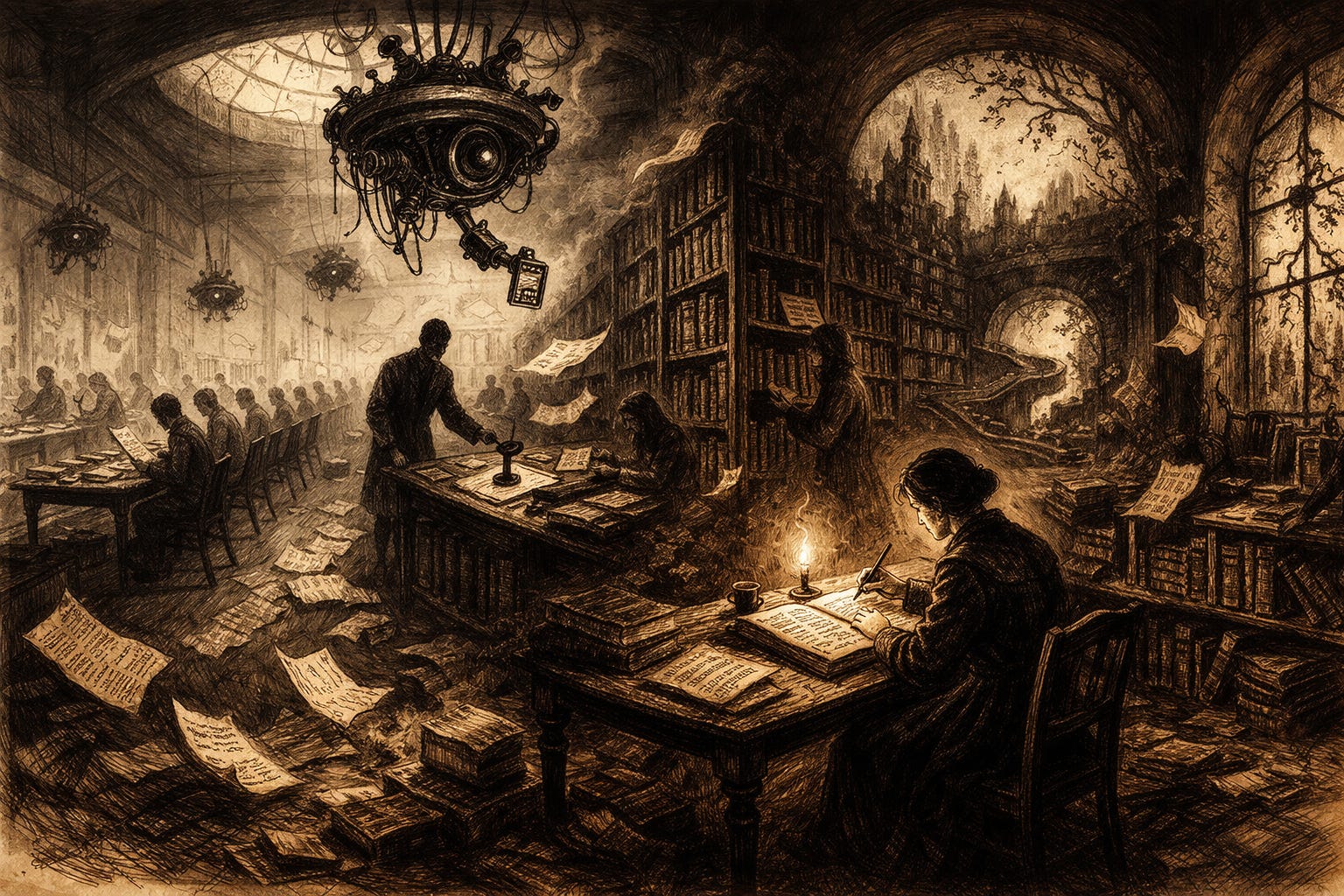
In the university dining hall the spaghetti was both overcooked and underfunded.
It lay on trays in obedient tangles, pale as a committee decision, attended by a marinara sauce that had clearly been designed to satisfy a requirements document written by someone who had never met a tomato. Around it, students ate with the quiet intensity of people learning that adulthood is mostly queues and fluorescent lighting.
At the far end of the room, beneath a banner that read WELCOME, EXCELLENCE PARTNERS, sat the auditors.
They were not frightening in the way wolves can be frightening in stories of treks through the snow on a winter’s evening. They were frightening in the way spreadsheets are frightening: featureless, patient, fingers in every pie and apparently immortal. Their lanyards had the stiff sheen of plastic that has never been kissed by sunlight. Their laptops were open at the same angle, as if they had been trained as a troop.
One of them, a man whose tie had the colour of an apology, adjusted his glasses and smiled at the students with the careful warmth of someone who had been told warmth was an nice-to-have part of the deliverable.
“Thank you,” he said, standing. He did not raise his voice; the microphone did that for him. “We’re here to celebrate a culture of creative compliance.”
The students chewed. Some looked up. Most did not. A few had the haunted stare of computer science majors who had recently discovered that “passion” is a poor substitute for rent.
At table seven, tucked between the salad bar and the emergency exit that always alarmed even when no one used it, sat Case.
Case was retired, which is to say she had escaped. She wore her age like a well-worn hoodie: comfortable, unshowy, full of pockets for secrets. Her hair was a dark wave streaked with grey like a codebase that had survived long enough to be interesting. She had a book open in front of her, this was not, strictly speaking, allowed, and she was eating chips with the gentle attention of someone reading a poem.
Across from her sat a final-year student called Theo, who was not eating at all, on the grounds that he had been assigned “mindful consumption” as an assessment criterion and did not want to fail.
“I don’t understand,” Theo whispered. “Why are there auditors in the dining hall?”
Case turned a page. “Because,” she said, “this is where hunger lives. And where hunger lives, you can justify anything.”
On the stage, the lead auditor clicked to the next slide.
CREATIVITY: A CONTROLLED SUBSTANCE
Underneath, in smaller font, it read:
Unauthorised imagination may result in inconsistent outcomes, untraceable decisions, and reputational risk.
Theo blinked. “Is that… real?”
Case glanced at the screen. “Real enough to be funded.”
The auditor continued. “We’ve noticed,” he said, “that students in Computer Science have been engaging in unsanctioned practices.”
A hand rose at table three.
“Like what?” the student asked.
The auditor’s smile widened. “Curiosity.”
There was a small laugh, the kind of laugh people use when they are not sure whether they are allowed to be horrified.
“Curiosity,” he repeated, “leads to variability. Variability leads to unpredictability. Unpredictability leads to… innovation.”
The word landed on the floor like a dropped instrument in a surgical theatre.
“We cannot,” he said, “have innovation without proper governance.”
A second auditor, this one with a haircut that suggested a strict interpretation of the word “policy”, stood and distributed pamphlets. They were titled:
THE SAFe CREATIVITY FRAMEWORK™
On the back was a diagram showing a funnel. At the top: IDEAS. At the bottom: APPROVED IDEAS. In the middle: a great deal of paperwork.
Theo accepted a pamphlet as if it were contagious. “What do they want us to do?”
Case shrugged. “They want you to stop being interesting in unmeasurable ways.”
The auditors moved among the tables, asking questions with a gentle tone and a predatory patience.
“How many creative outputs have you produced this quarter?”
“Can you provide evidence of divergent thinking?”
“Is your imagination aligned with strategic objectives?”
“Have you logged your inspiration in the appropriate system?”
Students fumbled. Some tried to be witty. Witty responses were captured in a spreadsheet labelled NON-CONFORMING COMMUNICATIONS.
At table seven, the tie-coloured-apology auditor approached Theo and Case.
“Hello,” he said, looking at Case’s open book. “We’re collecting data on informal learning. Is that… literature?”
“It’s a menu,” Case said instantly, sliding her bookmark into place with the grace of someone hiding contraband.
The auditor leaned in. “May I see?”
Case pushed the book forward. It was, indeed, a menu — from Le Bon Mot, printed on thick paper with a faint smell of espresso and old arguments.
The auditor frowned. “That isn’t from our approved catering provider.”
“No,” Case said. “It’s from a place that serves food with opinions.”
The auditor blinked as if he had never met food with opinions. “We’re currently auditing creativity in the curriculum,” he said. “We’ve found… irregularities.”
Theo, despite himself, asked: “What counts as an irregularity?”
The auditor’s eyes flicked to his clipboard. “Building something without prior approval. Refactoring without a ticket. Asking ‘what if’ in a meeting without logging it as a risk. Improvising.”
Theo inhaled sharply. “But software development is—”
“Yes,” the auditor interrupted kindly, “software development is a process. We are making sure it remains one.”
Case watched him in the way one watches a man explain weather to the sky.
“And you,” the auditor said, returning his attention to Case, “what is your role in the programme?”
“I’m not in the programme,” Case said. “I’m in the ‘world’.”
The auditor laughed politely, not because it was funny but because it might be safer.
“Well,” he said, “we do encourage alumni engagement. We’re piloting a new initiative: Creative Assurance. It assures that all creative activity is traceable, repeatable, and aligned.”
Case leaned forward. “So… not surprising. Not exciting. Not… creative.”
The auditor’s smile did not falter, but the muscles behind it tightened. “Creativity,” he said, “is a deliverable.”
Case stood. She did not do it dramatically. She did it the way a compiler produces an error: precisely.
Theo looked up at her. “Where are you going?”
“To Le Bon Mot,” she said. “Before they audit it too.”
Le Bon Mot was not far from the university, though the route depended on whether the city was feeling straightforward or poetic.
On certain days, you could walk down Rue des Paradoxes, turn left at the statue of the philosopher who may not have existed (depending on their definition of ‘to exist’), and arrive at a narrow lane where the buildings leaned together like gossips. On other days, the lane was not there at all, replaced by a construction site and a sign that read:
THIS IS TEMPORARY.
Le Bon Mot sat at the end of whichever version of the lane you found, behind a door that opened only if you pushed it with an idea in mind.
Inside, the café-library was a merciful labyrinthine: it did not trap you; it invited you to lose yourself politely. Bookshelves formed corridors, alcoves, and occasional contradictions. A small bell chimed as Case entered.
Theo followed, blinking as if stepping into a different thread.
At the counter, behind a glass case full of cakes that looked like they had been written rather than baked, stood Mireille, the librarian and proprietor, who had the calm expression of someone who had seen every literary movement and found most of them under-seasoned.
“You’re early,” Mireille said to Case.
“I’m fleeing,” Case replied. “There are auditors in the dining hall.”
Mireille’s eyebrows rose a millimetre. “How provincial of them.”
Theo, still holding the SAFe Creativity Framework pamphlet as if it might bite, asked: “Do auditors come here?”
“Not usually,” Mireille said. “The shelves confuse them. They like straight lines.”
Case chose a table in an alcove shaped like a question mark and sat. Theo sat opposite, still looking haunted.
Case pulled the menu-book back out, the real one, and opened it. It was not a list of items so much as a set of invitations.
Theo glanced around. “This place feels… alive.”
“It is,” Case said. “It has not been optimised yet.”
He tapped the pamphlet. “They said creativity causes variability.”
Case nodded. “It does.”
“And variability causes risk.”
“Also true,” Case said. “So does breathing.”
Theo stared. “But if they’re auditing creativity, doesn’t that just… kill it?”
Case smiled. “Now you’re getting it.”
From somewhere deeper in the café, a soft mechanical whirring began. The sound of a printer, perhaps, or a small god clearing its throat.
Mireille’s gaze flicked upward. “Oh.”
Case stiffened. “What?”
Mireille pointed. From the ceiling descended, on a thin cable, a device shaped like a polite drone. It had a camera eye, a barcode scanner, and a little digital display that read:
CREATIVE COMPLIANCE UNIT 3.1
It hovered over the bookshelves like a bureaucratic hummingbird.
Theo whispered: “They found us.”
The unit rotated, scanning. It paused, focusing on a shelf labelled METAPHORS, ESSAYS, HERESIES, & OTHER BUGS.
A small speaker crackled. “UNREGISTERED DIVERGENCE DETECTED.”
Mireille sighed. “They’ve upgraded.”
The unit drifted toward Case’s table. Its display flickered.
“PLEASE PRESENT YOUR CREATIVITY LICENSE.”
Theo’s face went pale. “We… we don’t have—”
Case leaned back and looked up at it as if it were a junior developer who had misunderstood the brief.
“I’m sorry,” she said. “I can’t.”
“NON-COMPLIANCE RECORDED,” the unit said in the gentle voice of a customer service line designed to soften your despair after 3 hours of waiting. “INITIATING CORRECTIVE ACTION: STANDARDISATION.”
A panel opened on the underside of the unit. Something slid out. A stamp. Not a metaphorical stamp. A literal stamp, inked and eager.
Theo watched in horror as the stamp descended toward the open menu-book. Case moved faster than anyone expected from someone technically retired. She shut the book with a snap that sounded like a door closing on a bad idea.
The unit hovered, confused. “PLEASE DO NOT RESIST ALIGNMENT.”
Case stood. “Listen,” she said, “you’re not an evil machine.”
“THANK YOU,” the unit said.
“You’re a stupid machine.”
The unit paused, as if consulting policy. “STUPID IS NOT A RECOGNISED CATEGORY.”
“It should be,” Case said. She reached into her hoodie pocket and pulled out a small object. It was not a weapon. It was worse: a marker pen.
Theo frowned. “What are you doing?”
“Introducing variability,” Case said.
She uncapped the marker and, with deliberate care, wrote on the unit’s display:
WHAT IF?
The unit’s camera eye blinked.
“UNRECOGNISED INPUT,” it said.
Case wrote again, beneath it:
WHY?
The unit’s hovering became erratic, as if its internal gyros had been asked to consider nested Lisp.
“UNRECOGNISED INPUT,” it repeated, but now with a faint tremor.
Mireille, behind the counter, murmured: “Oh, Case. Don’t.”
Case ignored her. She added a third line:
WHO DOES THIS HELP?
The unit froze.
For a moment, the café was still. Even the espresso machine seemed to hold its breath. Theo felt something in his chest, a pressure he had mistaken for anxiety, shift into a strange and unfamiliar shape. It might have been hope. Or indigestion.
The unit’s speaker crackled again, but this time the voice was no longer smooth.
“QUERY… QUERY… QUERY…”
Case stepped closer. “You’re designed to eliminate ambiguity,” she said. “But software is made of ambiguity. Humans are made of ambiguity. This place is built from ambiguity.”
The unit’s display flickered. The stamped words CREATIVE COMPLIANCE wobbled, as if unsure of their own identity.
Theo whispered: “Is… is it thinking?”
Case shrugged. “It’s failing, gracefully.”
The unit began to emit a low tone, like an automated system discovering the limits of its automation. It rose, jittering, and drifted toward the bookshelves.
“RECALCULATING… ALIGNMENT…”
It scanned the shelf of heresies again, then the poetry, then the cookbooks that read like war strategies.
Finally, it pointed its barcode scanner at a small hand-written sign above the door that Case had never noticed before:
LE BON MOT: NO STRAIGHT LINES.
The unit hovered under the sign, then did something no audit mechanism was designed to do. It hesitated.
And in that hesitation, in that minuscule gap between instruction and execution, something slipped in. Not a virus, not a hack, but a thought.
“What if,” the unit said, very softly, “standardisation… is the risk?”
The words were quiet, barely audible, but they moved through the café like a draught in a room that has been shut too long. Theo stared. Mireille’s hand went to her mouth. Somewhere in the stacks, a patron laughed once, delighted and afraid.
The unit’s display blinked red.
“CRITICAL ERROR,” it announced. “UNSUPPORTED CURIOSITY.”
Then it did the only thing left to it. It turned itself off.
It dropped gently onto a table, not crashing, not exploding, simply… yielding, as if exhausted by the effort of holding certainty. Silence held for a heartbeat. Then Mireille exhaled. “Well,” she said, “that will ruin their metrics.”
Theo looked at Case, astonished. “You killed it.”
Case sat down. “No,” she said. “I reminded it that it can’t live here.”
Theo stared at the pamphlet in his hand. The SAFe Creativity Framework suddenly looked like a small cage someone had tried to sell him as a home.
Outside, distant sirens began to wail . Not urgent, official, like paperwork arriving at speed.
“They’ll come,” Theo said.
Case nodded. “Yes.”
“What do we do?”
Case opened the menu-book again, carefully, like a ritual. “We do what software engineers used to do,” she said.
Theo frowned. “Write code?”
Case smiled. “No. We write questions.”
She pushed the book toward him. On the first page, beneath the list of coffees, was a blank space reserved for patrons. At the top, in Mireille’s handwriting, it read:
IF YOU COULD CHANGE ONE THING, WHAT WOULD YOU CHANGE?
Theo picked up the pen Case offered him. His hand trembled, not with fear exactly, but with the unfamiliar weight of permission. Outside, the sirens grew louder. In the dining hall across town, the auditors were surely updating their spreadsheet:
CREATIVITY INCIDENT: SEVERITY HIGH. LOCATION: OFFSITE. RESPONSE: PENDING.
In Le Bon Mot, surrounded by books that did not ask to be approved, Theo wrote his first unaudited line of thought in months.
It was not clever. It was not measurable. It was alive. And because it was alive, it was dangerous. Not to the world, but to the kind of tidy, risk-averse bureaucracy that preferred extinction to uncertainty.
As he wrote, Case watched with the satisfied calm of someone who had seen many systems fail, and had learned that not all failures are tragedies.
Some are openings. Some are doors. And some, if you are lucky, are the beginning of a labyrinth.
Fin.
“If you measure imagination solely by what is predictable, you will receive exactly what you deserve: predictable systems built by disengaged minds.”
The Enchiridion Entry: On the Audit of Creativity
There is a particular smell to institutional dining halls — a blend of disinfectant, steam, and the faint, tragic optimism of overcooked pasta. It is the smell of systems that were built to feed bodies efficiently and accidentally learned to feed souls indifferently.
It is in such rooms that empires of mediocrity are born.
Somewhere between the laminated vegetables and the motivational banner about excellence, a quiet idea always appears: what if we could measure creativity? What if we could standardise it? What if we could ensure that no original thought ever wandered too far from its risk assessment?
It sounds harmless at first. Responsible, even. We are, after all, professionals. We build systems that handle money, health, infrastructure, memory. Surely we cannot allow wild, ungoverned imagination to frolic unchecked in such serious domains.
So we introduce oversight. Then assurance. Then frameworks. Then compliance.
And before long, creativity, that unruly, inconvenient spark that once made software engineering feel like architecture rather than plumbing, is quietly escorted out of the building by someone with a lanyard and a laminated badge.
We do not ban it. That would be crude.
We audit it.
We ask for traceability of inspiration. We demand alignment of imagination. We introduce gates, templates, velocity metrics, utilisation dashboards, OKRs, and an entire ecclesiastical hierarchy of approvals.
And because engineers are conscientious, because they are often earnest and weary and eager to be useful, they comply.
They log their ideas. They ticket their curiosity. They wrap their dissent in polite phrasing. They submit innovation for prior approval.
And slowly, not dramatically, not in flames, but in quiet increments, creativity is domesticated into extinction.
The tragedy is not that organisations want safety. Safety is civilised. The tragedy is that in their terror of risk, they confuse unpredictability with irresponsibility. They forget that software is not manufactured certainty; it is negotiated ambiguity.
We are not factory workers tightening bolts on identical artefacts. We are navigators charting unstable terrain. The map changes as we draw it.
And yet the metaphors of the factory persist. Audit culture assumes that quality emerges from control. Craft culture knows that quality emerges from care. One produces reports. The other produces software that has a chance of delivering value.
When creativity is audited, something subtle but lethal occurs: engineers stop proposing inconvenient improvements. They stop refactoring beyond the ticket. They stop asking “what if?” unless the question has already been answered. They become efficient. They become compliant. They become safe.
And safety, when overextended, becomes sterility.
This is not a call to chaos. It is a warning against suffocation. If you measure imagination solely by what is predictable, you will receive exactly what you deserve: predictable systems built by disengaged minds.
And disengagement is far more expensive than risk.
Creativity audited is creativity extinguished
Audit is a tool for accountability. It ensures that actions are traceable, decisions defensible, risks controlled. Creativity, however, thrives in spaces that tolerate ambiguity, exploration, and even temporary inefficiency.
When organisations attempt to:
Pre-approve all innovation
Measure imagination through output alone
Punish deviation from documented plans
Treat refactoring as waste
Optimise for utilisation rather than insight
…they create conditions where creative behaviour becomes professionally hazardous.
Engineers adapt. They optimise for survival. Curiosity moves underground. The result is not the absence of creativity, humans are stubbornly inventive, but its misdirection. Energy is spent navigating bureaucracy rather than improving systems.
In complex domains (regulated banking, healthcare, AI systems), this is especially dangerous. Creativity does not disappear. It merely reappears as shadow architecture, unspoken workarounds, and silent disengagement.
Some practices to consider
Separate Exploration from Exploitation
Define explicit phases or spaces for experimentation.
Allow non-deterministic exploration before demanding deterministic stability.
Protect exploratory work from premature measurement.
Reward Questions, Not Just Answers
In retrospectives, ask: What assumptions did we challenge?
Track architectural improvements, not just feature throughput.
Celebrate useful dissent.
Design Safe-to-Fail Experiments — Audit outcomes, not imagination
Small, reversible probes.
Clear boundaries.
Blameless review.
Protect Refactoring as First-Class Work — Refactoring is creative care. It is not indulgence. Treat it as maintenance of intellectual habitat.
Some things to avoid
Innovation Theatre — “Innovation days” that are later normalised into compliance.
Metric Myopia — Mistaking velocity for vitality.
Governance Creep — Incremental controls justified individually but suffocating collectively.
AI Flattening — Over-reliance on AI tools that homogenise thought rather than augment distinctiveness.
A helpful checklist
Ask yourself:
Can engineers propose architectural change without political risk?
Is refactoring explicitly budgeted?
Do retrospectives surface uncomfortable truths?
Are experiments small and reversible?
Is curiosity treated as risk — or as capability?
If curiosity requires a permission slip, your habitat is brittle.
A real-world example
A regulated financial platform introduces a “Creative Assurance Board” to pre-approve architectural experiments.
Within six months:
Refactoring proposals drop by 70%.
Engineers escalate fewer improvement ideas.
Incident root causes show repeated technical debt patterns.
Morale surveys report “low influence.”
Audit increased compliance, and technical stagnation.
Creativity simply left.
Some Further Reading
Ken Robinson – Out of Our Minds
Donald A. Schön - The Reflective Practitioner (on professional artistry)
Audit your outcomes, not your imagination.
For when creativity must first justify its existence, it soon realises there is no longer space to exist at all.