
Becoming Comfortably Dumb
Avoiding The Unbearable Weight of Knowledge

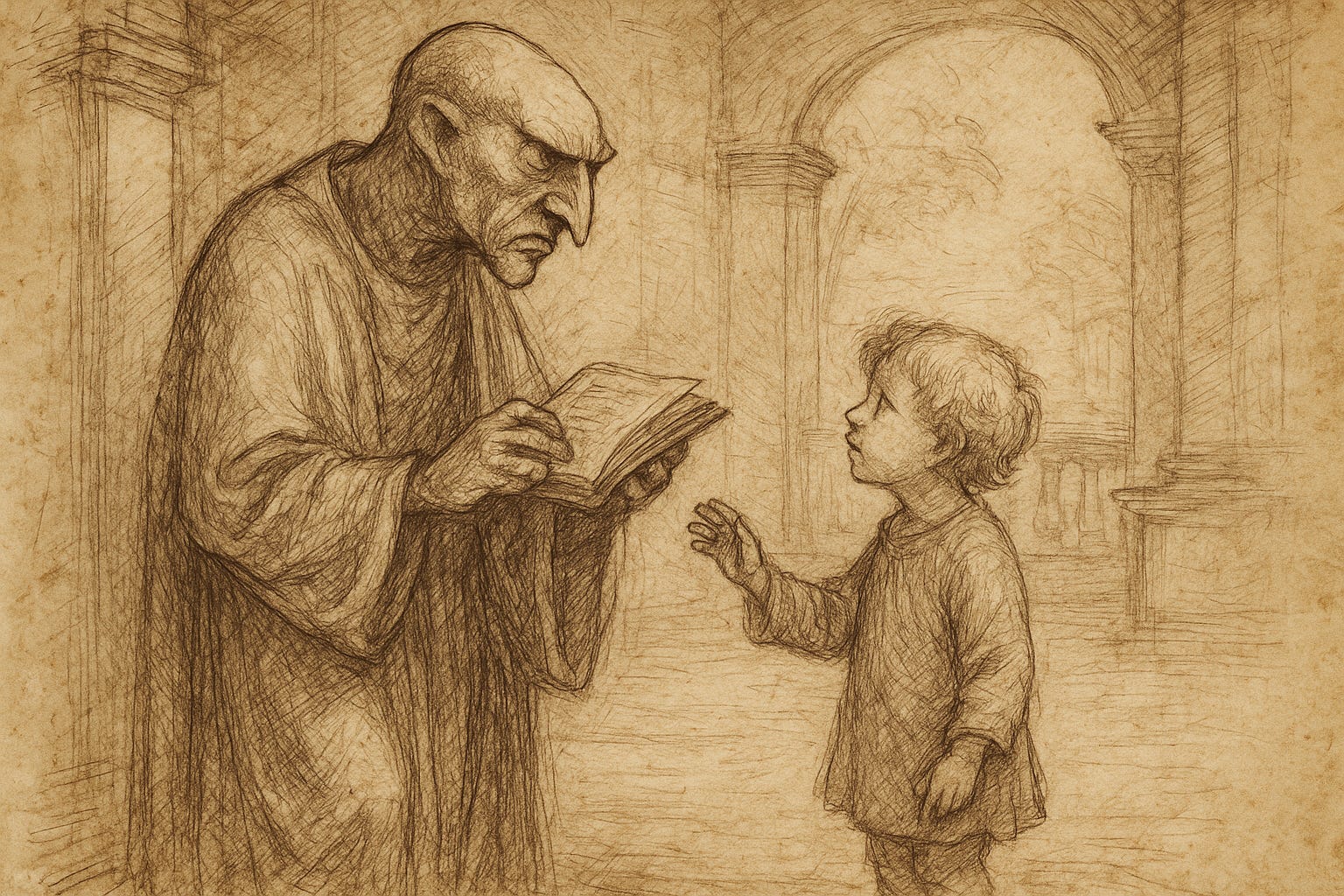
On yet another Monday where effort is being poured into dumbing-down a crucial concept, it’s time for a short story.
In the town of Middling-on-Sea—famous for its Pier of Unexamined Opinions and its annual Festival of Comfortable Half-Truths—there lived a creature known as The Reasonmonger. Nobody knew where it came from. Some said it was once a philosopher who took clarity too seriously. Others whispered it was summoned accidentally when two postgraduate students argued too passionately about epistemology near an open portal.
Whatever its origins, the Reasonmonger wandered the town offering what it called “helpful explanations.” It carried with it a small leather-bound notebook full of definitions, diagrams, and the sort of conceptual scaffolding that made normal people’s eyebrows ache.
One day, the Reasonmonger found itself in a heated conversation with the Council of Real-World Pragmatists—a group sworn to protect Middling-on-Sea from anything exceeding the intellectual altitude of a weather report.
The Reasonmonger was halfway through showing them, quite gently, where their logic caved in like wet cardboard. That was when Councillor Briggs raised his hand, palm outward, like a man stopping traffic or warding off a demon.
“Stop using big words,” he barked. “Talk like a normal person!”
This, of course, was Act One of the councillors well-rehearsed five-part tragedy.
The Reasonmonger blinked. “Which word troubled you?”
Briggs crossed his arms in the universal semaphore for ‘I’m not listening but I’m winning’.
“Doesn’t matter. All of them. If you need fancy language, your point can’t be very good.”
A murmur of agreement rippled through the Council Chambers, sounding uncannily like collective cognitive dissonance in a minor key. So the Reasonmonger simplified. Slowed down. Used smaller terms. Drew a tiny diagram of cause and effect shaped like a pancake.
“Ah,” said Councillor Webb, pouncing instantly on Act Two: 'The Simplicity Demand. “So you’re saying it’s… simple? That can’t be right. You academics always oversimplify things.”
The Reasonmonger frowned and erased the pancake.
Before it could continue, Councillor Hughes launched Act Three: Vocabulary Dismissal. “This is just buzzword bingo,” she declared. “Systems, structures, patterns. All waffle.”
“You just like sounding clever,” Briggs added, deploying Act Four with all the subtlety of a falling wardrobe. “Admit it. You’re showing off.”
A hush fell. Not because the accusation was insightful, but because it had worked. The Reasonmonger felt the trap close. It wasn’t defending an argument but defending itself. Its motives, not its reasoning, were on trial.
The Council sensed victory. The fifth and final act—the Relativist Retreat—arrived like clockwork.
“Look,” said Webb, leaning back with the satisfied air of a man who has successfully avoided learning anything new, “let’s agree to disagree.”
Middling-on-Sea applauded. Somewhere, a seagull squawked in epistemic despair.
The Reasonmonger packed away its notebook. Not because it had lost—nothing had been refuted—but because the Council had outlawed the very tools required to show they were wrong. They had turned ambiguity into armour, gut feeling into gospel, and ignorance into a kind of civic virtue.
As the Reasonmonger left the chamber, a small child tugged at its coat.
“Why do they hate big words?”
The Reasonmonger knelt. “They don’t hate the words,” it whispered. “They hate what the words reveal.”
“And what’s that?”
“That the world is complicated, and that they are responsible for understanding it.”
The child nodded, absorbing this with the fearlessness unique to those not yet invested in their own illusions.
“Will they ever learn?” the child asked.
The Reasonmonger paused. “Only if we stop letting them turn thinking into a crime.”
And with that, it walked out of Middling-on-Sea, leaving the Council to congratulate itself on another successful day of protecting the town from progress, nuance, and anything remotely resembling thought.
In its wake, the wind carried a quiet truth the Council could never quite silence:
Anti-intellectualism does not defend the people.
It merely protects the powerful by keeping everyone else comfortably stupid.