
Building a Creative Habitat
On Symmathesy, Environment, and an Ecology of Original Thought

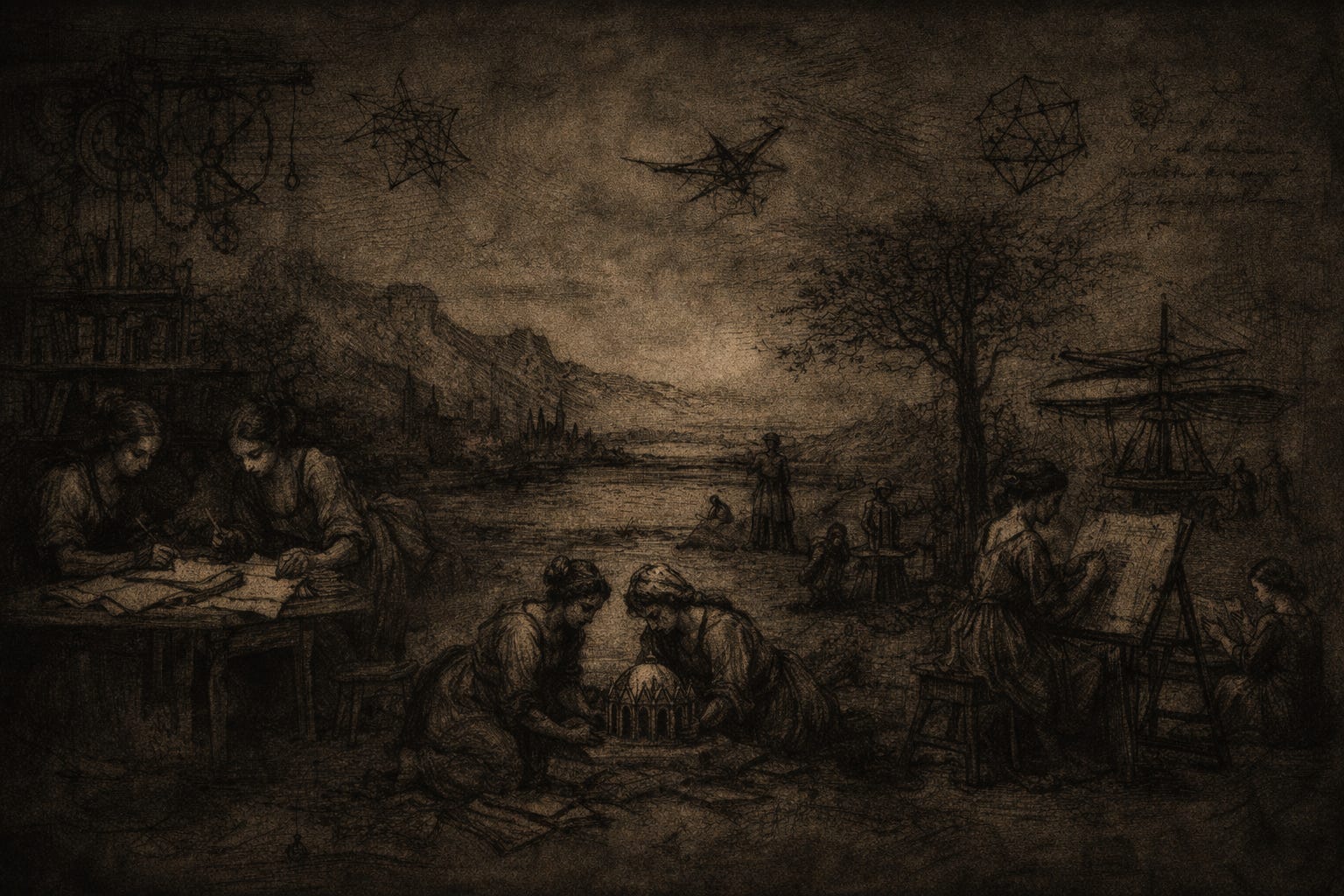
When institutions talk about creativity, they treat it like parsley: a garnish to be sprinkled after the roast of compliance has been served.
“We value creativity,” they declare, usually immediately before introducing a new standardisation framework.
In education, this arrogance was dissected with uncommon grace by Ken Robinson. In software, it survives in a different costume — quarterly objectives, story-point velocity, innovation theatre, resilience theatre, hackathons squeezed between delivery deadlines.
The pattern is usually the same. First, we narrow acceptable outcomes. Then we rank people by conformity. Then we ask why originality has declined.
Robinson’s great heresy was simple: creativity is not rare. It is suppressed.
The problem was never imagination. It was environment. This observation aligns uncannily with the notion of habitability — the idea that systems must be places people can live in, not merely operate. And it finds further depth symmathesy — learning together.
Put these together and something emerges: Creativity is not the property of an individual mind. It is the emergent property of a learning ecosystem. A learning habitat.
A student does not become creative in isolation. A developer does not become inventive by force of will.
They respond to signals:
Is it safe to be wrong?
Is divergence tolerated?
Is curiosity rewarded?
Is autonomy real or rhetorical?
If the environment whispers “comply,” imagination contracts. If it whispers “explore,” imagination gets a chance to expand.
The industrial metaphor — whether in schools or software — optimises for predictability and measurability. Predictability is tidy. Measurability feels scientific. They produce charts. They comfort governance.
But creativity is unruly. It requires ambiguity. It thrives on multiplicity before convergence. It requires time in the messy middle where nothing is yet certain and everything is still possible. It requires space and support to expend energy on that embracing that messy, incoherent middle.
When environments compress that middle, creativity suffocates.
In a symmathesic system — one that learns together — the environment itself evolves. Developers change the platform; the platform reshapes developers. Teachers shift pedagogy; students reshape teaching. Creativity is sustained not by heroics but by feedback loops.
This is a core to habitat thinking:
You cannot command creativity.
You can only cultivate the conditions under which it is likely.
And cultivation is habitat work.
Creativity is not a trait, it is a habitat
Robinson’s ecological metaphor reframes creativity from talent to context. Creative habits — curiosity, experimentation, risk tolerance, divergence — are adaptive responses to environmental signals.
In symmathesy learning is distributed, intelligence is relational, adaptation is mutual.
And in habitat thinking, structure shapes behaviour, affordances guide action. Constraints communicate values.
Creativity emerges when a system allows:
Safe divergence
Non-punitive feedback
Autonomy with shared purpose
Time before coherence is sought, let alone convergence
Cross-pollination of perspectives
Remove these, and creativity declines. Not because people lack imagination, but because the habitat penalises it.
Some practices to consider
Design for Divergence Before Convergence — Separate ideation from evaluation. Do not collapse exploration into decision-making too early.
Reduce the Penalty of Being Wrong — Treat mistakes as information, not incompetence. Reward learning signals.
Create Visible Feedback Loops — Symmathesy requires visible co-evolution, make adaptation explicit. Retrospectives that alter process. Platform changes driven by developer friction.
Protect Autonomy — Ownership increases intrinsic motivation — what Robinson called finding “The Element.” Without autonomy, creativity becomes compliance with decoration.
Increase Perspective Diversity — Cross-functional teams. Cross-disciplinary learning. Multiple intelligences recognised. Homogeneity reduces combinatorial possibility.
Some things to avoid
Confusing Busyness with Creativity — High output does not equal high originality.
Innovation Theatre — Hackathons without structural change. Suggestion boxes without autonomy. “Creative days” inside rigid, ignoring systems.
Over-Standardisation — Uniform metrics narrow cognitive bandwidth.
Premature Optimisation — Efficiency too early eliminates exploration space.
A Habitat Checklist
Ask yourself :
Do people feel safe asking naïve questions?
Are multiple approaches welcomed before narrowing?
Do mistakes reduce status or increase learning?
Does the platform evolve in response to developer friction?
Is autonomy structural or symbolic?
If most answers are “no,” creativity is being stifled.
A Real Example: Platform Engineering
A platform that:
Forces rigid golden paths with no extension points
Penalises deviation
Measures only throughput
…will reduce originality.
A platform that:
Reduces cognitive load
Encourages safe experimentation
Surfaces rapid feedback
Evolves with its users
…becomes a creative amplifier.
The difference is not tooling. It is habitat design.
Creativity is not a spark in the head of a gifted few. It is a garden condition.
And gardens do not bloom because we command them to. They bloom because the soil is right.
“Il faut cultiver notre jardin“ — Voltaire, Candide
Some Further Reading
Out of Our Minds – Ken Robinson
The Element – Ken Robinson
Patterns of Software – Richard P. Gabriel
Nora Bateson – Small Arcs of Larger Circles
Jessica Kerr – writings and talks on Symmathesy
Margaret-Ann Storey – on cognitive debt and developer cognition