
Creativity Hides in Strange Places
Creativity thrives where cognitive load is low. Enable your Internal Developer Platform to reduce the noise and let the ideas flow

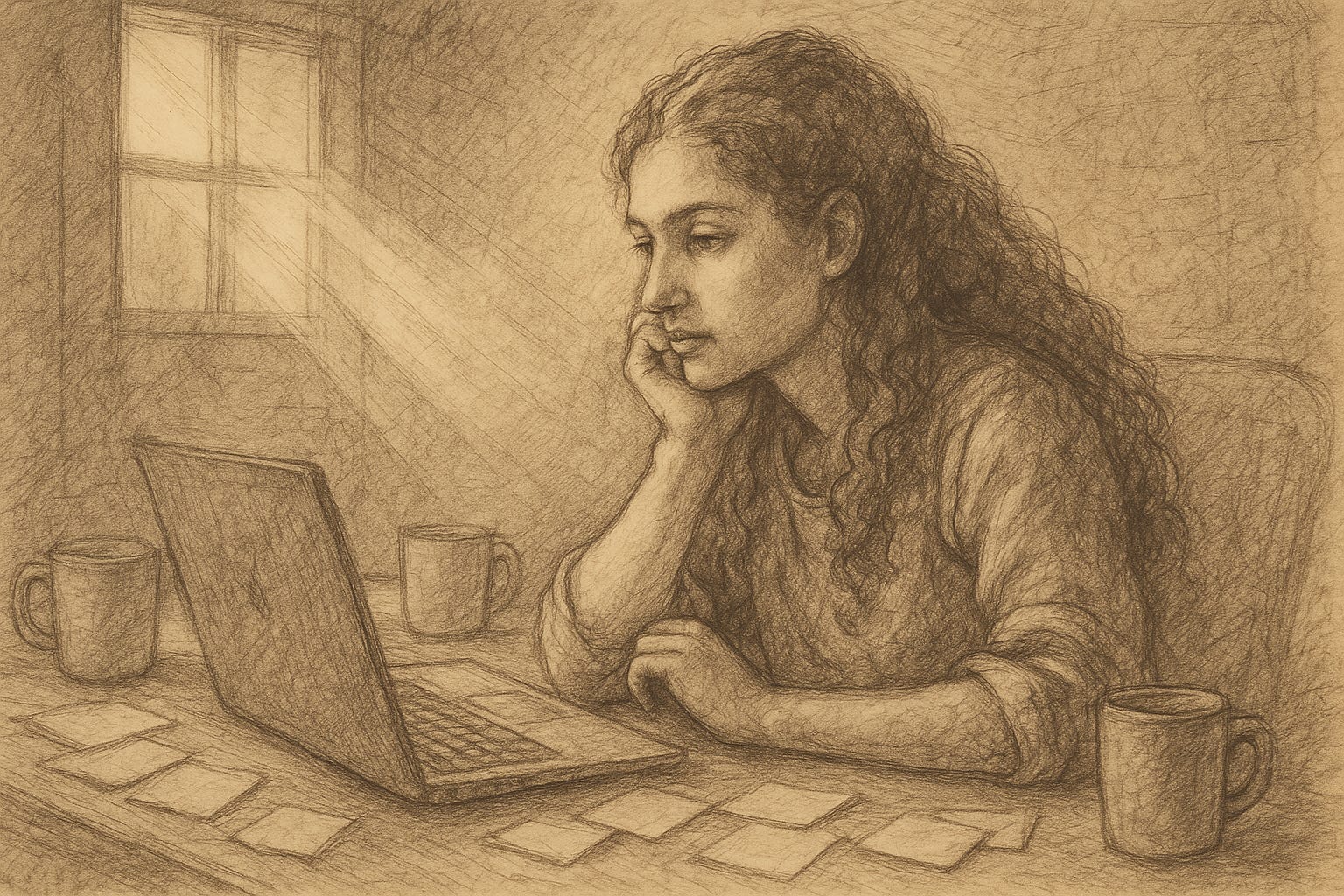
“No great thing is created suddenly.” — Epictetus
A payments team at a regulated bank used to spend hours every sprint Keeping the Lights On (KTLO).
After months of fatigue and zero innovation, the platform team automated or reduced this burden. Within weeks, the same team submitted three new feature experiments — one of which became a breakthrough self-service the product engineering teams loved.
Their creativity hadn’t been lost.
It had just been buried under weight.
Creativity is not a faucet you turn on in a meeting room. It comes sideways, at odd angles, when you’re not trying so hard. In the shower, where there are no whiteboards, JIRA tickets or, maybe, no pair programmers. On a dog walk, when your brain is chewing on smells and silence, not sprint points. On a long drive where the rhythm of the road lets your mind drift until something clicks.
Meetings are often where we try to force creativity. We drag people into a room, real or virtual, and hope that ideas will bloom on command. Sometimes they do. More often, they die under the fluorescent lights of agenda items, status updates, and the suffocating weight of too much context to hold in your head at once. Creativity hates heavy luggage. It prefers light carry-ons: a single thought, a single problem, something your mind can turn over lazily like a stone in your pocket.
Cognitive load is the silent killer of creativity. When your head is full of ticket numbers, system diagrams, and meeting notes, there’s no space for the spark to land. You can’t improvise a melody if you’re reciting a phone book. That’s why the shower is magic. No phone. No Slack. Just warm water and an uncluttered mind. That’s why the walk works. No one asks you for updates while you’re tying your dog’s lead. Creativity slips in through the cracks left open by idleness.
This is the paradox: the best ideas often arrive when you’re least equipped to capture them. You can’t exactly pair-program in a bathtub. But if you never allow yourself those off-guard moments, you’ll never get the spark at all. The trick is not to schedule creativity, but to make room for it — to reduce the background noise enough that ideas can surface when they’re ready.
And here lies the deep tie to platform engineering. Platforms are not built just to streamline, to automate, or to enforce. At their best, they exist to reduce the mental tax that crushes imagination. Every clunky tool, every needless hoop, every duplicated login is another pound on the rucksack of a developer’s mind. When platform engineers cut that weight, they’re not just saving seconds. They’re giving you back the quiet spaces where your best work actually happens.
You can’t force the muse, but you can clear her a desk
Creativity is not randomness. It’s recombination — the quiet merging of fragments that already exist in your mind. But recombination requires room. When the working memory is flooded with operational trivia, there’s no bandwidth left for play.
Platforms that demand context-switching and friction rob teams of this play-space. Simplification and automation are not luxuries; they are the conditions for imagination.
Practices
Design for flow, not control. Build systems that reduce context-switching.
Automate the boring parts. Repetition is where innovation goes to die.
Make feedback ambient. Let developers see the effects of their work without extra effort.
Provide calm defaults. Good defaults reduce decision fatigue and free up thinking time.
Encourage creative idleness. Allow for “wandering time” — periods with no expected output.
Things to avoid
Forcing ideation under pressure. Brainstorms on command often yield noise, not novelty.
Confusing busyness with creativity. Activity does not equal originality.
Over-instrumentation. Metrics matter, but constant measurement stifles exploration.
Designing platforms as constraint cages. Guardrails should guide, not imprison.
Ignoring recovery time. Creativity is a cycle: work, rest, reflect, and return.
A Checklist
Have we reduced context-switching between tools and domains?
Do our developers have the cognitive space to experiment?
Are our workflows clear enough to run subconsciously?
Have we automated the noise away from the signal?
Creativity thrives where cognitive load is low. Reduce the noise, and the ideas will find you.
The “shower thought” is not an accident — it’s a signal that your system has too much noise. When your brain finally escapes the constant hum of notifications, bureaucracy, and complexity, it starts to wander. That wandering is where insight lives. In software, those insights might be a simpler architecture, a clearer API boundary, or a name that captures what a domain really means. The less mental clutter we force on ourselves and others, the more likely the mind can connect patterns that were hiding in plain sight.
Platform engineering’s mission is not to box in imagination but to set it free. The measure of a good platform is not how many rules it enforces but how much it relieves the cognitive burden of those building upon it.
Reduce the number of tools needed to get something done. Remove the friction that makes developers hold entire workflows in their heads. Replace procedural bureaucracy with ambient guidance.
When the load lightens, creativity walks back in.
Further Reading
The Psychology of Discovery and Invention — Mihaly Csikszentmihalyi
Flow: The Psychology of Optimal Experience — Mihaly Csikszentmihalyi
Patterns of Software — Richard P. Gabriel
Team Topologies — Skelton & Pais (on reducing cognitive load)
Desert and Forest Metaphor — Kent Beck (on freedom and constraint in creative ecosystems)