
In Praise of Idleness in the Age of AI Coding
The purpose of the AI augmented coding is not to save us from thinking, but to buy us the time to think better.

The Gift of Time
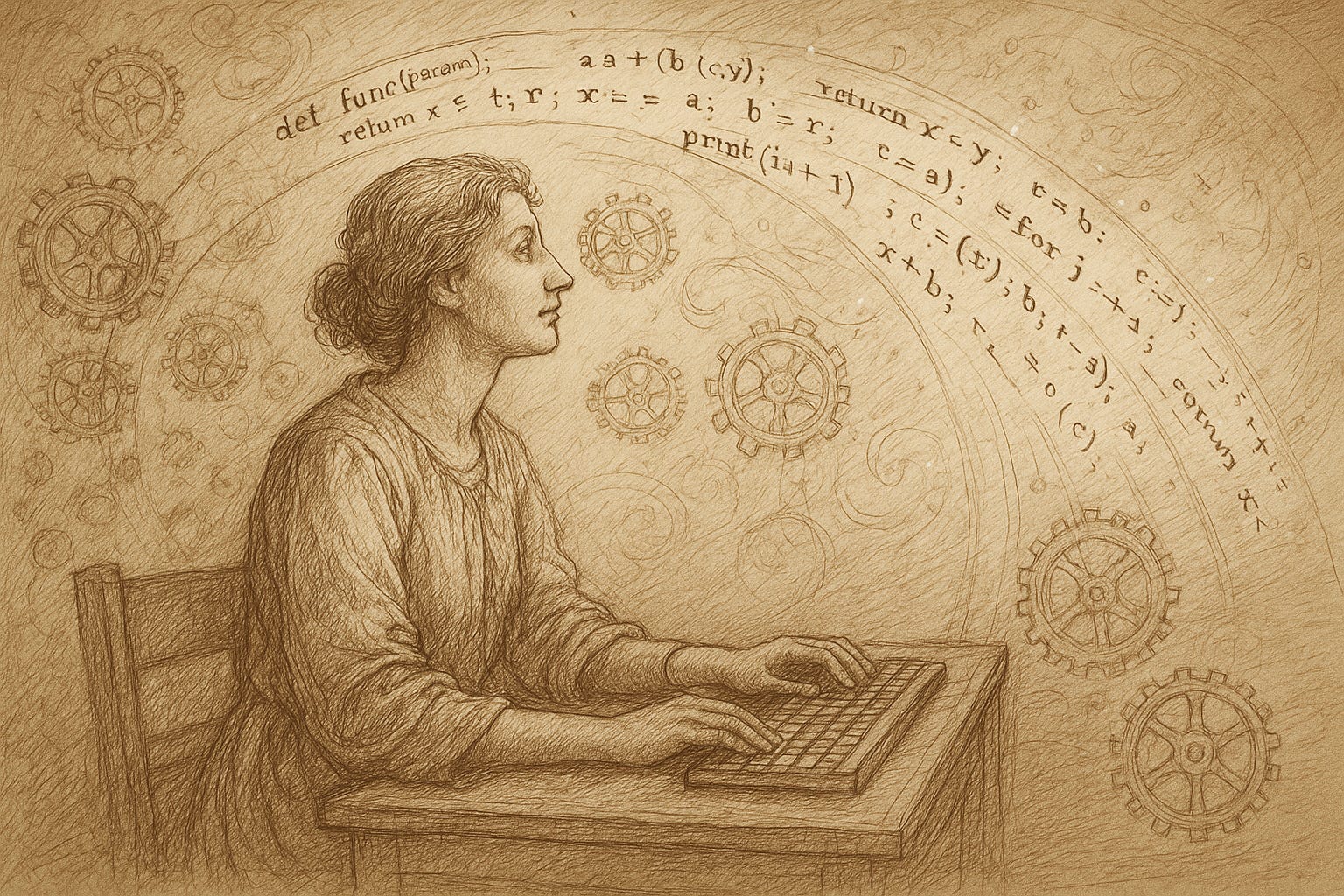
A young developer sits at her terminal, code flowing faster than she can think. Her “Djinn” completes her functions, writes the tests, documents the modules.
For the first time in years, she has time — the rarest resource in tech. So she stands, makes tea, and stares out of the window taking in a comfrting beauty from the mottled grey skies.
In that small act of idleness, she begins to see the system anew. How its parts fit, where it leaks, what beauty might live beneath the noise.
The code runs smoother not because she wrote more but because she finally had space to think.
The Factory of Infinite Output
Elsewhere, a team boasts that their new AI pipeline commits five hundred lines a day. Dashboards glow green; executives applaud.
No one reads the code. No one understands the emergent system. When it breaks, the humans stare at a wall of autogenerated logic and feel the panic of dependency.
The machines saved them time and took their understanding in return.
The Idle Mind and the Augmented Machine
When Bertrand Russell published In Praise of Idleness in 1932 he was rebelling against the tyranny of busyness. He saw the modern fixation on work as a form of moral confusion:
The belief that productivity itself was a virtue
That rest was suspicious
That a person’s worth was measured by output rather than imagination.
True civilization, he wrote, would grant its citizens leisure. Not mere rest, but the spaciousness required for thought, art, and play.
A century later, the same question confronts software engineers as artificial intelligence moves from curiosity to co-author. AI-augmented coding promises a world where boilerplate evaporates, syntax repairs itself, and documentation writes itself.
It is tempting to see this as Russell’s vision fulfilled. Machines working so that humans may think. This can make sense. The best of AI/Djinn can restore craftsmanship to engineering. It can free developers from rote repetition, returning to them the luxury of reflection.
When used wisely, AI buys us time to think, and thought, as Russell argued, is the real labour of progress.
But friction grows in the same soil. AI also feeds the very productivity cult Russell warned against. If speed becomes the new virtue, then the machine merely industrialises the intellect.
Developers risk becoming operators in a cognitive factory, measuring worth in lines generated rather than systems understood.
Russell’s fear was not that machines would work, but that humans would forget why they did. In that light, AI can either liberate us into leisure or seduce us into perpetual acceleration.
The difference lies not in the code, but in the culture. Whether we design our tools to amplify curiosity or control. To work with AI in Russell’s spirit we must treat idleness as a design principle. A platform should leave room for reflection. An AI should expose its reasoning, not hide it.
Our workflows should encourage reading, conversation, and slow understanding as much as execution.
Because idleness, rightly understood, is not the absence of work.
It is the presence of wisdom.
Some practices
Design for Spaciousness – Build feedback loops that allow time for reflection.
Schedule pauses in delivery to read, test, and understand what the AI has produced.
Cultivate Curiosity – Ask your AI coding co-author why as often as what.
Seek explanation over execution.
Read More Than You Write – Balance generation with comprehension.
Make “code reading sessions” a shared craft.
Treat Automation as Apprenticeship – Let the AI handle the chores,
but ensure the human remains the architect.
Protect Intellectual Leisure – Limit metrics that reward only speed or volume.
Celebrate insight, not output.
Some things to avoid
The Tyranny of Throughput – When AI increases output, management often raises targets. Leisure vanishes.
Loss of Comprehension – Reliance on AI suggestions without review erodes skill and autonomy.
Idleness Misunderstood – Leisure mistaken for laziness breeds guilt and undervalues reflection.
Speed as Success – The illusion that faster coding equals better software.
AI augmented coding—coding with the Djinn—promises to make us faster, but Bertrand Russell warned that speed without sense is the surest path to stupidity.
In In Praise of Idleness, he argued that true progress is measured not in output but in the space we earn to think. The same holds in software: the greatest engineers are not those who type the most, but those who pause well before they do.
The harmony lies here: AI can give us that pause. It can strip away the tedious scaffolding of code, freeing the human mind for architecture, ethics, beauty, experimentation and play. Used wisely, it becomes a companion in curiosity — a patient apprentice that handles the chores so the master can design the cathedral. To quote Kent Beck, you need to be the superego to the genie’s id and ego.
The friction lies in the familiar lie: that faster equals better. When AI becomes an instrument of the productivity cult, we repeat the industrial mistake Russell despised. We risk becoming overseers of infinite output — accelerating toward ignorance. AI can either expand our freedom or compress our thought. The choice is cultural, not technical.
The goal, then, is not to automate thinking but to automate space. Build tools that encourage reflection. Design workflows that protect idle time. Make curiosity a metric. The best AI platform is not the one that generates the most code, but the one that leaves the most silence and conversation — enough to think, question, and understand what we are building and why.
The purpose of the machine is not to save us from thinking,
but to buy us the time to think better.