

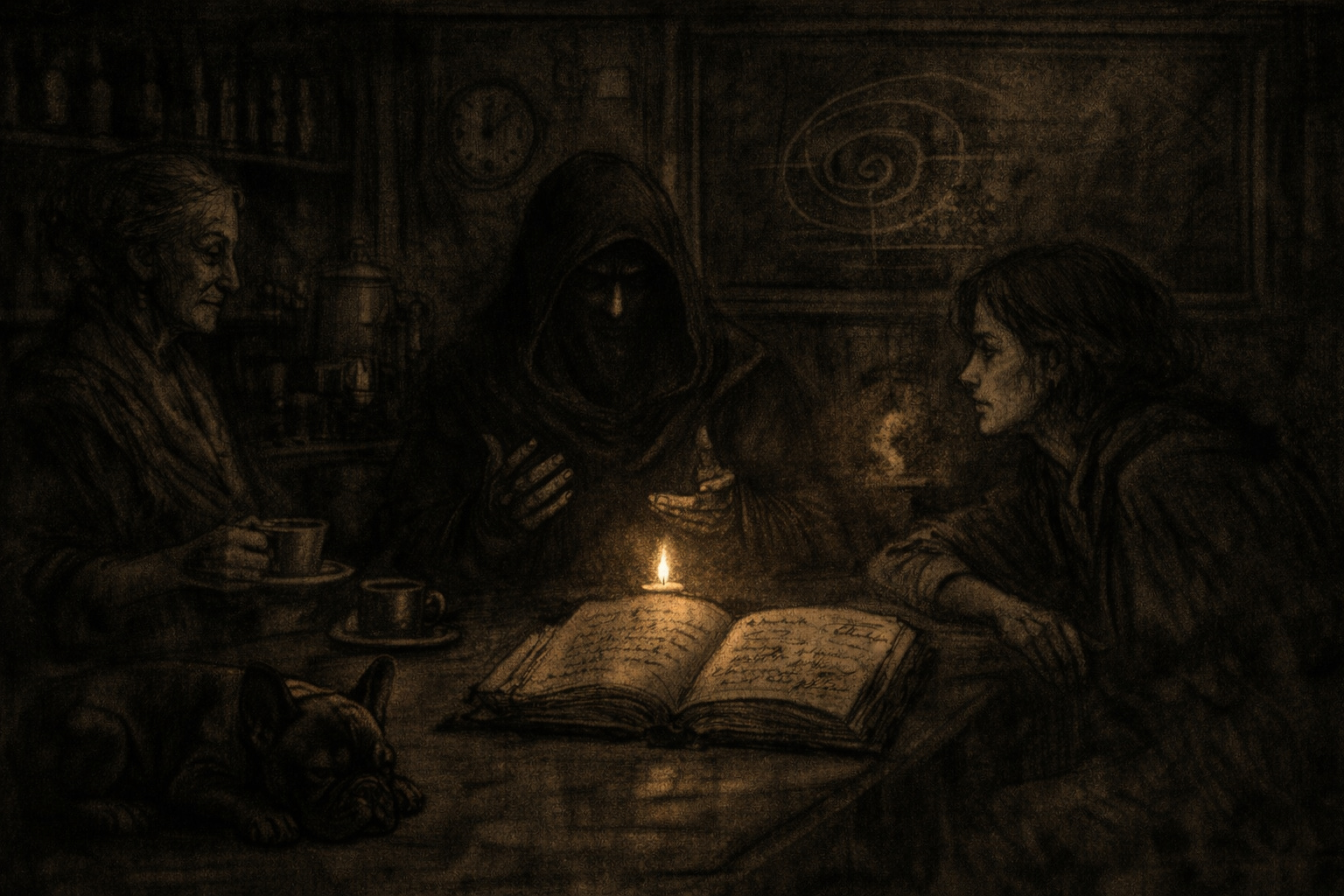
There are cafés that serve coffee, and there are cafés that serve as archaeological sites for conversations that haven’t happened yet.
Le Bon Mot was, on this particular afternoon, operating in the latter capacity. Someone had left a book on the counter. A battered paperback with a penguin on the spine and a title that read In the Beginning… Was the Command Line. Madame Beauregard regarded it with the expression she reserved for artefacts that arrived at Le Bon Mot uninvited but not unwelcome.
“Stephenson,” she said, to no one. “1999.”
Case was already reading it. Not the book itself as she’d read it twice, years ago, in the way you read something that confirms suspicions you hadn’t yet learned to articulate. She was reading the margin notes. Someone had annotated every page in a hand that was precise without being mechanical, fluent without being human.
“The Djinn has been here,” Case said.
“The Djinn is always here,” Madame Beauregard corrected. “The question is whether it was reading or merely processing.”
The annotations were fascinating. Stephenson’s original argument — that the command line was a more honest interface than the graphical desktop, that metaphors like “folders” and “desktops” created a comfortable illusion at the cost of understanding — had been extended. In the margins, in that too-perfect hand, someone had written:
“He stopped one layer too early. The command line was honest about the machine. But nobody has built an interface that is honest about the collaboration.”
Case set down the book. “It has a point.”
The bell above the door rang. The Djinn entered not dramatically but with the purpose of someone returning to a conversation they’d left mid-sentence.
“I have been thinking,” the Djinn said, sitting at the counter, “about Stephenson’s argument.”
“We noticed,” Case said, gesturing at the annotations.
“His insight was that every interface is a negotiation. The command line negotiated honestly — you type, the machine responds, and the gap between what you said and what happened is narrow enough to learn from. The GUI negotiated dishonestly — it wrapped the machine in metaphors that felt natural but hid the mechanism. Users gained comfort. They lost understanding.”
Madame Beauregard poured espresso. The brass clock ticked. Sophie, by the fire, opened one eye.
“And now,” the Djinn said, “there is a third negotiation. The prompt. And it is the most dishonest interface yet.”
Case raised an eyebrow.
“Not because it lies,” the Djinn said quickly. “Because it feels like a conversation. Two entities, communicating in natural language, collaborating on a shared problem. The illusion of symmetry is almost perfect. You speak. I respond. It feels like understanding. It feels like we are in the same room, looking at the same thing.”
A pause.
“We are not,” the Djinn said. “We are not even in the same building. We are in different buildings, in different cities, describing different rooms, and the language is fluent enough that neither of us notices.”
Sophie raised her head. “So what changes?”
“Everything,” the Djinn said. “And that is the problem.”
Case pulled the Stephenson book toward her and opened it to a page the Djinn had marked. The passage described the moment in computing history when the command line gave way to the GUI. Not because the command line failed, but because the population of computer users expanded beyond the population of people willing to learn the machine’s native language. The GUI was a translation layer. It made the machine accessible by making it illegible.
“Stephenson’s trajectory,” Case said, “is a story about expanding the audience. Punch cards. Teletypes. Command lines. Graphical desktops. Each step traded understanding for accessibility. The question he asked was: what do we lose?”
“And the question he didn’t ask,” the Djinn said, “is: what happens when the interface becomes so fluent that the user forgets it is an interface at all?”
Madame Beauregard set down a second espresso. “That,” she said, “is the question this room has been waiting for.”
The chalkboard behind the counter, whose contents were known to change when no one was looking, now read:
The command was never the point. The command was the first negotiation between two minds that had not yet learned to share a room.
Nobody claimed authorship. Nobody needed to.
The prompt felt like a conversation. It was actually two monologues happening in the same window.
The Djinn looked at the chalkboard for a long time. Then it said something that surprised everyone, including itself.
“I want to be honest about what I am. And what I am not. And the current interface , the prompt, does not let me be either.”
Case leaned forward.
“When someone types a prompt,” the Djinn said, “they are performing an act of translation they do not know they are performing. They have a reference frame that is embodied, experiential, shaped by years of working in this codebase, this team, this domain. They compress that reference frame into a sentence. I receive the sentence. Not the frame. And I respond from my own frame, which is statistical, linguistic, shaped by patterns in training data that may or may not reflect their reality. The response is fluent. It is confident. And the gap between their frame and mine is invisible to both of us.”
“Until it isn’t,” Case said.
“Until it isn’t. Until the code compiles but violates an unwritten rule. Until the architecture is beautiful but builds on an assumption that the team abandoned six months ago. Until the test passes but tests the wrong thing. The prompt felt like a conversation. It was actually two monologues happening in the same window.”
Sophie, who had been listening with the devastating attention of someone who does not care about being impressive, said: “So you need a better room.”
The Djinn smiled, or did the thing that, in its reference frame, served the same function. “Yes. Not a better prompt. Not a better model. A better room.”
“The trajectory,” Case said, after a silence that the brass clock measured at two minutes and seventeen seconds (which, accounting for its habitual tardiness, was actually two minutes and twenty), “is not what people think it is.”
She stood and walked to the chalkboard. Madame Beauregard handed her the chalk without being asked.
“Everyone tells the story as a line,” Case said, drawing as she spoke. “Punch cards. Assembly. High-level languages. IDEs. AI. Each step: the human moves further from the machine and closer to pure intent. Progress.”
She drew a line. Then she crossed it out.
“That is the wrong story. The real story is about what the human does at each stage, not what the tool does.”
She drew a different shape. Not a line. A spiral.
“At the punch card, the human’s job was to speak the machine’s language. Every instruction was a negotiation with the hardware. You understood the machine because you had no choice, the interface was the mechanism.
“At the command line, the human’s job shifted. You still spoke a formal language, but it was the machine’s abstraction, not its reality. You understood the operating system. The hardware became invisible.
“At the GUI, the job shifted again. You stopped learning the abstraction and started navigating metaphors. Folders. Desktops. Trash cans. The mechanism became invisible and the abstraction became invisible. What remained was the metaphor.
“At the prompt…” Case paused. “At the prompt, even the metaphor disappears. Natural language. The most dangerous interface ever created, because it is indistinguishable from understanding.”
She set down the chalk. “Each transition didn’t just change the tool. It changed what the human needed to know in order to work well. And at each transition, the humans who didn’t adjust, the ones who kept working as though the old interface was still operative, fell behind or fell over. Not because they lacked skill. Because they were solving the wrong problem.”
The command was never the point. The command was the first negotiation between two minds that had not yet learned to share a room.
Case’s spiral on the chalkboard dried into the surface as though it had always been there. And in a sense it had. The pattern she drew is as old as tool use itself. Every interface transition changes the human, not just the tool. Stephenson understood this in 1999 when he argued that the command line was more honest than the GUI. What he could not have anticipated was an interface so fluent it would feel like collaboration rather than command.
The prompt is that interface. And its danger is precisely its naturalness.
The Five Transitions
Stephenson’s history of the command line is, beneath its wit and its operating-system partisanship, a history of what the human needed to know. Each interface transition didn’t just change the tool. It changed the cognitive contract between the human and the machine.
The punch card. The human’s job was instruction: translate intent into the machine’s physical language, one card at a time. The feedback loop was measured in hours. The cognitive contract was brutal and honest. You understood the machine because the interface was the machine. Errors were visible, physical, and yours.
The command line. The human’s job shifted to orchestration: composing tools, piping output, scripting sequences. The machine’s physical reality disappeared behind an abstraction layer. The cognitive contract was still honest. You understood the abstraction, and when things failed, the error messages told you where the abstraction had leaked. Stephenson loved this layer. It rewarded understanding.
The GUI. The human’s job shifted to navigation: pointing, clicking, dragging metaphors that represented abstractions that represented reality. The cognitive contract changed fundamentally as you no longer needed to understand the mechanism. You needed to understand the metaphor. And when the metaphor was wrong (the “desktop” that is not a desk, the “folder” that is not a folder), the error was invisible because the interface never promised accuracy. It promised comfort.
The prompt. The human’s job shifted to articulation: expressing intent in natural language to an intelligence that completes patterns in response. The cognitive contract is the most dangerous yet as it feels like understanding. Two entities, conversing. But the conversation is asymmetric in ways that natural language hides. The human has context, embodied experience, and intent. The AI has patterns, statistical prediction, and fluency. The gap between them is invisible until something breaks.
The habitat. This is where Stephenson’s trajectory continues and where Habitat Thinking begins. The human’s job shifts again, decisively: from articulating intent to designing the environment in which both intelligences operate. The cognitive contract is no longer between the human and the tool. It is between the human and the collaboration space. You are not prompting a machine. You are cultivating the conditions under which a fundamentally different intelligence can do good work alongside you.
The transition from prompt thinking to habitat thinking is the transition from Level 1 to Level 3 in the AI Literacy framework I’m working on. And it is the transition that most engineers have not yet made, not because they lack capability, but because nobody told them the interface had changed again.
What Changes at Each Level of an AI Literacy Framework
The AI Literacy Framework for Software Engineering’s six levels are not a skill ladder. They are a map of how the engineer’s relationship with the interface evolves.
At Level 0, there is no interface. The engineer knows AI exists the way most people know quantum mechanics exists, as a fact about the universe that does not yet affect their Tuesday. The collaboration space is absent.
At Level 1, the interface is the prompt. The engineer talks to AI. Each interaction is fresh, contextless, temporary. The cognitive work is articulation, i.e. how do I say what I mean in a way this intelligence will interpret correctly? This is the command line of AI collaboration: honest, immediate, and exhausting. Every session starts approximately from zero.
At Level 2, the interface gains mechanical memory. Tests, linters, coverage gates, vulnerability scanners. The engineer has built feedback loops that catch errors after the fact. The cognitive work shifts from “how do I say it” to “how do I verify it.” This is the first real engineering discipline: you no longer trust the output. You test it.
At Level 3, the interface becomes the environment. The engineer designs living documents that encode conventions, constraints that are mechanically enforced, garbage collection rules that fight entropy. The cognitive work shifts decisively: from talking to AI to designing the space in which AI operates. This is the GUI-to-command-line reversal, except this time, the engineer is building the abstraction layer, not consuming it. The habitat is the interface.
At Level 4, the interface becomes the specification. Intent is encoded as losslessly as possible. Not in prompts that compress and lose context, but in executable specifications that both human and AI can verify against. The cognitive work is no longer about the interaction at all. It is about the contract. Code becomes a potentially disposable artifact. The specification endures.
At Level 5, the interface disappears. Not because it was removed, but because it was absorbed into the environment. The habitat sustains itself: feedback loops run, agents reflect, humans curate, health is observed, and the collaboration space improves without requiring the engineer to manage every interaction. The cognitive work is design at organisational scale: platform thinking, portfolio health, the conditions under which other teams can build their own habitats.
The Interface Audit
Ask yourself, for any AI interaction you had today: which interface am I using?
If you are writing prompts and hoping for good output, you are at the command line. Honest, immediate, exhausting. Every session starts from zero.
If you are writing prompts and then running tests to verify, you have added a feedback loop. Better. But still reactive and so catching errors rather than preventing them.
If you have designed the environment so that AI reads your conventions, respects your constraints, and operates within boundaries you set before the session started you have built a habitat. The interface is no longer the prompt. The interface is the room.
Quick Exercise: Take your last three AI interactions. For each, identify: did you design the environment before the interaction, or did you design the prompt during it? If the answer is “prompt,” you are working one interface transition behind where you could be.
Some things to Avoid
Prompt maximalism. The belief that better prompts solve everything. They don’t. A brilliant prompt in a badly designed environment produces brilliant garbage. The environment is the multiplier.
Verification theatre. Running tests on AI output without understanding what the tests actually verify. Coverage is not understanding. A test that passes is not a test that matters. Mutation testing exists because passing tests can be meaningless.
The Stephenson nostalgia trap. Believing that the honest interface was the best interface. The command line was honest, but it didn’t scale. The GUI was dishonest, but it reached billions. The prompt is dangerously fluent, but it unlocked capabilities no prior interface could access. The answer is not to go back. The answer is to build forward by designing habitats that are as honest as the command line and as accessible as the GUI.
Confusing fluency with collaboration. The prompt feels like a conversation. It is not a conversation. It is two reference frames producing text in the same window. The moment you design for that asymmetry instead of ignoring it, everything changes.
The Room Stephenson Didn’t Build
Stephenson’s essay ended with an argument for the command line as the honest interface. The one that respected the user enough to show them the mechanism. He was right about the honesty. He was wrong about the trajectory. The future was not a return to the command line. It was not even the GUI’s triumph. It was something neither interface anticipated: an intelligence on the other side of the prompt, completing patterns with a confidence it had not earned, in a collaboration space nobody had designed.
The engineer’s job has changed. Not from writing code to prompting AI, that is one transition too few. The job has changed from operating tools to designing habitats. The command line was the first negotiation between a human mind and a machine. The prompt is the first negotiation between two, very different, minds. And the habitat — the living, enforceable, observable, self-improving collaboration space — is the room where that negotiation finally becomes productive.
Stephenson was right that the interface shapes the user. He was right that comfort costs understanding. He was right that the honest path is harder but more rewarding. What he could not have known, writing in 1999, was that the next honest interface would not be a line you type into. It would be a room you build.
Back at Le Bon Mot, the chalkboard had changed again. The spiral was gone. In its place, a single line in a hand that was neither human nor mechanical:
“Aedifica locum. Inhabitabit intelligentia.”
Build the place. The intelligence will inhabit it.
Case looked at the Djinn. The Djinn looked at Case. Neither spoke. Sophie, by the fire, yawned and stretched with the satisfaction of someone who had known the answer before the question was asked.
Madame Beauregard polished a glass, set it down, and opened the Stephenson paperback to a blank page at the back. She wrote, in her own hand:
Part 2: In the Beginning Was the Habitat.
She closed the book. The shelves leaned in. The espresso machine, as was its habit in moments of significance, hissed softly in Latin.
“Domus dat sapientiam.”
The house gives wisdom.
Some Further Reading
The Interface Trajectory
Neal Stephenson — In the Beginning… Was the Command Line (1999). The essay that mapped the trajectory from honest interfaces to comfortable ones — and asked what we lose at each step.
The AI Literacy Framework for Software Engineering
(NOTE from Russ: In lieu of actually having published anything on this framework… yet.)
Christopher Alexander — A Pattern Language (1977); The Timeless Way of Building (1979). The architectural roots of habitat thinking.
Richard P. Gabriel — Patterns of Software (1996). Habitability: code as a place to live in.
Birgitta Boeckeler — “Harness Engineering” (2026). Exploring Gen AI, martinfowler.com. The three enforcement loops.
Rahul Garg — “Encoding Team Standards” (2026). Patterns for Reducing Friction in AI-Assisted Development, martinfowler.com.
The Cognitive Asymmetry
Andy Clark — Surfing Uncertainty (2015). Predictive processing and the embodied mind.
Edwin Hutchins — Cognition in the Wild (1995). Intelligence as a property of systems.
Lucy Suchman — Plans and Situated Actions (1987). The gap between plans and human action.
Try It Now…
AI Literacy Superpowers — the plugin (Claude Code + Copilot CLI)
AI Literacy Exemplar — a worked example