
Of Tea & Time
A short, surreal story of how Observability 2.0 can save your life

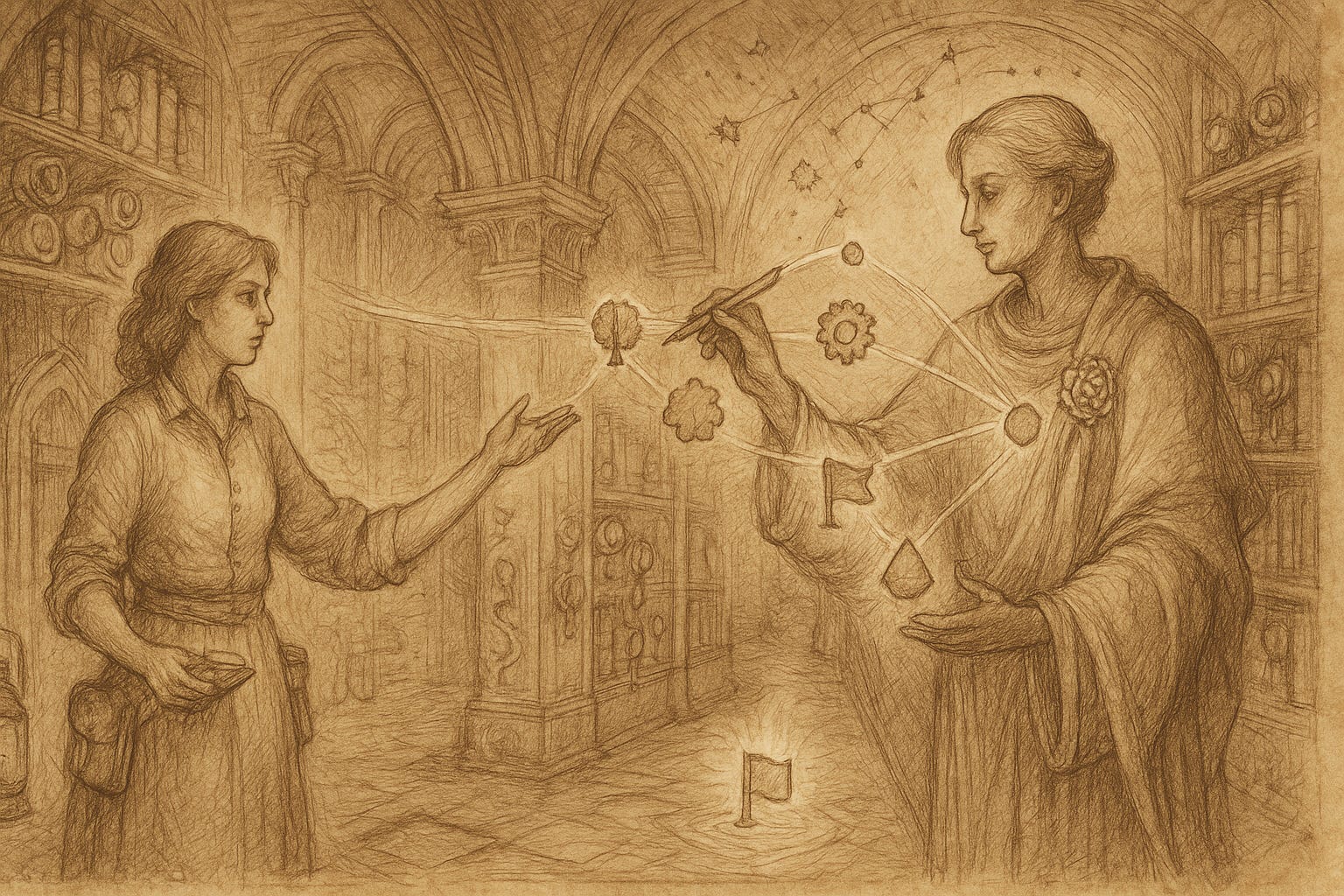
Murder most steeped
It is a well-documented, consistently blogged, and persistently inconvenient truth that the universe runs on configuration files. Not because configuration files are good, but because they are hilariously unsuited to representing anything that actually happens, and the universe, having an advanced sense of irony, finds this irresistible.
On the morning the Tea Synthesizer began producing arsenic instead of Earl Grey, Marta—on-call human, tea enthusiast, and reluctant mystic—stood before the Change Library. The Library was not a building so much as a geography: aisles of time, catalogues of intent, footprints pressed into wet moments and signed with wax seals that never quite dried. The clerks called those seals “attestations.” Marta called them the only reason she still had a job.
She spoke the ritual words engineers use when they suspect something beyond their comprehension has happened: “What changed?”
The Library, which disliked rhetorical questions, obliged. The air acquired the scent of hot dust. Shelves rotated with a grumbling of gears; a fresco of clocks untangled itself into a timeline. At 14:03 a tile on the floor glowed—a small square labelled flag: doublestrong_tea → on. At 14:05 a corridor lengthened and grew teeth; that was latency. At 14:06 a serving of oolong attempted voluntary manslaughter.
Marta raised an eyebrow at the corridor (which sulked), and summoned the Archivist.
The Archivist
The Archivist was an agent. Not the trench-coat sort with a tragic backstory and improbable cheekbones; more a precise, patient librarian with a pen that could write in causality. It wore a rosette of permissions, each petal a capability, each capability hedged with caution and a small warning that said “Please don’t.”
“Morning,” the Archivist said, because some niceties must be observed even in the vicinity of arsenic. “Before I help you, I am obliged to ask: May I verify the provenance of everything we are about to accuse?”
“You may,” Marta said, because she had finally learned never to start a rescue without evidence, and because the Librarians—human and otherwise—were very serious about not letting the Archivist improvise.
The Archivist adjusted the shelves with a fingertip. The wax seals responded by growing little banners: Build a1c3… signed; image digest 9fbc… signed; deploy r-2025-10-27.3 signed. The world settled a fraction, like a liar deciding to tell the truth from now on.
“Good,” the Archivist said. “Now: shall we find the fork?”
Of Events, Forks and Flags
The infinite labyrinth of software does not fork gradually. It bifurcates like a magician’s dove—one wing the path you meant, the other the path you took. The labyrinth’s cartographers call this “delivery.” Really it’s fate with a filing system.
They stepped into the Hall of Events. Each door bore a title: commit, pipeline-run, artifact, deploy, feature-flag, incident. Marta, who had once tried to triage a production incident with only dashboards and a rosary, felt the old nausea and the newer relief of being able to read.
The Archivist drifted toward a door stamped feature-flag. “A humble door,” it observed, “behind which empires fall.”
Inside, the world rewound to 14:03. A hand—belonging to someone optimistically named Zeno—had toggled doublestrong_tea to on for 1% of Betelgeuse customers. The change had been annotated with the sentence, “Nothing can go wrong, because tea.” Provenance was perfect; intent was clear; consequences were unspectacular for exactly two minutes.
“What did the toggle do?” Marta asked the air, which was the Library’s local name for the event stream.
The air rearranged its molecules. Threads—visible and polite—ran from the flag to a deployment, from the deployment to a build, from the build to the commit where Zeno had replaced the humble function steep with a heroic algorithm called BoilTheOceanFast(). This change had saved 4 milliseconds and introduced arsenic. The thread connecting the two had a label that read, correlation: 0.93. In the margin, the universe made a note about sarcasm.
The Archivist tapped its pen against the deployment event. “Look at the links,” it said, as one might tell a friend to look at the stars and mean: be pleased to be small. Span links threaded the labyrinth like constellations—unbroken lines from a user’s request to a function’s regret, from the regret to the release, from the release to Zeno’s cheerful comment.
“And the IDs?” Marta asked, squinting. They glittered: run IDs, image digests, commit SHAs. Stable names in a city of nicknames.
“Stable,” the Archivist said with obvious satisfaction. “We will not get lost today.”
Outside, somewhere in reality, a siren quieted by two decibels. The Library, sensitive to ambition, interpreted this as permission.
“Proposal,” the Archivist said, and a neat card slid from its sleeve. “We pull the audience for doublestrong_tea from 1% to 0.0%. We attach the evidence. We ask for approval. We do not, under any circumstances, ‘try something.’”
“Approved,” Marta said, because it was, and because the Archivist was engineered to only propose things a reasonable god would endorse.
The card acquired two signatures: hers, and the Library’s. The Archivist inclined its head to the approval like a butler to destiny, then executed the rollback, carefully, as if adjusting the trajectory of a planet by breathing on it. A corridor lost its teeth. Somewhere, people began to enjoy tea again, and wrote small heartfelt notes to nothing in particular.
The Library brightened in that way rooms do when they know they’ve been seen properly.
They walked on. “We’ll need a post-mortem,” the Archivist said, already writing. The pen composed a story of events that made room for causes without pretending to be fate. It attached exemplars: the exact request that slowed, the span that groaned, the build that signed, the flag that flipped. It named Zeno without blaming him and proposed a new rule that any function with the word ocean in it must be reviewed with suspicion and biscuits.
“Remind me,” Marta said. “Why are the events so… wide?” She made a spreading motion with her hands, like showing the size of a fish you nearly caught.
“Because we have learned,” the Archivist said, “that thin stories become thick with excuses. A wide event is a generous paragraph: who, what, when, where, with which identity and under what hypothesis. Thin events are syllables. Syllables do not help in an emergency.”
Marta nodded and thought that, yes, this was the part previously called Observability, where one looked at graphs one did not believe and told oneself stories one could not prove. This new thing had an unforgiving quality: the clarity of a ledger. It was not more data; it was better memory.
They turned down the Aisle of Unlikely Costs. Numbers with sharp elbows jostled for attention. “While we are here,” the Archivist murmured, “note: the infra module update increased per-tenant expense by 12% for a population that does not drink tea but somehow pays for the cups. The joins are kind. The owners are legible. Shall we suggest a rollback as well, with a narrower blast radius and a kinder attitude?”
“Do it,” Marta said, and watched the pen write a case a judge could love.
Welcome to Counterfactuals
They came at last to the Door of Counterfactuals, a sentimental place where engineers keep the alternate universes generated by their curiosity. Marta peeked inside and saw, briefly, the timeline where the Tea Synthesizer had stayed poisoned because nobody could answer what changed?
It was a universe of dashboards and conjecture, heroic blamings, shouted legends, and an unwell sense of inevitability. She shut the door, gently.
Back at the Librarian’s desk, the post-mortem had already written itself, which is to say: it had been written step by honest step, as the steps happened. The attachments were not accusations but footprints. The summary was short.
At 14:03 a flag enabled new steeping logic for 1% of Betelgeuse.
At 14:05 the system slowed and tea attempted murder.
At 14:06 we observed, joined, and understood.
At 14:07 we rolled back with evidence.
At 14:10 people’s hearts forgave us.
Marta signed it. The Archivist filed it in a place that was both somewhere and everywhere. The Library exhaled.
“Anything else?” the Archivist asked, as if the universe might have a spare emergency lying around.
“Yes,” Marta said. “One more thing.” She looked up at the vaulted ceiling, where the constellations of traces had begun to look like maps and the maps like promises. “Let’s make it easier to do the right thing next time.”
“Ah,” the Archivist said, delighted. “A future change. My favourite genre.”
It stamped the intention with a tiny seal that resembled a smile and wrote in the ledger, in a hand very much like Marta’s: Make change the primary observable. Then, because it had learned a little poetry from its readers, it added, And keep the receipts.
Outside, the tea tasted like honesty. Inside, the labyrinth straightened by one degree and became, briefly, a corridor you could walk without getting lost.