
On the Half-Dream and the Long Way Round
Or: Why Ideas Arrive When You Are Between Things

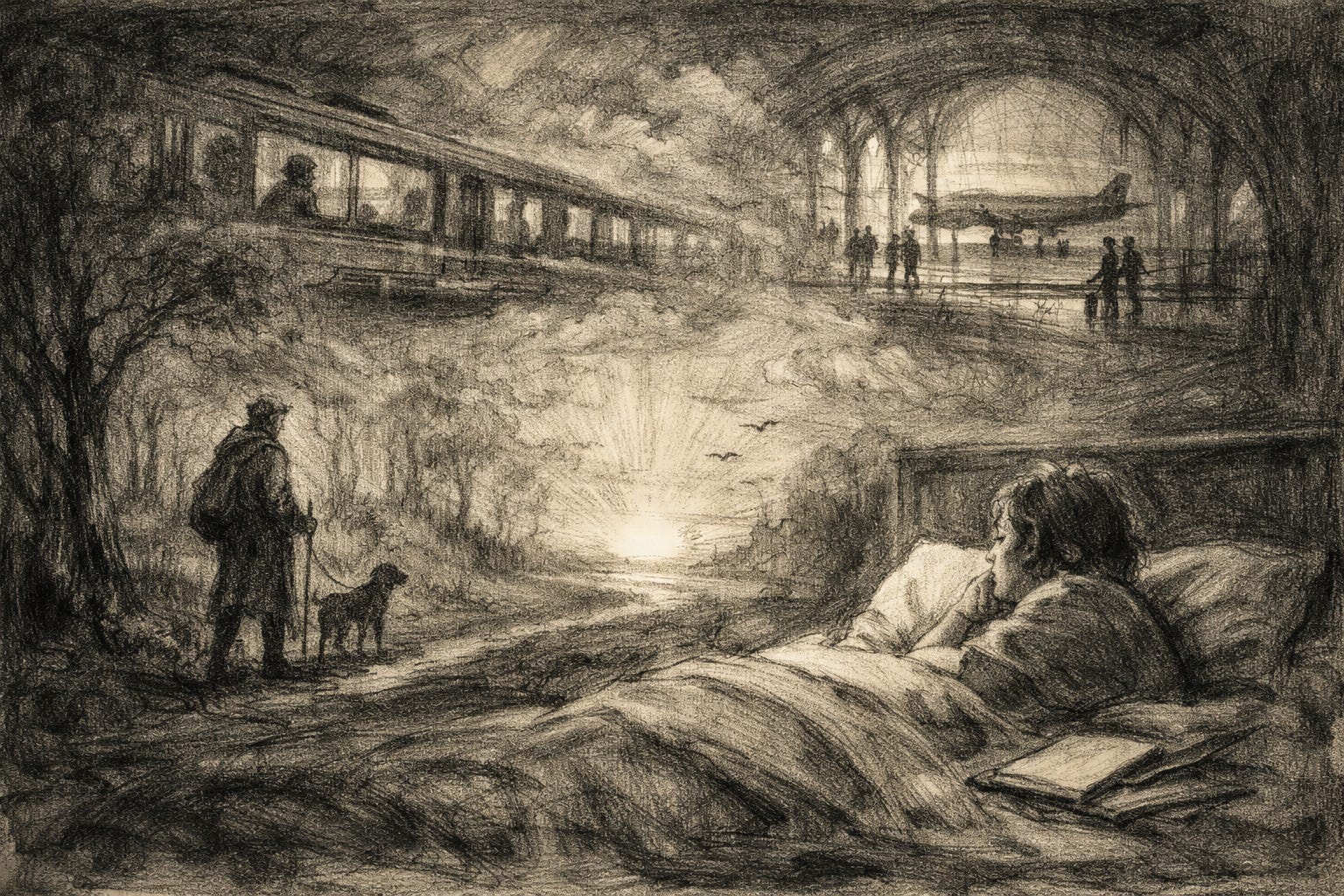
Sunday has an important place in the way my brain works. It’s the day I’m most likely to not set an alarm, and so I’ll get a chance to lay in and just exist in a between state caught in the middle of sleep and waking up, for the longest time of the week. Possibly the only time of the week.
And I’ve found those moments are important to me as someone who like to create things, especially write and code things. It’s in those moments that I get easily my best ideas. Not as a carefully packaged stream of deliveries, but wrapped in lucid half-dreams that seem to give my brain a chance to surface things.
It is from this mine that I have retrieved some of the best ore of my talks, articles, and even just simple ideas for work. And so today I decided to write about those moments, those liminal spaces where we get our best ideas. Because they are rare, valuable, and almost entirely impossible in the busy-ness of work life.
I’ll begin with a story.
The Department of Transitional Thought
The first thing she noticed was that the idea had arrived too early.
It was still dark. The alarm had gone off once, been snoozed with moral conviction, and now lay quietly reconsidering its life choices. She was neither asleep nor awake, but something less official. Her body had remained behind, while her mind had wandered forward slightly, like a tourist who steps off the train to look around while their luggage continues to circle the station.
And there it was: The idea.
Fully formed. Calm. Waiting.
This annoyed her. Ideas were supposed to require effort. Notes. Diagrams. Coffee.
This one had simply turned up, as if it had taken a later train and arrived ahead of schedule.
She tried not to look directly at it, knowing from experience that attention frightened such things away. Instead, she let it sit there, hovering politely, like a cat that has chosen you but is pretending it hasn’t.
Then, without warning, her bedroom dissolved.
She found herself standing in a long corridor. Not an alarming corridor—no flickering lights or ominous doors—just a deeply administrative one. Beige walls. Linoleum floor. A sense that if you followed it far enough you would encounter a notice about fire exits written in six languages, none of them particularly helpful.
A sign above read:
THE DEPARTMENT OF TRANSITIONAL THOUGHT
— Ideas Lost and Found
A man at a desk looked up. He wore glasses of the sort that suggested he had once been very curious and now curated that curiosity carefully.
“Ah,” he said. “Between states, are we?”
“I suppose so,” she said.
“Excellent. We do our best work then.”
He slid a form toward her.
“Name?”
She hesitated.
“That’s… complicated right now.”
He nodded approvingly. “Good. If you knew exactly who you were, you wouldn’t be here.”
Behind him, the corridor opened into a vast hall.
People wandered through it slowly: commuters staring out of train windows that weren’t there; walkers moving at a steady pace while their bodies remained conspicuously absent; travellers dragging suitcases filled entirely with half-finished thoughts. A man was clearly mid-shower, eyes fixed on a revelation that would evaporate the moment he reached for a towel.
Above them all, ideas drifted like paperwork caught in a gentle updraft.
“Are these… ideas?” she asked.
“Of course,” said the man. “Where did you think they came from?”
“I assumed… thinking?”
He smiled patiently. “A common misconception.”
He gestured toward a marked section of the hall.
NON-URGENT. LOW-IDENTITY. RHYTHMIC CONDITIONS.
“That’s where most of the good ones originate,” he explained. “Walking the dog. Long drives. Trains between stations. That moment just after waking when you don’t yet remember your email password.”
“And desks?” she asked.
He winced. “We try not to send anything important there. Too many forms. Too much judgment.”
She spotted her idea floating nearby. It looked slightly embarrassed to be seen.
“I should probably take that,” she said.
“Careful,” he replied. “Once you fully wake up, it may refuse to follow.”
“Why?”
“It doesn’t like supervision.”
She considered this. “Can I write it down?”
“You may attempt capture,” he said, tapping a clipboard. “Interpretation is forbidden until later.”
“That seems inefficient.”
“Yes,” he agreed. “Efficiency is where ideas go to die.”
An alarm sounded somewhere far away—not loud, but insistent, like responsibility clearing its throat. The woman sighed. “You’re being recalled.”
The hall began to fade. Walkers slowed. Trains dissolved into even blurrier metaphors. Ideas scurried toward filing cabinets marked LATER and PROBABLY NEVER.
As she felt herself returning to the weight of the bed, the man called after her:
“Remember—if you want to come back, don’t fill the spaces. Leave the corridors empty.”
“What corridors?” she asked, but she was already gone.
She woke properly this time. Morning light. The alarm blinking triumphantly. The day waiting to be impressed.
The idea was still there—fainter now, but intact.
She did not rush. She reached for a notebook, wrote three words that made no sense yet, and closed it again. Somewhere, in a beige corridor that existed only between moments, a man ticked a box:
SUCCESSFUL TRANSFER: PROVISIONAL.
And the idea, having survived its journey, settled in to wait for a time when it would be least expected—and therefore, most useful.
On Liminal Spaces
Most people imagine ideas as events: lightning strikes, moments of brilliance, sudden clarity. They imagine them arriving at desks, summoned by effort, produced by intention. This belief persists despite overwhelming personal evidence to the contrary.
Because ideas rarely arrive when we are trying to have them. They arrive when we are between:
Between home and work.
Between tasks.
Between attention and rest.
Between sleep and waking.
Just between.
They arrive when we are commuting, walking the dog, travelling, staring out of windows, moving through airports, or lying half-awake after the alarm has failed to recruit the body. They arrive when we are getting from A to B—or when we are not yet fully at A at all.
These moments share a property that is easy to overlook and hard to manufacture: they are liminal. Thresholds. Transitional spaces. Times when identity loosens its grip and obligation briefly looks the other way.
In such states, the mind is doing something very specific and very old.
Liminality as Cognitive Slack
A liminal space is not rest, and not work. It is movement without decision. Attention without demand. Presence without performance.
When commuting or walking, the body is occupied with something sufficiently absorbing to keep consciousness awake, but sufficiently automatic to free the mind from executive burden. The route is known. The stakes are low. The task is already solved.
This matters because the human mind is not at its best when fully mobilised. When you are planning, responding, evaluating, deciding, prioritising, defending—when you are “being useful”—a large portion of cognition is spent on control. Control narrows thought. It edits aggressively. It favours the familiar because the familiar is cheap.
Liminal spaces loosen control without abolishing it.
Too much control, and nothing new survives.
Too little control, and nothing coherent forms.
Walking, commuting, travelling—these create a narrow and precious channel where attention is stable but unclaimed. The mind is allowed to wander, but not to scatter.
Movement as a Carrier Wave for Thought
There is something important about motion. Important enough to be called out all on its own.
Rhythmic, low-stakes movement—walking, rolling trains, steady driving—acts as a kind of metronome for cognition. It entrains attention. Thoughts begin to arrive in cadence. Ideas hitch themselves to the rhythm of steps or wheels.
This is why:
Walks produce disproportionate clarity
Long drives surface decisions you thought were stuck
Trains invite notebooks, metaphors, plans
Your body takes responsibility for continuity, freeing the mind to explore discontinuity. The motion carries you forward so thought does not need to.
The Disappearance of Urgency
Another shared feature of liminal spaces is the absence of immediate consequence. While walking the dog or commuting:
Nothing you think must be acted on right now
No one is watching
No decision will be enforced immediately
This creates temporal slack.
Ideas do not like urgency. Urgency compresses time, and compressed time favours the obvious. Insight needs room to stretch, to simulate, to run ahead and loop back.
When you are “getting from A to B,” the present moment is already complete. You decision is largely done. That completion creates an empty stage on which something else can appear.
Context Collapse and Identity Suspension
Travel, in particular, weakens the context part of the liminal space equation. You are no longer fully who you were five minutes ago. You are not yet who you will be when you arrive. Roles soften. Narratives blur. The habitual story—this is what I do, this is how I think, this is what matters—temporarily loses its authority.
This is not trivial stuff.
Many ideas fail to appear not because they are wrong, but because they do not fit the identity currently in charge. Liminal spaces suspend that identity just long enough for unfamiliar thoughts to surface.
Often, what arrives is not a new idea at all—but an old one, finally released from a frame that kept it quiet.
And Then There Is the Half-Dream
If commuting and walking are liminal spaces of movement, then the extended snooze—the long hover between sleep and wakefulness—is liminality stripped to its essence. This is the essence of my Sunday morning moments.
In this moments, there are:
No destination
No role
No performance
No requirement to make sense yet
The body is heavy. Time is elastic. The day has not yet asked its questions.
This state is not unconsciousness. It is pre-identity. Before the mind remembers who it is supposed to be, it remembers what it knows.
The internal editor—the voice that asks Is this useful? Is this sensible? Is this impressive?—wakes up late. Judgment lags behind imagination. Memory becomes fluid, associative, promiscuous. Past conversations, technical problems, metaphors, bodily sensations drift into proximity without explanation. This is recombination without agenda.
And because linear time has not yet asserted itself, ideas can arrive strangely complete—already tested, already played out, already felt.
They do not feel clever. They feel obvious. Not because they are trivial, but because they were not forced into being.
One Ecology, Many Thresholds
Seen together, walking, commuting, travelling, and snoozing are not separate curiosities. They are variations of the same condition:
The mind thinking without being supervised.
In all of them:
Control relaxes
Rhythm steadies attention
Urgency disappears
Identity loosens
Judgment softens
These are not accidents of modern life. They are remnants of an older cognitive rhythm—one in which thinking happened while moving through the world, not sitting apart from it.
The tragedy of modern work is not that it is demanding, but that it colonises every gap. Notifications invade commutes. Podcasts occupy walks. Phones steal the half-dream before it has finished speaking.
And then we wonder where the ideas went.
Ideas arrive when the mind is unguarded but not absent
Ideas are not manufactured. They are completed.
What feels like sudden inspiration is often the end of a long, quiet process that required slack, safety, and silence to finish its work. Liminal spaces provide those conditions.
Some practices to consider
Defend unscripted transitions
Do not optimise every in-between moment.Capture without interpreting
Write fragments. Record phrases. Meaning can wait.Move gently between states
Especially between sleep and waking. Do not rush the border.Resist constant input
Leave some corridors empty.
If you want better ideas, stop chasing them. Create places where they are no longer afraid to appear.
Sometimes that place is a path through a park. Sometimes a train between stations. Sometimes an airport at dawn.
And sometimes—
It is the quiet half-dream,
before the day remembers to ask you who you are.