
On the Pair, the Mob, and the Factory
A first Software Tale from Le Bon Mot for the Software Enchiridion

README (or skip, it’s your call really)
Welcome to Le Bon Mot!
The stories of Le Bon Mot are set in a café-library that sits, inconveniently and deliberately, at the intersection of metaphor and machinery. Within its labyrinthine shelves and espresso-stained tables, the maxims of the Software Enchiridion are not presented as commandments but encountered as lived paradoxes to be argued over, misunderstood, misapplied, trumped up and occasionally redeemed.
Each tale takes a familiar myth, or set of myths, of software engineering—the factory, the lone genius, the dashboard deity, the cult of productivity—and subjects it to the gentler but more dangerous light of story. In the company of Case and the café’s shifting regulars, principles become people, metaphors acquire voices, maxims become warnings and ideas long treated as doctrine are invited, politely but firmly, to defend themselves.
These are not stories about code per se; they are stories about the humans who write it, and the myths they must outgrow in order to understand it together.
Context is, so often, Queen: The Geography of Le Bon Mot
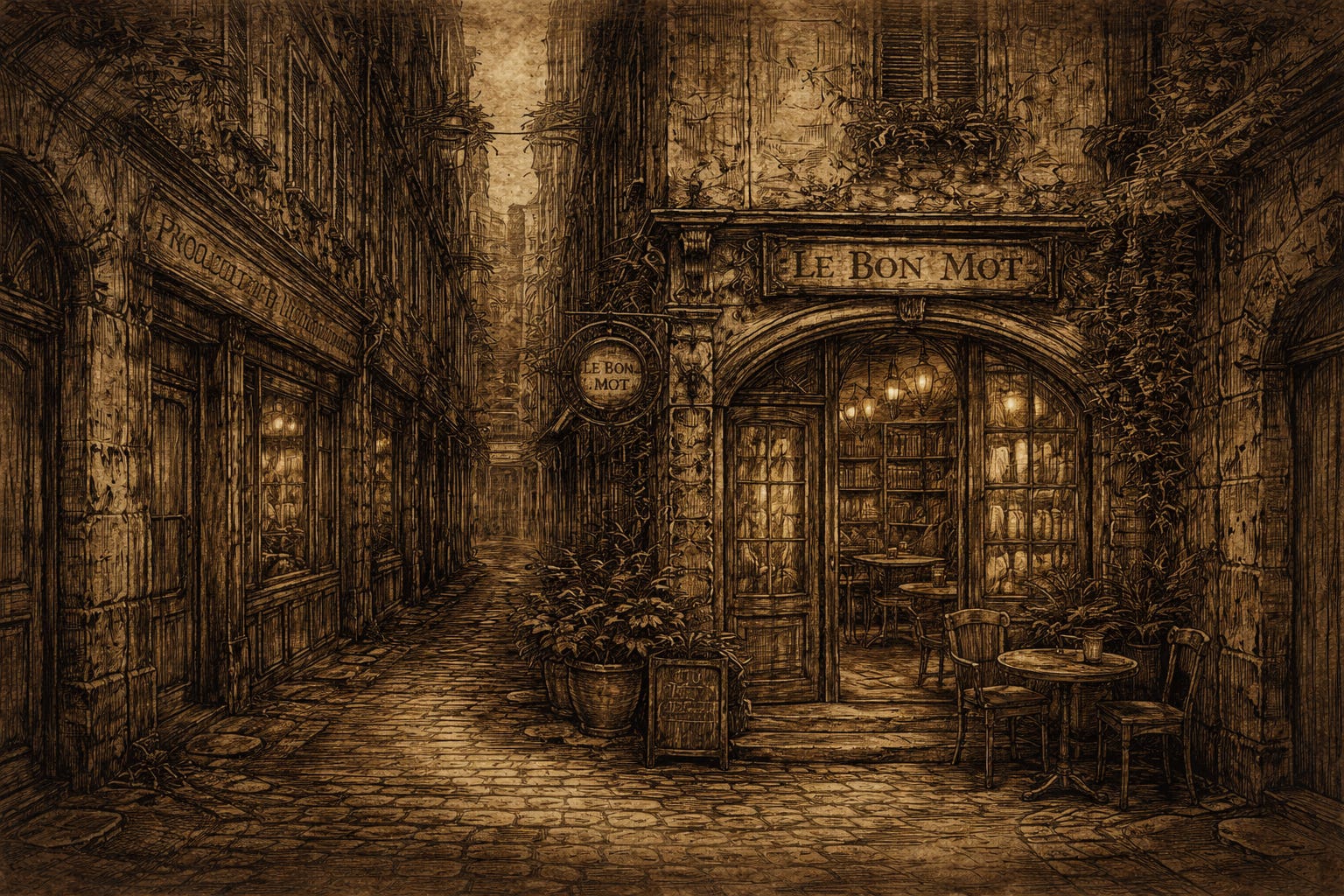
There are cities that are planned, cities that are grown, cities that are surprising and cities that are accidentally compiled from centuries of civic merge conflicts. In one such city, whose name is omitted out of courtesy rather than mystery, there exists a narrow lane that appears on no reliable map and on several unreliable napkins.
Half the lane insists it is called Productivity Passage. The other half insists it is Throughput Mews. Both are wrong. The compromise plaque, in a fit of municipal diplomacy, reads Productive Throughput Passage Mews, which is both technically accurate and spiritually exhausting.
Halfway down this argumentative artery stands Le Bon Mot.
Le Bon Mot is a café in the sense that it serves coffee strong enough to reboot a conscience, and a library in the sense that it contains more knowledge than is strictly safe. The entrance looks as though it has survived three architectural paradigms and one ideological purge. Inside, the shelves refuse linear obedience. Philosophy bleeds into software manuals. Gardening texts share space with systems theory. Bakery sits beside balance sheets. Reality leans conspiratorially against compliance documentation.
The tables are mismatched, the chairs unrepentant. Lamps cast a light that flatters both first drafts and second thoughts. Regulars say the café rearranges itself when no one is looking—not maliciously, but helpfully. The book you did not know you needed will be within reach. The one you were certain about will have wandered off to reconsider its position.
It is the sort of place where arguments are conducted with crockery, code comments are treated as love letters, and where one may discover that software engineering has more in common with ecology than with industry.
It was here, among the labyrinthine shelves and the slow, deliberate hiss of the espresso machine, that Case liked to sit. And it was here that Milo arrived, carrying with him the faint industrial scent of a factory.
“It is amazing what you can accomplish if you do not care who gets the credit.”
— Harry S. Truman
A Confusion of Metrics and Mobbing
Our tale begins in the back streets of an unnamed city where there is a narrow lane that appears on no official map, because it is technically a merge conflict between two councils.
Half the lane belongs to Borough A, which insists it is called Productivity Passage. The other half belongs to Borough B, which insists it is called Throughput Mews. A small plaque attempts compromise by calling it Productive Throughput Passage Mews, which satisfies nobody and therefore has been adopted as truth.
Halfway down this lane, between a shuttered co-working space and a shop that sells artisanal rubber ducks to people who are both wealthier and lonelier than you’d expect, there is the legendary café-library called Le Bon Mot.
It is a library in the sense that it contains more books than any reasonable person can admit to owning, and a café in the sense that it contains more opinions than any reasonable person can admit to holding. The entrance is a door that looks as though it has been reused from three previous buildings, all of which had burned down for entirely justified reasons.
Inside, the air is thick with espresso and footnotes.
The shelves are labyrinthine, but not maliciously so. It is less a maze than a rearrangement of category theory: biographies filed under “Fiction,” fiction filed under “Compliance,” compliance filed under “Mysticism.” Somewhere, inevitably, a book you have been looking for all your life is filed under “Miscellaneous” next to a pamphlet about walking tours.
At a table near the window sat Case, retired developer, with the posture of someone who had once stared down production incidents and survived to tell the tale with a raised eyebrow. She had the calm of code that has been refactored lovingly enough that it no longer remembers the panic that birthed it.
Across from her sat a young engineer named Milo, who had arrived with the anxious energy of a person whose calendar contained no blank spaces and whose soul contained no cache.
He placed his laptop on the table like a priest setting down a relic.
“I’ve been told,” he began, “that pair programming is good. And mob programming too. But… in my company it feels like saying you’ve started worshipping wind. Everyone nods politely and then asks when you’ll return to doing ‘real work.’”
Case stirred her coffee with the slow deliberation of someone debugging a race condition by listening to it.
“Ah,” she said. “You work in a factory.”
Milo blinked. “We make software.”
“Factories make things,” Case said. “Software engineering makes mistakes, mostly. And then tries to make fewer of them tomorrow. That isn’t manufacturing. That is horticulture with anxiety.”
Milo leaned forward, earnest. “But we have metrics.”
Case nodded gravely, as though he had just confessed to owning an unlicensed copy of Microsoft Office. “Yes. Factories love metrics. They make people feel like reality is in a spreadsheet and not a swamp.”
Milo had the look of someone about to say We’re agile and stopped just short of it.
Case reached into her bag and pulled out a small brass key. Not a metaphorical key but a literal one, slightly tarnished, with the faint inscription UTILISATION.
“This,” she said, “opens the door to the part of Le Bon Mot the council doesn’t like.”
Milo’s eyes widened. “There’s a forbidden section?”
“There’s always a forbidden section,” Case said. “In some libraries it’s erotica. In some it’s anarchist pamphlets. In ours it’s the truth about productivity.”
She stood. Milo followed, trying not to look too much like someone about to receive mystical enlightenment in exchange for a subscription.
They walked between shelves that rearranged themselves when you stopped looking directly at them. This was a feature installed by the librarian to deter people who alphabetised for fun. They passed a sign that read:
SILENCE IS GOLDEN. EXCEPT IN PAIRING, WHERE IT IS DEATH.
At the back of the library was a door so plain it seemed embarrassed to exist. Or it was hiding from the tax man. Case inserted the key. The lock clicked with the smugness of a dashboard hitting its monthly target.
Inside was a room that was not a room but an idea of a room. An architectural abstraction, a crude diagram someone had mistaken for reality. It contained rows of desks arranged with the grim symmetry of an assembly line. Overhead, fluorescent lights hummed like management. On the far wall, a colossal screen displayed numbers that changed constantly: velocity, utilisation, cycle time, story points, tickets closed per soul.
At the front, in front of the screen stood a figure in a high-visibility jacket, holding his clipboard like a weapon. His face was an industrial accident of certainty.
He turned as they entered with a look that made them sit abruptly at a workstation.
“Welcome,” he said, “to the Factory of Software. I am the Foreman.” He said “Foreman” the way a bishop might say “God.”
Milo glanced at Case, who looked unimpressed.
The Foreman smiled too widely. “We pride ourselves on efficiency here. Each engineer produces units of value. We measure them. We compare them. We reward them.”
Behind him, engineers sat alone at desks. Each wore noise-cancelling headphones and a haunted expression. Above each desk a sign displayed their personal statistics, updated in real time. Some signs flashed green, others red, like the emotional status lights of a very, very sick machine.
Milo lowered his voice. “This is… familiar.”
“Of course it is,” Case said. “This place is built out of assumptions. That’s why it feels like home.”
The Foreman stepped closer, eyes narrowing with suspicion. “Two of you?” he said. “Together? At one workstation?”
He spoke as if they’d arrived in a horse costume.
Case gave him her calm smile. “We’re thinking.”
The Foreman looked appalled. “Thinking is not in the plan.”
He gestured to the screen. “We have throughput targets. Two engineers on one task halves output.” Case tilted her head. “Only if output is typing.”
The Foreman’s eyes glittered. “Output is what we can count.”
Milo, who had been quiet, found himself speaking, because youth has an unfortunate habit of believing truth is persuasive.
“But pair programming reduces defects,” he said. “It improves knowledge sharing. It—”
The Foreman raised a hand. “Defects are downstream. Knowledge sharing is non-billable. And ‘improves’ is not a number.”
He pointed at Milo’s laptop. “One keyboard. One person. If you must collaborate, do it asynchronously. Leave comments. File tickets. Create documentation no one reads. Like civilised people.”
Case sighed with the delicate exhaustion of someone who has attended a meeting about meetings.
“Tell me,” she said, “what happens when your best engineer leaves?”
The Foreman frowned. “We hire another. Resources are interchangeable.”
Behind him, one of the solitary engineers made a small noise. Half laughter, half sob.
Case nodded. “That’s a myth. And myths are powerful. But also dangerous. Like fireworks or senior, ivory tower architects.”
The Foreman bristled. “Myths?”
Case tapped the brass key against her palm. “The Factory Myth. The Productivity Metric Myth. The Lone Genius Myth. The Utilisation Myth. They’ve built a temple here. And you are its priest.”
The Foreman smiled coldly. “And you,” he said, “are a heretic.”
He clapped. From the shadows emerged two more figures: one wore a hoodie so deep and dark it seemed to absorb light. The other wore a tailored suit covered in KPI badges like medals.
The hooded figure spoke first, voice low and dramatic. “I am the Lone Genius,” he intoned. “I do my best work at 3 a.m. fuelled by caffeine and disdain. You will never understand the depths of my code!”
The suited figure smiled with corporate warmth. “And I am Productivity,” she said. “I am here to ensure value delivery. Also I have graphs.”
Milo stared. “Are these… personifications?”
Case shrugged. “In a room like this, metaphors congeal.”
Productivity stepped forward and looked Milo up and down like a management report. “Pair programming,” she said, “is a cost. Two salaries. One ticket. Terrible ROI.”
The Lone Genius scoffed. “Pairing is distraction. I enter flow. I commune with the machine. I am…”
Case cut him off. “…lonely.”
The Lone Genius blinked, as if someone had interrupted a monologue with an accurate diagnosis.
Milo felt something tighten in his chest, Part anger, part recognition. “We’ve been told,” he said, “that deep work is sacred.”
“It is,” Case said. “But sacred things become dangerous when turned into absolutes. Even water. Even silence. Even velocity.”
Productivity waved a hand toward the screen. “We optimise resource efficiency. Everyone busy. No idle time. No slack.”
Case nodded. “And you create queues, defects, burnout, and heroics. You treat humans like CPU cores. But they are… not.”
The Foreman leaned closer, voice hardening. “So what do you propose? A circle of engineers holding hands around a laptop, singing songs of shared ownership?”
Milo surprised himself by answering. “Yes.”
There was a moment of stunned quiet.
Then Case laughed. Not cruelly, but with that bright, dangerous laughter of someone who has just spotted an elegant solution.
“Not singing,” she said. “But yes. Shared cognition. Shared context. The work is not the typing. The work is the understanding.”
The Foreman’s face flushed. “Understanding does not ship.”
Case’s smile vanished. “Understanding is the only thing that ships,” she said softly. “Code is just a receipt for it.”
The screen flickered. Numbers danced. The fluorescent lights buzzed louder, as if the building itself were offended.
Milo felt the room tighten around them, like a policy document opening.
Productivity leaned in, voice honeyed and lethal. “If you pair,” she said, “who gets credit? Who gets promoted? Who is accountable?”
Case answered, “The team.”
It sounded simple. It sounded obscene.
The Foreman’s eyes narrowed. “Teams cannot be rewarded. Only individuals can be compared.”
“And that,” Case said, “is why you will never have sustainable excellence. Only exhausted saints and fragile miracles.”
The Lone Genius, who had been scowling, suddenly spoke with a hint of panic. “But… if we do it together,” he said, “then I am not special.”
Case looked at him with something almost kind. “You might become something better,” she said. “Kind, and helpful.”
The Lone Genius recoiled as if struck.
A sharp sound echoed through the room. A door at the back, one Milo hadn’t noticed, swung open. Through it came a gust of air that smelled like rain and soil and the exhilarating terror of not knowing.
A new figure entered. Barefoot, sleeves rolled up, hair wild, carrying a trowel. Leaves clung to her like someone had tried to compost her.
“I am Habitat,” she announced cheerfully, as though arriving late to a party and bringing plants instead of wine.
The Foreman groaned. “Not you.”
Habitat ignored him, walking between the desks. Wherever she stepped, the rigid rows seemed less certain. A potted fern appeared on one workstation. Someone’s sign stopped flashing red and simply… became quiet.
“I’ve heard,” Habitat said to Case and Milo, “that you want to stop treating software like a factory. Good. Factories are awful. Let everything grow wild! Everyone follow their instincts. No coordination! No constraints!”
Milo hesitated. This sounded like the kind of advice that gets repeated enthusiastically on social media and then quietly regretted in production.
Case’s eyebrow rose. “Careful,” she said. “You too can become a myth.”
Habitat blinked. “What?”
Case gestured around. “Wild ecosystems are not anarchies. They are networks. Interdependent. Dense with feedback loops. If your ‘habitat’ becomes ‘leave everyone alone,’ you’ll just make loneliness feel virtuous.”
Habitat looked genuinely wounded, which is what happens when someone points out that your liberation narrative contains a trapdoor.
“So,” Milo said slowly, “pairing and mobbing aren’t factories… but they aren’t solitary wilderness either.”
Case nodded. “They are ecology. Shared soil. Pollination. Symbiosis.”
The Foreman laughed derisively. “Poetry. One cannot manage poetry.”
Case turned to him. “That’s your tragedy,” she said. “You think management is control, not cultivation.”
Habitat, regaining enthusiasm, clapped her hands. “Yes! Cultivation! Let’s do it now. Right here.” She pointed at the nearest workstation. “We’ll mob.”
The Foreman’s eyes widened in horror. “You can’t! That would—”
“—look inefficient?” Case finished. “Good.”
Milo felt his pulse quicken. “How?”
Case pulled out a small notebook and wrote one sentence, then placed it on the desk:
GOAL: REDUCE DEFECTS IN THE PAYMENT MODULE WITHOUT BREAKING AUDIT LOGGING.
Immediately, something in the room shifted. The goal acted like gravity. The desk became a focal point.
Engineers at the solitary desks looked up, as if hearing their names spoken kindly for the first time in months.
Case raised her voice. “We rotate driver every five minutes. One conversation at a time. Speak your thinking. No sarcasm. Curiosity only.”
The Foreman sputtered. “This is unauthorised collaboration!”
Productivity hissed, “Who will get credit?”
The Lone Genius murmured, “What if they see me not knowing?”
Case looked at him. “They already do,” she said. “They just pretend not to.”
One by one, the solitary engineers stood and drifted toward the workstation, drawn by an instinct older than agile frameworks: the instinct to work together.
Milo sat at the keyboard. His hands hovered. He felt every eye on him full of fear, hope and exhaustion.
Case stood behind him, the navigator. “Start with a test,” she said.
Milo swallowed. “We don’t have good tests.”
Case smiled. “Then you’ve been manufacturing without measuring quality. Let’s be heretics properly.”
He wrote a failing test. Someone suggested an edge case. Another engineer spotted a hidden dependency. A third remembered a compliance requirement that would have been missed.
The conversation became a living thing. Not a meeting. Not a performance. A shared mind.
The screen above them flickered again. The utilisation numbers wobbled. The ticket counts trembled like frightened animals.
Productivity stepped forward, aghast. “Stop that! You’re reducing throughput!”
Case didn’t look at her. “We’re reducing rework,” she said.
The Foreman tried to shout, but his voice came out as a hollow corporate slogan that evaporated midair. It was difficult to maintain authority in a room where people were thinking aloud.
The Lone Genius watched, conflicted. He stepped closer, tentatively offering a suggestion about a refactor. Someone nodded. Another built on it. His idea became part of the group rather than a private jewel.
His shoulders lowered. He looked… relieved.
Habitat danced between them, delighted. “Look!” she said. “Interdependence!”
The Foreman backed away, as if the collaboration were contagious. “This is chaos,” he muttered.
“No,” Case said. “This is context.”
They worked like that for what might have been an hour or a lifetime. Time behaves strangely around shared understanding; it stretches and compresses like a poorly specified API.
The test turned green. Then another. A subtle bug, one that would have lived quietly until it ruined a weekend, was caught by a comment someone made only because they felt safe enough to sound uncertain.
Milo leaned back, dizzy with the unfamiliar sensation of progress that didn’t taste like exhaustion.
Above them, the colossal screen dimmed. The numbers didn’t vanish, but they lost their religious glow. They became what they should have been all along: signals, not commandments.
Productivity stared at the dimming screen, trembling. “But… how will we know who is valuable?”
Case finally turned to her. “Watch what happens to the system when they’re together,” she said. “That’s your value.”
Productivity opened her mouth, then closed it, as if encountering a concept for which she had no metric.
The Foreman looked smaller now. “This won’t scale,” he whispered.
Case smiled gently. “Neither does loneliness,” she said. “But you’ve tried anyway.”
Milo looked around at the group. He saw tired faces, bright eyes, people who had been resources an hour ago and were now unmistakably human.
“What happens now?” he asked.
Case took the brass key and placed it on the table.
“We leave,” she said. “The factory room will always exist. Myths don’t die. They just get replaced by better ones.”
Habitat nodded solemnly, then brightened. “Also we should get pastries.”
They walked back through the shelves. Behind them, the room of metrics did not collapse dramatically but something had changed. The door no longer felt like a boundary. It felt like a choice.
At the front of Le Bon Mot, the librarian looked up from a book titled The Tragedy of Measuring the Unmeasurable. She nodded at Case as though this were a normal Tuesday.
Milo exhaled. “So the myths and metaphors… they’re everywhere.”
Case sat down again by the window, coffee waiting like a familiar prompt. “Yes,” she said. “Factory, genius, productivity, utilisation, deep work as dogma. The list goes on. Muddying the waters by making collaboration look like waste.”
Milo frowned. “But pairing and mobbing do cost something.”
“Of course,” Case said. “They cost the illusion of individual heroism. They cost the comfort of hiding. They cost the ability to pretend you understand when you don’t.”
She took a sip.
“And in exchange,” she added, “they buy you something rare in this industry: a team that can think and build together quickly without fear. And if you want to see high performance, that is what it can look like.”
Milo stared out at the lane, where the street sign still argued with itself.
“Is that the point?” he asked.
Case’s smile returned. “It’s not the only point,” she said. “But it’s the one that survives contact with reality.”
Outside, a man hurried past clutching a dashboard report like a religious text. Inside, in the labyrinthine library café, two people sat at one table, and quietly, scandalously, began to share their understanding.
Fin.