
Platforms demonstrate value through Intended and Surprising Impact
Part of a Software Engineering Enchiridion: Platform Engineering

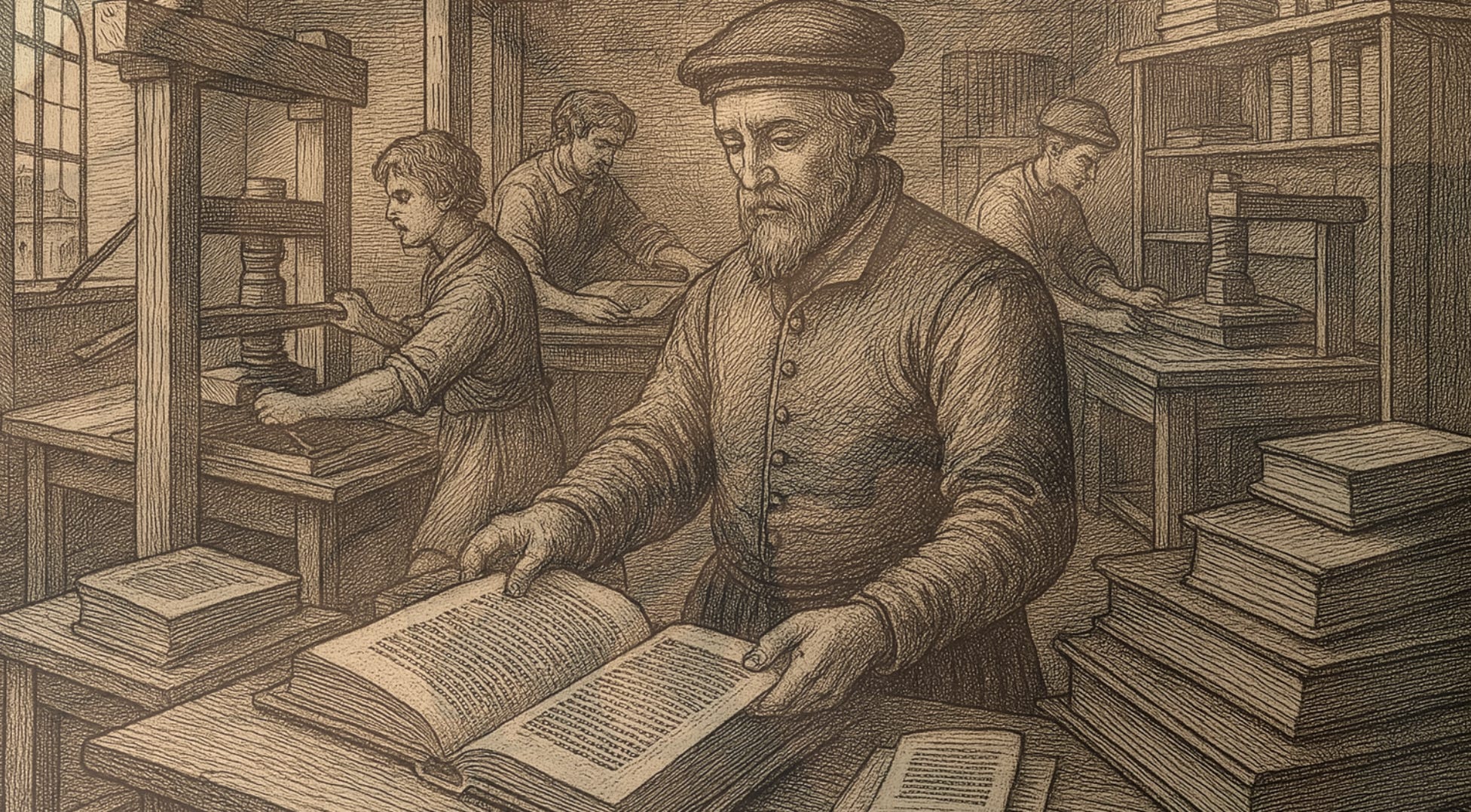
Following on from yesterday’s post, every platform begins with intent. Christophe Plantin wanted profit, not poetry. He ran his Antwerp press like a gambler, feeding type into the jaws of war, plague, and censors. His intent was simple: sell books, feed family, stay alive. Yet his press unleashed something else. Galileo squinted at the stars, Shakespeare lit the stage, Montaigne invented the essay, and modern literacy itself walked out of Plantin’s shop with ink still wet.
This is the lesson: the intended impact of a platform is rarely its only impact. A platform is a machine built for one outcome, but it leaks. It leaks possibility. It spills into the world in ways you cannot predict, and that is both its danger and its genius.
In software, we make the same mistake as Plantin’s creditors and rivals. We think a platform is a business plan, a tool, or worse, a stack of technology. But platforms are habitats. They are gardens where other people’s work can grow. You plant what you think are roses and suddenly find wild grapes climbing the wall. That is the surprising impact.
My Platform Engineering workshop (being given in New York, London and Munich in 2025) teaches the same lesson by other names: context before tech, pain before polish, design from the top-down, resilience through residuality, and roadmaps as experiments. None of this is mystical. It is sober recognition that platforms evolve like living things, not like blueprints.
The danger is hubris. The platform engineer who believes they can nail every requirement, lock every dependency, and predict every outcome will end up like the priest in Galileo’s tale—staring at the telescope and refusing to look. The world changes. Your platform, bends, breaks or amplifies.
Plantin bent type against paper every day, gambling against silence. His press was fragile, yet its fragility was the condition of its greatness. The same is true for us. Your platform will break. People will curse it. Outages will expose its guts. Regulations will pull it sideways. And still, if you have designed for residuality, something will remain. Some path forward will survive. And in that survival lies its power.
Do the work. Map your climate like Plantin mapped his buyers. Walk the pain of your users like Montaigne walked the Stoics. Design for your own and your users’s evolving OODA loops—observe, orient, decide and, crucially, act—so you never ossify, calcify or stagnate. Stress-test your platform until it screams, then note what survives. Help your users do the same with their applications. Build your platform roadmap as evidence, not dogma.
Above all, accept that your platform will have impacts you never intended. This is not failure. This is the very definition of success.
Profit may be your intent. Poetry will be the surprise. If you are lucky, both will endure.
The “intended” is profit, the “surprising” is poetry; build for both.
Platforms should not be controlled into submission. They evolve under stress and context. Their most lasting impact is rarely the one you set out to create.
Practices
Map business climate while exploring your platform.
Map the value streams and survey the developer pain.
Use domain storytelling and OODA loops to design the experience, tuning clear cognitive load.
Explore your architecture with residuality: ask what remains when parts fail.
Treat roadmaps as hypothesis boards, not commandments.
Things to Avoid
Designing only for happy-path intent.
Confusing features with resilience.
Ignoring the cognitive load of users.
Treating adoption as mandate, not experiment.
A Checklist
Have we mapped our business climate and ownership constellation?
Do we know the top 3 developer pain points?
Is each high-value flow wrapped with a feedback loop that enables safe action?
Have we explored residual survivability under stress scenarios?
Is our roadmap framed as experiments, with metrics and timeboxes?
Design platforms not only for the outcomes you intend, but for the surprising futures they will inevitably create. Residuality, context, and experiments make this possible.
A platform’s greatness lies in the tension between its designed purpose and the unexpected possibilities it unlocks.
Focus on reducing pain and building resilience, and let the surprising impact be your ally, not your blind spot.
Further Reading
Wardley Mapping by Simon Wardley
Team Topologies by Skelton & Pais
Patterns of Software by Richard P. Gabriel
Antifragile by Nassim Nicholas Taleb
Residues by Barry O’Reilly
If you enjoyed this article in the Software Engineering Enchiridion series you might also enjoy:

