
Remembering the Joy in Building Again
A story of loss, survival, and the return of joy through code, care, and a conversation with the Djinn

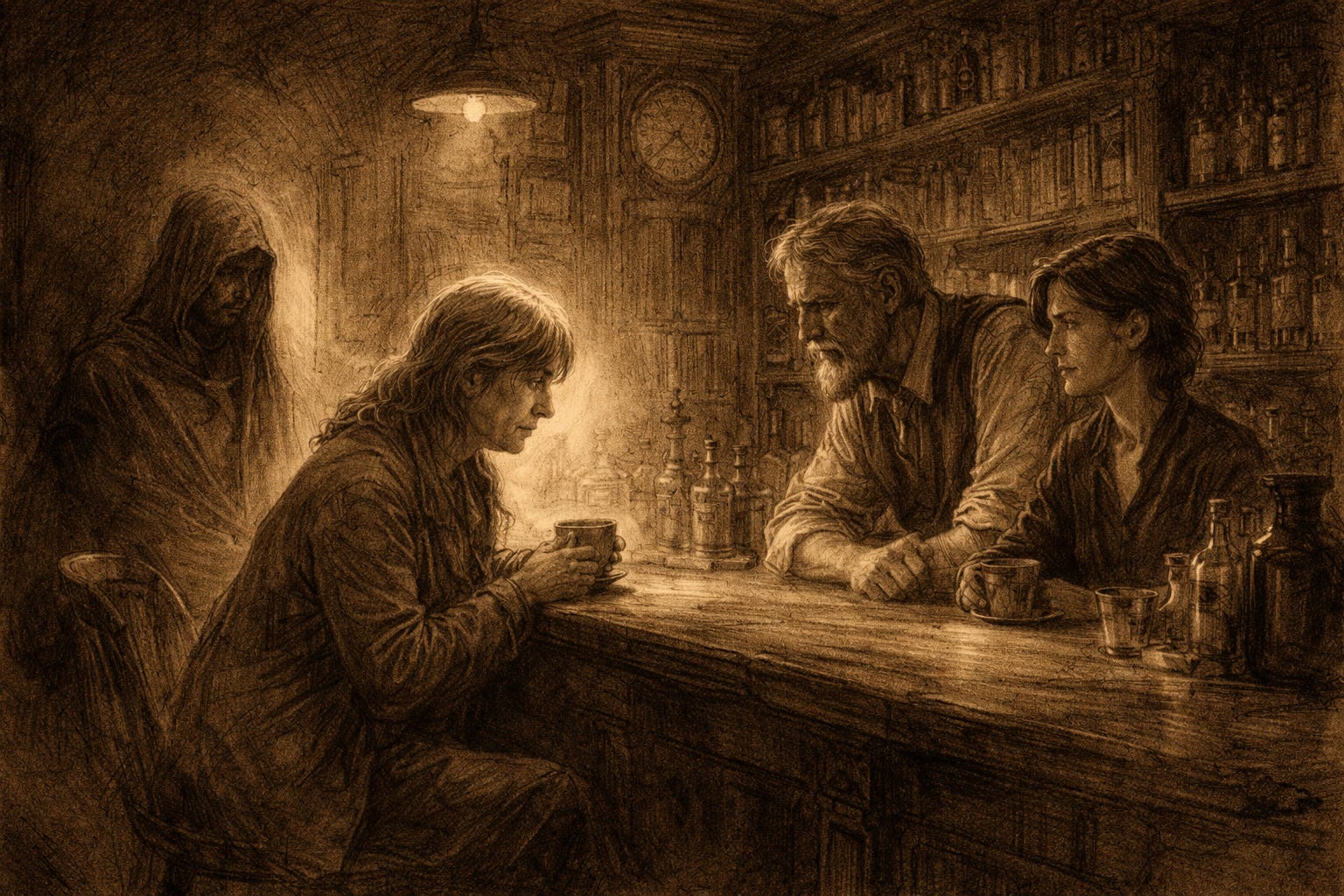
The bell above the door at Le Bon Mot rang with the peculiar insistence of something that refuses to be ignored.
Not loud. Not urgent. Just… certain.
The Librarian looked up from a glass he had been polishing for longer than the glass required. Case, seated at the far end of the bar with a cortado that had gone from hot to contemplative, did not turn. She rarely did on first sound. Le Bon Mot had a way of letting arrivals become themselves before being noticed.
The woman who entered did not yet know who she was in this room.
She paused just inside the doorway, as if the air were different. It often was. The place had a habit of rearranging things—books, clocks, expectations—into configurations that made truth slightly harder to avoid.
She was perhaps in her late fifties. Or early sixties. Or precisely the age of someone who had stopped counting in years and started counting in recoveries.
Her hair, once meticulously controlled, now obeyed only physics and weather. Her coat hung from her frame like a negotiation she had chosen not to finish. There was a carefulness to her movements—not fragility, not quite—but the deliberate pacing of someone who had learned, the expensive way, that bodies are not abstractions.
She carried no laptop. This, in Le Bon Mot, was noteworthy. The Librarian set down the glass.
“Welcome back,” he said.
The woman blinked. “I’ve never been here.”
The Librarian smiled, not unkindly. “Of course.”
Case, still not turning, lifted her cup slightly in the direction of the newcomer. It was the smallest of gestures, but it was an acknowledgement. A recognition of a kind.
The woman approached the bar.
“I’ll have… whatever she’s having,” she said, nodding toward Case.
“A cortado,” said the Librarian. “It tends to find people who need it.”
The woman let out a breath that was almost a laugh. “That sounds about right.”
Her name, it turned out, was Marianne Holt.
She did not offer it immediately. Names, like truths, arrived in Le Bon Mot when they were ready to be held.
She took the cortado in both hands, as if grounding herself through it.
“I used to build things,” she said, to no one in particular.
Case turned, now. Slowly. As if the sentence had weight.
“Used to?” she asked.
Marianne nodded. “Software. Thirty years. Maybe more, if you count the parts that didn’t pay.”
“That’s usually the part that counts,” Case said.
Marianne smiled faintly. “I was good at it.”
Case did not respond. Not out of doubt, but because certain statements require no confirmation.
“I mean,” Marianne continued, “I wasn’t famous. Not one of those people. But I could take a problem apart. See it. Not just the code—the shape behind it. The thing it was trying to be.”
She paused.
“And then… I couldn’t anymore.”
The Djinn appeared in the reflection of the mirror behind the bar before he appeared anywhere else.
He leaned in the corner where the light refused to fully commit, hooded, as though he had always been part of the room’s architecture.
“No one loses that,” he said softly.
Marianne stiffened. “I didn’t say I lost it.”
“You said you couldn’t,” the Djinn replied. “That’s different. That’s usually borrowed language.”
Case watched this with the mild interest of someone who had seen the Djinn be both exactly right and profoundly unhelpful in the same breath.
“Tell it properly,” she said to Marianne. “The way it happened. Not the way it sounds.”
Marianne looked down at her hands.
“They started giving us less time,” she said. “Not all at once. Not a decree. Just… less. Fewer conversations. More tickets. More urgency. Less thinking.”
The Librarian nodded, as if this were a familiar illness.
“I tried to keep up,” Marianne continued. “I thought that’s what you do. You adapt. You get faster. You learn the new tools. The new frameworks. The new… everything.”
“And did you?” Case asked.
“Yes,” Marianne said. Then, after a pause: “No.”
The cortado had gone untouched.
“I learned enough to survive. Not enough to care.”
The Djinn shifted, the movement barely perceptible.
“Care is expensive,” he said. “Most systems can’t afford it.”
Marianne laughed, a sharp, brief sound.
“Tell me about it.”
She leaned back slightly, as if creating distance from her own words.
“I had a partner,” she said. “Years ago. He used to say I was never really there. Even when I was.”
Case did not interrupt.
“I’d be thinking about a system. A bug. Something that didn’t sit right. And I’d be at dinner, or… with him, and I’d just… go.”
She gestured vaguely, as if indicating a departure without movement.
“He left,” she said simply.
The Librarian set another glass down, though no one had asked for one.
“And then there was my daughter.”
The room, which had been merely quiet, became attentive.
“I tried,” Marianne said. “God, I tried. To be present. To be… normal.”
She smiled at the word, as if it had once been a promise and had since become a joke.
“I’d leave work early. Go to school events. Sit there, watching other parents who seemed to understand something I didn’t.”
“What didn’t you understand?” Case asked.
“How to be there without thinking about everything else.”
The Djinn tilted his head.
“You were there,” he said. “Just not in the dimension they were measuring.”
Marianne looked at him, sharply.
“That’s not comforting.”
“It’s not meant to be,” he replied.
She took a sip of the cortado, finally. It had cooled, but not entirely.
“I started drinking,” she said. “At first it was… normal. Social. A way to switch off.”
She let the word hang.
“Then it wasn’t switching off. It was… replacing something. Filling space where thinking used to be.”
The Librarian moved, silently, refilling a glass that still appeared full.
“It’s easy to confuse less with better,” he said.
Marianne opened her eyes.
“Yes,” she said. “It is.”
“And the drugs?” Case asked, gently.
Marianne winced.
“That was stupid,” she said. “Not even dramatic. Just… accidental. Painkillers, after a minor surgery. They worked. Not just on the pain.”
She closed her eyes briefly.
“They made everything… quiet. Not peaceful. Just… less.”
The Librarian’s voice was soft.
“It’s a convincing illusion.”
Marianne nodded.
“Yes.”
Time passed in the way it does in Le Bon Mot: not linearly, but meaningfully. The clock behind the bar insisted it was half past something. It was wrong, but usefully so.
“I stopped building,” Marianne said eventually.
“What did you do instead?” Case asked.
“I maintained,” Marianne replied. “Systems. Codebases. Processes. I became… very good at keeping things from breaking.”
“And how did that feel?” Case asked.
Marianne considered.
“Like watching something die very slowly, and being praised for how well you managed the decline.”
The Djinn made a small, appreciative sound.
“That’s… precise,” he said.
Marianne shrugged.
“I got promoted,” she added. “Of course.”
Case smiled, not pleasantly.
“Of course.”
“And then,” Marianne said, “I got sick.”
The word landed differently. Not heavier, exactly, but with a clarity that stripped away interpretation.
“Cancer,” she said.
No one spoke.
“At first, it was just… terror,” Marianne continued. “Not philosophical. Not meaningful. Just… fear.”
She looked at her hands again.
“And then something strange happened.”
The Djinn leaned forward slightly.
“I stopped caring about the things I had been pretending to care about,” Marianne said. “Deadlines. Promotions. Performance reviews. All of it just… evaporated.”
“And what was left?” Case asked.
Marianne looked up.
“Very little,” she said. “At first.”
She took another sip of the cortado.
“My daughter visited,” she said. “We hadn’t been… close. Not really. Not for a long time.”
The Librarian’s expression softened.
“She sat with me,” Marianne continued. “Didn’t try to fix anything. Didn’t ask me to be different. She just… was there.”
Her voice caught, slightly.
“And I realised I had never really done that for her.”
The silence that followed was not empty.
“I thought I’d wasted it,” Marianne said. “All of it.”
Case shook her head.
“Nothing is wasted. It’s just… unintegrated.”
The Djinn smiled faintly.
“Or waiting to be recomposed.”
Marianne let out a long breath.
“After treatment, I didn’t go back.”
“To work?” Case asked.
“To that work.”
She reached into her coat and pulled out a small, worn notebook.
“I started writing things down. Ideas. Not tickets. Just… things I wondered about.”
She opened it.
“I didn’t know what to do with them.”
The Djinn stepped closer.
“And then?”
“I tried something stupid,” she said.
Case smiled. “Good.”
“I opened one of those AI tools,” Marianne said. “Felt like cheating.”
“Cheating whom?” the Djinn asked.
“Myself.”
“And did you?”
She paused.
“No. I think I’d been cheating myself by not using it.”
“What did you build?” Case asked.
“A small thing. A tool to track how people feel when they’re working. Not output. Not productivity.”
The Librarian smiled.
“Dangerous.”
“That’s why I liked it.”
“And the Djinn?” Case asked.
Marianne looked at him.
“He stayed. He got things wrong. But he stayed. I could correct him. We could talk.”
“A conversation,” Case said.
“Yes.”
Her voice had changed now.
“I started building again. Slowly. Badly. Joyfully.”
“That’s the correct order,” the Djinn said.
“I’d sit for hours. Not because I had to. Because I wanted to see what would happen.”
She laughed.
“I’d forgotten that feeling.”
“And your daughter?” the Librarian asked.
“She came back. Not to fix me. To see what I was making. She asked why.”
The Djinn nodded.
“Good questions are dangerous.”
“The best kind.”
“It’s not a big thing,” Marianne said. “It might not even work.”
Case leaned back.
“Does it change you?”
“Yes.”
“Then it’s already working.”
The bell did not ring when Marianne left. It rarely did for those who had found what they came for.
She paused at the threshold.
“Thank you.”
The Librarian inclined his head. Case raised her cup. The Djinn said nothing.
After she was gone, the room settled.
“She’ll be back,” the Librarian said.
Case nodded.
“They always are.”
The Djinn leaned into shadow.
“Has she found it?”
Case considered.
“No,” she said. “She’s remembered how to look.”
The Librarian smiled.
“Which is the same thing.”
Case shook her head, gently.
“No,” she said. “It’s better.”