
The Art of Being Grounded
What emerges when you stop imposing explanations and start observing the habitat you are already part of

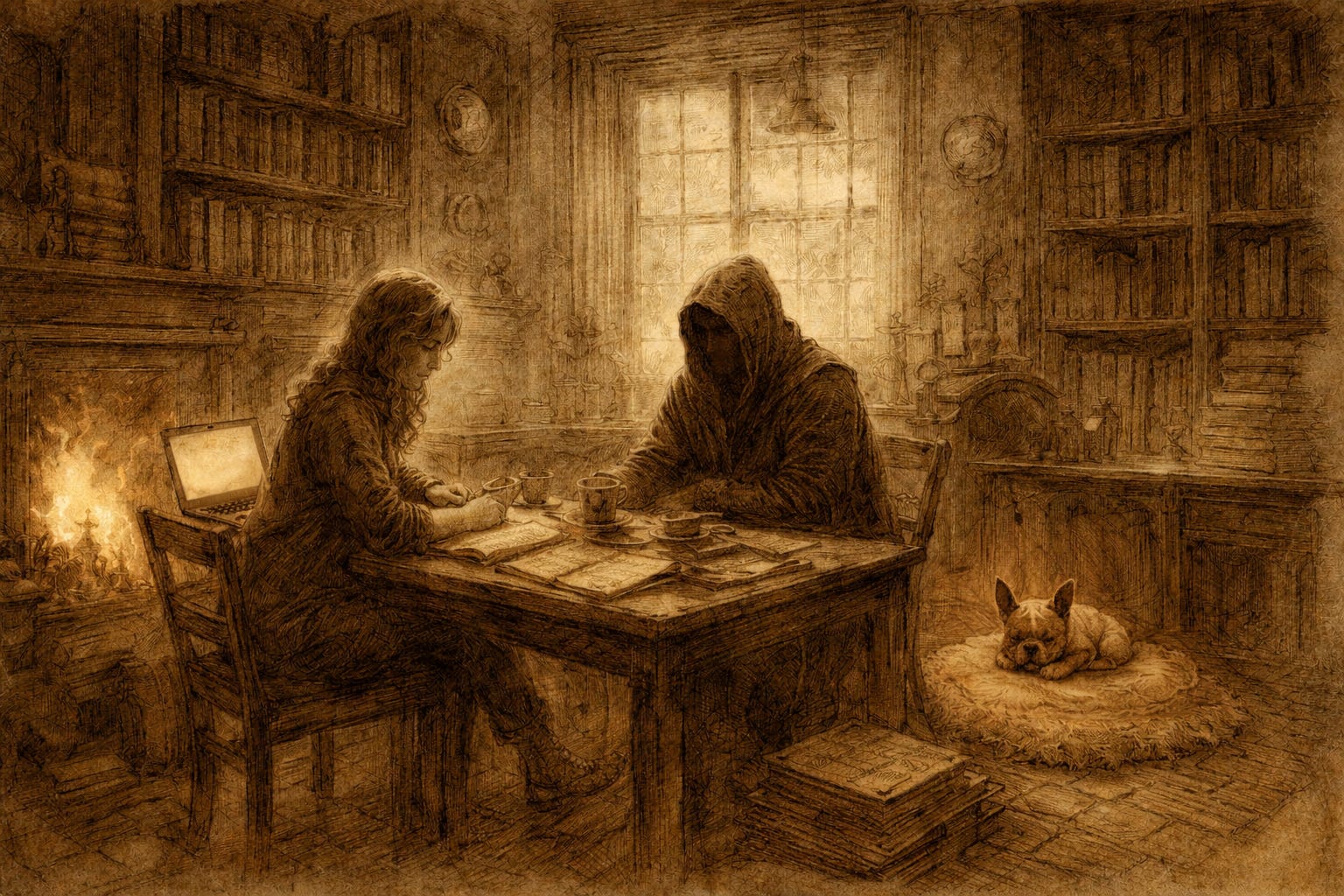
There are cafés that serve coffee, and there are cafés that serve as places where questions learn how to stand up.
Le Bon Mot was, on this particular evening, doing very much the latter.
The rain had settled into that persistent rhythm. Less a storm, more a suggestion that the outside world could wait. Inside, the shelves leaned as they always did, not precariously but curiously, as though the books were listening to each other. The clock above the door disagreed with itself by three minutes. Sophie, the French bulldog, had arranged herself into a small, breathing philosophy on the rug by the fire.
Case sat at the table nearest the window, a laptop open but unattended. This was unusual. Case did not abandon tools lightly. It suggested a problem that tools had failed to improve.
The Djinn occupied the chair opposite her. Hood up, as ever. Presence first, explanation later.
“I have been,” Case began, “watching developers work with you.”
The Djinn inclined his head slightly. This was, for him, both compliment and warning.
“And?” he asked.
“They are not writing code in the way they used to.”
“They are more productive.”
Case smiled, but not in agreement.
“They are doing something else.”
The Librarian placed two coffees on the table without interrupting. Espresso for Case. Something darker, less easily named, for the Djinn.
Case turned the laptop slightly, not to show the screen, but to reorient the conversation.
“I thought I understood what was happening,” she said. “I thought I could explain it. Faster production. Better autocomplete. The factory metaphor, resurrected with better lighting.”
The Djinn said nothing.
“But when I watched them,” she continued, “really watched them, the pattern refused to settle.”
Sophie snored softly, as if to indicate that patterns, like sleep, could not be forced.
“They prompt,” Case said, “and then they pause. Not to rest. To read. Then they edit. Then they test. Then they ask again. Not for more code, but for explanation. Or variation. Or reassurance.”
The Djinn shifted, almost imperceptibly.
“They are not producing,” Case said. “They are interpreting.”
“And this troubles you?”
“It troubles some explanations. And hype, it upsets hype enormously.”
The Librarian, who had been polishing a glass that had no visible need of polishing, spoke without looking up.
“You began with a theory,” she said.
Case nodded.
“And now the theory does not fit the world.”
“Yes.”
“Then you have two options,” the Librarian said. “Force the world to fit the theory. Or change the theory.”
The Djinn smiled, though only the suggestion of it escaped the hood.
“You are describing science,” he said.
“No,” Case replied. “I am describing humility.”
There was a pause.
“I tried to categorise what I was seeing,” Case said. “Productivity. Acceleration. Augmentation. None of them held. They felt… imposed. Like labels applied before the thing had agreed to be labelled.”
“And so?” the Djinn asked.
Case reached into her bag and placed a small, worn book on the table. It had the look of something that had been read not once, but repeatedly, each time differently.
“I found a different way of looking,” she said.
The Librarian glanced at the cover and nodded, as if greeting an old acquaintance.
“Grounded theory,” she said.
The Djinn tilted his head.
“Explain.”
Case leaned back slightly. Not distancing herself, but making space for the idea to breathe.
“It begins,” she said, “without a theory.”
The Djinn laughed softly.
“That seems inefficient.”
“It is,” Case said. “At first. You watch. You listen. You collect fragments. Conversations. Behaviours. Small inconsistencies. You resist the urge to explain them too early.”
“And then?”
“You compare,” Case said. “This instance with that one. This developer with another. This moment with the next. You look for patterns, but you do not force them.”
Sophie shifted in her sleep, as if to underline the point.
“And eventually?” the Djinn prompted.
“Eventually,” Case said, “you begin to name what you see. Not abstractly. Precisely. Struggling to trust generated code. Rewriting to understand. Negotiating with the machine.”
The Djinn was very still now.
“These are not production activities,” he said.
“No,” Case replied. “They are cognitive ones.”
The Librarian set the glass aside.
“You are not discovering a theory,” she said. “You are constructing one.”
Case nodded.
“That is the part I was missing,” she said. “I thought the explanation was in the data, waiting to be found. But it isn’t. It emerges through how we engage with it. Through the questions we ask. The comparisons we make. The meanings we assign.”
The Djinn considered this.
“So your theory of AI collaboration is not… objective?”
Case smiled again. This time, there was warmth in it.
“It is grounded,” she said. “In what people actually do. But it is also constructed. It reflects how I see, what I notice, what I consider important.”
“And if someone else observed the same developers?”
“They might construct a different theory.”
The Djinn leaned forward slightly.
“That sounds dangerously close to subjectivity.”
“It is,” Case said. “But it is disciplined subjectivity. Transparent. Reflexive. Open to revision.”
The rain pressed gently against the windows, as if listening.
“So,” the Djinn said, “what have you constructed?”
Case closed the laptop. Not in dismissal, but in completion.
“That AI does not turn software engineering into a factory,” she said. “It reveals that it never was one.”
The Djinn said nothing.
“It shifts the work,” Case continued. “From writing to reading. From producing to interpreting. From knowing to negotiating meaning with a system that appears to understand but does not.”
Sophie opened one eye, briefly, as if to check the coherence of the statement, then returned to sleep.
“And the developers?” the Djinn asked.
“They are not operators on a conveyor belt,” Case said. “They are participants in a conversation. One that requires judgment, context, and constant recalibration.”
The Librarian smiled, just slightly.
“You have built a theory,” she said.
Case shook her head.
“I have begun one. A theory of habitat.”
The Djinn leaned back, the hood catching the firelight just enough to suggest a face, but not enough to confirm it.
“And what will you do next?”
Case picked up her coffee.
“I will go back,” she said, “and watch again.”
The clock above the door disagreed with itself by three minutes. Outside, the rain continued its quiet argument with the pavement. Inside, a theory — partial, provisional, and grounded — waited patiently to be refined.
Thanks Arty for the inspiration!
/Russ