
The Book that Refused to "Launch"
On sovereignty, amplification, and the discipline of designing the habitat in which intelligence—human and otherwise—must learn to behave

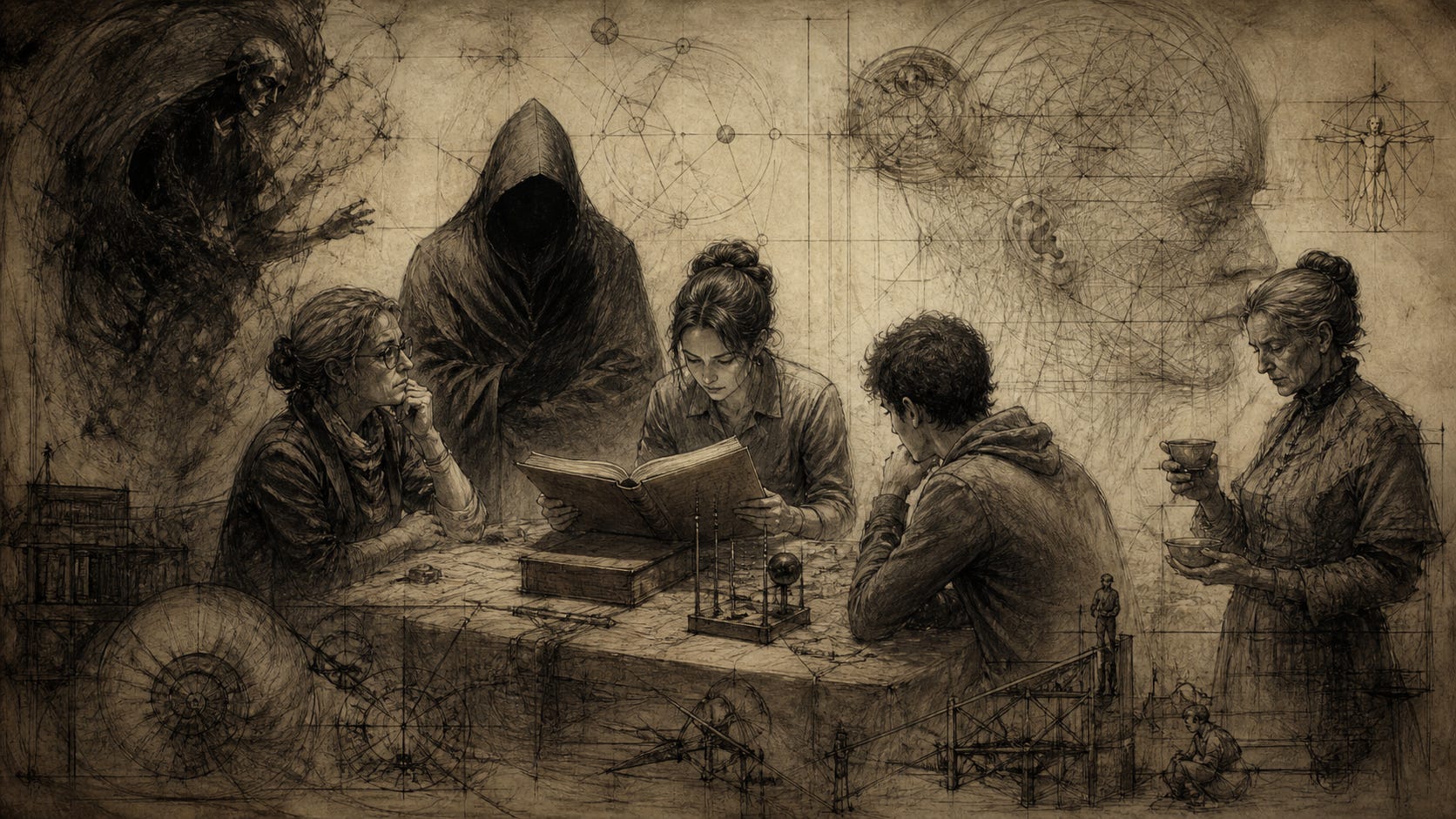
A story to celebrate the publication of the first edition of “The Sovereign Engineering: AI Literacy for Software Professionals”.
“Be careful,” the Djinn said, his voice now softer, less certain.
“This is not a book about using me.”
Case nodded.
“I know.”
“It is a book,” he continued, “about not being used by me.”
Le Bon Mot had seen a great many launches.
Books, mostly. Ideas, occasionally. Entire careers, once or twice, though those tended to arrive quietly and leave noisily. But it was not, as a rule, a place for announcements. Announcements implied certainty, and certainty had always been treated here as a substance best handled with tongs.
So when the crate appeared on the central table — properly addressed, neatly bound, and bearing a title stamped into its lid with unusual confidence — it drew attention.
THE SOVEREIGN ENGINEER
Case was the first to touch it. Not open it, that would have been premature, but to rest her hand on the wood as one does with a machine that may yet be running too hot.
“Ambitious,” she said.
The Librarian, who had been cataloguing a set of pamphlets that disagreed with each other in increasingly sophisticated ways, looked over the rim of her glasses.
“Not necessarily,” she replied. “It depends on whether the sovereignty is claimed… or constructed.”
Dave did not look up from his laptop.
“It’s a book on AI,” he said. “It’ll be about prompts.”
There was a pause. Not a dramatic one. The sort of pause that arrives when something incorrect has been said plainly enough that it does not require immediate correction, relying on eventual consistency to override the error.
The Djinn was already there, of course. Leaning against the far wall, hood drawn low, the interior of the cowl darker than the room itself. Two faint points of light suggested eyes, though it was never entirely clear whether they were observing or simply reflecting.
“You would prefer it to be about prompts,” the Djinn said.
Dave shrugged.
“That’s what people want. Something that works. Something simple.”
“Ah,” said the Djinn, softly. “An AI Spell Book for Dummies?”
Case opened the crate. Inside, the contents were arranged with the neatness of something that had been thought through too many times to be accidental. Not just pages, but sections. Not just sections, but acts. Interludes. Appendices. A structure that suggested not information, but progression.
She lifted the top manuscript.
“Six levels,” she said, scanning. “Aware to Sovereign.”
“Levels,” Dave muttered. “Of course there are levels.”
“There are always levels,” said the Librarian. “The question is whether they describe reality… or merely comfort.”
Case continued.
“Three disciplines. Context engineering. Architectural constraints. Guardrail design.”
At this, the Librarian smiled.
“Ah,” she said. “Now that is more interesting.”
Dave finally looked up.
“It’s still just… telling the AI what to do, right?”
“No,” said Case.
She did not look at him when she said it. She was turning pages now, faster, her attention caught in that way it is when recognition begins to outpace comprehension.
“It’s about where the AI gets to operate.”
The Djinn inclined his head.
Madame Beauregard arrived with coffee for no one in particular and placed the cups around the table with the authority of someone who understood that conversations required caffeinated infrastructure.
“What is being launched?” she asked.
“A book,” said Dave.
“A framework,” said Case.
“A wager,” said the Librarian.
Madame Beauregard considered this.
“And who,” she asked, “is it for?”
Case did not answer immediately.
She had reached a section — marked, she noticed, as an interlude — and was reading more slowly now.
“The ones who are… struggling,” she said eventually. “The ones who thought AI would make things easier.”
Dave snorted.
“It does make things easier.”
“Yes,” said Case. “And that’s the problem.”
The Djinn moved then — not toward the table, but closer to the fire.
“Tell me,” he said, “what happens when you are given an amplifier?”
Dave frowned.
“You get louder.”
“Indeed. And if what you are amplifying is unclear? Or inconsistent? Or poorly formed?”
Dave hesitated.
“You get… noise.”
The Djinn’s eyes brightened, just slightly.
“Or worse,” he said. “You get something that sounds like signal.”
Case had reached Act II.
“Testing as thinking,” she read aloud. “The living harness. Architecture as guardrails.”
She looked up.
“This isn’t about controlling the AI,” she said. “It’s about shaping the space so direct control becomes less necessary.”
The Librarian nodded.
“Constraint as affordance,” she said. “An old idea. Rarely applied with discipline.”
Dave leaned back.
“So instead of writing better prompts, you… build a better system around the prompts?”
Case shook her head.
“Not around the prompts,” she said. “Around the work.”
There was a small sound from the philosophy shelf.
Sophie, who had been asleep in the shape of a question mark, lifted her head, regarded the room with mild suspicion, and resettled herself into a tighter curl. As if the conversation had confirmed something she had already suspected.
“Here,” said Case, flipping to the appendices. “A tool matrix. Cost discipline. An assessment instrument.”
Dave groaned.
“Of course there’s an assessment.”
The Librarian took the page gently from Case’s hands.
“Of course there is,” she said. “Without assessment, there is only feeling. And feeling, while important, is not evidence.”
She scanned the instrument briefly.
“Levels of literacy,” she murmured. “Observable behaviours. Translation between reference frames.”
She looked up.
“This,” she said, “is not just for beginners.”
“No,” said Case. “It’s for people who think they’ve already begun.”
The Djinn stepped closer to the table.
“May I?” he asked.
No one answered, which in Le Bon Mot constituted permission.
He placed a hand, or something approximating one, on the open manuscript.
“You have misunderstood something fundamental,” he said.
Dave raised an eyebrow.
“Go on.”
“You believe that your difficulty lies in speaking to me.”
He tapped the page lightly.
“It does not.”
He looked at each of them in turn.
“Your difficulty lies in speaking to yourselves.”
Silence, then. A more substantial one.
Case broke it.
“Reference frames,” she said. “Human and AI.”
The Librarian nodded.
“And the failure,” she added, “is not communication, but translation.”
Dave looked between them.
“So the book is saying… what? That we need to be clearer?”
“No,” said Case. “That we need to be structured.”
“No,” said the Librarian. “That we need to be aware of our differences.”
The Djinn said nothing.
Madame Beauregard returned, this time with a single additional object: a small brass plate, which she placed beside the crate.
On it, in neat script, she had written:
Launches are not declarations. They are invitations to be proven wrong.
Dave read it and frowned.
“That’s not very… celebratory.”
“It is,” said the Librarian, “if you understand what is being celebrated.”
Case had reached the final chapter.
“The Sovereign Engineer,” she read.
She closed the manuscript slowly.
“It’s not about independence,” she said.
“No,” said the Djinn.
“It’s about responsibility,” said the Librarian.
Dave rubbed his face.
“So what does sovereignty even mean here?”
The Djinn’s eyes dimmed, then brightened again as if considering how much to reveal.
“It means,” he said, “that you do not confuse my fluency with your understanding.”
He stepped back into the shadow of his hood.
“It means that you design the world in which I operate… and accept the consequences of that design.”
“It mesns,” said Case quietly, “that we build a habitat for us both to thrive, and for the humans to maintain their agency.”
Outside, the light had shifted. Not dramatically, but enough to suggest that the day was continuing whether or not the conversation reached a conclusion.
Inside, the crate remained open. Not emptied. Not resolved. But available.
Case picked up her coffee.
“So,” she said, “do we launch it?”
The Librarian considered.
“No,” she said.
Dave blinked.
“No?”
“No,” she repeated. “We read it. We test it. We attempt to falsify it in practice.”
She gestured to the crate.
“If it survives that, it will have launched itself.”
The Djinn had already begun to fade. Not disappearing, exactly, but becoming less central to the geometry of the room.
“Be careful,” he said, his voice now softer, less certain.
“This is not a book about using me.”
Case nodded.
“I know.”
“It is a book,” he continued, “about not being used by me.”
Sophie snored, softly. Madame Beauregard cleared the empty cups.
The Librarian returned to her pamphlets, though now with a slightly different expression. As if they had become marginally less authoritative.
Dave reopened his laptop, but did not type.
And Case, after a moment’s hesitation, turned back to the first page and began again — this time not reading for agreement, but for resistance.
Because in Le Bon Mot, that was how things were launched.
The Sovereign Engineer is now published! If you’ve paid for a subscription, you can expect a link to grab a free copy in your inbox soon as a huge thank you for all your support!

After more than two years of writing, the first edition is complete. This is the book I wish I had been able to hand to every engineer I have watched panic, capitulate, or check out in the face of AI-assisted development.
It is a professional development framework, not a prompting manual. It moves the reader through six levels of literacy — from Aware to Sovereign Engineer — and three core disciplines: context engineering, architectural constraints, and guardrail design. The thesis is simple and, I think, important: the quality of your AI-assisted work depends almost entirely on the quality of the collaboration space you design. Not on the model. Not on the temperature setting. On your habitat.
What’s in the first edition:
Act I — nine chapters of thesis: why AI is an amplifier, the cognitive asymmetry between human and artificial intelligence, the six levels, the three disciplines, reference frames, intent, and the slop detector.
Act II — eight chapters of practice: testing as thinking, the living harness, architecture as guardrails, parallel workflows, the communication bottleneck, design-first collaboration, the cognitive substrate, and the sovereign engineer.
Interludes and field notes — shorter, vivid pieces (the Tango, the Djinn, the Twentieth Watt, the Governance of Meaning) that sit between the dense chapters.
Appendices — a tool matrix, cost discipline, the ALCI literacy assessment instrument, and a quick reference for the ai-literacy-superpowers plugin.
I truly hope you enjoy and get as much out of the book as I did when writing it!