
The Café Where Intelligence Was Served Incorrectly
A Story of Sailors, Libraries, Dave and the Subtle Art of Not Letting the Machine Take the Wheel

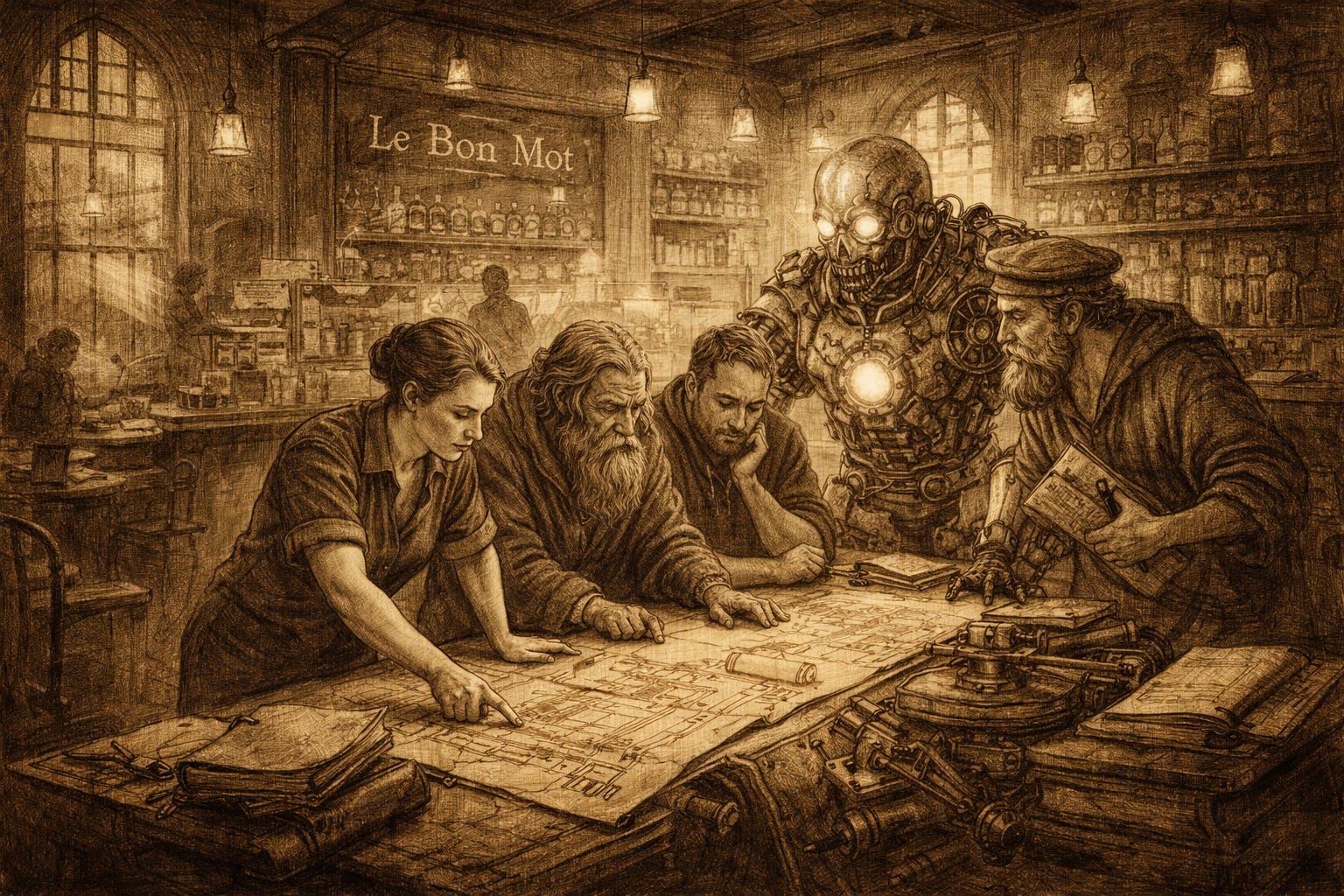
There are cafés where one goes to drink coffee. There are cafés where one goes to think. And then there is Le Bon Mot, where thinking itself is occasionally placed on the menu, poorly labelled, and served at a temperature that suggests it has been waiting for you longer than you have been alive.
On the morning in question, the blackboard outside read:
Today’s Special: Intelligence, two ways. Served together or separately. No substitutions.
Case paused before entering.
Inside, the air held its usual contradiction: part library, part workshop, part cafe, and part something that had not yet been named because naming it would have required agreement, and agreement was rarely achieved before the third espresso.
At the far table sat the usual cast. The Librarian, who catalogued ideas no one remembered writing. The Sailor, who insisted that all thinking was navigation. And Dave, who had recently taken to referring to the espresso machine as “a stochastic pressure system.”
Case joined them.
“I see,” she said, glancing at the board, “we’re serving intelligence now.”
The Librarian did not look up.
“We always have,” he said. “We’ve simply been dishonest about the ingredients.”
The Panic
The trouble began, as it often does, with a question asked too early. Dave leaned forward.
“So,” he said, “are we all about to be replaced?”
There was a silence. Not the comfortable kind. The other kind. The kind that suggests the room is attempting to decide whether the question is foolish, dangerous, or simply badly phrased.
The Sailor spoke first.
“Replaced by what?”
“The machines,” Dave said. “The models. The agents. The—” he gestured vaguely—“everything.”
The Librarian finally looked up.
“Ah,” she said. “You have encountered the panic.”
“The panic?”
“Yes. It arrives with every new way of knowing.”
She reached behind him and pulled down a book. Then another. Then another. The titles were inconvenient.
The Printing Press Will Ruin Memory
Photography Will Destroy Art
Calculators Will End Mathematics
Synthesisers Will Kill Music
Dave frowned.
“These are all… wrong.”
“Not wrong,” said the Librarian. “Incomplete. They are correct descriptions of fear, not of reality.”
Case leaned back.
“And what do they all have in common?”
The Librarian smiled.
“They mistake amplification for replacement.”
The Amplifier
The Sailor took a slow sip of coffee.
“Imagine,” he said, “you are steering a ship.”
“I often am,” Dave muttered.
“You have poor maps, unclear destination, and a tendency to panic when the wind changes.”
“Hypothetically.”
“Now I give you a faster ship.”
Dave considered this.
“I crash faster.”
“Exactly.”
The Librarian nodded.
“The machine does not replace your judgment. It amplifies it. If your practice is sound, it accelerates excellence. If your practice is weak, it industrialises confusion.”
Case tapped the table.
“This is the mistake everyone is making. They’re asking: What can the AI do?”
“And the better question?” Dave asked.
“What does it amplify?”
There was a pause. Dave frowned.
“That’s… uncomfortable.”
“Yes,” said the Librarian. “Reality often is.”
Two Kinds of Intelligence
At this point, the barista—who had been listening with the particular attention of someone who understands far more than they let on—placed two cups on the table.
“They’re different,” he said.
“How?” Dave asked.
He pointed to Case.
“She understands the codebase because she has lived in it.”
He pointed to the espresso machine.
“That understands the instructions because it has seen patterns like it before.”
Dave blinked.
“That’s… not the same.”
“No,” said the Librarian. “It is not.”
She leaned forward.
“Human intelligence is embodied. It feels friction. It remembers failure. It carries history.”
“And the machine?” Dave asked.
“It processes symbols. It predicts patterns. It simulates discourse about reality without ever touching it.”
The Sailor nodded.
“You are a navigator. It is a library.”
“And the collaboration?” Case asked.
The Librarian smiled.
“The navigator consults the library… but keeps both hands on the wheel.”
The First Room: The Aware
Le Bon Mot, it must be said, is larger on the inside than it has any right to be. All the best fictional devices are.
Behind the bar, a narrow staircase descended. Case had seen it before, though she had never taken it. It had always felt like a metaphor waiting to become inconveniently literal.
Today, it was open. A small sign read:
Level 0 — The Aware
Dave stood.
“This feels like a bad idea.”
“Most learning does,” said Case.
They descended.
The room they entered was filled with noise. Newspapers shouted contradictions. Books argued with themselves. Screens displayed graphs that rose and fell with suspicious enthusiasm. Dave covered his ears.
“How is anyone supposed to make sense of this?”
“You aren’t,” said the Librarian. “Not yet.”
“What do I do then?”
“You learn to see patterns.”
Case picked up a headline.
“‘AI Will Replace All Developers.’”
She placed it beside another.
“‘AI Is Just Fancy Autocomplete.’”
Dave laughed.
“They can’t both be true.”
“They can both be wrong,” said the Librarian.
She handed Dave a card. On it were five words:
Aesthetic
Accuracy
Economic
Moral
Intellectual
“These,” he said, “are the recurring complaints. Every panic reduces to them.”
Dave looked around again. The noise had not changed. But something else had.
“I can… classify them.”
“Yes,” said Case. “And once you can classify them, they stop controlling you.”
Dave nodded slowly.
“So this level isn’t about using AI.”
“No,” said the Librarian.
“It’s about beginning to understand what it is—and what it is not.”
The Second Room: The Prompter
They descended again. The next room was quieter. In the centre stood a peculiar contraption: part typewriter, part mirror. Above it hung a sign:
Level 1 — The Prompter
Dave approached it.
“What does it do?”
“Tell it what you want,” said Case.
Dave hesitated.
“Write a function that sorts transactions.”
The machine whirred. Paper emerged. The code was… plausible.
Dave smiled.
“That was easy.”
Case raised an eyebrow.
“Is it correct?”
Dave frowned.
“I… don’t know.”
“Then try again,” she said.
Dave refined the prompt. Then again. And again. The outputs improved. Slowly. Painfully.
“This is frustrating,” he said.
“Yes,” said the Librarian. “Because you are translating between worlds.”
Dave gestured at the machine.
“It doesn’t understand what I mean.”
“No,” said Case. “It understands what you say.”
There was a long silence.
“Oh,” Dave said.
The Bridge
Case took a piece of paper.
“Why is the first version wrong?”
“It… doesn’t handle edge cases.”
“Which ones?”
Dave hesitated.
“The ones that… feel risky.”
“Good,” said Case. “Now write that down.”
Dave tried. It was awkward. Clumsy. Imprecise. But gradually, the feeling became language. The language became constraints. The constraints shaped the output.
The Librarian nodded.
“This is the first discipline.”
“Context engineering,” Case said.
“Making the invisible visible. The implicit, explicit as the DDD crowd would love.”
Dave leaned back.
“This is harder than coding.”
“Yes,” said the Sailor.
“That is why so many avoid it.”
The Third Room: The Verifier
Down the stairwell again, the next room smelled faintly of burnt tests. A long table stretched across the space, covered in code. Above it:
Level 2 — The Verifier
Dave picked up a snippet.
“It compiles.”
Case nodded.
“Run it.”
He did. It passed.
“Looks good,” he said.
“Does it?” asked the Librarian.
Dave frowned. He looked closer. Then closer still.
“…oh.”
The code was wrong. Subtly. Dangerously.
“I would have missed that.”
“Yes,” said Case. “Most people do.”
Dave sat down.
“So I just need to check more carefully?”
“Not just carefully,” said the Librarian. “Systematically.”
Case handed him a test.
“Write this first.”
Dave obeyed. Then generated the code. The test failed. Dave smiled.
“That’s… satisfying.”
“Yes,” said the Sailor. “Because you have moved from hope to evidence.”
The Metacognitive Trap
Dave leaned back.
“I think I’m getting good at this.”
Case looked at him.
“How confident are you?”
“Very.”
She handed him another piece of code.
He reviewed it.
“Looks fine.”
She ran it.
It failed.
Dave blinked.
“I was sure.”
“Yes,” said the Librarian. “That is the problem.”
“The problem?”
“AI makes you more capable,” she said. “And less aware of your limitations.”
Dave stared at the code.
“So I need to doubt myself more?”
“No,” said Case.
“You need to calibrate yourself.”
The Fourth Room: The Habitat
The next room was… different. It felt less like a room and more like a system. Documents hung in the air. Pipelines flowed through the walls. Agents moved quietly, performing tasks with eerie consistency. Above it:
Level 3 — The Habitat Engineer
Dave looked around.
“This is… organised.”
“Yes,” said the Librarian.
“Finally.”
Case pointed to a document.
“AGENTS.md.”
“What’s in it?”
“A strongly limited description of what the machine needs to know that you cannot assume.”
Dave opened it. Architecture. Constraints. Conventions. Pitfalls.
“This is… the developer’s memory.”
“Yes,” said the Librarian.
“For an intelligence that has none.”
The Shift
An agent approached. It began to generate code. It followed the rules. It respected the architecture. It passed the tests.
Dave blinked.
“This is… better.”
Case nodded.
“Because the environment is better.”
Dave turned.
“So the problem wasn’t the AI.”
“No,” said the Sailor.
“It was the sea you asked it to sail.”
The Meta-Loop
A failure occurred. The agent produced something incorrect. Dave frowned.
“There it is again.”
Case shook her head.
“What’s missing?”
Dave paused. He checked the document. He updated it.
The agent tried again. This time, it worked.
Dave smiled slowly.
“Oh.”
“Yes,” said the Librarian.
“Every failure is a design flaw in the habitat.”
The Fifth Room: The Specification
The next room was almost empty. At its centre was a single sheet of paper. Above it:
Level 4 — The Specification Architect
Dave approached the paper.
“This is it?”
Case nodded.
“Write what you want.”
Dave hesitated. He began. Not code. Intent. Examples. Constraints.
He handed it to the agent. The agent generated code. It worked.
Another agent tried. Same result.
Dave stared.
“This is… different.”
“Yes,” said the Librarian.
“You are no longer describing how.”
“You are describing what.”
The Bottleneck
Dave sat down.
“This is harder than everything else.”
“Yes,” said Case.
“Because you are finally doing the real work.”
Dave looked at the paper.
“Code wasn’t the point.”
The Librarian smiled.
“It never was.”
The Sixth Room: The Sovereign
The final room was vast. Too vast. It had to stretch beyond the café. Beyond the city. Beyond the visible. Above it:
Level 5 — The Sovereign Engineer
Agents moved in coordinated patterns. Systems interacted. Decisions propagated and were audited.
Dave felt… small.
“This is too much.”
“Yes,” said the Sailor.
“That is why you must design it.”
The Risk
The Librarian spoke quietly.
“There is a danger here.”
“What kind?” Dave asked.
“A subtle one.”
She gestured at the agents.
“They can do everything.”
Dave nodded.
“That’s the point.”
“And if they do everything,” said the Librarian, “what do you stop doing?”
Dave froze.
“…learning.”
“Yes.”
Case stepped forward.
“This is the final discipline.”
“Preserve the human.”
The Return
They climbed the stairs. Back to Le Bon Mot. Back to the coffee. Back to the quiet hum of conversation. Dave sat down.
“That was… a lot.”
“Yes,” said Case.
“But it is only one thing really”
“One thing?”
“A collaboration space.”
Dave nodded slowly.
“The context. The architecture. The guardrails. The feedback.”
The Librarian smiled.
“You see it now.”
The Single Insight
Dave stared at his coffee.
“So the whole thing…”
“Yes?” said the Librarian.
“…depends on how we design the space between us and the machine.”
There was a pause.
Then the Sailor laughed.
“Not between you and the machine.”
Dave frowned.
“Then where?”
The Sailor tapped the table.
“Between two intelligences that were never meant to understand each other.”
The Maxim
The blackboard outside Le Bon Mot was updated that evening.
It read:
When the machine can write the code,
literacy is no longer the ability to write it.
It is the ability to understand what is being written in your name,
and to shape the space in which it is written.
And, in smaller text beneath:
The sailor still holds the wheel.
Inspired by my AI Software Engineering Literacy talks and workshops.