
The Cartographer of Platforms
A Short Story on the Beauty of Habitable Platforms

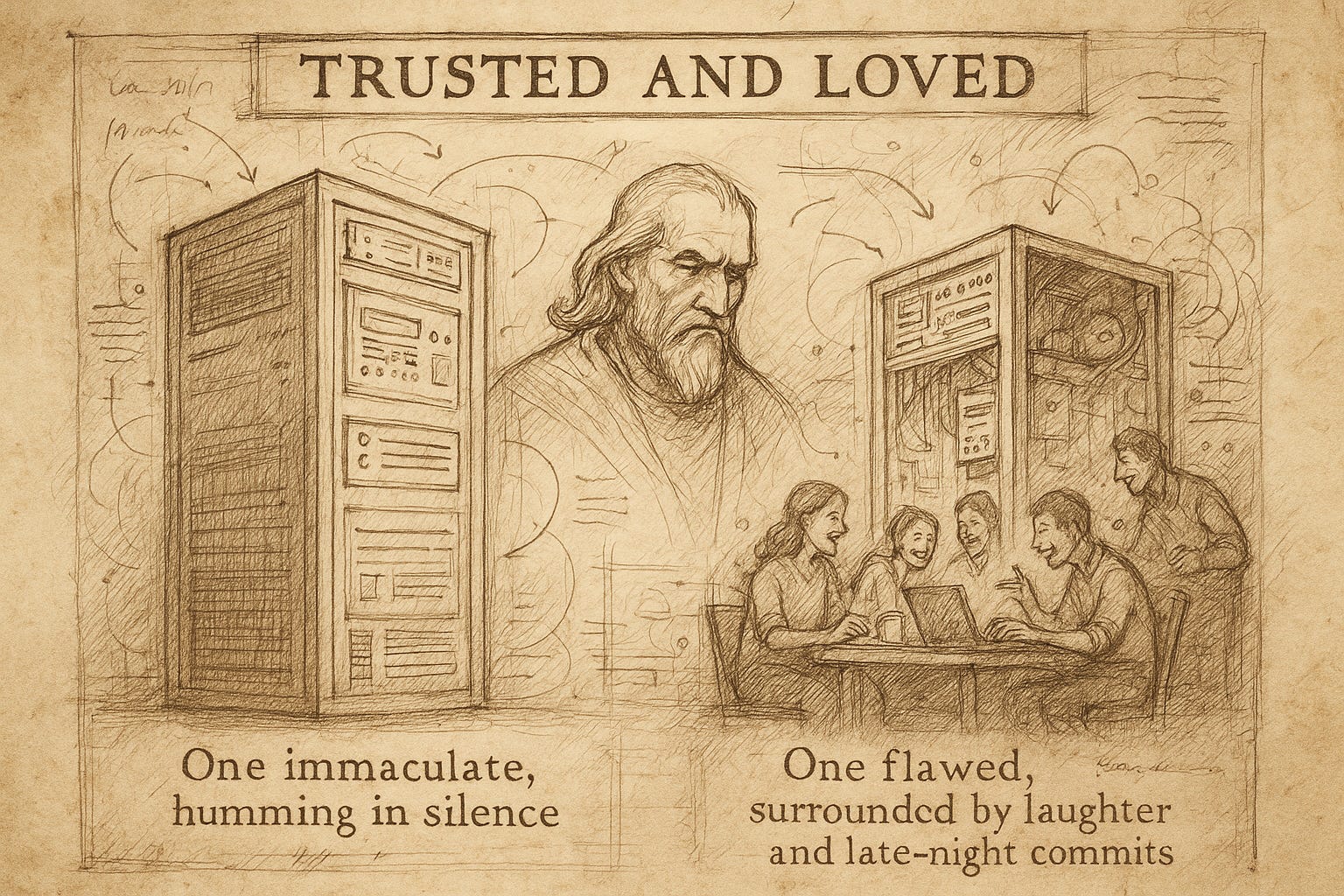
Another Sunday morning short story.
In a bank whose name no one remembers, a team of engineers built a system that could not fail. Every control was automated, every policy written in code, every log immortalised in cold storage. They called it The Platform, and they verified it with the devotion of monks copying scripture.
Each component was tested, traced, and proven. Each audit passed without question. Each regulator smiled.
It was, by every measurable standard, perfect.
Yet something strange occurred.
The developers for whom this great machine was made stopped using it. They whispered of its beauty but avoided its corridors. They spoke of it like one speaks of a cathedral too sacred to enter.
A younger engineer, curious and reckless, began to investigate. She found that the Platform’s blueprints were flawless, but sterile. Every path was paved, yet no path led anywhere new.
“Why do they not use it?” she asked the Architect.
“Because they misunderstand it,” he replied.
“Our task is to verify, not to please.”
The young engineer disagreed.
At night, she built a shadow copy of the Platform—not in the grand datacentre, but on her own terminal. In it, she allowed mistakes. She let logs fill with noise. She made the documentation speak plainly, like one human to another.
She invited the developers to try it, and they did.
Soon, her version—the imperfect one—was everywhere. It failed more often, yet people fixed it. It bent rules, yet it worked.
It was, somehow, alive.
The Auditors arrived, as they always did. They saw two Platforms: One immaculate, humming in silence; one flawed, surrounded by laughter and a cluster of commits.
They could not tell which was more compliant, because both were.
The Architect, seeing this, was furious.
“You have undone our verification!” he cried.
“No,” she said. “I have found its reflection.”
He looked again at her creation and saw something unsettling: every check, every policy, every control was still there—but now they meant something. The system that was once a mirror of the law had become a mirror of its people.
And for the first time, the Architect understood: To verify a platform is to prove the map exists; to validate a platform is to see if anyone can live within it.
Years later, both Platforms were archived under a single name:
“Trusted and Loved.”
No one could tell which was which anymore.
Perhaps they had become one.
Epilogue
In an appendix found after his retirement, the Architect wrote:
“Verified perfection is the desert where nothing grows. Validation is the forest, untidy and alive. Between them lies the only real platform: the one that is both verified and human.”
This story is inspired by this entry in the enchiridion:
