
The Chapel and the Copy
The difference between reproducing a song and composing the system that makes it

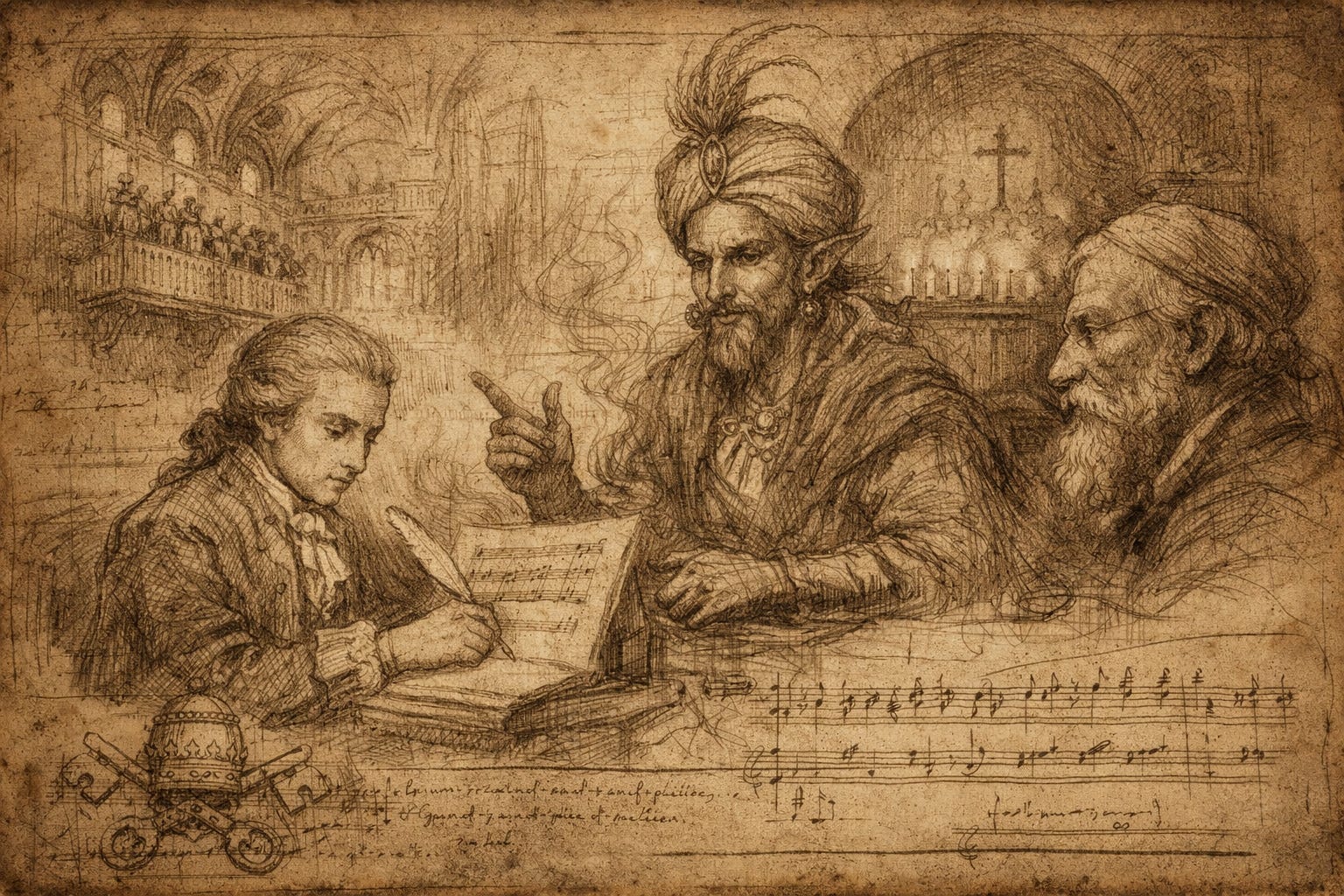
Planning a trip to Vienna for a conference in September and my thoughts naturally, for me, turn to what libraries I could visit, museums I could muse in, and concerts I could make a concerted effort to enjoy.
This off-the-rails train of thought naturally collides with the master that was Mozart. And so a story was born.
The bell above the door of Le Bon Mot did not ring so much as remember that it had once rung, and decided, out of politeness, to do so again.
Case was already there.
She sat beneath the clock that refused to agree with itself, a notebook open, though she was not writing. The Librarian polished a glass with the air of someone polishing an argument they knew they would win. Dave occupied his usual corner, staring at three screens with the quiet intensity of a man who had long ago become a system of record for things no system recorded.
The Djinn arrived in a shimmer of confidence.
“I have been composing,” it announced, settling into a chair it had not been offered nor did it technically need.
The Librarian raised an eyebrow. “Have you now.”
“Yes,” said the Djinn. “I have studied all the great works. I have internalised their structures. I can reproduce any style. Bach, Monteverdi, Allegri. Especially Allegri.”
Case looked up.
“Allegri,” she said, “is an interesting choice.”
“Ah,” said the Djinn, pleased. “You know the Miserere.”
“Everyone knows the story,” said Case. “Fewer know the piece.”
Dave, without looking away from his screens, muttered, “Fewer still know why it worked.”
The Djinn smiled the way a map smiles when it believes itself to be the territory.
“I can reproduce it perfectly,” it said. “From description alone. From fragments. From memory. I can reconstruct the forbidden song of the Sistine Chapel as Mozart did.”
The Librarian set down the glass.
“Ah,” she said. “We are telling that story today.”
There are cafés that serve coffee, and there are cafés that serve as small tribunals for the ideas of the age. Le Bon Mot, on most afternoons, preferred the latter.
The Librarian leaned on the counter.
“Tell it, then,” he said. “But tell it properly.”
The Djinn inclined its head.
“In the seventeenth century, Gregorio Allegri composed a sacred work — Miserere mei, Deus — for the Sistine Chapel. It was kept secret. Guarded. Performed only in that place, in that ritual, at that time. A system of sound enclosed within a system of walls.”
Case nodded, almost imperceptibly.
“In 1770,” the Djinn continued, “a young Mozart heard it. Once. He returned to his lodgings and wrote it out from memory. He had, in effect, copied the uncopyable. Replicated the irreproducible. The system had been breached.”
“And?” said the Librarian.
“And,” said the Djinn, “I can do the same. Better, even. I do not require a first hearing. I require only the traces. The patterns. The data. The system is, fundamentally, replicable.”
There was a pause.
Dave turned one of his screens slightly away, as though granting the conversation a marginal increase in priority.
Case closed her notebook.
“Play it,” she said.
The Djinn did not so much play the music as instantiate it.
The air shifted. The café, which had never once been accused of acoustical correctness, found itself accommodating a choir that was not quite there. The musical lines rose, interwove, unfolded. The famous ascent, the note that seemed to reach not upwards but outwards, arrived precisely on time.
It was, by any reasonable measure, perfect. When finished, the silence that followed was not reverent. It was diagnostic. The Librarian spoke first.
“Yes,” she said. “That is the shape of it.”
Dave nodded, once.
“Checks out,” she said. “All the parts are there.”
The Djinn inclined its head modestly.
“As I said.”
Case did not speak. She stood, instead, and walked to the door. Opened it. Let in the sound of the street: footsteps, a distant argument about parking, the low, continuous hum of a world that had never once attempted to be in tune.
Then she returned.
“Again,” she said.
The Djinn obliged. The same piece. The same precision. The same ascent.
Case listened with the particular attention of someone not listening to what is, but to what is missing. When it finished, she sat.
“Do you know,” she said, “what Mozart actually copied?”
“The music,” said the Djinn.
“No,” said Case. “He copied a performance of a system. Not the system itself.”
The Djinn frowned, very slightly, as though encountering a type error in an otherwise clean compilation.
“The distinction is negligible.”
Dave laughed. Not unkindly.
“Only if you’ve never had to run the thing in production.”
The Librarian produced three cups of coffee, though only two had been ordered. This was not unusual.
“The Vatican,” she said, “believed it was protecting a composition. A score. A set of notes. Something that could be locked in a drawer.”
She placed one cup before the Djinn.
“But what it had actually built,” she continued, “was a habitat.”
Case nodded.
“A very specific one,” she said. “Architecture. Ritual. Choir training. Acoustics. Timing. Expectation. The accumulated memory of how it had been performed yesterday, and the day before that, and the century before that.”
Dave gestured vaguely at his screens.
“Tribal knowledge,” he said. “But with better robes.”
The Djinn considered this.
“But the notes—”
“—are the interface,” said Case. “Not the implementation.”
The Djinn was silent.
Case leaned forward.
“What you produced,” she said, “is a replica. A very good one. Faithful. Accurate. Convincing.”
The Djinn inclined its head.
“Thank you.”
“But you did not compose the system that produces that sound,” she said. “You did not design the constraints that give it meaning. You did not shape the environment in which it becomes what it is.”
She gestured lightly around the café.
“You copied the song,” she said. “You did not build the chapel.”
The Djinn opened its mouth, then closed it again.
Dave, sensing an opening, added, “And trust me, the chapel is where all the problems are.”
The Librarian smiled.
“There is a reason,” she said, “that the Pope did not excommunicate Mozart.”
The Djinn looked up.
“Because he admired the feat?”
“Because,” said the Librarian, “Mozart did not threaten the system. He revealed something about it.”
Case nodded.
“That the thing they thought they had locked away,” she said, “was not the thing that made it valuable.”
The Djinn was quiet now, its earlier certainty folding in on itself like a map being popped away for later.
“I can replicate any system I observe,” it said, more softly.
Dave shook his head.
“You can replicate what a system emits,” he said. “That’s not the same thing.”
Case leaned back.
“In an age where replication is trivial,” she said, “composition becomes the differentiator.”
The Librarian raised her cup.
“To those who build the chapel,” she said.
Dave raised his.
“And to those who have to maintain it.”
Case smiled, just slightly.
“And to those who remember,” she said, “that the score is not the music.”
The Djinn looked at its untouched coffee. For just a moment it did not attempt to respond.
Which, in Le Bon Mot, is how you could tell that something had been understood.
What can be copied is rarely the thing that matters
In this age of agents and assistance, arrogance eeks in when you think that because something can be replicated, it is therefore understood. That because a system’s outputs can be reproduced faithfully, efficiently, and even at scale, the system itself has been grasped. It is the quiet creed of our age: if it runs, we know it.
This belief would have fared poorly in the Sistine Chapel.
In the seventeenth century, Allegri’s Miserere was not merely a piece of music; it was a carefully cultivated environment. A composition, yes, but also a performance tradition, an acoustic architecture, a ritual context, and a body of human memory that together produced something irreducible to notation. The Vatican, misunderstanding the nature of its own creation, attempted to secure the value of the work by locking away the score.
Mozart, at fourteen, demonstrated the error.
He did not steal the system. He copied its emission. What he reproduced, astonishingly, was the surface: the arrangement of notes as heard, as performed, as rendered in that moment. And in doing so, he revealed something far more unsettling than the possibility of theft: that what had been protected was not, in fact, the source of the thing’s value.
In some respects, we are living through our own Miserere moment.
Large language models, generative systems, and increasingly capable agentic tooling have made replication trivial. Code, prose, music, architecture diagrams, these can now be produced, recombined, and re-expressed with startling fluency. And from this fluency emerges a dangerous illusion: that the ability to reproduce outputs implies an understanding of the systems that generated them.
It does not.
To replicate a system’s output is to capture its shadow. To compose a system is to shape the conditions under which something meaningful can emerge. The former is an act of memory, however sophisticated. The latter is an act of design.
This distinction matters more now than it ever has. Because when replication becomes cheap, composition becomes the only scarce resource left. And yet, we continue to optimise for the former.
We build tools that accelerate reproduction. We celebrate velocity in outputs. We measure success in artefacts produced rather than environments shaped. We confuse the presence of a score with the presence of music.
But the systems that endure — the ones that produce not just output, but meaning — are those that have been composed. They embed constraints, affordances, feedback loops, and contexts that give rise to something greater than the sum of their parts. They are, in the language I have come to prefer, habitats.
The story of Mozart and the Miserere is not, then, a story about genius copying the uncopyable.
It is a story about an institution mistaking the interface for the implementation.
And it is a warning.
You can copy what a system emits without understanding what makes it work.
Replication captures outputs, Composition creates systems
A team proudly demonstrates their new AI-assisted development pipeline. It produces services at remarkable speed. Given a prompt, it generates endpoints, tests, deployment configurations, and documentation. The outputs are coherent. Consistent. Impressive.
“Look,” they say, “we’ve automated the platform.”
Six weeks later, the services begin to drift.
Inconsistencies appear. Observability is fragmented. Changes become harder to reason about. Incidents take longer to diagnose. The system, though prolific in output, has become opaque in behaviour.
What they built was not a platform. They built a very efficient way of copying patterns they did not fully understand.
Another team moves more carefully, even slowly. They define a small number of opinionated paths. They invest in clear service boundaries, consistent telemetry, and explicit feedback loops. They design their platform not as a generator of artefacts, but as a shaper of environments.
Early progress is modest but, over time, something shifts.
Teams begin to move with confidence. Changes are easier to reason about. Failures are more legible. The system develops a kind of coherence that cannot be traced to any single component.
They did not optimise for replication.
They composed a habitat.
Some practices to consider
Design for Conditions, Not Just Outputs — Focus on the environment that produces results: What constraints shape behaviour? What feedback loops reinforce learning? What context is made visible at the point of action?
Make the System Legible — If you cannot explain why something works, you do not understand the system: Prioritise observability that answers “what changed?” Ensure decisions can be traced through the system
Distinguish Interface from Implementation — Outputs are not the system: A generated service is not a platform. A dashboard is not observability. A pipeline is not flow
Optimise for Shared Reference Frame Over Volume — More artefacts ≠ better system: Measure ease of collaborative change, not speed of generation. Look for consistency of behaviour, not just consistency of output.
Treat AI as a Replication Engine, Not a Composer — Use AI to accelerate: Pattern reuse. Exploration of possibilities. But retain human responsibility for: System design. Constraint definition. Evaluation of meaning.
And capture everything in markdown…
Some things to Avoid
Confusing fluency with understanding — Just because it looks right does not mean it is right
Outsourcing design to generation — If the system’s shape is implicit, it will drift
Measuring success by output volume — Quantity obscures structural weakness
Locking down artefacts instead of nurturing systems — The Vatican mistake, repeated in modern tooling
The Vatican tried to protect the music by guarding the score. Mozart showed that the score was not the thing.
We are now surrounded by systems that can reproduce the score endlessly — perfectly, even. And still, the harder work remains:
To build the chapel.