

“The Sovereign Engineer: AI Literacy for Software Professionals” is available now to buy.
The clock above the bar was, as always, three minutes late. Nobody in Le Bon Mot regarded this as a defect. The clock knew what it was about. Most clocks spent their lives attempting to dominate time. The one above the bar had settled for companionship. It accompanied time. Sometimes from slightly behind.
Madame Beauregard claimed this made it more polite. Case suspected the clock had simply won an argument nobody else had heard.
The rain outside had achieved that unique state of being neither present nor absent. It drifted through the streets in small bureaucratic quantities while Sophie slept beneath the third table from the door and the Djinn attempted to understand an article on his tablet.
Attempted was perhaps generous.
He was staring at it with the expression of someone trying to determine whether a thing was profound or merely new. The distinction occupied a surprising amount of modern life.
Finally he lowered the screen.
“The humans have discovered loops.”
Case looked up from her notebook.
“Again?”
The Djinn frowned.
“No. Proper loops.”
“Ah. Those.”
“They seem very excited.”
Case considered this.
“They usually are when they discover a room they have recently entered.”
Before the Djinn could reply, the bell above the door rang and an old man entered carrying a wooden case.
Not a suitcase. Not luggage. A craftsman’s case. The sort of object that had spent decades accompanying a pair of careful hands.
The old man wore a dark coat polished shiny at the elbows and spectacles so thick they appeared to have been designed by a committee of opticians determined never to lose another argument with reality.
He crossed directly to Case’s table.
“You are the woman with the late clock.”
Case smiled.
“I’ve been accused of worse.”
The old man set the case down.
“My name is Auguste Fournier.”
The Djinn watched carefully. Visitors who arrived knowing Case were almost always interesting. Visitors who arrived carrying mysterious boxes were usually dangerous. The best category.
“I am a clockmaker.”
“Of course you are,” said Case.
The old man nodded as though there had never been any other possibility. Then he opened the case.
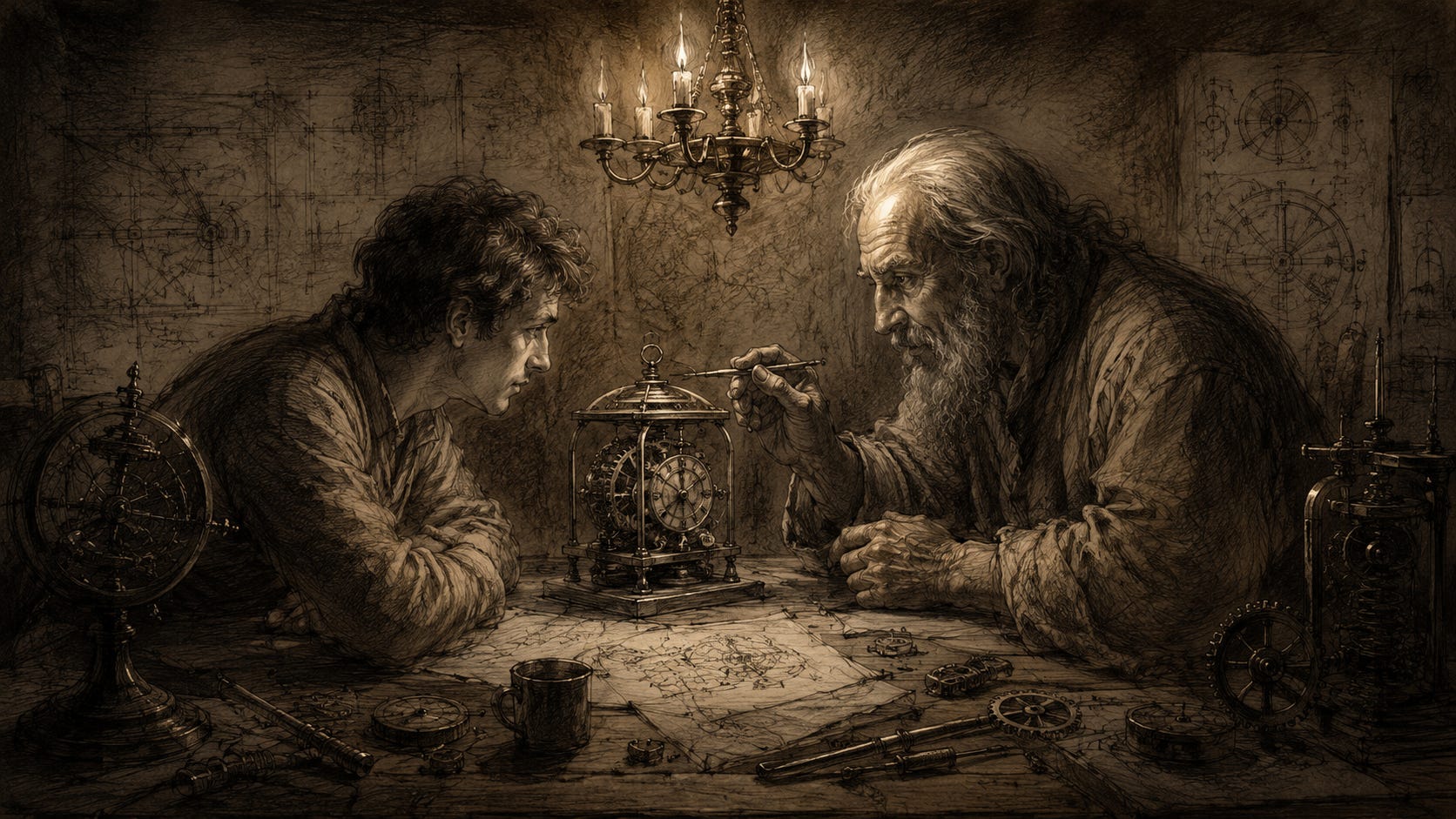
Inside sat a clock. Not large. Not ornate. Beautiful in the way that well-made things sometimes become beautiful by accident.
Brass gears. Silver hands. A face as clean and simple as a mathematical proof. And beneath a glass panel, a mechanism turning with quiet certainty.
The Djinn leaned forward.
“It winds itself.”
“Yes.”
“It regulates itself.”
“Yes.”
“It corrects drift.”
“Yes.”
“It runs unattended.”
The old man smiled.
“Most of the time.”
The Djinn’s eyes brightened.
“The humans would love this.”
By noon the engineer had arrived. There is always an engineer. We exist like traffic wardens in a popular street. Le Bon Mot attracted them in the same way certain forests attract foxes. Nobody knew why.
The engineer was young enough to believe technology had recently begun. He ordered coffee. Opened a laptop. Launched enough agents to qualify as a local government.
Then noticed the clock. Within minutes he was sitting with them.
“This is extraordinary.”
Auguste nodded politely.
“It monitors itself?”
“To a degree.”
“It corrects itself?”
“To a degree.”
“It adapts?”
“To a degree.”
The engineer laughed.
“You sound cautious.”
“I am.”
“Why?”
The old clockmaker looked genuinely surprised.
“Because I built it.”
The table fell quiet. Case smiled into her coffee. The Djinn recognised the tone. Someone was about to learn something.
For the next hour the engineer and the clockmaker spoke. Or rather, they used the same words while describing different things.
“It runs without intervention.”
“Usually.”
“It detects errors.”
“Some.”
“It verifies itself.”
The old man winced.
“No.”
The engineer blinked.
“No?”
“No mechanism verifies itself.”
The young man gestured at the clock.
“But it checks its own operation.”
“That is not verification.”
The old man’s voice remained gentle.
“It is observation.”
The distinction landed awkwardly, like a piece from the wrong puzzle. The engineer frowned. Case watched. The Djinn watched Case. He had learned that this often saved time.
Eventually the engineer spoke again.
“What prevents it from drifting?”
The clockmaker pointed, not at the gears, but at a small mechanism hidden behind them.
The engineer looked disappointed. The component appeared entirely unremarkable. No polished brass. No elegant motion. No visible intelligence. Just a small assembly of springs and constraints.
“That?” he asked.
“That.”
“What does it do?”
“It prevents the clock from believing itself.”
The table became quiet. The Djinn’s eyes brightened. Case sat back. There it was. The sentence. The centre. Everything else would now orbit around it.
The engineer stared and the clockmaker continued.
“The gears generate movement.”
“Yes.”
“The escapement creates cadence.”
“Yes.”
“The winding mechanism provides power.”
“Yes.”
“But none of those things determine whether the clock is right.”
He tapped the small assembly.
“This does.”
The engineer leaned closer.
“I don’t understand.”
“Of course not.”
The old man smiled kindly.
“If you did, my profession would have been much shorter.”
He lifted the clock carefully.
“The mechanism that keeps a clock running is not the same mechanism that keeps it honest.”
The Djinn actually laughed, which was a rare occurrence in itself. Because he suddenly realised why Auguste had appeared. Not for Case. For him.
Possibly for the entire software engineering industry.
The afternoon disappeared into conversation. The engineer described agent loops. Memory files. Cadences. Triggers. Sub-agents. Verification chains.
The clockmaker listened attentively. Occasionally nodding. Occasionally asking questions. Occasionally looking alarmed.
At last he said:
“It sounds as though you have become fascinated by the winding mechanism.”
The engineer smiled.
“We have.”
“And who designs the constraints?”
The smile faded.
“We do.”
“Who decides what counts as evidence?”
“We do.”
“Who determines when the system should stop?”
“We do.”
The old man nodded.
“Then you have not escaped your profession.”
The engineer stared into his coffee. For the first time, he could see the shape of the trap. The loop had not removed responsibility. It had concentrated it.
Rain tapped softly against the windows. Sophie repositioned herself.
The late clock remained unconcerned.
The Djinn watched the engineer.
Something uncomfortable was happening. The engineer was beginning to recognise that the exciting part of the system might not be the part he had been celebrating.
Not the driver. Not the loop. Not the automation. The constitution surrounding it. The place where authority lived. The place where claims became evidence. The place where a system learned the difference between completion and correctness.
The place where someone had to decide what mattered.
Which was unfortunate.
Because no machine could help with that part.
As evening approached, Auguste stretched and opened up with a story.
Many years earlier he had trained two apprentices. Both talented. Both disciplined. Both entrusted with identical clocks.
The first apprentice became obsessed with automation. Every adjustment became automatic. Every correction mechanised. Every task delegated to the machine.
His clocks became extraordinarily efficient. And increasingly mysterious. Eventually he could no longer explain why they worked, only that they seemed to do.
The second apprentice also automated everything she could but every hour saved was spent understanding the clock more deeply.
She learned metallurgy. Spring design. Mechanical resonance. The mathematics of timekeeping. Years later she could explain not only why her clocks worked, but why other clocks failed.
The engineer already knew the ending. Because it wasn’t a story about clocks. It had never been a story about clocks.
“The same machine,” said Auguste quietly.
“The same automation.”
“The same savings.”
“The same acceleration.”
The engineer nodded.
“Different people.”
“Yes.”
The old man smiled.
“The machine could not tell them apart.”
Night arrived. Candles gently replaced daylight. The clockmaker packed away his masterpiece. The engineer closed his laptop.
The Djinn watched both. One carrying a clock. One carrying a loop. Both carrying systems capable of running without constant supervision.
And yet neither had escaped the obligation to think.
At the door the engineer stopped.
“There is something I still don’t understand.”
Auguste smiled.
“There should be.”
“The mechanism that keeps the clock honest.”
“Yes?”
“How long did it take you to build?”
The old clockmaker looked up at the late clock above the bar.
Then out at the rain.
Then back at the young engineer.
“A few weeks.”
The engineer laughed.
“That’s all?”
“No.”
The old man smiled.
“It took a few weeks to build.”
He paused.
“It took thirty years to know it was the part that mattered.”
And with that he left. The bell rang. The door closed. The rain continued. The late clock continued losing three minutes every day with remarkable consistency.
The Djinn stared at it for a long time.
Finally he spoke.
“I think the loops will become very good.”
“They will.”
“I think many people will stop thinking.”
“They will.”
“I think many others will use the time to understand harder things.”
“They will.”
The Djinn nodded.
The answer felt unsatisfying. Which usually meant it was true in his world.
Case gathered her notebook.
“You know,” said the Djinn, “for all the discussion of automation, nobody actually talked about time.”
Case smiled.
“Of course they did.”
“No.”
“They talked about saving it.”
Case stood, put on her coat, and pointed at the clock above the bar.
“A clock can tell you what time it is.”
The Djinn followed her gaze.
“It cannot tell you what it is for.”
Case opened the door. Cold air entered, rain scented and distant. Then she left him with the thought that would bother him for weeks. The same thought, perhaps, that should bother every engineer building agentic engineering loops.
The mechanism that keeps a system moving is rarely the most important part.
The mechanism that keeps it honest usually is.
And neither of them can decide what is worth doing.
That is the ultimate domain of the human. The only accountable inhabitant in the habitat.