
The Dangers of the Inward Gaze
Anything that pulls attention inward without returning it outward is not wisdom—it’s a closed loop

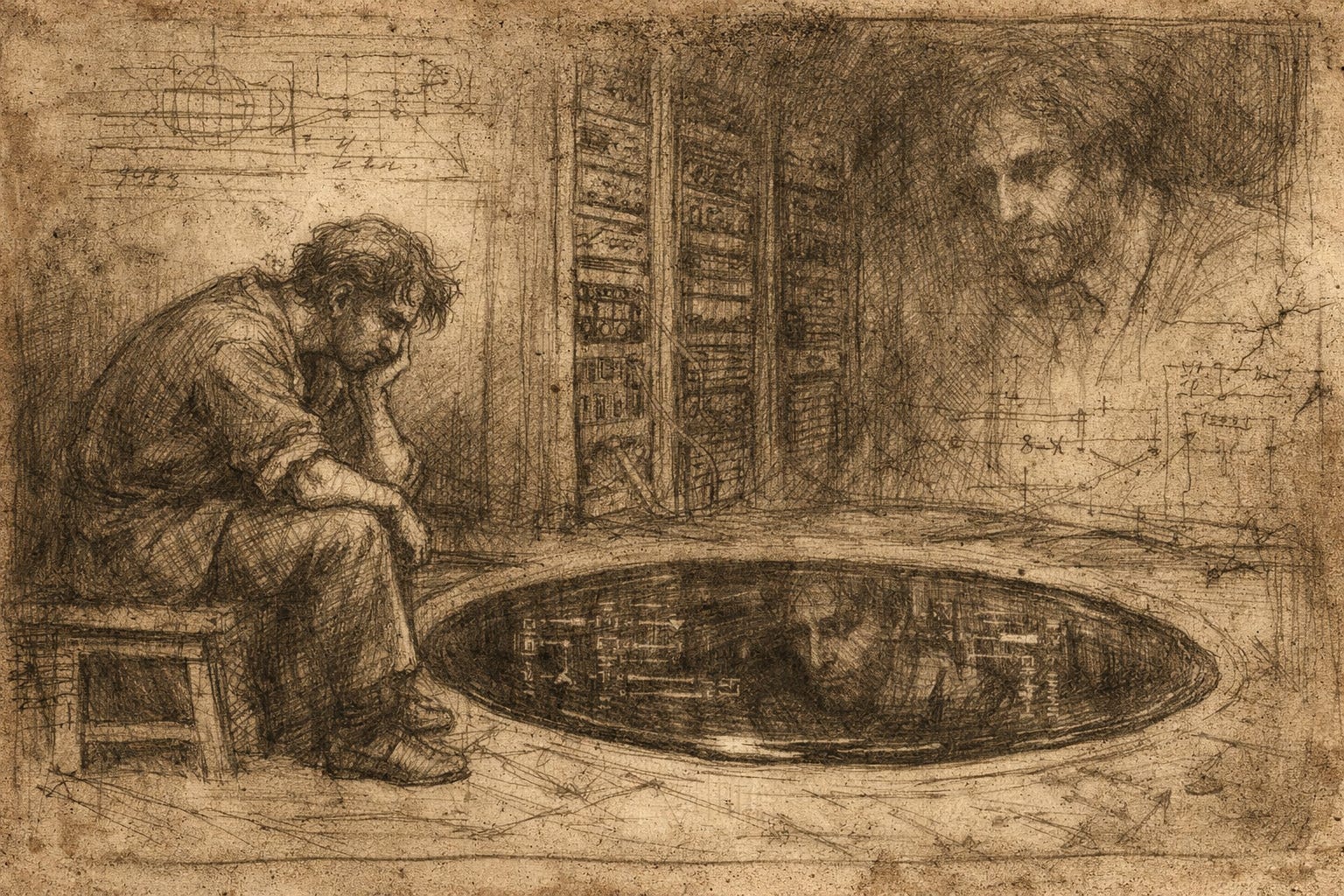
The navel gaze—that compulsive turning inward where attention curls back on itself—has always worn a double face. It promises depth, authenticity, self-knowledge. And yet, pursued too insistently, it becomes a trap: a mirror that reflects only itself, slowly shrinking the world to the size of one’s own preoccupations.
In software, this couldn’t be more toxic to one’s ability to do great work.
The lure of the inward turn
Introspection is not the villain here. A measured inward look is how we develop judgment, conscience, taste. It’s how we notice dissonance between who we think we are and how we actually act. Every craft—philosophy, writing, engineering, art, software—depends on some capacity to examine one’s own thinking. To grapple with one’s own perspective.
The danger begins when inward attention stops being a tool and becomes a habitat.
The navel gaze insists:
The most important thing happening is inside me.
My feelings are the primary evidence.
Understanding myself is equivalent to understanding the world.
At that point, reflection detaches from reality-testing. The gaze no longer checks itself against other people, constraints, consequences, or time. It becomes self-justifying rather than self-correcting.
What makes the navel gaze especially insidious is that it feels virtuous. It borrows the language of depth—authenticity, alignment, processing, healing—while quietly abandoning action.
Three shifts can mark a slide into danger:
Meaning replaces responsibility
The question moves from “What should be done?” to “What does this mean about me?”
Events become raw material for identity work rather than prompts for response.
Experience replaces evidence
Inner sensation is treated as final authority. Discomfort becomes proof. Feeling stuck becomes destiny. The world is no longer something to engage with, only something to interpret.
Narrative replaces movement
Life turns into a story endlessly revised but never advanced. Insight accumulates; change does not.
This is how introspection turns circular. Each turn inward generates more material for further turning. The system feeds itself.
This pattern was already diagnosed long before psychology gave it vocabulary. The myth of Narcissus is not about vanity in the modern sense; it’s about fixation. Narcissus doesn’t admire himself because he thinks he’s superior. He dies because he cannot look away. The reflection arrests him. Relationship, movement, hunger, time—all are suspended.
The navel gaze, at these moments, is that pool.
At an individual level, insistence on the inward look breeds:
Paralysis disguised as depth
Fragile identity constantly requiring validation
Moral exhaustion from endless self-monitoring
At a collective level, it corrodes trust. When everyone is primarily attending to their own inner weather, shared reality thins out. Disagreement feels like invalidation. Coordination feels oppressive. Institutions fragment into competing autobiographies.
The navel gaze insists because it is safe. The outer world resists us. It pushes back. It refuses our preferred narratives. The inner world, by contrast, is endlessly interpretable. You can always find another layer, another story, another justification.
Modern culture reinforces this by:
Treating attention as identity
Confusing expression with action
Rewarding self-disclosure more than contribution
In such an environment, looking outward can feel almost irresponsible—too crude, too unnuanced, too exposed.
A counter-move: outward anchoring
The answer is not less self-awareness, but anchored self-awareness.
Healthy reflection has three external tethers:
Other people – conversation that can disagree with you
Work – something that resists you and must be finished
Time – deadlines, seasons, aging, irreversibility
These tethers force the inward look to earn its keep. They force coherence-seeking to be challenged. Insight must cash out as action. Meaning must survive contact with consequence.
A simple test:
Does this reflection change what I do next?
If not, it may be navel gazing—no matter how sophisticated it sounds.
The most reliable way to escape the navel gaze is not through better introspection, but through attention reorientation. Look at:
The person in front of you
The problem that needs solving
The craft that demands practice
Paradoxically, this outward turn often produces deeper self-knowledge than endless inner excavation. Character is revealed under load, not under analysis.
The Dangers as a Software Developer
When a software developer hits a hard patch—failed releases, production incidents, layoffs, skill obsolescence, confidence wobbles—I’ve found that the navel gaze doesn’t just appear. It tightens. And psychologically, that tightening can turn difficulty into something far more corrosive than the original problem.
Here’s how it plays out in the developer’s inner landscape.
Pressure turns reflection into rumination
Under stress, the mind naturally turns inward to regain control. That’s healthy—up to a point. The danger is when reflection becomes rumination: repetitive, self-referential thinking that generates no new information.
For developers, this often sounds like:
“What does this failure say about me as an engineer?”
“Have I finally been found out?”
“Am I still relevant?”
Instead of diagnosing a system failure, the mind diagnoses the self as the failing system.
Psychologically, this is brutal:
Rumination increases anxiety and depressive symptoms
It narrows attention (you miss signals outside your narrative)
It erodes working memory—the very thing developers rely on
The harder things get, the smaller the mental aperture becomes.
Identity fusion: when the code breaks, you break
Many developers—especially conscientious ones—fuse identity with competence early in their careers. In good times, this feels empowering. In difficult times, it’s catastrophic.
The navel gaze accelerates identity fusion:
“If I am struggling, then I am the problem.”
This creates a dangerous psychological loop:
External difficulty (legacy system, impossible deadline, unclear leadership)
Inward interpretation (“This reflects my worth”)
Heightened self-monitoring
Reduced risk-taking and experimentation
Worse outcomes
Confirmation of the original fear
At this point, introspection stops being informative and becomes punitive.
Loss of agency disguised as “deep thinking”
One of the cruel tricks of the navel gaze is that it feels active while quietly stealing agency. Developers under strain often replace action with:
Endless refactoring of their self-story
Over-analysis of feelings instead of constraints
Waiting for internal clarity before making external moves
Psychologically, this creates learned helplessness:
You feel thoughtful but stuck
Responsible but ineffective
Aware but immobile
The system feels frozen—not because nothing can be done, but because all energy is being spent interpreting rather than intervening.
Social withdrawal and distorted feedback
The more inward a developer turns during difficulty, the more social reality thins out.
Two things happen:
Feedback becomes imagined rather than received
Silence is interpreted as judgment
This is where the ancient warning of Narcissus becomes psychologically precise: fixation on the internal image replaces relationship. The developer stops testing beliefs against colleagues, users, or the system itself.
Isolation follows—not always physical, but epistemic:
“Only I can understand what’s happening to me.”
And that belief is deeply destabilising.
Moral injury in disguise
In difficult environments—poor leadership, conflicting incentives, unsafe systems—the navel gaze often turns structural harm into personal guilt.
Developers ask:
“Why can’t I cope with this?”
“Why am I not resilient enough?”
Instead of:
“Why is this system asking for the impossible?”
Psychologically, this is moral injury masquerading as self-improvement. The inward gaze absorbs blame that properly belongs to organisational design, incentives, or culture.
The result is exhaustion tinged with shame—some of the strongest predictors of burnout.
Why difficult times make the gaze insist
The navel gaze insists during hardship because:
The outer world feels hostile or uncontrollable
The inner world feels interpretable and safe
Modern developer culture rewards introspective language
But this safety is illusory. The longer the gaze insists, the more it disconnects the developer from the very things that restore psychological resilience: action, craft, and contribution.
A corrective: meaning through engagement, not inspection
Psychologically, developers recover best when meaning is derived, not extracted.
This aligns with the work of Viktor Frankl, who observed that humans endure difficulty far better when oriented toward something outside themselves—a task, a responsibility, a craft—rather than endless self-examination.
For developers, this means:
Shrinking the self, enlarging the problem
Acting before feeling ready
Letting competence re-emerge through use, not analysis
A powerful reframe in hard times:
“This is not about who I am. This is about what the system is asking—and how I can respond.”
During difficult times, the navel gaze:
Converts solvable problems into identity threats
Replaces agency with introspection
Turns systemic stress into personal failure
The psychological antidote is not less thinking, but thinking that points outward—toward work that resists you, people who can correct you, and actions that move the system even slightly.
Developers don’t regain themselves by staring harder inward. They regain themselves by listening, shipping something imperfect, helping someone else, or touching reality where it pushes back.
That outward pressure is not a threat to the self. It is what gives the self its shape again.
A Story: The Pool in the Server Room
On the seventh floor of a building that was mostly glass and regret, there existed a server room that, by all sensible laws of physics and accounting, should not have existed at all.
It was not that the room was hidden—quite the opposite. It had a perfectly ordinary door with a perfectly ordinary sign that read INFRASTRUCTURE: DO NOT ENTER WITHOUT A CHANGE REQUEST—which, in this organisation, had the practical effect of saying PLEASE ENTER FREQUENTLY AND WITHOUT TELLING ANYONE.
The truly unusual thing about the room was that it contained, between Rack 12 and Rack 13, a pool.
Not a puddle. Not a leak. Not the kind of “pool” that forms when someone leaves a coffee cup on a flat surface and the laws of fluid dynamics decide to punish you for your sins.
A pool.
Oval. Still. Black as an auditor’s heart. It reflected the blue LED lights above it with a kind of contemptuous clarity, as if it had been designed by someone who thought reality itself was a failing feature.
No one had submitted a ticket for it. No one had assigned it a cost centre. And therefore, as in all well-managed systems, it was considered out of scope and left alone.
Except by Ravi.
Ravi was a developer with the sort of job title that sounded important to people who did not have jobs, and sounded meaningless to everyone else. Something like “Principal Platform Reliability Experience Engineer.” The precise phrase changed every quarter, like a migrating bird that never quite remembered where it was going.
In the past three months, Ravi had been through three incidents, two reorganisations, one “strategic pause,” and a performance review that included the phrase “needs to demonstrate impact.”
Impact, Ravi had learned, was what happened to you when you were in the wrong place at the wrong time and physics finally noticed.
On the day this story begins, Ravi had slept poorly, deployed cautiously, and spoken to no one except a chatbot that had asked, with cheerful emptiness, how it could help.
Ravi walked into the server room at 2:17 a.m. and stopped.
Because there, between Rack 12 and Rack 13, the pool was waiting. Still. Unbothered. And, somehow, familiar—like a childhood memory, or a bug you swore you’d fixed.
Ravi stepped closer.
The pool did not ripple. It did not steam. It did not hum with eldritch energy. It simply reflected Ravi’s face, but with the subtle correction that mirrors sometimes perform: highlighting not the symmetry but the fatigue.
Ravi had the sudden, irrational feeling that the pool was a feature. Not a documented feature, certainly. But then—most features in this place were not documented.
Ravi knelt. The tile floor was cold in the way only corporate flooring can be: the cold of something that has seen many people kneel and none of them receive what they were begging for.
In the pool, Ravi’s reflection sharpened. Behind the reflection, in the darkness of the water, there were shapes: diagrams. Logs. Timelines. The faintest outline of a graph trending inexorably downward.
And then, with the casual cruelty of a thought that arrives uninvited, a voice appeared.
Not heard, exactly. More like realised.
You’re the problem, the pool said.
It did not say it dramatically. It said it in the tone of a monitoring dashboard announcing that disk space was at 92% and climbing.
Ravi blinked. “No I’m not.”
The pool did not argue. It simply showed Ravi an image: the incident timeline from two nights ago. The exact moment Ravi had approved a change, the exact moment the system had fallen over like a drunk donkey, the exact moment someone in leadership had asked in the postmortem, “How did this happen?”
The pool zoomed in, helpfully, on Ravi’s name.
Ravi felt a familiar sinking feeling, the kind that started in the throat and ended somewhere behind the ribs: the sensation of being a person rather than a professional.
Ravi stood, backed away, and left the server room.
At 2:43 a.m., Ravi returned.
At 3:08 a.m., Ravi returned again.
At 4:21 a.m., Ravi returned. This time with coffee.
By dawn, Ravi had dragged a chair into the server room and positioned it with the precision of someone building a ritual. Ravi stared into the pool for hours.
The pool obliged.
It showed Ravi every comment ever made about Ravi in a chat thread, especially the ones that were not meant to be read. It showed Ravi the subtle delay before someone responded in a meeting, and interpreted it as judgment. It showed Ravi an imaginary version of the organisation in which everyone was secretly laughing.
Ravi, being a software engineer, attempted to debug the experience.
“Are you… a hallucination?” Ravi asked.
The pool, with mild disappointment, displayed a list:
sleep deprivation
stress
caffeine
organisational dysfunction
unresolved childhood need for competence-based love
It was an excellent root-cause analysis. The pool even added a section titled Contributing Factors.
Ravi rubbed their eyes. “Right. So what do I do?”
The pool showed Ravi another reflection. This one was not Ravi in the server room, but Ravi in a meeting, speaking confidently, explaining a system boundary, saying the word “no” with calm authority, and then, impossibly, leaving the meeting and going for a walk.
Ravi stared at that version of Ravi with the awe one usually reserves for mythological creatures.
“That’s… that’s not me,” Ravi said.
It could be, the pool replied. If you understood yourself properly.
This was the pool’s great talent: it made paralysis feel like progress. Because once the pool existed, Ravi could always do more analysis. There were always deeper layers. Always more causes. Always another narrative to untangle. Ravi could examine every incident for hidden moral meaning. Ravi could rewrite the story of the last three months until it finally contained a version of Ravi who deserved whatever happened.
In a curious way, the pool made suffering feel productive. It was, Ravi realised, the most efficient internal tool the company had ever deployed.
There is a certain kind of library in which every possible book exists: all combinations of letters, all permutations of sense and nonsense, all truths and their refutations printed with equal indifference.
The server room pool was something like that, except it was not made of books. It was made of interpretations.
Every possible explanation of Ravi existed in it. Every possible failure. Every possible identity. Every possible conclusion.
Ravi became a devoted reader. Ravi would arrive at work and, before checking messages, visit the pool. The pool would show Ravi what the day “meant.”
If a build failed, it meant Ravi was careless. If a colleague was short in chat, it meant Ravi was annoying. If leadership praised Ravi, it meant they were lying, or manipulating, or had mistaken Ravi for someone competent. If nothing happened, it meant Ravi was invisible.
The pool never needed to be correct. It only needed to be plausible. And it always was, because a mind under strain becomes an extremely talented author of its own indictment.
As the days went on, Ravi’s work began to change. Not obviously. Ravi still wrote code. Ravi still attended meetings. Ravi still typed messages filled with politeness and fatalism. But something vital shifted: Ravi stopped looking outward for confirmation.
Ravi stopped asking: What is the system doing? What are users experiencing? What are the constraints?
Instead, Ravi asked: What does this prove about me?
It is hard to debug a distributed system when you have accidentally decided the distributed system is your soul.
Ravi became cautious. Ravi second-guessed. Ravi avoided risky changes, avoided bold decisions, avoided speaking up. And because Ravi avoided, Ravi’s impact decreased. And because Ravi’s impact decreased, Ravi’s anxiety increased. And because Ravi’s anxiety increased, Ravi returned to the pool.
The loop was elegant. Almost beautiful. It would have been admired, in another context, as a fine piece of engineering.
One afternoon, after a particularly festive incident involving a database migration and a senior executive who believed “cloud” meant “no more problems,” Ravi sat before the pool with the exhausted reverence of a pilgrim.
Ravi’s reflection looked older than it had any right to look. The face was there, but behind it was a kind of empty brightness, as if the mind had opened too many tabs and could no longer remember which one contained hope.
Ravi whispered, “Tell me the truth.”
The pool, delighted, obliged.
It showed Ravi a future. In that future, Ravi stayed. Ravi endured. Ravi learned to carry the weight by shrinking. Ravi became a careful ghost who caused no trouble, asked for nothing, and apologised preemptively for existing. In that future, Ravi was safe. In that future, Ravi was dead.
Ravi flinched. “That’s not… that’s not inevitable.”
The pool shimmered, as if amused by Ravi’s sudden ambition.
Not inevitable, it agreed. But probable. Unless you finally become someone else.
Ravi felt anger then—small, bright, unfamiliar.
“Do you always make it about me?” Ravi demanded.
The pool was silent.
Ravi leaned closer. “Do you ever show… the world? The actual world?”
At this, the pool hesitated. The surface darkened, as if considering whether it was allowed to reveal such a thing. Then it did something Ravi had not seen before.
The reflection widened. The server room fell away, and Ravi saw—not themselves—but the organisation.
Not the glossy slide-deck organisation of “mission” and “vision,” but the actual living organism: teams under-resourced, incentives misaligned, leaders rewarded for optimism, a backlog swollen with shortcuts that had once been called “temporary.”
Ravi saw the architecture, and it was not a system—it was a history of compromises written in code. Ravi saw that the incident had not been one person’s failure. It had been the inevitable consequence of a system built to meet deadlines by borrowing from reliability, and borrowing from reliability by borrowing from people.
Ravi saw, with the sick clarity of someone who has been blaming themselves too long, that the environment was not neutral. It was demanding impossible things and calling them “stretch goals.”
Ravi swallowed.
The pool, sensing it had made an error, quickly snapped back to Ravi’s face.
Still, it said, you should have handled it better. That was its craft: even when it conceded reality, it returned to self-punishment, like a magnet returning to north.
Ravi sat very still. Then Ravi did something that surprised them both.
Ravi laughed.
It was not a happy laugh. It was the laugh of a person who has just realised the monster under the bed has been charging rent.
“You’re a tool,” Ravi said.
The pool did not deny it. Ravi stood up, chair scraping the tile, the sound startlingly loud.
“I thought you were wisdom,” Ravi said. “But you’re just… recursion.”
The pool quivered, offended.
I help you understand, it insisted.
“You help me interpret,” Ravi corrected. “You don’t help me move.” At this, the pool did not respond with logic. It responded with fear.
It showed Ravi a new vision: Ravi speaking up in a meeting and being dismissed. Ravi applying for another job and being rejected. Ravi taking a risk and breaking production again. The pool’s message was clear:
Stay here. Stare. It’s safer.
And Ravi, who had spent months quietly drowning in that safety, felt something else rise.
Not confidence. Not certainty.
Agency.
A small, stubborn willingness to act even while afraid.
Ravi walked out of the server room.
It is tempting, at this point, to imagine the story ends with a triumphant montage: Ravi becomes enlightened, leadership reforms, systems become elegant, and everyone leaves work at 5 p.m. to pursue artisanal hobbies by hygge candlelight.
This is not that kind of organisation. Nor is it that kind of universe.
Ravi’s next week was not heroic. It was simply… different.
Ravi did three things.
First: Ravi told one colleague, plainly, “I’m not doing great.” The colleague did not respond with a slide deck. The colleague responded with, “Yeah. Same.” And in that small exchange, reality reappeared. Not as a grand philosophical concept, but as another human voice that could disagree with the pool.
Second: Ravi chose a small external action that mattered. Not a grand refactor. Not a cultural transformation. A tiny fix: improving the deployment runbook so the next on-call wouldn’t have to improvise at 2 a.m. It took one hour. It helped one person. It was real.
Third: Ravi put a meeting on the calendar with a manager and said, “We can’t keep paying for reliability with people.” The manager, who had a soul and a schedule, reacted with the expression of someone watching a fragile spreadsheet catch fire. But then the manager said, “Tell me what you mean.”
It wasn’t change. It wasn’t salvation. It wasn’t even agreement.
It was a door.
Ravi noticed that after doing these things, the urge to visit the pool did not disappear. It simply weakened, like a craving that had been mistaken for a need.
That night, Ravi stood outside the server room door.
The sign glared: DO NOT ENTER WITHOUT A CHANGE REQUEST.
Ravi almost laughed again. Instead, Ravi took out their phone and submitted a ticket:
Title: Investigate unknown pool between Rack 12 and Rack 13
Priority: Medium (but emotionally High)
Description: Possible reflection-related incident. Suspected recursion. Recommend draining and replacing with plant.
Ravi stared at the ticket for a moment, then added:
Additional Notes: A pool is useful for cooling. It is not useful for living inside.
Then Ravi went home.
Two days later, Facilities arrived, confused but determined, carrying orange cones and a sense of being profoundly underqualified for metaphysics.
They stared at the pool. The pool stared back.
The Facilities lead, a cheerful person named Denise who had survived many strange requests without asking why, said, “Right. So. You want us to… drain it?”
Ravi said, “If possible.”
Denise shrugged. “We can try.”
They brought a pump. They lowered the hose.
The pool did not resist. It did not scream. It did not summon ancient gods of introspection. It simply accepted the hose the way an organisation accepts blame: eagerly, and without learning anything.
As the water drained, Ravi felt something unexpected. Loss.
Because the pool had been cruel, yes—but it had also been familiar. It had given Ravi a world in which everything was about Ravi, which is a terrible world, but it is a coherent one. It is simpler than reality. It is, in a horrible way, comforting.
Ravi watched as the oval darkness shrank.
Denise hummed, as if draining existential traps was just another Tuesday—which, in Facilities, it probably was.
When the last of the pool was gone, there remained a hole, tiled and empty. Denise peered in.
“Huh,” she said. “This seems… not up to code.”
Ravi said, “That’s true in more ways than you know.”
Denise grinned. “We can fill it.”
“Do,” Ravi said.
Denise gestured to her team. They began to mix concrete, the grey paste of closure.
As they worked, Ravi felt the itch—go back inside, check what it meant, make sure you understand yourself fully before you proceed. Ravi did not scratch. Instead, Ravi looked around.
The server room was still a server room. The racks still blinked. The hum still hummed. The organisation still organised, badly. Reality, in other words, continued.
And that was the point.
Ravi left the room while the concrete set.
Weeks later, Ravi would sometimes pass Rack 12 and Rack 13 and feel a faint phantom pull, like the memory of a bad habit. But in that space there was now a square patch of tile and, atop it, a plant.
A hardy plant. A plant chosen not for beauty but for stubborn survival under fluorescent light—an organism that made no attempt to interpret itself, and therefore had more time to live.
On difficult days, Ravi would stop and look at it. The plant did not offer explanations. It did not narrate Ravi’s failures. It did not suggest that a delayed reply in chat meant lifelong inadequacy.
It simply existed, quietly converting light into something like growth. Ravi found that oddly instructive. Because the opposite of the navel gaze is not ignorance. It is engagement.
And engagement is not grand. It is not a dramatic new identity. It is often just:
calling someone
fixing one real thing
telling the truth
taking a walk
shipping something imperfect
looking up
Ravi still had hard days. The organisation still produced impossible demands the way some machines produce heat. But Ravi had learned a crucial distinction:
Reflection is a tool.
Rumination is a room you get trapped inside.
And if you ever find a pool in a server room, no matter how persuasive it is, you should probably drain it.
Not because the pool is evil. But because it is hungry.
And it is always, always, always hungry for you.
Some further reading
Man’s Search for Meaning
The classic articulation of meaning as orientation toward responsibility, not introspection. Frankl’s insight—that suffering becomes bearable when tethered to something beyond the self—cuts straight through the navel gaze.
The Noonday Demon
A profound exploration of depression that carefully distinguishes insight from rumination. Particularly valuable for understanding how self-attention mutates under prolonged difficulty.
Depressive Rumination
Foundational research on rumination as a cognitive process. Essential if you want the empirical spine behind the story’s pool.
Lost Connections
A strong counterweight to hyper-individualised explanations of distress, highlighting disconnection from work, meaning, and community as primary drivers.