
The Developer Who Lost the Thread
A Sunday Short Story on the Pain of Task Switching

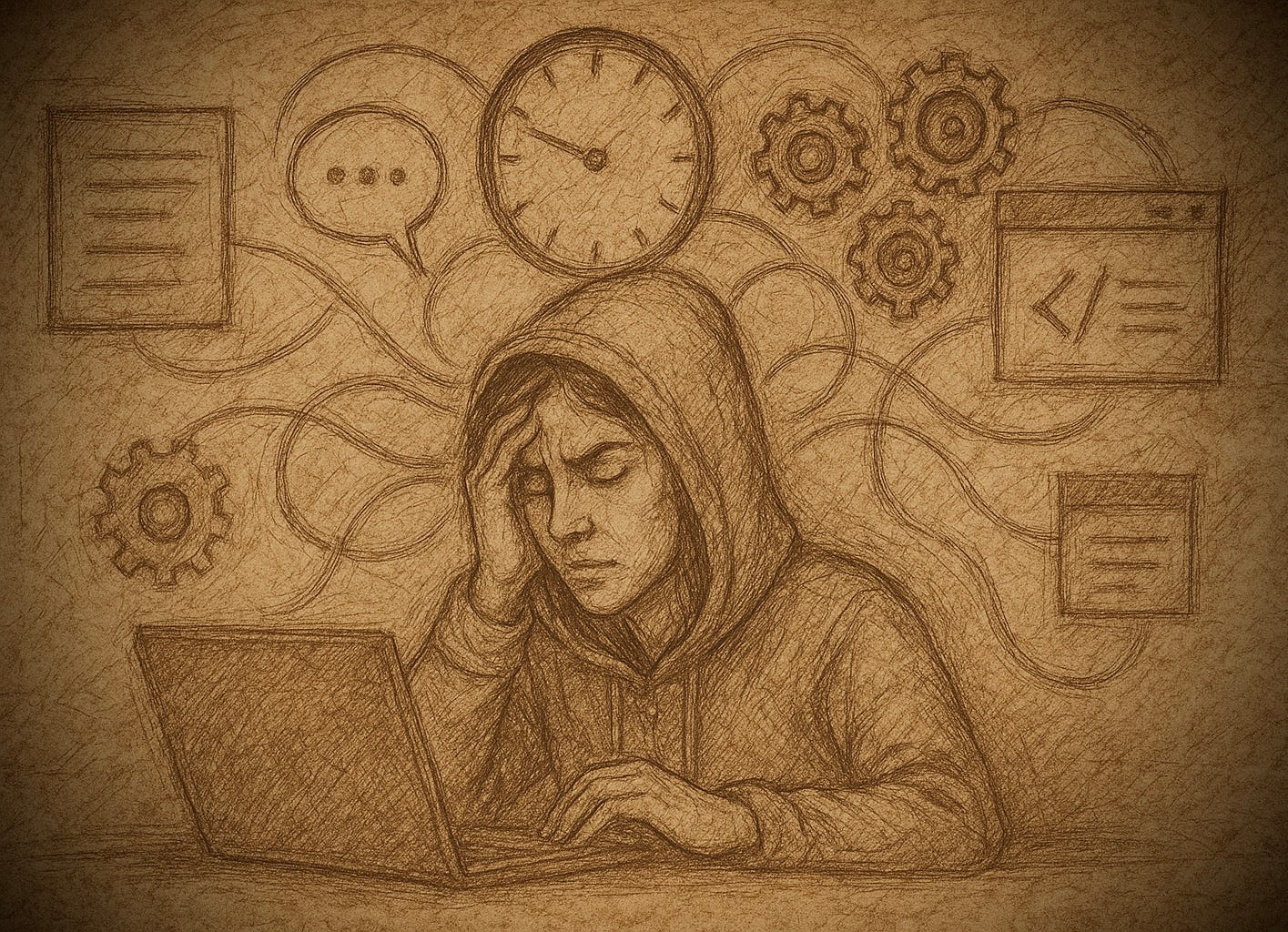
In the far corner of an open-plan office, a place where noise travels faster than thought, sat a woman in a grey hoodie. Her name was Mara, though most people simply called her “Ping,” because every time someone needed something, it was her Slack icon that was the first to light up.
Mara wasn’t sure when her work had stopped being work and become something evil. More like psychic plate-spinning than focussed progress. Her laptop hummed with the gentle menace of an overworked oracle. Tabs multiplied like rabbits. Notifications arrived with the breathless enthusiasm of recruiters. Every time she reached for a single, clear thought, three others tackled it to the ground.
If the universe is an infinite library, then software development was the broom cupboard where all the broken cataloguing systems had been shoved.
On this particular Tuesday, Mara was debugging a memory leak that only appeared on alternate Thursdays during leap years, while simultaneously triaging an incident, reviewing a half-finished pull request, answering questions about a system she didn’t design, and trying to remember what she had meant — hours earlier — by a cryptic comment she’d left for Future Mara:
“Don’t forget the thing with the thing.”
Somewhere in the haze of context switching, she felt the first wobble in her mental stack. A gentle one. Like a teacup sliding towards the edge of a saucer.
Then another.
Then a full avalanche.
Her thoughts collapsed like a Jenga tower kicked by a bored god.
She pressed her hand to her forehead — not quite a headache, more like a psychic paper cut — and tried to breathe. Her hoodie, soft and vaguely comforting, was the closest thing her company provided to a psychological safety course.
A notification pinged.
Another.
Six more.
Each one severed the fragile thread of whatever she’d been rebuilding in her mind. Ideas dissipated like steam escaping a cracked pipe. Her brain kept trying to reload the last known good configuration, but the system logs were corrupted by interruption.
Then — somewhere between despair and caffeine — something strange happened.
The world slowed.
Not in a mystical, time-stopping way. More in the way a failing process slows down just before it crashes. But instead of crashing, a voice — calm, dry, and vaguely annoyed — emerged from the laptop speakers.
“You’re doing it again,” it said. “Trying to carry everything at once.”
Mara looked around. Nobody appeared surprised, which was concerning. Either they were all too busy to notice, or the office had finally achieved the long-prophesied state of ambient madness.
“Who said that?” she whispered.
“I did,” said the voice. “Your system. Your tools. Your notifications. Your habits. All of us. We’ve unionised.”
Mara blinked. She wondered briefly whether burnout now came with hallucinations.
The voice continued, “You humans are remarkable. You can split your minds into eight flapping pieces and then act surprised when they complain.
But here’s the trick: systems have limits. Minds do too. And threads — mental or otherwise — get tangled when pulled in too many directions.”
Mara exhaled, half-laughing, half-terrified.
“What do you want me to do?” she asked.
The voice softened, “Choose one path through the labyrinth. Just one. For now.”
She stared at the endless forest of open windows. One tab glowed faintly — the memory leak investigation. The real work. The meaningful work. The work that required her whole mind, not the fragments the world kept carving off.
She closed everything else. The silence that followed was not silence at all but the rediscovery of mental oxygen.
The voice spoke one last time:
“Good. Protect the thread. It’s the only way through.”
And then it was gone. Mara pulled up her hood, took a breath, and stepped back into the labyrinth — not to conquer it, but to walk it properly, with one thought at a time.
For the first moment all day, she could breathe.