
The Developer Who Would Not Drive in the Rain
A Tale from Le Bon Mot on moving fast and not breaking things

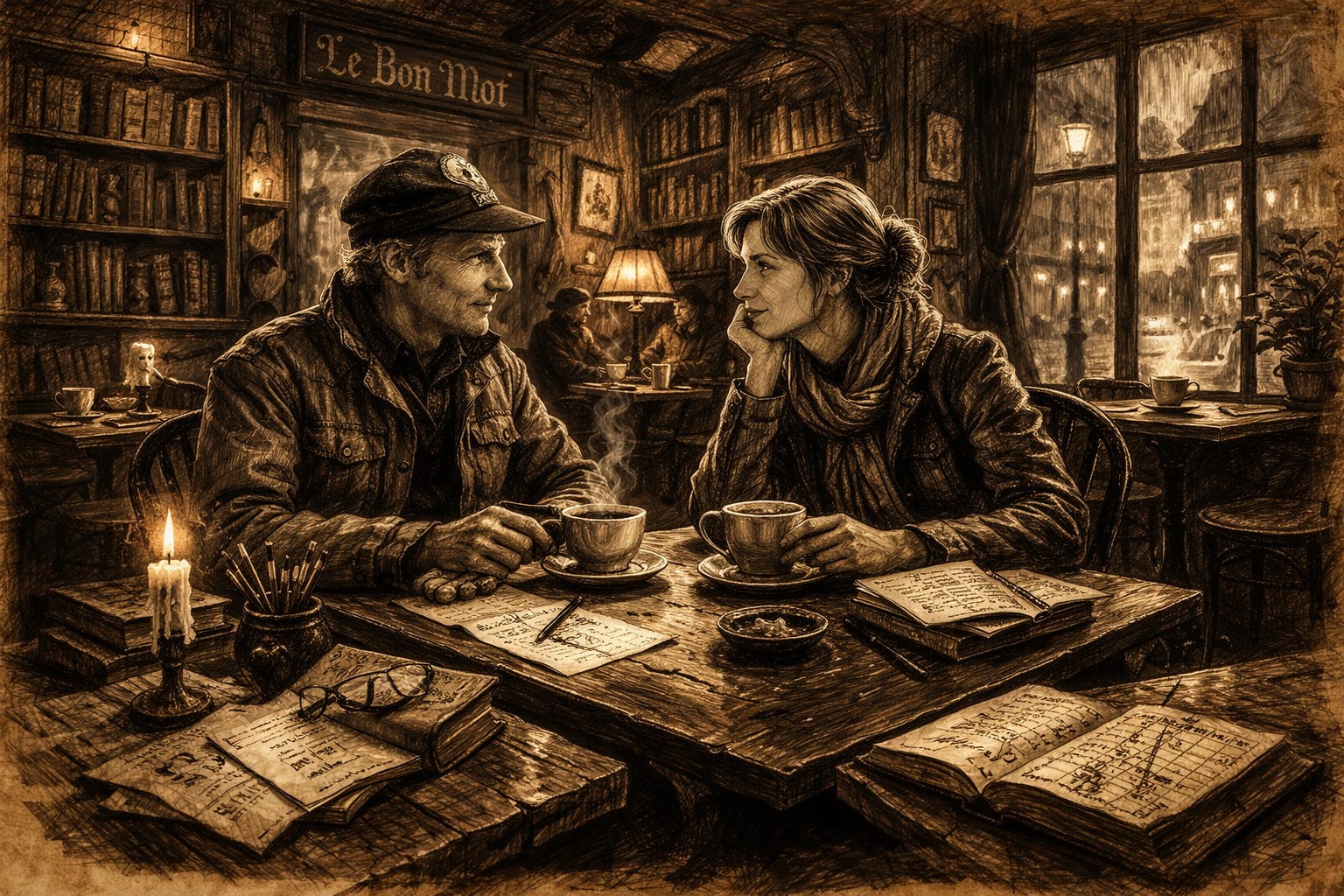
There are cafés in the world that serve coffee, and there are cafés that seem instead to serve time.
Le Bon Mot, which occupies a crick in a lane that refuses to appear on most maps, does both. It is a library café, which is to say it contains more books than customers and more metaphors than pastries. The shelves rise like overconfident theology. The tables wobble with philosophical intent. And the regulars, who believe themselves accidental, are in fact curated.
On the afternoon in question, Case was annotating a margin in a book she had already read twice and disagreed with both times. The bell above the door rang with unusual precision.
He entered without spectacle. No leather jacket. No aura of destiny. Just a man in a dark jacket and the posture of someone who had learned long ago that posture was a decision.
He ordered tea. Not coffee.
Case noticed the hands first. Not soft. Not theatrical. Mechanic’s hands, if mechanics had degrees in economics and a distrust of adjectives.
“You’re new,” she said.
“Yes,” he replied. “And I prefer it that way.”
His accent was Austrian, lightly sanded by years elsewhere. He took the seat opposite her without asking, which in Le Bon Mot is less rude than it sounds. The café has a habit of seating people where their arguments will be most productive.
“You look,” Case said, “like someone who has tested systems at their limits.”
He nodded. “Limits are honest. People are not.”
The Platform That Wanted to Be Brave
At the next table, a cluster of local developers were in the middle of a familiar argument.
“Our platform needs to be bold,” said one.
“We need to push faster. AI can generate in minutes what used to take days.”
“Review is the bottleneck,” said another. “Manual review just doesn’t scale.”
The Austrian man stirred his tea with the calm of someone who had once stirred something far more volatile.
“Bravery,” he said quietly, not looking at them, “is expensive.”
They turned.
“Excuse me?”
“In my experience,” he continued, “people confuse speed with courage. They celebrate risk because they do not understand cost.”
One of the developers laughed. “We’re not racing cars.”
“No,” the Austrian agreed. “You are racing time. And that is more dangerous.”
Case smiled. She had seen this before. The moment when someone thinks they are discussing features and discovers they are discussing physics.
“What would you do?” she asked him.
“I would ask,” he said, “whether your system is fast because it is well configured, or fast because you are lucky.”
The group bristled.
“We have monitoring.”
“Dashboards?”
“Yes.”
“Do they tell you what is happening,” he asked gently, “or what you wish were happening?”
Silence is a frequent visitor at Le Bon Mot. It sat down between them.
The Rain
Case noticed something peculiar. Whenever the conversation drifted toward heroics — toward “shipping at 2am” or “crushing the sprint” — the Austrian’s expression tightened. Not with fear but with irritation.
“You speak,” he said at last, “as though risk is a personality trait.”
“It’s about ambition,” said the enthusiastic one as if quoting from the latest tech bro autobiography-touting podcast.
“No,” he replied. “Ambition is measurable. Recklessness is theatrical.”
He leaned back.
“In the rain,” he said, “you must decide whether you are proving something or preserving something.”
They stared at him.
“I once backed out,” he continued, “Conditions were unacceptable. Others continued. They called it courage.”
“And you?” asked Case.
“I called it mathematics.”
He sipped his tea.
“You build systems that move money, yes? In regulated environments?”
Case raised an eyebrow. “Sometimes.”
“Then you do not get to be brave. You get to be precise.”
The developers shifted in their chairs.
He continued:
“You speak of AI agents as though they are fearless drivers. Generating code at impossible speed. Fine. Let them. But ask yourself — is the habitat configured to offer control at that speed?”
One of them frowned. “So we slow down?”
He shook his head.
“No. You tune.”
Setup
It emerged, through careful questioning, that the Austrian had once been obsessed with calibration. He spoke of feedback loops the way others speak of love.
“You must feel degradation before telemetry confirms it,” he said. “Otherwise you are already too late.”
Case nodded. “Cognitive debt.”
“Yes,” he said. “Small imbalances compound. The machine whispers before it screams.”
“You make it sound all sound mechanical,” someone muttered.
“It is,” he replied. “And it is human. The machine degrades. The developers tire. The team misjudges. Systems fail in chorus.”
He asked about their runbooks. They did not have good answers.
He asked about incident reviews. They described blame in polite language.
He asked whether anyone had ever refused to deploy because conditions were wrong. They looked at one another as though he had suggested treason.
“You must be willing,” he said calmly, “sometimes, to return to the garage.”
The Unknown Developer
Case changed tack.
“You’re a software developer?” she asked.
He smiled faintly.
“I have built things,” he said.
They all blinked.
“I have run teams,” he clarified. “I care about cost structures. Efficiency. Margins. And, yes, speed.”
This explained his hands.
“But originally,” he added, “I was an engineer.”
“Of what?”
“Systems that punish imprecision.”
Case leaned forward. “Why are you here?”
He looked around the café as if assessing wind conditions.
“I am curious,” he said, “how modern engineers think about risk.”
“And?” she prompted.
“You romanticise it.”
The enthusiastic developer protested. “We’re innovating!”
“Innovation,” the Austrian said evenly, “is disciplined experimentation. Not adrenaline.”
He placed his cup down with surgical neatness.
“You must understand trade-offs. When is non-determinism is feature? And when it is it a defect?”
“Automation,” he continued, “is for reliability. Creativity is for exploration, and edge. Do not confuse the two in production.”
“And if we do?” someone asked.
“You will learn,” he said, “in fire.”
The Withdrawal
The rain began outside.
Rain at Le Bon Mot is rarely dramatic. It is more administrative. But the Austrian watched it carefully.
“If your observability tells you nothing,” he said softly, “and your conditions deteriorate, do you continue?”
Case answered before the others could.
“No.”
“Why?”
“Because survival is a metric.”
He nodded, satisfied.
“You must not optimise for headlines. You optimise for continuity. You can’t win when firefighting is your only skill.”
The enthusiastic developer looked unconvinced. “But sometimes you have to push.”
“Yes,” the Austrian agreed. “But only when you understand the envelope.”
“And if we misjudge?”
“You will,” he said. “The question is whether your system is designed to absorb that misjudgement.”
He stood.
“You build platforms,” he said to Case. “Habitats.”
“Yes. I have done.”
“Then remove hero culture. Reward calibration. Teach how to safely back off.”
“That sounds,” she said carefully, “almost anti-climactic.”
“It is,” he replied. “Championships are not won on drama.”
Departure
He paid in cash. Exact change. And at the door he paused, glancing once more at the rain.
“You know,” Case said, “you never told us your name.”
He considered this.
“It is not important.”
“That’s rarely true here.”
A small smile.
“In my experience,” he said, “the work matters more than the mythology.”
He stepped out into the rain. Not dramatically, not defiantly, but with the measured assessment of someone who has already decided the conditions, this time, are acceptable.
The bell rang once more.
The café exhaled.
The Aftermath
The developers did something unusual.
They did not schedule a hero sprint. They did not declare “AI-first bravery.”
Instead, they:
tightened feedback loops
clarified rollback strategies
distinguished exploration environments from production systems
rewrote incentives that celebrated taking care
They even documented conditions under which deployment would be halted.
Someone pinned a note to the corkboard:
“We are paid to build systems that endure. Not to look brave.”
Case smiled at the phrasing.
Later, as she was shelving a book misfiled under Metaphysics (it belonged these days in Engineering), she noticed a newspaper folded beside an empty chesterfield chair.
A photograph stared up at her.
A man in a red racing suit. A narrow face. Eyes that had seen fire and preferred mathematics.
Case looked toward the door, where the rain had already thinned to mist. In Le Bon Mot, visitors often arrive as metaphors and leave as history. She closed the paper gently.
“Of course,” she murmured.
Outside, somewhere beyond the visible lane, an unknown Austrian continued to tune his systems — never romantic, always precise — and remained forever uninterested in driving in the rain merely to prove that he could.
In memory of Niki, on the eve of a new F1 season.