
The Five-Minute Library
On Caches, Clocks, and the Cost of Forgetting

A short story to celebrate a new addition to “The Sovereign Engineer: AI Literacy for Software Professionals”: What’s beneath the invoice — The cache and the attention budget that quietly govern every AI interaction.
Pro memoria: quod tenetur, pretium habet. Quod obliviscitur, pretium habet maius.
(What is remembered has a price. What is forgotten has a greater one.)
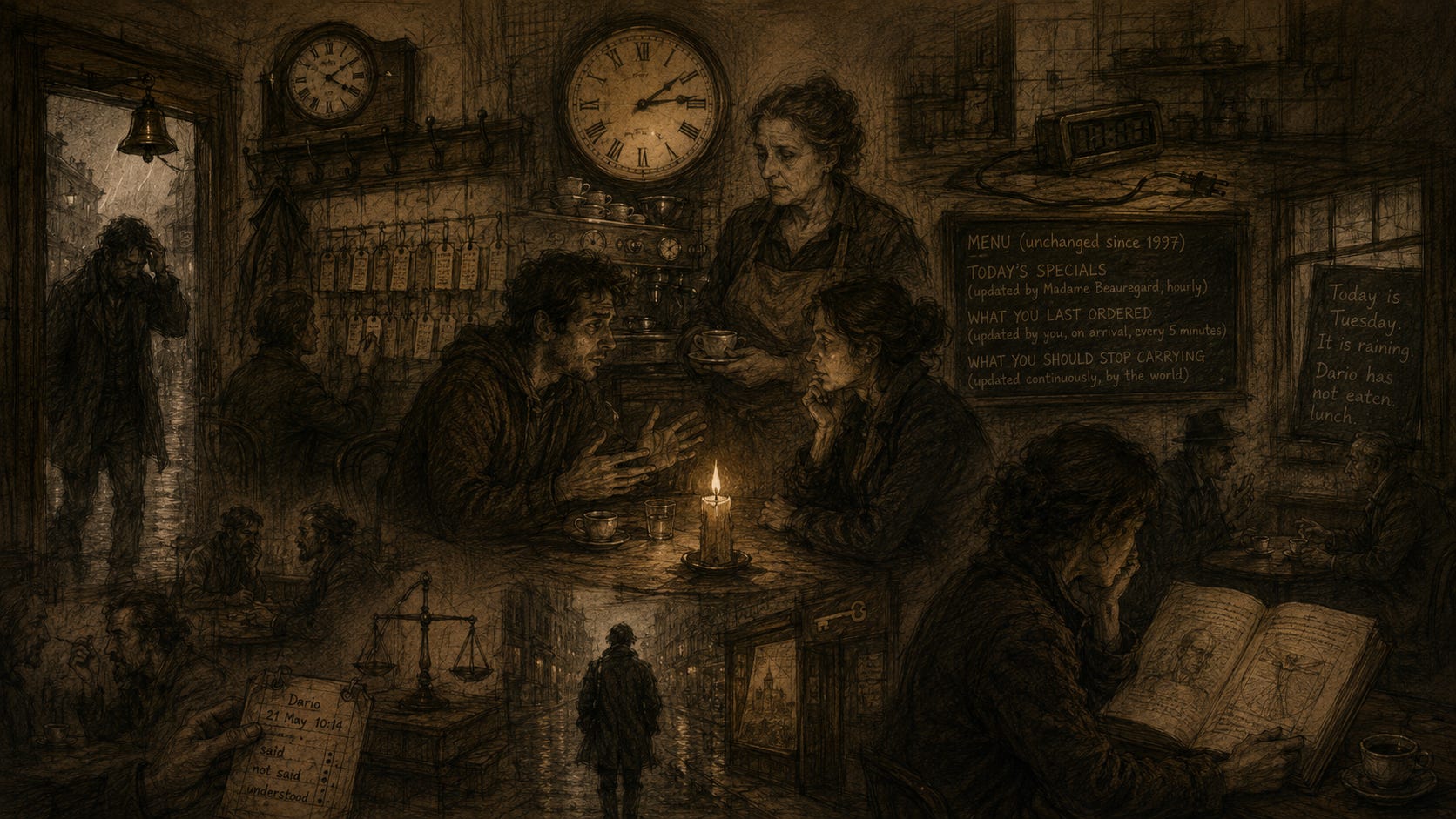
There were, in Le Bon Mot, a number of clocks.
The brass clock above the espresso machine ran, as everyone knew, three minutes late. This was a punctuality it maintained with such fierce consistency that the regulars treated it as the true time and the rest of the world as having drifted, by the same three minutes, into error.
Less well-known was the small mahogany clock above the coat rack, which kept perfect time, but only for those who had arrived in the last five minutes. Those who lingered longer — the regulars, the philosophers, the one journalist who had been working on the same paragraph since the spring — found that the mahogany clock no longer recognised them. Its hands moved, but not for them. They had to consult the brass clock, three minutes late and therefore entirely correct.
There was also a digital clock in the kitchen, but Madame Beauregard had unplugged it during a dispute the nature of which she declined to specify.
Case had, over the years, come to understand the café’s relationship with time as something less like physics and more like accounting. Time, in Le Bon Mot, was kept on a number of separate ledgers, each with its own rules, and the bills came due at irregular intervals.
The brass clock was the ledger of the regulars. The mahogany clock was the ledger of the new. The unplugged digital clock was, presumably, a ledger of disputes. There were probably others. Case suspected the espresso machine itself maintained one, but had not yet found a polite way to ask.
She was reading, on the morning in question, a monograph titled Memoria Ephemera: On Forgetting at Scale, which someone had misfiled under Cookery. It opened with the observation that all memory is a wager, and that the cost of remembering must be set against the cost of forgetting, and that civilisations were mostly characterised by which side of this wager they had chosen to live on.
She had reached the third paragraph when the bell above the door rang and a man entered who looked as though he had been mugged, recently and thoroughly, by his own laptop.
His name, it would emerge, was Dario. He was a developer of agentic systems, and he had spent the morning, he explained, trying not to use too many words.
“I was told,” he said, “that I was burning tokens. I don’t know how, exactly, it happened. But I was told. And I was told to talk like a — like a — “
“Caveman?” said Case.
“Caveman,” said Dario, with the relief of a man whose fugitive vocabulary had been returned to him by a kind stranger. “Yes. Caveman. I was told to be brief. I have been being brief for four hours. I have lost, I think, the ability to construct certain kinds of subordinate clause. I came here because I was hoping coffee would — would — “
“Restore them?” said Case.
“Mostly,” said Dario.
Madame Beauregard arrived, as she did, without having been summoned, set down a small espresso and a glass of water, and examined Dario in the manner of a ship’s chandler assessing damage that the captain had not yet acknowledged.
“You have been speaking,” she said, “in fragments.”
“Yes.”
“To save?”
“Tokens. Yes.”
“And what,” said Madame Beauregard, “did you save them for?”
Dario opened his mouth, and then closed it, and then opened it again, in the manner of a man who had just discovered that the answer to the question was significantly more important than the question itself.
“I —” he said. “I don’t actually know. I think the assumption was that I would use them later. But I don’t think they accumulate. I think they just —”
“Disappear?” said Case.
“At five-minute intervals,” said Dario.
Madame Beauregard nodded, in the manner of a woman who had heard this particular confession before and would, she suspected, hear it again.
“You will want,” she said, “to speak to the Library.”
Le Bon Mot’s Library was not a library in the ordinary sense. It occupied a space behind the espresso machine that, like most of the spaces behind the espresso machine, was only nominally three-dimensional, and it consisted not of books but of small wooden tags hung on hooks along a brass rail. Each tag bore a name, a date, and what appeared, on closer inspection, to be a list of — but here Dario’s understanding faltered.
“Orders?” he ventured.
“Not exactly,” said Madame Beauregard. “Conversations. The shape of them. What was said. What was not said. What was understood.”
“You — keep them?”
“For five minutes.”
Dario stared at her.
“After five minutes,” said Madame Beauregard, “they fade. The tag remains. The contents do not.”
“That seems,” said Dario, “wasteful.”
“It is the price of the café,” said Madame Beauregard, with the air of someone who had, over the years, examined the alternatives and found them all to be worse. “If we kept everything, we would be unable to think. If we kept nothing, our regulars would have to reintroduce themselves every morning, and they have, on the whole, better things to do. Five minutes is the wager. It is short enough to forget the trivial. It is long enough that the conversation does not have to be paid for twice.”
“Unless—” said Case.
“Unless,” said Madame Beauregard, “you pay for the hour.”
“There is an hour ledger?”
“There is. It costs twenty-five per cent more per cup. But for those whose conversations have a longer arc than an espresso — for those who linger — it is, on the whole, cheaper.”
“Cheaper how?”
“Because every time the five minutes runs out,” said Case, looking up from her monograph, “you have to write your conversation back into existence. You pay for the writing, not the reading. The hour ledger pays once for the writing and lets you read for an hour. Whether it is cheaper depends entirely on whether you are still in the café an hour from now.”
Dario looked, for the first time that morning, as though something had been explained to him in a way that might actually stick.
“There was a moment,” he said, after a pause, “in February, when I think the café — or somewhere very like it — kept things for an hour by default. And then in March, without telling anyone, it went back to five minutes. People only noticed because their bills doubled.”
Madame Beauregard nodded slowly. “The proprietor of any café,” she said, “may revise the terms of their hospitality at any time, and the regulars must keep their wits about them. This is one of the older rules. It is not pleasant. It is not new.”
“It happened without a note.”
“It often does.”
He turned the espresso cup in its saucer, as though looking for the answer in the patterns of the crema.
“My company,” he said, “responded by trying to make us all caveman. The reasoning was that if we used and asked for fewer words, we would pay less. And — yes. We do pay less. About four per cent less, when I measured it. But—”
“But?” said Case.
“But the answers got worse. Or — not exactly worse. They became useful only to people who already knew the answer.”
Case set the monograph down.
“Tell me,” she said. “When one of these systems explains something to you alongside its answer — what would you call the explanation?”
“Filler. That is what they called it. They said it was filler.”
“And if you were a senior engineer, who already knew most of what was being explained, would you say it was filler?”
“Yes. Probably.”
“And if you were a junior engineer, who did not yet know it?”
Dario was silent.
“In that case,” said Case, “it would be the lesson.”
“Yes.”
“And the saving — the four per cent — comes at the cost of the lesson.”
“Yes.”
“Not for the senior. For the junior.”
“Yes.”
“Then your saving is not really a saving. It is a transfer. From the well-equipped to the under-equipped. You are saving on what you could afford to lose, and charging the cost to those who could not.”
Madame Beauregard, who had been listening with the patience of a woman who had heard variations of this argument across four decades and three espresso machines, gestured at the chalkboard above the counter.
The chalkboard, on this particular morning, read:
MENU (unchanged since 1997)
TODAY’S SPECIALS (updated by Madame Beauregard, hourly)
WHAT YOU LAST ORDERED (updated by you, on arrival, every five minutes)
“Notice,” she said, “that the menu does not change. It has not changed in twenty-nine years. It is, to use Dario’s word, cached — written once, read many times. The specials change, but slowly. Today’s specials. Yesterday’s specials. The week’s. They are written more often than the menu, but less often than your order. And your order — what you actually want at this moment — changes constantly. It is the most volatile thing in the café.”
“And —”
“And the question that determines whether the café functions, in any meaningful sense, is whether we keep these things in the right order.”
“In the right order?”
“The menu first. The specials in the middle. Your order last. If we put your order at the top, every time you ordered something, we would have to reprint the menu. Twenty-nine years of menu, reprinted, every espresso. We would be insolvent by Tuesday.”
Dario stared at her.
“You are explaining cache architecture,” he said, “via a sandwich board.”
“I am explaining,” said Madame Beauregard, “why a sandwich board is a sensible thing. The architecture is the same architecture. It has always been the same architecture. Your machines are simply doing in milliseconds what cafés have been doing in mornings for a hundred and fifty years.”
“And the things that change every conversation — the date, the weather, who I am — “
“Go on the small slate,” said Madame Beauregard, indicating a slate by the window that bore, in chalk, Today is Tuesday. It is raining. Dario has not eaten lunch. “We do not write them on the menu. The menu is the menu. The slate is the slate. To put one in the place of the other is a category mistake of a particularly expensive kind.”
Case, who had been watching this exchange with the look of someone whose monograph had just become considerably more interesting, opened it again to a passage near the end.
“Listen to this,” she said. “The cost of remembering is not the same as the cost of attending. A library may hold a million books and attend to none. A reader may hold three and attend to all. The wager of memory is not how much to keep, but how much to allow into the room of attention at any one time.“
“Attention,” said Dario, “is —”
“Finite. Yes. The window may be vast. The attention is small. If you fill the window completely, the attention goes elsewhere — into the noise, into the periphery, into the spaces between the things you wanted it to attend to. The skilful reader stops at sixty per cent.”
“Sixty per cent of what?”
“Of the window. Of the page. Of the morning. The brass clock,” she said, gesturing upward, “runs three minutes late for this exact reason. Madame Beauregard could have a clock that runs to the second. She does not, because she does not want the morning to be filled. The three minutes is —”
“Margin,” said Madame Beauregard.
“Margin,” said Case. “Without margin, the clock tells you nothing except that it is too late. With margin, it tells you that you have three minutes left to think. Margin is not waste. Margin is what makes the rest of the time intelligent.”
Dario looked up at the brass clock, which was, as ever, three minutes late, and therefore exactly correct.
He sat for some time. The mahogany clock — which had, by now, ceased to recognise him as a recent arrival — moved its hands without consulting him. The brass clock did its slow, accurate, three-minutes-late work. Madame Beauregard refilled his espresso without asking, and Case returned to her monograph, leaving him the considered courtesy of being alone in his thinking.
When he finally spoke, it was with a kind of weariness that had become, somewhere in the previous half-hour, a kind of clarity.
“So caveman is not wrong,” he said.
“It is not wrong,” said Case. “It is incomplete. It addresses the cost of speech. It does not address the cost of forgetting. It does not address the question of which speech is filler and which is lesson. It does not address the question of whom the speech is for. A tool that compresses everything compresses what should not be compressed. The skill is not in the compression. The skill is in knowing what is filler and what is lesson, and to whom.”
“And the cache —”
“The cache is older than your machines. It is older than the café. It is the question every memory has always asked: what is worth keeping, for whom, and for how long? The five-minute window is not a punishment. It is a question, asked at five-minute intervals, of every conversation in this room. Is this still worth holding? If yes, refresh. If no, let it go. If you cannot answer the question, pay the twenty-five per cent and buy yourself an hour.”
Dario looked at his espresso, which was now lukewarm, and then at the chalkboard, which had — without anyone seeming to touch it — acquired a fourth line:
WHAT YOU SHOULD STOP CARRYING (updated continuously, by the world)
“That,” he said, “is new.”
“It isn’t actually,” said Madame Beauregard. “You are just attending to it for the first time.”
He paid his bill, which was — owing to the length of the conversation and his absence of a regular’s tab — slightly more than he had expected, and walked out into a morning that was, by the brass clock’s reckoning, three minutes earlier than the rest of the world believed.
It was, he reflected, exactly the right amount of time.
He walked past the locksmith who claimed to open only conceptual locks, past the shop that sold maps of places that did not yet exist, and turned up his collar against a rain that the small slate in Le Bon Mot had, with characteristic honesty, declined to deny.
Behind him, in the café, Case turned a page.
The brass clock, which was three minutes late, told her — accurately — that it was time for another coffee.
The mahogany clock, which had not seen her arrive, did not.
Madame Beauregard, who had seen everyone arrive, brought the coffee anyway.
“The Sovereign Engineer” is a book that provides a practical framework for Human-AI Collaboration. It is currently available to purchase on LeanPub.