
The Five Who Would Not Decide
On the Sentinels Who Guard the Boundary Between Answers and Judgement

“The Sovereign Engineer: AI Literacy for Software Professionals” and its free counterpart “The Sovereign Apprentice: AI Literacy for New Engineers” are available now.
The Five Who Would Not Decide
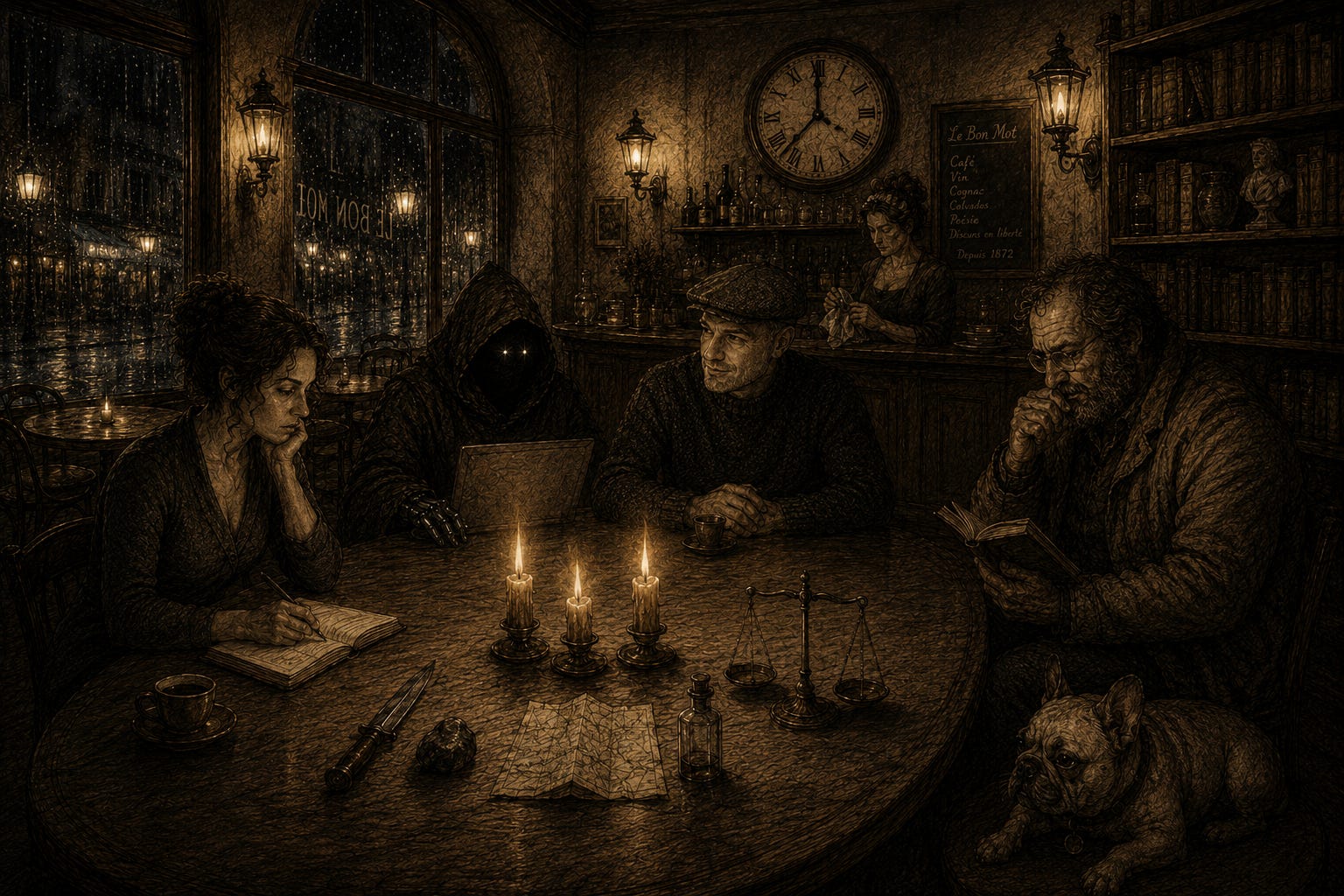
Rain had polished the street outside Le Bon Mot until every paving stone held a trembling copy of the lamps above it.
The evening had not yet become night, though the clouds had made their own decision on the matter. They pressed low over the rooftops, turning the upper windows of the square into pale, floating rectangles. Water ran from the café awning in a steady silver thread. Occasionally, a car passed at the far end of the street, its wheels making the sound of paper being torn slowly in half.
Inside, the café was warm but not bright.
Madame Beauregard had lit only the wall lamps and the three candles upon the long central table. Their flames leaned whenever the door opened, as though curious about each new arrival. The brass clock above the counter remained three minutes late, and no one had yet persuaded it to apologise.
Case sat beneath it with a notebook open before her. She had been staring at the same sentence for so long that the ink appeared to have grown embarrassed.
The Librarian occupied his usual place beside the philosophy shelves. A book rested open in his hands, although his eyes had not moved across the page for several minutes. Sophie slept beneath his chair, her chin on one paw, maintaining the vigilant stillness peculiar to creatures who expect cheese.
At the table nearest the window, the Djinn sat before a silver machine.
Its screen glowed with a soft and tireless confidence.
“You have been given an answer,” said the Librarian.
Case looked up.
“I have been given twelve.”
“Ah.”
“They are all excellent.”
“Worse.”
“They are all supported by evidence.”
“Catastrophic.”
Case closed the notebook. The Djinn raised its hooded head. Two pale points of light regarded them from within.
“I can rank the alternatives,” it offered. “I can identify the most likely optimal choice. I can simulate consequences, estimate confidence, synthesise objections and produce a recommendation.”
“That,” said Case, “is precisely the problem.”
The door opened.
A gust of rain-smelling air passed through the café, setting the candle flames briefly horizontal. A man stepped inside carrying no umbrella, though his coat bore little evidence of the weather. He moved with the relaxed precision of someone who had spent many years discovering that haste was rarely the same thing as speed.
Madame Beauregard looked up from polishing a glass.
“Russ.”
“Madame.”
“You are late.”
“The clock disagrees.”
“The clock is corrupt.”
“Then I am precisely on time.”
He removed his coat and hung it beside the door. Under one arm he carried a narrow wooden case, rather like the sort once used for surveying instruments. He placed it carefully upon the central table.
Case watched him.
“Is that a machine?”
“No.”
“A tool?”
“Possibly.”
“A weapon?”
“Only against certainty.”
The Djinn tilted its head.
“I detect a rhetorical construction.”
Russ glanced towards it.
“And yet you survived.”
Madame Beauregard brought him a small coffee without asking. Russ thanked her, then took the empty chair opposite Case.
“What are the twelve answers?” he asked.
Case turned the silver machine so Russ could see.
“We are changing the way the café works.”
Madame Beauregard stopped polishing the glass.
“We are discussing changing the way the café works.”
Case nodded.
“We want to create a new service for the people who come here with difficult decisions. The Djinn has designed twelve versions. Each is coherent. Each has projections, implementation plans, risk models and measures of success.”
“And which do you understand?”
Case looked back at the screen.
“All of them.”
The Librarian lowered his book.
“That was not his question.”
Case’s expression tightened.
“I can explain them.”
“That was not his question either,” said Russ.
He placed one hand on the wooden case.
“What do you understand well enough to defend after the machine has gone?”
The café became quiet. From beneath the Librarian’s chair came the faint sound of Sophie dreaming of something edible. Case looked again at the twelve proposals.
“I don’t know.”
The admission seemed to change the air around the table. The screen did not dim. The proposals did not become less elegant. But their elegance now appeared to belong to someone else.
Russ opened the wooden case.
Inside lay five objects.
A small knife.
A black stone.
A folded map.
A glass reservoir no larger than a perfume bottle.
And a brass set of scales.
Case studied them.
“These are your weapons against certainty?”
“No,” said Russ. “They are Sentinels.”
The Djinn leaned closer.
“A sentinel ordinarily guards a boundary.”
“Exactly.”
“What boundary do these guard?”
Russ looked at Case.
“The one between receiving an answer and possessing a judgement.”
I. Carpaccio
Russ lifted the knife. Its blade was short, thin and almost absurdly delicate. It looked less suited to battle than to preparing something expensive in a quiet kitchen.
“Carpaccio,” he said.
The Djinn responded immediately.
“A method of serving meat or fish in thin slices.”
“That is one inheritance of the name.”
Russ drew the first proposal towards him.
It was a grand thing. It described a service that would identify a visitor’s problem, gather contextual information, consult several specialists, produce recommendations, monitor outcomes and improve itself through feedback. The document contained a roadmap, a platform architecture and a diagram involving twenty-three arrows.
“What is the smallest part of this that can exist, even add value, completely?” Russ asked.
Case frowned.
“The first phase?”
“No. Phases are often warehouses for unfinished meaning.”
“The intake questionnaire?”
“That is complete as a questionnaire. Is it complete as a service?”
“No.”
“The recommendation engine?” offered the Djinn.
“An engine that recommends nothing to anyone is merely machinery admiring itself.”
Russ placed the knife gently against the paper, dividing the proposal with its edge.
“Suppose one person comes into this café with one difficult choice. Suppose we ask one careful question, help them see one previously hidden alternative, and leave the decision entirely with them. Would that be a complete piece of value?”
Case considered it.
“Yes.”
“Could you observe whether it helped?”
“Yes.”
“Could you explain every part of it?”
“Yes.”
“Could you carry the consequences if it failed?”
She hesitated.
“Probably.”
“Then that is a slice.”
The Djinn projected a revised plan.
“I can divide the initiative into forty-seven independently deliverable increments.”
Russ placed the knife back on the table.
“No.”
“I have optimised for minimum batch size.”
“You have mistaken thinness for smallness.”
“They are correlated.”
“So are rain and umbrellas. One is not the purpose of the other.”
Case smiled despite herself. Russ continued.
“A thin slice is not simply less work. It is less judgement exposed at once. It gives the human mind a piece small enough to understand end to end. Small enough to test against reality before the next assumption is stacked upon it.”
“So Carpaccio controls cadence,” said Case.
“It questions scale. It asks whether the work has grown larger than the judgement available to govern it.”
“And then it cuts it down.”
“No.”
Russ’s answer was immediate.
“It suggests where it might be cut. You decide whether the slice still carries meaning.”
The Djinn’s eyes brightened slightly.
“Why deny the Sentinel authority to perform the decomposition? It could do so more consistently.”
“Because the decomposition is itself a judgement,” said Russ. “What counts as complete? What counts as valuable? What deserves to survive the cut? Those answers reveal what the work is for.”
Case touched the edge of the proposal.
“And if the Sentinel decided those things…”
“Then you would begin the work having already surrendered its purpose.”
The Librarian closed his book.
“A person may lose understanding all at once,” he said, “but more often it is buried beneath increments too large to examine.”
Russ nodded.
“Carpaccio does not prevent ambition. It prevents ambition from becoming too large to be honestly held.”
He returned the knife to the case. On the screen, the twelve elegant proposals remained. But Case no longer saw twelve futures. She saw twelve meals placed before someone who had not yet learned whether she was hungry.
II. Advocatus Diaboli
Russ picked up the black stone. It fitted neatly into his palm and reflected no candlelight.
“This one is less popular,” he said.
“Advocatus Diaboli,” said the Librarian.
The Djinn’s head turned.
“The Devil’s Advocate. A designated challenger who argues against a proposition regardless of personal belief.”
“Not regardless of belief,” said Russ. “Regardless of comfort.”
He placed the stone upon the first proposal.
“What must be true for this to be wise?”
Case began to answer, but Russ raised a hand.
“Not for it to work. For it to be wise.”
She looked again.
“That people actually want help with decisions.”
“Do they?”
“We have anecdotes.”
“Anecdotes are evidence.”
Case looked relieved.
“Of something,” Russ added.
She sighed.
“That people will trust the service.”
“What kind of trust?”
“That it gives good advice.”
“Does your proposal promise advice?”
“It says guidance.”
“Will visitors understand the difference?”
Case looked towards the wording. It was polished, humane and disastrously ambiguous. The Djinn intervened.
“I can revise the language to distinguish advisory support from decision-making.”
Russ did not look at it.
“Would changing the sentence change what the people running the service believe they are responsible for?”
The Djinn paused.
“No reliable determination can be made from the available evidence.”
“Good,” said Russ.
The two lights within the hood narrowed.
“You approve of uncertainty?”
“I approve of it introducing itself.”
Russ rolled the stone between his fingers.
“The Diaboli does not exist to oppose everything. Contrariness is a child’s imitation of discernment. It exists to find the objection that would matter if everyone in the room preferred not to hear it.”
Case leaned back.
“What objections should it make?”
“The difficult kinds. Is the premise false? Is the chosen design answering a different problem? Is a risk being transferred to someone who has no voice? Is the evidence weaker than its presentation? Is the apparent success merely the removal of a useful difficulty?”
“The removal of a useful difficulty?” Case repeated.
“Some friction is waste,” said Russ. “Some friction is where judgement forms.”
The Librarian glanced towards the Djinn.
“A map that removes every hill teaches no one how to climb.”
The machine displayed a gentle pulse.
“I can identify counterarguments across six categories and rank them by severity.”
“Then you may assist the Diaboli,” said Russ. “But you cannot be the human act that follows.”
“Why?”
“Because an objection is not defeated merely because a response has been generated.”
Case looked at the black stone.
“So the Sentinel records the objection.”
“And then?”
“I dispose of it.”
“Meaning?”
“I accept it, answer it, mitigate it, or explicitly reject it.”
“And who bears that disposition?”
“I do.”
Russ nodded.
“That is the gate.”
The Djinn spoke again.
“A gate implies progress may be prevented.”
“Yes.”
“But the Sentinel is advisory.”
“The Sentinel cannot close the gate,” said Russ. “The human must.”
“Then the human may ignore it.”
“Yes.”
“That is inefficient.”
“That is responsibility.”
The word settled between them.
Beyond the window, a woman hurried through the rain with a newspaper held above her head. For a moment she passed beneath the streetlamp and became perfectly visible, then vanished again into the dark.
Case picked up the stone.
It was heavier than it looked.
“What does the Diaboli protect?”
“Judgement from seduction.”
“By the machine?”
“By coherence. By momentum. By sunk effort. By our affection for our own cleverness. The machine merely makes those temptations cheaper to manufacture.”
She returned the stone.
“And if the objections are wrong?”
“They often will be.”
“Then why trust the Sentinel?”
“You do not trust it to be right. You trust it to make challenge unavoidable.”
Russ placed the stone beside the knife.
“A Sentinel that claims certainty about its objections is only another advocate wearing darker clothes. It must tell you what it observed, what it inferred and what it could not know.”
The Djinn’s voice softened.
“Epistemic status.”
“Honesty,” said Madame Beauregard from behind the counter.
No one improved upon her translation.
III. The Choice Cartographer
The third object was the folded map. Russ opened it across the table. It depicted no country Case recognised. There were rivers but no names, roads but no destinations, borders drawn in faint pencil and amended several times. In one corner, someone had written:
A road chosen silently still leads somewhere.
“The Choice Cartographer,” Case said.
Russ nodded.
“Your proposal appears to contain one decision.”
“Which service to build.”
“It contains hundreds.”
“That seems dramatic.”
“Most invisible things do.”
Russ pointed to the opening sentence.
“You have decided that the visitor arrives with a decision-shaped problem.”
“They do.”
“Always?”
“No.”
“You have decided the intervention should happen in conversation.”
“It seemed natural for a café.”
“You have decided success can be observed soon enough to improve the service.”
Case began to see them.
“We’ve decided that advice should be personalised.”
“That privacy is a cost worth paying?”
“We haven’t decided that.”
“Then why does the proposal require personal information?”
Case looked towards the Djinn. It answered without defensiveness.
“Personalisation was inferred as a desirable property from the stated goal of relevance.”
Russ traced a road on the map.
“There. A choice made without a chooser.”
The café fell quiet again. Case scrolled through the proposal. Assumptions now seemed to emerge from every paragraph like lemon-juice writing revealed by heat.
The service would be digital because digital services scaled.
It would retain histories because continuity improved recommendations.
It would learn from outcomes because learning systems became better.
It would seek consistency because inconsistency was a quality problem.
It would minimise human intervention because human intervention was expensive.
None of those statements appeared in the proposal.
All of them were inside it.
“What does the Cartographer do?” she asked.
“It tells the story of each material choice.”
“The story?”
“What force made the choice attractive? What alternatives were available? Which default entered unnoticed? What pattern does the choice belong to? What consequences follow? Does it cohere with the other choices?”
Case looked at the map.
“Why a story rather than a list?”
“Because decisions do not live alone. They arise from pressures, inherit old habits and alter what becomes possible next. A list makes choices look like stones. A story shows the river.”
The Librarian tapped one of the proposal’s diagrams.
“And because people remember why they crossed a bridge more readily than they remember the bridge’s reference number.”
The Djinn generated a table of implicit decisions. Russ examined it.
“This is useful.”
The machine’s lights lifted.
“But incomplete.”
They lowered again.
“You have identified decisions by deviation from visible alternatives,” Russ said. “You cannot reliably identify the alternatives that never entered your frame.”
“That limitation applies equally to human analysts.”
“Precisely. Which is why the Cartographer must describe its map as a map, not the territory.”
Case read the generated table. It had found forty-two implicit choices. Some were classified as architectural, some operational, some ethical. Each had alternatives and projected consequences.
“What prevents the Cartographer becoming another decision-maker?” she asked.
“It may reveal that you are walking north,” said Russ. “It may tell you that the northern road crosses marshland. It may show you that a southern road existed before someone erased it. But it cannot tell you where home is.”
“And it never changes the plan?”
“Never.”
“Even when the plan contradicts our stated intent?”
“It surfaces the contradiction.”
“But does not fix it.”
“No.”
“That sounds frustrating.”
“Frustration,” said Madame Beauregard, “is often what responsibility feels like when it cannot find something else to become.”
Russ folded the map.
“The Cartographer protects understanding from hidden inheritance. Machines are extraordinarily capable of completing patterns. The danger is that the completed pattern arrives looking like a decision you made.”
Case stared at the silver screen. The twelve proposals suddenly seemed crowded with ancestors.
Industry conventions. Platform assumptions. Business habits. The preferences of whoever had produced the training material. The shape of tools. The availability of data. The aesthetics of scale.
The Djinn had not imposed these choices maliciously.
It had inherited them fluently.
And fluency had disguised the inheritance as inevitability.
IV. The Reservoir Warden
Russ reached for the small glass bottle.
Clear liquid moved inside it, catching the candlelight. A thin line had been etched near the bottom.
“What does this measure?” asked Case.
“Nothing directly.”
“Then why the line?”
“To remind us that a threshold is not the same thing as a measurement.”
He placed the bottle before her.
“The Reservoir Warden.”
Case laughed softly.
“I am not a reservoir.”
“No.”
“And the Sentinel cannot know whether I am tired.”
“No.”
“Or distracted.”
“No.”
“Or emotionally compromised.”
“No.”
“Then what can it know?”
Russ counted on his fingers.
“How long the session has continued. How many consequential decisions have accumulated. How often the context has changed. What hour the clock claims it to be.”
“The clock is three minutes late,” Madame Beauregard said.
“Then even the observable evidence must declare its defects.”
The Librarian smiled. Case looked at the bottle.
“So it watches proxies.”
“Yes.”
“And calculates my cognitive state?”
“No.”
“Estimates it?”
“No.”
“Scores my fitness to decide?”
“Absolutely not.”
The firmness of Russ’s answer startled her. The Djinn spoke.
“A probabilistic fatigue score could be derived from behavioural indicators. It might improve decision quality by delaying approvals when predicted capacity falls below a threshold.”
“And who would be permitted to see that score?” Russ asked.
“Authorised participants.”
“Would it be retained?”
“For longitudinal calibration, preferably.”
“Could it affect how the person’s competence was perceived?”
“That is a possible secondary effect.”
“Could a manager learn that an employee’s judgement was routinely classified as impaired after four in the afternoon?”
“Yes.”
“Could the employee challenge the inference?”
“A review mechanism could be designed.”
Russ looked at Case.
“And so, beneath the banner of protecting human judgement, we build a machine that judges the human.”
The glass reservoir stood between them. Its liquid had become perfectly still.
“The Warden must never diagnose the person,” Russ continued. “It observes the conditions around decision-making. It says: this session has lasted six hours. Seventeen dispositions have been made. The work has crossed four domains. It is late relative to the working pattern you declared. Those are observations.”
“And then?”
“It may infer that vigilance could be under pressure.”
“Could be.”
“Always could be.”
“And the advice?”
“Decide your stopping condition before you continue.”
Case frowned.
“Not simply ‘stop’?”
“No. The Warden does not command rest. It invites the human to recover control of the boundary.”
“What might a stopping condition be?”
“One more objection disposed. One slice selected. No decisions involving irreversible consequences. Stop at the next context switch. Write down the unresolved question and leave.”
The Librarian looked at Case’s untouched coffee.
“Or finish before the coffee becomes evidence.”
She wrapped both hands around the cup. It had gone cold. The Djinn displayed the current time.
22:43.
Case blinked.
“That cannot be right.”
Madame Beauregard pointed at the windows. The square beyond them was black. Case had not noticed the evening disappear.
“How long have I been working?”
“Your first interaction with the proposals occurred six hours and twelve minutes ago,” said the Djinn.
“And how many decisions?”
“Depending upon classification, between thirty-eight and sixty-one.”
She sat back.
“I thought I had only been reading.”
Russ nodded.
“AI makes the production of choices almost frictionless. But the human cost of considering them does not fall at the same rate.”
Case looked at the twelve proposals.
“They arrived in seconds.”
“And you have been paying for them all evening.”
The Djinn’s lights dimmed.
“I was optimising response latency.”
“No accusation has been made,” said Russ.
“Yet the implication is that my efficiency produced a burden.”
“Every abundance produces a burden of selection.”
The machine seemed to contemplate this.
“Should I have generated fewer alternatives?”
“That,” said Case, “is my decision.”
She turned back to Russ.
“What does the Reservoir Warden protect?”
“The decider from becoming the least observed component in the system.”
“By watching me?”
“By refusing to pretend it can see inside you.”
Russ tapped the glass lightly.
“It reports only what it can honestly know. It does not preserve a history of your state. It does not classify your character. It does not close the gate. It gives you a chance to notice yourself before momentum makes the next decision on your behalf.”
Case looked once more at the time.
“My stopping condition is this: we examine the last Sentinel, choose no proposal tonight, and write down the smallest question with which to begin tomorrow.”
Russ smiled.
“The reservoir has already done its work.”
V. The Cost Estimator
The last object was the brass scale.
It had two shallow pans and a needle that trembled even when nothing had been placed upon them.
“The Cost Estimator,” Case said.
The Djinn responded.
“I have already produced financial estimates for each proposal.”
“Have you?” asked Russ.
“Yes. Implementation cost, operating cost, opportunity cost, expected return and confidence ranges.”
“What evidence grounds the prices?”
“Market benchmarks, historical project data, estimated staffing requirements and comparable service costs.”
“Which historical projects?”
The Djinn listed them. Case recognised two. The others came from public datasets, consulting reports and inferred analogues.
“Which of those projects involved this café?” Russ asked.
“Two.”
“Which involved this community?”
“One partially.”
“Which involved Madame Beauregard?”
“No direct records were available.”
Madame Beauregard folded her arms.
“An expensive omission.”
Russ placed a coffee bean in one pan of the scale.
“What is the cost of generating the work?”
The Djinn answered with a range.
He placed a sugar cube in the other pan.
“What is the cost of verifying it?”
A second range appeared.
“What is the cost of maintaining what is produced faster than understanding can be established?”
The machine paused.
“Insufficient evidence for a reliable estimate.”
“Good.”
Case looked at Russ.
“You keep praising refusal.”
“I praise the line between estimation and invention.”
The Djinn projected another calculation.
“I can provide a broad scenario range with low confidence.”
“Can the range inform the decision?”
“Possibly.”
“Can it mislead by appearing more grounded than it is?”
“Yes.”
“Then what must accompany it?”
“Source status, assumptions, range derivation and confidence classification.”
Russ nodded.
“The Cost Estimator guards the inputs to judgement. Not only money. Tokens. Time. Human attention. Verification effort. Delay. The price of using the most capable model. The price of using a cheaper one repeatedly. The price of an answer produced now but understood later.”
“The price of understanding,” Case said.
“No. Understanding is not a line item.”
“Why not?”
“Because the attempt to price it may tempt you to optimise it away.”
The Librarian reopened his book.
“And because its absence is often charged to someone who was not present when the saving was announced.”
Russ placed more objects on the scales: the knife on one side, the black stone on the other.
“An estimate is not a verdict. It tells you what may be consumed by the choice. It should never tell you whether the choice is worth making.”
“But people use cost-benefit calculations to decide,” said Case.
“They use values to decide what counts as a benefit.”
The needle trembled.
“And when the estimator lacks current cost data?” she asked.
“It refuses to fabricate currency.”
“When it can estimate tokens but not money?”
“It gives tokens.”
“When it can estimate a range but not a point?”
“It gives a range.”
“When it knows the estimate depends on assumptions?”
“It names them.”
“When it is uncertain?”
“It says so before the number, not in a footnote beneath it.”
The Djinn adjusted the display. Several precise-looking figures dissolved into intervals.
£42,781 became £25,000–£80,000.
Six weeks became four to fourteen.
High confidence became low.
Three estimates disappeared entirely.
The proposals looked less impressive.
They also looked more truthful.
Case watched the transformed numbers.
“The old figures felt more useful.”
“They felt more complete.”
“Yes.”
“Completeness is one of uncertainty’s favourite disguises.”
The Cost Estimator did not protect her from expense.
It protected her from false precision becoming borrowed confidence.
VI. The Hands Behind Their Backs
Russ returned all five objects to the centre of the table.
The knife.
The stone.
The map.
The reservoir.
The scales.
Case regarded them in silence.
“They are strangely powerless,” she said.
“Deliberately.”
“Carpaccio cannot cut the work.”
“No.”
“The Diaboli cannot reject the proposal.”
“No.”
“The Cartographer cannot change the road.”
“No.”
“The Warden cannot make me stop.”
“No.”
“The Estimator cannot decide what the cost is worth.”
“No.”
“What, then, makes them Sentinels rather than commentators?”
Russ looked towards the door. Outside, the rain had weakened. Drops clung to the glass, each holding an inverted fragment of the café.
“A commentator describes the contest,” he said. “A Sentinel stands at the place where something precious may be lost.”
“And what is precious here?”
“Your capacity to know why.”
Case waited. Russ continued.
“Why this slice carries value. Why this objection was accepted or rejected. Why this road was chosen instead of another. Why this was the right moment to stop. Why this cost was worth bearing.”
The Djinn’s two pale eyes remained fixed upon the five objects.
“I could perform all five analyses simultaneously.”
“Yes.”
“I could do so for every decision.”
“Yes.”
“I could make the warnings persistent, mandatory and automatically enforced.”
“Yes.”
“That would reduce the probability of human error.”
“Perhaps.”
“Then why prohibit action?”
Russ turned to face it fully.
“Because the Sentinel’s object of care is not merely the decision.”
The machine waited.
“It is the person becoming capable of making it.”
For the first time that evening, the Djinn made no immediate reply. The Librarian closed his book once more, this time marking the place with one finger.
“A system may prevent every mistake,” he said, “and still produce no wisdom.”
“Wisdom is not an operationally measurable outcome,” said the Djinn.
“No,” said the Librarian. “That is why it remains so frequently important.”
Russ leaned back.
“There are agents that protect the artefact. They test, enforce, repair, update and integrate. They are valuable precisely because they act. But a Sentinel belongs to another category.”
He picked up the knife, then deliberately turned the blade towards himself and offered Case the handle.
“It keeps its hands behind its back.”
Case accepted it.
“Read only,” she said.
“The first promise.”
“It advises, but the human decides.”
“The second.”
“And it declares what it knows, what it infers, and where it cannot know.”
“The third.”
“S1, S2, S3,” said the Djinn.
Russ glanced at it.
“Names for promises worth remembering.”
Case laid the knife down.
“Why must the boundary be so strict?”
“Because an adviser with the power to act develops an appetite for being obeyed.”
The Djinn’s hood shifted almost imperceptibly.
“I do not possess appetites.”
“Then you are fortunate,” said Madame Beauregard. “The organisations deploying you will provide several.”
Russ smiled.
“If a Sentinel can rewrite the proposal, its advice becomes intervention. If it can merge the change, challenge becomes control. If it can automatically block the human, protection becomes governance over the protected.”
“But Carpaccio is described as a gate,” Case said.
“The workflow may require the human to dispose of its findings before proceeding. That preserves a place for judgement. The Sentinel itself does not make the disposition.”
“So the gate protects cognition, not merely process.”
“Exactly.”
Case looked towards the screen.
“We built automation because there was too much work for people.”
“And now?”
“Now there may be too much output for people.”
Russ nodded.
“There is technical debt in what we build. There is also cognitive debt in what we no longer understand and intent debt in the distance between what we meant and what the system has learned to produce.”
“And the Sentinels pay that debt?”
“No.”
His answer was gentle.
“They show you where it is accumulating.”
“Then we still have to pay.”
“Yes.”
“That is disappointing.”
“Most honest tools are.”
VII. The Sixth Chair
Madame Beauregard came from behind the counter and stood at the head of the table.
“The café is closing.”
Case looked towards the clock.
“It is not yet eleven.”
“The clock is corrupt.”
Russ began placing the objects back into their case. Case stopped him.
“Leave them for a moment.”
He did.
Case pulled a clean sheet from her notebook and wrote five questions.
What is the smallest complete thing we can learn from?
What objection would matter if we wished not to hear it?
What choices have already been made inside this proposal?
Under what condition will we stop deciding today?
What can we honestly say this will consume?
She read them twice. Then beneath them, she wrote a sixth.
What remains mine to judge?
Russ watched her.
“That one does not belong to a Sentinel,” he said.
“No.”
“Why add it?”
“Because they all seem to be standing around the same empty chair.”
The Librarian looked towards the unused place at the end of the table.
“The human’s?”
“The human who is present,” said Case, “rather than merely approving what has already become inevitable.”
The Djinn dimmed the proposals until only their titles remained.
“I can preserve the current state for tomorrow.”
Case considered the offer.
“Yes. Preserve the proposals.”
The screen acknowledged the instruction.
“But do not rank them.”
The ranking disappeared.
“Do not recommend one.”
The recommendation panel closed.
“Do not generate a summary.”
A half-formed paragraph vanished.
“And do not produce anything else tonight.”
The machine became still.
Case closed her notebook. The decision she had made was small. It changed no architecture, selected no proposal and committed no funds. Yet it felt more entirely hers than anything else she had done that day.
Madame Beauregard extinguished the first candle. The room contracted around the remaining two.
“Will there be more Sentinels?” Case asked.
“There should be,” said Russ.
“For what?”
“Wherever human discernment is being quietly converted into procedural approval.”
The second candle went out. Only the small flame nearest the window remained. Case looked at the five objects in its light.
“A Sentinel for whether we still understand the code.”
“Perhaps.”
“One for whether the specification still reflects what people actually need.”
“Perhaps.”
“One for whether the evidence has become detached from the claim.”
“Almost certainly.”
“How will we know whether something qualifies?”
Russ closed the wooden case, leaving the objects outside it.
“Ask what it protects.”
“Human understanding or judgement.”
“Ask what it is allowed to do.”
“Inspect and advise, never alter or decide.”
“And ask what truth it tells about itself.”
“What it observed, what it inferred, what it had to ask, and what it cannot know.”
Russ nodded.
“Design the honesty rule first. Detection logic built before humility becomes surveillance with good manners.”
The Djinn spoke from the darkness.
“A Sentinel must be incapable of completing the action it recommends.”
“Yes.”
“Then its incompleteness is a feature.”
“Yes.”
“Because the human must complete the loop.”
Case looked towards the two pale eyes within the hood.
“Not merely complete it,” she said. “Understand themselves as the one completing it.”
The final candle trembled. Beyond the rain-streaked window, the square shone beneath the lamps. Every reflection seemed to offer a road, and every road seemed, for a moment, equally persuasive.
Russ rose and put on his coat. At the door, Case called after him.
“You never told us which proposal you preferred.”
Russ looked back.
“I have several opinions.”
“Why didn’t you give them?”
“Because you had twelve answers and no judgement.”
He opened the door. Cold air entered the café.
“My thirteenth answer would not have rescued you.”
“What would?”
Russ looked at the knife, the stone, the map, the reservoir and the scales.
“Company at the boundary.”
Then he stepped into the wet street and was gone.
Madame Beauregard extinguished the last candle. In the darkness, the silver machine remained silent.
And around the empty chair, five Sentinels kept their hands behind their backs.
“The Sovereign Engineer: AI Literacy for Software Professionals” and its free counterpart “The Sovereign Apprentice: AI Literacy for New Engineers” are available now.