

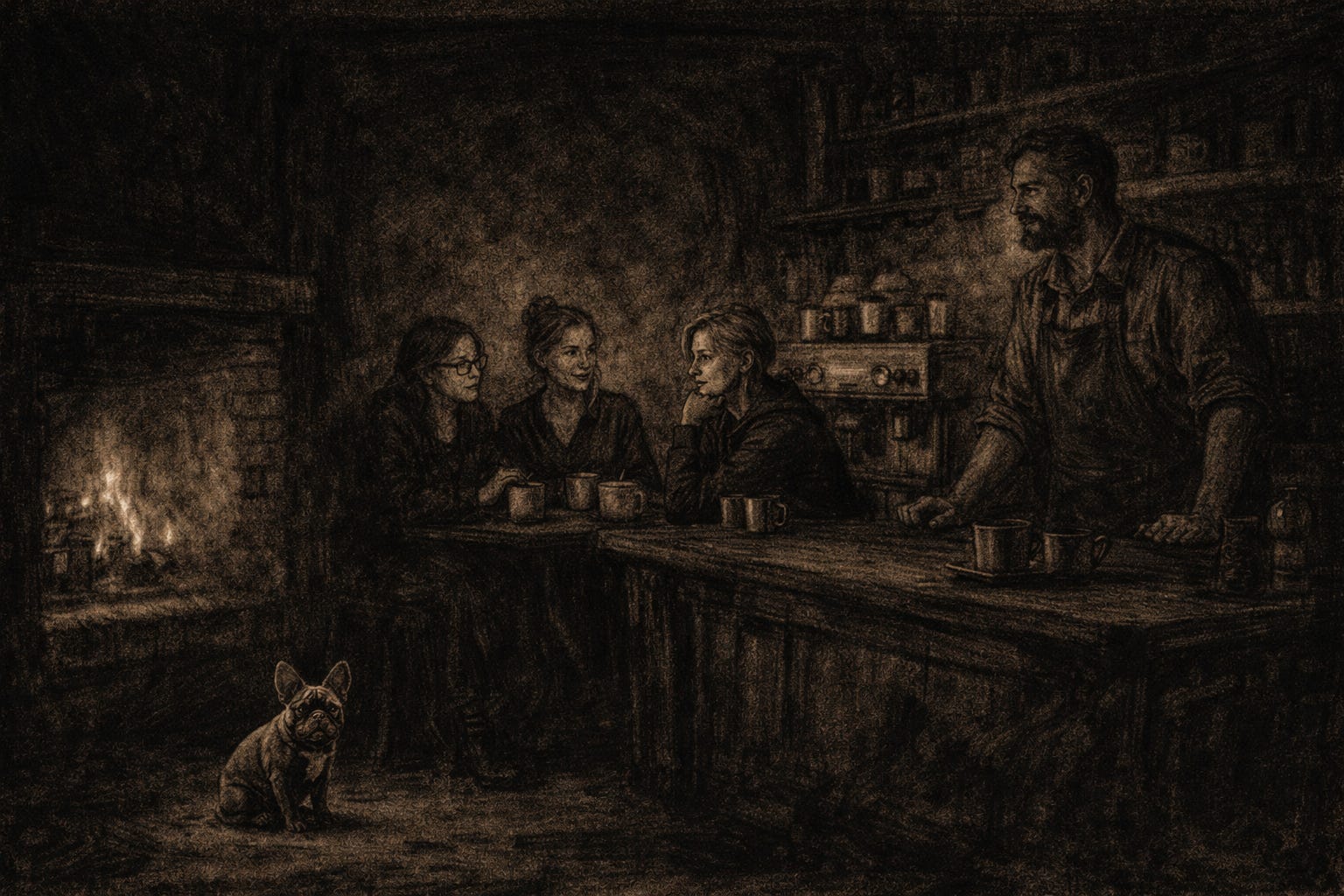
The espresso machine hissed in Latin. It always did, to the point of being socially acceptable. Not loudly—never loudly—but with the quiet insistence of something that understood pressure better than most people ever would.
Étienne adjusted the grind by a fraction. He no longer measured coffee in grams. He measured it in response.
The Room That Looked Like Collaboration
Before Le Bon Mot, there had been glass. Always glass. Walls that implied transparency while reflecting everything back at you.
Étienne had helped design that place. Not the architecture—the system. A system for contribution. Or so they called it.
There were forums for ideas, dashboards for visibility, structured rituals for feedback. Everything the leadership article would later describe as mechanisms for voice.
And yet no one spoke. Not really.
It happened during a “contribution session.” A bright, hesitant junior engineer offered an idea. Not fully formed. Not perfect.
The room tilted. Not visibly. Not aggressively. Just enough.
A senior voice reframed it. Another improved it. A third summarised it—cleaner, sharper, safer. And by the end, the idea had been accepted. Accepted beyond all recognition or attribution.
But the person who offered it … never spoke again.
That night, Étienne had stared at the participation metrics.
High engagement. High input. And yet no risk, no original voice, no ownership.
Only later would he find the words:
Psychological safety is not a feeling.
It is a precondition for contribution.
Without it, voice becomes performance.
The failure, when it came, was subtle. A decision made too late. A concern never raised. A pattern noticed but not spoken.
Because no one felt they could.
In the post-mortem, leadership asked the wrong question:
“Why didn’t people speak up?”
Étienne felt the answer before he could articulate it:
Because the system had never truly invited them to.
Culture Is What the System Rewards
The organisation had values. Beautiful ones.
“Transparency.”
“Collaboration.”
“Innovation.”
But none of them showed up in how decisions were made. Or who was heard. Or what was rewarded.
And so people learned. Quietly. Efficiently. To:"
Say what is safe.
Offer what fits.
Withhold what might disrupt.
Later, Étienne would read something that felt like a mirror held to that past:
Culture is not what you say, it’s the behaviours your systems enable and reinforce.
He left soon after. Not in protest. But in absence.
Coffee, and the Discipline of Not Forcing Things
Le Bon Mot did not ask any questions. The Librarian simply handed him an apron.
“Coffee,” she said, “is mostly about restraint.”
At first, he worked like before:
Precise. Controlled. Optimised.
But coffee refused.
Too much pressure: bitter.
Too little: weak.
Too rigid: dead.
It changed with the air. With the bean. With the moment.
And slowly, reluctantly, Étienne began to understand:
You cannot force extraction.
You can only create the conditions where it becomes possible.
Contribution Must Be Invited, Not Extracted
One morning, he watched the Librarian interact with a regular. They were struggling to explain something.
Half-words. Pauses. The old system in him twitched — refine it, clarify it, fix it.
But the Librarian did nothing. She waited.
And the idea arrived. Not polished. But real.
Étienne felt something shift. Not extraction. Invitation. And a recognition.
People do their best work when systems create belonging, voice, and growth — not pressure.
The Conversation of the Words
Arty had arrived on a grey afternoon. Case was already there. The Librarian, as ever, seemed to have always been. Sophie simply observed.
The conversation began with hesitation. Not lack of thought. But lack of language.
“The words we didn’t have,” Arty said.
Case nodded.
Silently, unnoticed, Étienne froze behind the counter. Because he had lived an entire failure made of that absence.
As the conversation deepened, themes emerged:
the inability to name uncertainty,
the difficulty of expressing partial ideas,
the absence of shared language for thinking together.
Case said quietly:
“A habitat that cannot hear its people cannot evolve.”
Étienne remembered the old system again.
The dashboards. The processes. The “channels for contribution.”
They had built interfaces but not language.
And without language uncertainty becomes silence, ideas remain internal, contribution never arrives.
He placed three coffees down. Carefully. Listening now, not just to words but also to what struggled to be said.
The Redesign of a Place That Never Claimed to Be Designed
The emergence of what Le Bon Mot is today began invisibly. A chalkboard appeared:
What are you noticing today?
No instructions. No requirement. Just an invitation.
Then Etienne stopped finishing people’s sentences. He asked questions without expecting answers. He let pauses live longer than comfort allowed.
At first, nothing happened.
Then …
Something did.
A customer offered an unfinished thought. Another picked it up. A third extended it.
Not because they were told to. But because the space allowed it.
Étienne saw it clearly now:
People contribute when they feel safe enough to risk, valued enough to speak, connected enough to care.
Contribution was not an individual act.
It was an environmental outcome.
What Are You Here For?
It was late. The café had thinned into quiet. The Librarian asked the question as if it had been waiting all day:
“What are you here for, Étienne?”
He opened his mouth. Closed it. Tried again.
“I used to think I built systems,” he said.
A pause.
“I think I was building silence.”
Case did not interrupt. Arty did not fill the gap. Sophie looked to be asleep, the fireplace was cosy.
The Librarian simply watched.
“And now?” she asked.
Étienne looked around. At the half-finished conversations. The lingering questions. The quiet courage of people trying to say something they didn’t yet fully understand.
“I think,” he said slowly,
“I’m here to help people say things before they’re ready.”
Sophie
The fire crackled.
And from beside it—small, almost unnoticed—sat Sophie.
She watched Étienne. Not expectantly. Not curiously.
Just… present.
Étienne met her gaze.
And something in it, something wordless and precise, cut through everything he had been thinking.
Not systems. Not culture. Not contribution.
Just:
Why?
What was he really here for? And why?
Not the organisational why. Not the mission statement. The quieter one. The one beneath all of it.
Sophie tilted her head slightly.
And in that moment, Étienne remembered:
You are not here to control the system.
You are here to care for the conditions.
Not to extract. Not to optimise. Not to perform. But to enable others to become. To be creative. To thrive.
The espresso machine hissed again. Softly. As if in agreement:
Non cogimus crescere.
We do not force growth.
And Étienne, finally, not as barista, not as architect, not as exile, but as something quieter, and far more potent…
Chose to stay.
The Fourth Voice
If you listen closely in Le Bon Mot, you can hear it. Not Case. Not the Librarian. Not the regulars, and not even Sophie.
A fourth voice. Not speaking, but shaping. The one that asks:
Is this a place where something unfinished can live long enough to become true?
And if the answer is yes…
Then the habitat is working.
Some points behind the story
The Bridges Summit and the works shared the inspiration for this little story:
Building Cultures That Invite Contribution: A Blueprint for Thriving Teams
The foundational article: reframes productivity toward participation, contribution, and shared ownership, grounded in real-world industry and research dialogue.
Dimensions of Software Excellence (Bridges Summit follow-up)
Expands the frame: if productivity is insufficient, what should we optimise for instead? A useful companion lens for redefining success beyond output.
Reframing “Productivity”: What Are We Aiming For?
Challenges metric-centric thinking and highlights the risks of reducing human systems to narrow efficiency measures.
These works (and further readings I encourage you to delve into!), in particular the “Building Cultures That Invite Contribution: A Blueprint for Thriving Teams” work, converged, for me, on a powerful synthesis:
Contribution is not a behaviour you demand.
It is a property of the environment you design.
Or in Habitat Thinking terms:
Platforms and teams do not produce value.
Habitats are purposefully designed to allow it to emerge.
Connecting the dots
“The wisdom is already in the room”; Étienne learns to listen; Habitat reveals, not extracts
Starting with the foundational belief that the knowledge needed for change already exists within the system. In the story Étienne stops correcting, refining, and shaping ideas and begins waiting. The unfinished thoughts of others become the source of insight. In habitat thinking the platform is not the source of intelligence, it is the medium through which system intelligence becomes visible.
“Bring the whole system together”; The café becomes the room; Habitat enables co-presence
Starting with meaningful change requires diverse voices in shared conversation. In the story Le Bon Mot gathers Case, the Librarian, Arty, and others. Not as roles, but as perspectives. In habitat thinking fragmentation is a failure mode. The habitat must reduce distance between perspectives and reference frames.“Start from strengths, not problems”; The shift in questions; Habitat amplifies what gives life
Reframing from fixing problems to building on what works. In the story the question changes from “What’s wrong with this idea?” to “What is trying to emerge here?” In habitat thinking systems that fixate on failure create fear and systems that amplify strengths create momentum and agency.
“Design the conditions, not the outcome”; Coffee becomes the teacher; Habitat is designed, not dictated
Don’t script solutions and design environments for emergence. In the story Étienne learns you cannot force extraction, only prepare the conditions. In habitat thinking platforms should not prescribe behaviour. They should instead provide affordances that make good behaviour natural.
“Everyone has a voice”; Silence becomes space; Habitat protects unfinished thinking
Every perspective is included and valued. In the story the most important shift is subtle: Pauses are no longer filled and incomplete thoughts are no longer corrected. In habitat thinking silence is not absence, it is unformed contribution waiting for safety.
“Make thinking visible and shared”; The chalkboard; Habitat externalises cognition
The importance of making ideas visible and collectively owned. In the story this is the chalkboard, the repeated phrase, and the idea picked up by another. In habitat thinking observability is not just for systems, it is for thought, intent, and emergence.
“Co-creation creates ownership”; The idea evolves across voices; Habitat distributes authorship
People commit to what they help create. In the story no idea belongs to one person. Each is shaped, extended, and carried forward. In habitat thinking ownership is not assigned, it is an emergent property of participation
“The experience is the culture”; Le Bon Mot itself; Habitat is the system
How people collaborate becomes the culture. In all these stories Le Bon Mot is not describing a better way of working. It is enacting it. In habitat thinking culture is not layered on top of systems it is produced by them.
“Contribution emerges from belonging”; The emotional arc of Étienne; Habitat restores humanity
Belonging drives engagement and contribution. In the story Étienne moves from control to absence to care and in doing so rediscovers his own place in the system. In habitat thinking systems do not just produce output, they produce identity and meaning.
“Trust the system”; Sophie’s silent question; Habitat is an act of belief
People have something worth contributing. This is a core belief and foundation of trust. In the story Sophie does not explain. She simply looks, and Étienne remembers. In habitat thinking you cannot design a system that invites contribution if you do not believe contribution already exists.
A thriving system is not one where people are told to contribute.
It is one where they cannot help but do so.