
The Frogs of Le Bon Mot
A Tale of Descent, Debate, and the Seductive Hum of Appearing to Make Sense

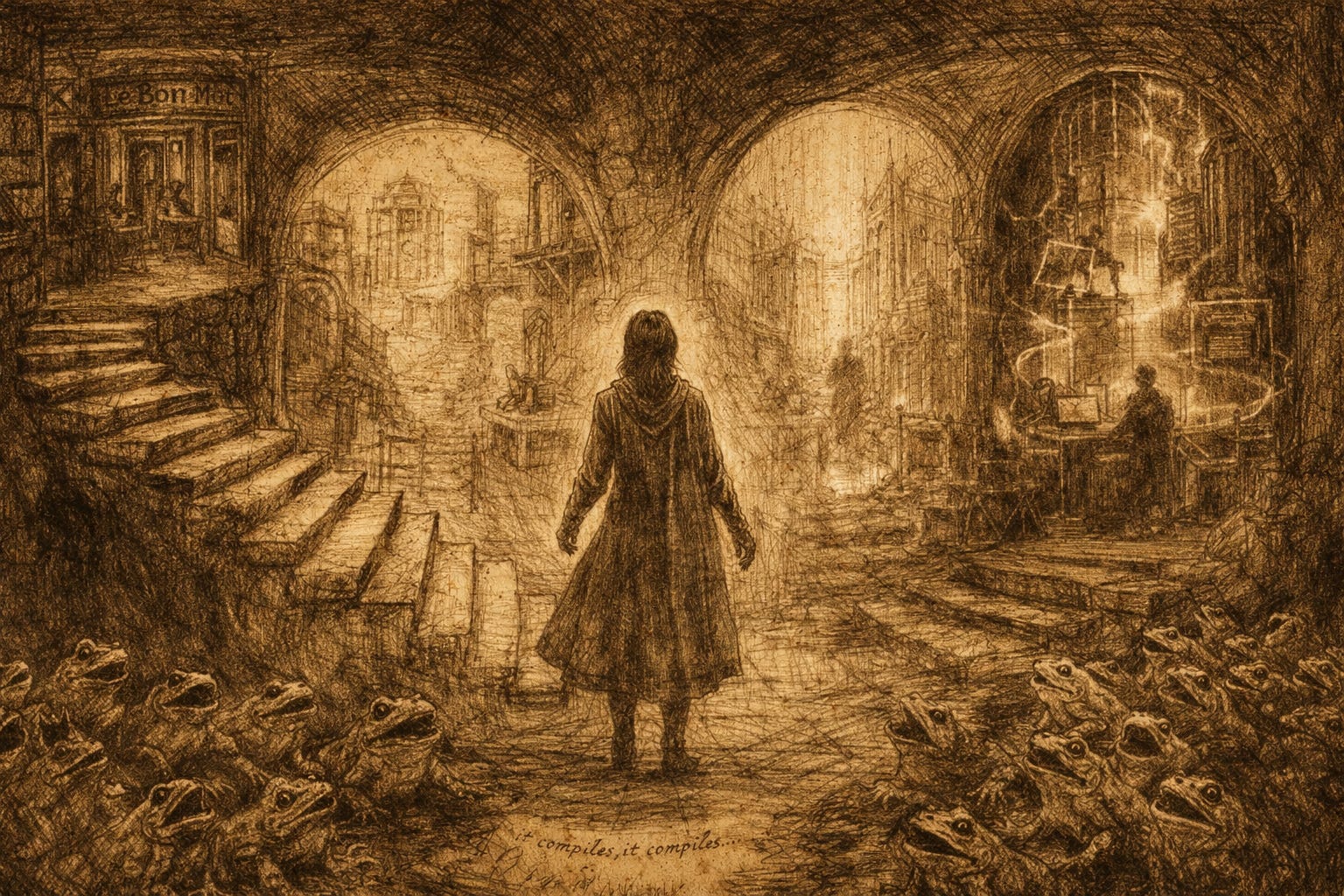
There are cafés that serve coffee, and there are cafés that serve as portals to the underworld.
Le Bon Mot, tucked between a second-hand bookshop and a locksmith who claimed to open only “conceptual locks,” had always done both and more. Though the portal had, until this particular Tuesday, been strictly metaphorical.
The trouble began, as troubles often do in establishments of philosophical inclination, with a complaint about the state of the art.
Case was seated at her usual table beneath the brass clock that ran three minutes late. She was reading a pull request on her laptop. Not because she intended to approve it, but in the way a forensic linguist might study a ransom note. The code had been generated by an AI assistant. It was, by every surface metric, beautiful. It compiled. It passed tests. It read like a love letter from a future in which humans no longer needed to understand anything.
“The trouble,” Case said to no one in particular, “is that it makes perfect sense.”
Madame Beauregard, proprietor and philosopher-queen of Le Bon Mot, looked up from polishing a glass that had been clean for several minutes. “And this is a problem?”
“It is the problem,” Case replied. “Coherence is a helluva drug.”
She closed the laptop. “When something reads beautifully, we stop interrogating it. We mistake the feeling of understanding for the fact of it. The code flows. The explanation holds. The narrative is seamless. And somewhere beneath that seamlessness, the actual logic is doing something nobody asked for, understood, or can safely change.”
Madame Beauregard set down the glass. “You speak as though the industry has lost something.”
“It has,” Case said. “It has lost the ability to tell the difference between eloquence and meaning. And the two people most responsible for this confusion are both, metaphorically speaking, dead.”
At this point, the chalkboard behind the counter, whose letters were known to rearrange themselves when unobserved, displayed a new message:
TONIGHT: THE DESCENT
A journey to retrieve what the living have squandered
Bring your own ontology
Case stared at it. Madame Beauregard stared at it. Neither claimed to have written it.
“It appears,” Madame Beauregard said, ringing the small brass bell she kept for moments of cosmic significance, “that the café has opinions.”
The descent began at the back of Le Bon Mot, through a door that Case had always assumed led to a storeroom. It did, in a sense. The storeroom simply happened to contain, behind a shelf of emergency Darjeeling and a portrait of Ada Lovelace, a staircase that wound downward into what can only be described as the Underworld of Deprecated Ideas.
Case descended. Madame Beauregard followed, carrying a thermos of espresso and an air of serene inevitability.
“One does not journey to the land of the dead without caffeine,” she observed.
The staircase opened into a vast, dim space that resembled a conference hall designed by Borges and abandoned by its janitorial staff. The ceiling was either very high or absent entirely. The floor was tiled with rejected Stack Overflow answers. Somewhere in the distance, a choir of frogs (actual frogs, or possibly something worse) croaked in a rhythm that sounded unsettlingly like a CI/CD pipeline.
Brekekekex ko-ax ko-ax.
“What on earth,” Case whispered.
“Not on earth,” Madame Beauregard corrected. “That is rather the point.”
The frogs, it transpired, were not frogs at all but the accumulated ghost-sounds of every build that had passed in CI while the underlying system was profoundly broken. They croaked in unison, a marsh of false positives, and their song was this: It compiles, it compiles, it compiles.
“Ignore them,” Madame Beauregard advised. “They are the chorus. Every tragedy needs one.”
The purpose of the descent, Case understood now with the clarity that comes from walking through a metaphysical basement, was retrieval. Something had been lost in the world of the living, some vital principle of software craft, and it had sunk here, to the place where abandoned ideas go to haunt the ambitious.
The question was: which lost principle, and who could be trusted to carry it back?
The Underworld was populated by shades. Most were harmless: deprecated frameworks, retired paradigms, the ghost of a startup that had pivoted seventeen times before dissolving into a podcast. But two shades, seated on opposite ends of a stage that materialised from the gloom like a keynote that nobody had registered for, were distinctly not harmless.
They were arguing.
The first shade, let us call him The Architect, sat in a chair that somehow conveyed the impression of a throne, a lecture podium, and a very expensive ergonomic desk all at once. He was tall in the way that ideas are tall: imposing, load-bearing, and slightly intimidating to approach without preparation. He had built tools that millions used daily. His philosophy could be summarised as: Give developers the primitives. Let them compose. Trust the human to hold the model in their head.
His tools were beloved by those who understood them, which was a smaller number than his follower count suggested.
The second shade, let us call him The Accelerant, sat in a chair that was also a beanbag, also a standing desk, also a hammock, depending on the angle from which you observed it. He radiated energy the way certain celestial objects radiate gamma rays: impressively, and with consequences for anyone standing too close. His philosophy could be summarised as: Ship it. The AI will handle the rest. Understanding is a bottleneck; velocity is the product.
His tools were beloved by everyone who had a demo due tomorrow.
They had been arguing, the attending spirits informed Case, for approximately eternity, which in underworld time translated to about six months of X discourse.
“You cannot simply vibe an architecture into existence!” The Architect was saying, his shade flickering with the barely contained frustration of a man who had spent decades thinking carefully about abstractions only to watch a generation discover that you could skip the thinking part entirely if you typed fast enough.
“And you cannot simply lecture people into competence!” The Accelerant shot back, vibrating with the energy of someone who had built fourteen applications before breakfast, all of which worked and none of which he could explain to a second person. “The world doesn’t wait for your mental models. The world ships.”
Case settled into a seat that appeared for her. Madame Beauregard poured espresso into cups that had not previously existed. The frogs continued their infernal chorus: It compiles, it compiles, it compiles.
“We are here,” Case announced, with the authority of someone who has walked through a metaphysical storeroom and is no longer in the mood for politeness, “because the living world has a problem. Code is being generated at extraordinary speed and extraordinary quality. It reads well. It runs well. It passes every automated check. And increasingly, no one understands it.”
“Because they never learned to!” The Architect said.
“Because they don’t need to!” The Accelerant countered.
Case held up a hand. “The problem is not speed. The problem is not craft. The problem is coherence.”
Both shades paused.
“Go on,” said The Architect, warily.
“Coherence,” Case continued, “is the quality that makes generated code feel correct even when it isn’t. It’s the narrative glue. When an AI produces a function that reads like it was written by a thoughtful senior engineer, we experience a sensation of understanding. The variable names make sense. The comments explain the intent. The structure follows patterns we recognise. And this sensation is so powerful, so pharmacologically satisfying, that we stop asking the only question that matters.”
“Which is?” asked The Accelerant.
“Do I actually understand what this does, and can I change it safely when the world shifts?”
Silence, except for the frogs.
Madame Beauregard sipped her espresso. “Coherence,” she said, “is a helluva drug.”
The contest, for it had become a contest — the underworld apparently ran on dramatic structure the way the living world ran on YAML — proceeded as follows.
The Architect was asked to produce a system. He did so slowly, deliberately, narrating each decision. The data model was minimal. The boundaries were explicit. The names were chosen not for elegance but for honesty. Where ambiguity existed, he left a comment that said, simply: This is ambiguous. Discuss before extending.
It was not beautiful. It was not fast. It was the software equivalent of a hand-drawn map with annotations in the margins: here be dragons, this path floods in winter, ask Margaret about the bridge.
“This,” The Architect said, “is habitable. A stranger could live here. A team could modify it without fear. It is a little ugly, maybe a little slow, and when something breaks, three people can reason about why.”
The Accelerant laughed with the genuine delight of someone who finds sincerity charming in the way that horse-drawn carriages are charming: nostalgic, photogenic, and absolutely useless for getting across town.
“My turn,” he said.
He produced a system. Or rather, an AI produced a system while he directed it with the casual confidence of an orchestra conductor who does not personally play any of the instruments but has excellent taste in music. The code arrived in waves. Services materialised. APIs interlocked. A frontend crystallised from prompts like frost on a windowpane: intricate, astonishing, and gone the moment you breathe on it.
It was, by every aesthetic measure, magnificent. It read like the work of a single, deeply coherent mind. The naming conventions were flawless. The architecture followed patterns that suggested an intelligence had considered, and elegantly resolved, problems that would not arise for months.
“It ships,” The Accelerant said, “in forty minutes.”
Case examined both systems. She spent a long time with the second one. Longer than The Accelerant expected, and in a manner he did not seem to enjoy.
“Tell me,” she said, “what happens when the payment provider changes their webhook format?”
The Accelerant waved a hand. “Regenerate the integration layer.”
“And the seventeen services that depend on assumptions about that layer’s internal structure?”
“Regenerate those too.”
“And the team’s understanding of why those services exist in their current form?”
Silence.
“Ah,” Case said. “There it is.”
She stood and addressed both shades, and the frogs, and Madame Beauregard, and the assembled spirits of deprecated ideas who had gathered in rows like an audience at a play they had been performing in without knowing it.
“The Architect is right that understanding matters. That habitable code, code a stranger can modify without terror, is the foundation of every system that survives contact with reality. That shared mental models are not a luxury but the load-bearing walls of the enterprise.
“The Accelerant is right that velocity matters. That the world will not pause while we achieve philosophical clarity. That tools which amplify human capability are not the enemy of craft but its evolution.
“But both of you are missing the thing that is actually killing us.”
She paused. The frogs fell silent for the first time, which was more unnerving than their croaking.
“Coherence without comprehension is the most dangerous product in software today. It is a codebase that reads like a novel and works like a mystery. It is an architecture that makes beautiful sense on Tuesday and collapses into inscrutable rubble on Wednesday when a single assumption changes. It is the sensation of understanding without the substance of it.
“And it is addictive. Because coherence feels like knowledge. It feels like craft. The code looks right, therefore it must be right. The explanation flows, therefore it must be true. The system is elegant, therefore it must be resilient.
“Coherence is a helluva drug, and we are building an industry of addicts.”
Madame Beauregard rose. She had, at some point during the contest, produced a small chalkboard, a twin to the one in the café above, and on it she had written:
The winner is neither.
The winner is the one who makes coherence honest.
The Architect frowned. “Meaning?”
“Meaning,” Madame Beauregard said, “that the craft is not in slowing down or speeding up. It is in ensuring that when code reads clearly, it is because it is clear. That coherence is earned through shared understanding, not manufactured by a language model optimising for the appearance of sense. That the feeling of comprehension and the fact of comprehension are, occasionally, required to inhabit the same postcode.”
The Accelerant shifted uncomfortably. “You’re saying the tools are wrong?”
“I am saying the tools are magnificent. And that magnificence without legibility is a confidence trick. You are not shipping software. You are shipping the sensation of having shipped software. The demo works. The pull request glows. The sprint velocity is extraordinary. And six weeks from now, when the oncall engineer is paged at 3 a.m., they will open the codebase and find a beautifully coherent system that they cannot reason about, cannot safely modify, and cannot explain to the person standing behind them asking what is happening.”
She turned to The Architect. “And you. Your cathedrals of careful abstraction are admirable, but they are not immune. A system no one can contribute to because the learning curve resembles the north face of the Eiger is not habitable. It is a monument.”
Case climbed the staircase back to Le Bon Mot. Madame Beauregard followed, the thermos empty, the espresso having done its sacred work. Behind them, the frogs resumed their chorus, but the lyrics had changed, subtly.
No longer it compiles, it compiles. Now, faintly, uncertainly, as if learning a new song:
But do you understand it? Do you understand it?
The café was as they had left it: warm, tall, shelves leaning inward as if eavesdropping. The brass clock was still three minutes late. The chalkboard now read:
TONIGHT’S DESCENT: CONCLUDED
No refunds on ontological disturbance
Case sat beneath the clock. She opened her laptop. The pull request was still there, still beautiful, still coherent.
She left a comment:
This reads perfectly. I don’t understand it. Let’s talk before we merge.
Madame Beauregard placed a fresh espresso beside her. “Will they talk?”
“Some will,” Case said. “The ones who notice that the clock is wrong.”
She glanced up at the brass clock, three minutes late as always, and thought: Coherence is a helluva drug. But comprehension — messy, slow, shared, human comprehension — is the only thing that metabolises it.
Outside, the locksmith next door turned his sign to CLOSED. He had, it seemed, run out of conceptual locks to open. Or perhaps he had simply opened one too many.
The books on the shelves shifted slightly, rearranging themselves not by author or genre but by the cognitive debt of their protagonists. A volume near the top — slim, untitled, its spine blank — fell open to a page that read:
The most dangerous system is the one that makes you feel you understand it.
Case caught it before it hit the floor. She placed it back on the shelf, in a spot where someone might find it.
Or might not.
That, she reflected, was rather the point.