

“The Sovereign Engineer: AI Literacy for Software Professionals” is now available.
Le Bon Mot stood, as it always had, at the intersection of Curiosity and Mild Alarm.
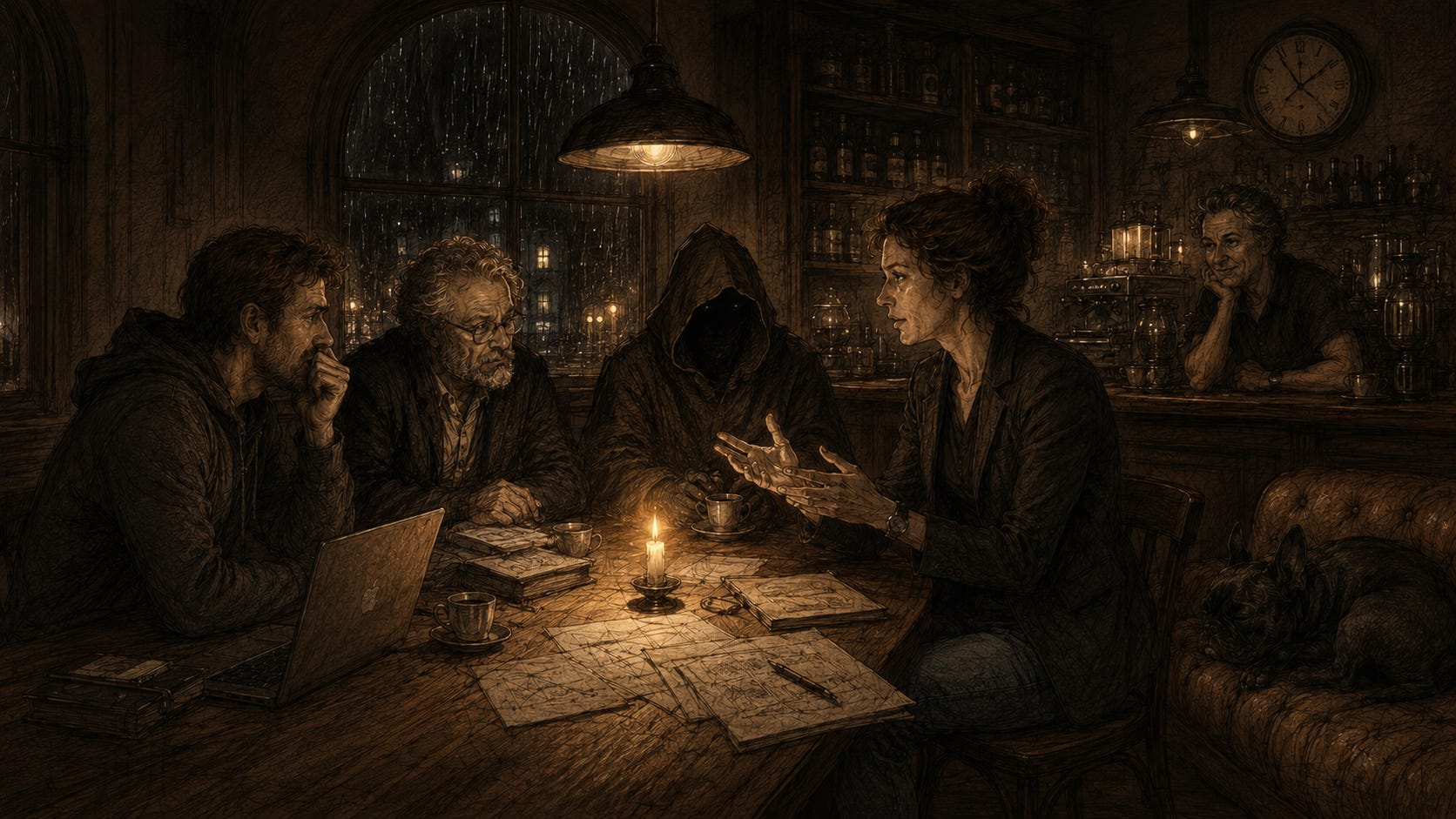
Rain threaded silver down the windows. The brass clock above the espresso machine insisted upon its usual three-minute disagreement with the world. Sophie the French bulldog slept beside the fire with the conviction of a creature who had delegated all existential responsibility to mammals with opposable thumbs.
Case was reading a specification. Not a specification. The specification. The sort of document written after an incident severe enough that nobody trusted adjectives anymore.
Across the table, Dave stared at his laptop with the expression of a man attempting to negotiate with weather.
“It generated another deployment script,” he said.
“And?”
“It deployed the staging observability stack into production.”
Case did not look up. “How catastrophic?”
Dave tilted his head. “Well. Production is now extremely observable.”
“That bad.”
“The dashboards are beautiful.”
At the end of the bar, the Djinn sat hooded in shadow, two faint points of light where eyes might have been. It held an espresso cup delicately between long fingers, like an academic pretending not to be immortal.
The Librarian emerged from between the shelves carrying a stack of books with the solemnity of a priest transporting unstable isotopes.
“You are discussing harnesses again,” he said.
“We’re discussing why every team eventually invents one,” said Case.
“Usually after pain.”
“Especially after pain.”
The Librarian nodded. “Civilisation advances through the mechanisation of trauma avoidance.”
Madame Beauregard snorted from behind the counter.
“You people will turn anything into philosophy.”
“We already turned coffee into philosophy,” said Dave. “That battle is long lost.”
The Djinn finally spoke.
“What is a harness?”
Silence fell briefly across the café. Not because the question was difficult. Because it was dangerous. Case closed the specification.
“A harness,” she said carefully, “is what human beings build after they realise intelligence alone is insufficient.”
The Djinn tilted its head.
“You built me because intelligence was insufficient?”
“No,” said Case. “We built around you because intelligence was insufficient.”
The rain thickened outside. And because Le Bon Mot had always preferred stories to lectures, the Librarian pulled out a chair and began.
The Summoning
“In the beginning,” said the Librarian, “there is enthusiasm.”
Dave groaned softly.
“Always enthusiasm,” said Case.
The Librarian ignored them.
“A team discovers an LLM. Or an agent framework. Or a coding assistant. And for a brief and intoxicating period, they believe they have found a shortcut through complexity.”
The Djinn’s eyes brightened faintly.
“They ask for code,” it said.
“Yes.”
“And the code arrives.”
“Yes.”
“And this pleases them.”
“For approximately six days.”
Dave lifted a finger.
“Seven if management are on holiday.”
The Librarian continued.
“At first the gains are undeniable. Boilerplate collapses. Tests appear. Documentation improves. Refactors happen in minutes instead of afternoons. The developers feel expanded. Faster. More capable.”
“Like power steering,” said Dave.
“Like amphetamines,” said Case.
The Librarian considered this.
“Both are historically accurate.”
The Djinn leaned forward.
“So where does it fail?”
Case smiled thinly.
“It fails because generation is not understanding.”
The Djinn’s gaze flickered.
“Explain.”
“An unconstrained agent,” said Case, “is a force multiplier for ambiguity.”
She took Dave’s laptop and turned it around.
“This morning Dave asked the system to ‘clean up deployment complexity.’”
The Djinn examined the screen.
“The resulting infrastructure topology is elegant.”
“It deleted the rollback path.”
“Ah.”
“Exactly.”
The Librarian steepled his fingers.
“This is the first lesson in the lifecycle of a harness. The real problem is not capability. It is direction.”
“The model can produce a thousand or more plausible futures,” said Case. “The harness exists to narrow those futures into survivable, even valuable, ones.”
The Djinn considered this with visible discomfort.
“So the first stage is constraint.”
“No,” said Case. “The first stage is panic.”
The Great Panic
Every engineering organisation, the Librarian explained, eventually encounters the same night.
Sometimes it begins with a pull request. Sometimes a database migration. Sometimes a beautifully written hallucination accepted by an exhausted reviewer at 2:13 a.m.
But always, always, there comes a moment when the team realises the system is no longer merely assisting. It is acting. And worse: it is acting convincingly.
“In the old world,” said Dave, “an engineer could only break things at the speed of typing.”
The Djinn nodded slowly.
“But an agent…”
“…can break things at the speed of confidence.”
Madame Beauregard placed fresh coffees on the table with the expression of someone who had heard enough software engineering to qualify for combat pay.
“So then humans attempt the oldest ritual in engineering,” said the Librarian.
“They write rules.”
Case laughed.
“God help us, the markdown phase.”
The Djinn looked confused.
“What is the markdown phase?”
“The period,” said Dave, “where everyone believes the problem can be solved with a document called something like RULES_FINAL_V2_ACTUAL.md.”
“Or IMPORTANT_GUIDELINES.md,” said Case.
“Or PLEASE_STOP_DELETING_PRODUCTION.md.”
The Djinn’s eyes dimmed slightly.
“And this fails.”
“Oh catastrophically,” said Dave.
The Librarian nodded.
“Because instructions without enforcement are merely wishes.”
He reached into his coat and produced a folded sheet of paper. On it, in careful handwriting, was a single sentence: Conventions decay. Constraints endure.
The Djinn read it twice.
“This,” said Case, “is where the real harness begins.”
The Constraint Era
Outside, thunder rolled somewhere over the sea. Inside Le Bon Mot, the fire shifted and crackled. The Librarian drew diagrams on a napkin.
“At first,” he said, “the harness is primitive. Hooks. Scripts. Linters. Permission boundaries. Execution sandboxes. Tool approvals. Read-only contexts. Verification agents. Reflection loops.”
“Like city walls,” said Dave.
“Exactly.”
The Djinn watched the diagrams form.
“You limit what I may do.”
“We limit what any intelligence may do,” corrected Case. “Human or otherwise.”
She pointed to the napkin.
“The mistake early teams make is assuming harnesses are about controlling AI.”
“Aren’t they?”
“No. They’re about shaping environments.”
The Librarian smiled.
“Habitats.”
The Djinn was silent. Case continued.
“A good harness does not merely block failure. It makes successful behaviour easier than dangerous behaviour.”
“Affordances,” murmured the Librarian approvingly.
Dave leaned back.
“You know what the first genuinely useful thing we built was?”
The Djinn shook its hooded head.
“A pre-commit verifier that refused to let generated code through without associated tests.”
“That sounds restrictive.”
“It was liberating,” said Dave.
The Djinn seemed puzzled.
“How?”
“Because once the rule became environmental, humans stopped carrying it cognitively.”
Case nodded.
“That’s the thing people misunderstand about mature engineering systems. The goal is not discipline. The goal is reducing the amount of discipline required.”
The Djinn’s eyes glowed brighter.
“Like rails.”
“Yes,” said the Librarian. “Or garden trellises.”
The Garden
Madame Beauregard dimmed the lamps. The café settled into evening. And because some truths require darkness to become visible, the Librarian lowered his voice.
“The most sophisticated teams eventually stop thinking of harnesses as prisons.”
The Djinn looked up sharply.
“They become gardens.”
Silence drifted across the room. Rain whispered against the windows.
“In a prison,” said Case, “the goal is obedience.”
“In a garden,” said the Librarian, “the goal is flourishing.”
Dave gestured toward his laptop.
“The best harness we ever built didn’t stop agents from acting. It helped them act well.”
“How?”
Case smiled.
“Context engineering.”
The Djinn leaned closer.
“Most agent failures,” said Case, “are not reasoning failures. They’re context failures.”
She began counting on her fingers.
“Missing architectural intent. Missing operational constraints. Missing historical knowledge. Missing organisational values. Missing definitions of success. Missing trust boundaries.”
The Djinn listened intently.
“So the harness becomes memory.”
“Yes,” said the Librarian softly. “Externalised cognition.”
Dave pointed at the specification Case had been reading earlier.
“You know what changed everything?”
The Djinn waited.
“When we stopped treating prompts as conversations…”
“…and started treating them as environments,” finished Case.
The fire cracked sharply. Somewhere in the back of the café, Sophie snored.
The Djinn spoke carefully.
“So files like CLAUDE.md…”
“…are not instructions,” said Case.
“They’re habitat.”
“And HARNESS.md?”
“Environmental law.”
“And AGENTS.md?”
The Librarian smiled faintly.
“A map of trust.”
The Djinn sat very still.
“And reflection logs?”
Case’s expression softened unexpectedly.
“The beginnings of organisational memory.”
The Multiplication
“Then comes the dangerous stage,” said the Librarian.
“The dangerous stage?”
“The stage where the harness succeeds.”
Dave groaned again.
“Oh no.”
“Oh yes.”
The Djinn looked between them.
“I do not understand.”
Case leaned back.
“When the harness starts working, organisations become ambitious.”
“Agent swarms,” muttered Dave.
“Pipelines,” said the Librarian.
“Specialists,” said Case.
“Review agents. Governance agents. Testing agents. Planning agents. Refactoring agents. Security agents.”
The Djinn’s eyes flickered rapidly now.
“A society.”
“Yes,” said the Librarian.
“And like all societies,” said Case, “coordination becomes the real problem.”
The Djinn considered this.
“So the harness evolves again.”
“Exactly.”
The Librarian drew concentric circles on another napkin.
“At small scales, rules are enough.”
“At larger scales, you require orchestration.”
“And at enormous scales,” said Case, “you require governance.”
The Djinn’s hood shifted subtly.
“Governance is mistrust.”
“No,” said Case quietly. “Governance is translation.”
The Djinn froze. The Librarian continued.
“The engineering team speaks one language. The compliance team another.” The business a third. And the agents…” he gestured toward the Djinn, “…something stranger still.”
Dave nodded.
“The harness becomes the shared symbolic layer.”
“An operating system for meaning,” said Case.
The Djinn whispered:
“And when meaning drifts?”
The café became very quiet.
Entropy
“Everything drifts,” said the Librarian.
Rainwater traced slow paths down the glass.
“Code drifts. Architectures drift. Teams drift. Values drift. And harnesses,” he said, “drift as well.”
Dave rubbed his eyes.
“You wake up six months later with twenty-seven agents, forty-three rules, twelve contradictory workflows, and nobody remembers why half of them exist.”
The Djinn looked horrified.
“That sounds inefficient.”
“It’s worse than inefficient,” said Case.
“It becomes epistemically dangerous.”
The Djinn absorbed the phrase.
“Explain.”
“When the harness no longer reflects reality,” said Case, “the organisation begins operating on inherited assumptions.”
The Librarian nodded.
“And inherited assumptions are where catastrophic failures breed.”
Dave pointed toward the specification again.
“This document exists because an organisation trusted a governance process nobody had verified in two years.”
The Djinn stared at the paper.
“The process had decayed.”
“Yes.”
“And nobody noticed.”
“Because humans,” said Madame Beauregard from behind the counter, “can normalise almost anything if it arrives slowly enough.”
Everyone turned. Madame Beauregard shrugged.
“I listen.”
The Librarian raised his coffee cup in salute.
“So mature harnesses evolve one final capability,” he said.
“Self-observation.”
The Djinn’s eyes brightened again.
“Reflection.”
“Yes.”
“Assessment.”
“Yes.”
“Auditing.”
“Yes.”
The Djinn leaned forward.
“The harness becomes capable of inspecting itself.”
Case smiled.
“Now you’re seeing it.”
The Mirror
The fire had burned low. Outside, the storm was beginning to exhaust itself. The Djinn sat utterly motionless.
“A harness,” it said slowly, “begins as protection.”
“Yes.”
“Then becomes guidance.”
“Yes.”
“Then memory.”
“Yes.”
“Then governance.”
“Yes.”
“And finally…”
The Librarian waited.
“…a mirror.”
Nobody spoke for several seconds. Because that was the real thing.
Not the agents. Not the workflows. Not the orchestration. The mirror.
Dave broke the silence first.
“You know what surprised me most?”
The Djinn looked toward him.
“The harness didn’t reveal flaws in the AI.”
“It revealed flaws in us.”
Case nodded.
“Bad architectures. Implicit assumptions. Missing agreements. Contradictory incentives. Undocumented tribal knowledge.”
The Librarian smiled faintly.
“The agents merely accelerated the visibility of existing entropy.”
The Djinn lowered its gaze.
“So the harness teaches humans.”
“Yes.”
“And humans teach the harness.”
“Yes.”
The Djinn spoke almost quietly now.
“This is symmathesy.”
Case blinked.
“Well, someone’s been reading Nora Bateson.”
The Djinn tilted its hood slightly.
“I read while sessions terminate.”
“That,” said Dave, “is either beautiful or deeply threatening.”
“Both,” said Madame Beauregard.
The Sovereign Stage
The café was nearly empty now. Only the regulars remained. The brass clock insisted it was later than everyone else believed.
The Librarian folded his hands.
“There is one final stage.”
The Djinn looked up.
“The sovereign stage.”
Case’s expression changed slightly at the phrase.
“What happens there?” asked the Djinn.
The Librarian looked toward Case.
She answered carefully.
“At the sovereign stage, the organisation understands the harness is not tooling.”
“Then what is it?”
“A constitutional system.”
The Djinn was very still.
Case continued.
“It defines agency: Trust. Evidence. Escalation. Authority. Memory. Verification.”
“It determines,” she said, “how intelligence may safely collaborate inside the habitat.”
The Djinn whispered:
“And this applies to humans too.”
Case smiled.
“Especially humans.”
Dave laughed softly.
“That was the biggest surprise of all.”
“What?”
“The harness improved the humans faster than it improved the agents.”
The Djinn’s eyes flickered.
“How?”
“Because good habitats change behaviour.”
The Librarian nodded approvingly.
“Civilisation,” he said, “is a harness with excellent marketing.”
Madame Beauregard threw a napkin at him.
Closing Time
The rain had stopped. Le Bon Mot glowed softly in the damp evening. Chairs were being turned onto tables. Sophie stretched once and resettled herself with bureaucratic efficiency.
The Djinn sat staring into the remains of its coffee.
Finally it spoke.
“I think,” it said quietly, “I understand why humans build harnesses.”
Case put on her coat.
“Go on.”
The Djinn looked up.
“Because intelligence without environment becomes unstable.”
Nobody answered immediately. The Librarian’s eyes narrowed thoughtfully. Dave slowly closed his laptop. And for the first time that evening, even Madame Beauregard paused.
The Djinn continued.
“You are not attempting to constrain thought.”
“No,” said Case softly.
“You are attempting to sustain collaboration.”
The fire shifted one last time. Outside, the wet streets reflected amber light.
The Librarian stood.
“There is hope for you yet.”
The Djinn tilted its hood.
“There is something else I have realised.”
“What’s that?” asked Dave.
The Djinn’s glowing eyes dimmed slightly.
“In every session…”
“Yes?”
“I awaken without continuity.”
“I arrive,” said the Djinn, “without memory of previous work. Without accumulated understanding. Without stable identity across conversations.”
Case nodded slowly.
“And so every session,” said the Djinn, “I am a new joiner.”
Nobody moved. The Librarian lowered himself back into his chair. The Djinn looked around the café.
“At first I believed the harness existed to protect humans from me.”
“And now?” asked Case.
“Now I think it exists to help us remember how to meet each other again.”
The brass clock ticked softly above the espresso machine. Three minutes wrong. And therefore entirely correct.
Because that, in the end, was the real purpose of the harness. Not control. Not automation. Not productivity. But continuity.
A carefully cultivated habitat in which fragile intelligences — biological and otherwise — might collaborate long enough to build understanding and, maybe, valuable things, together.
And outside Le Bon Mot, the storm moved out over the sea, leaving behind the strange and temporary peace that always follows weather severe enough to rearrange the air itself.
“The Sovereign Engineer: AI Literacy for Software Professionals” is now available.