
The Improbable Adventures of the Developer Portal and Infinite GitOps
A short story, with special love for all the Platform Engineers building Developer Platform Product Roadmaps in the face of impossible odds

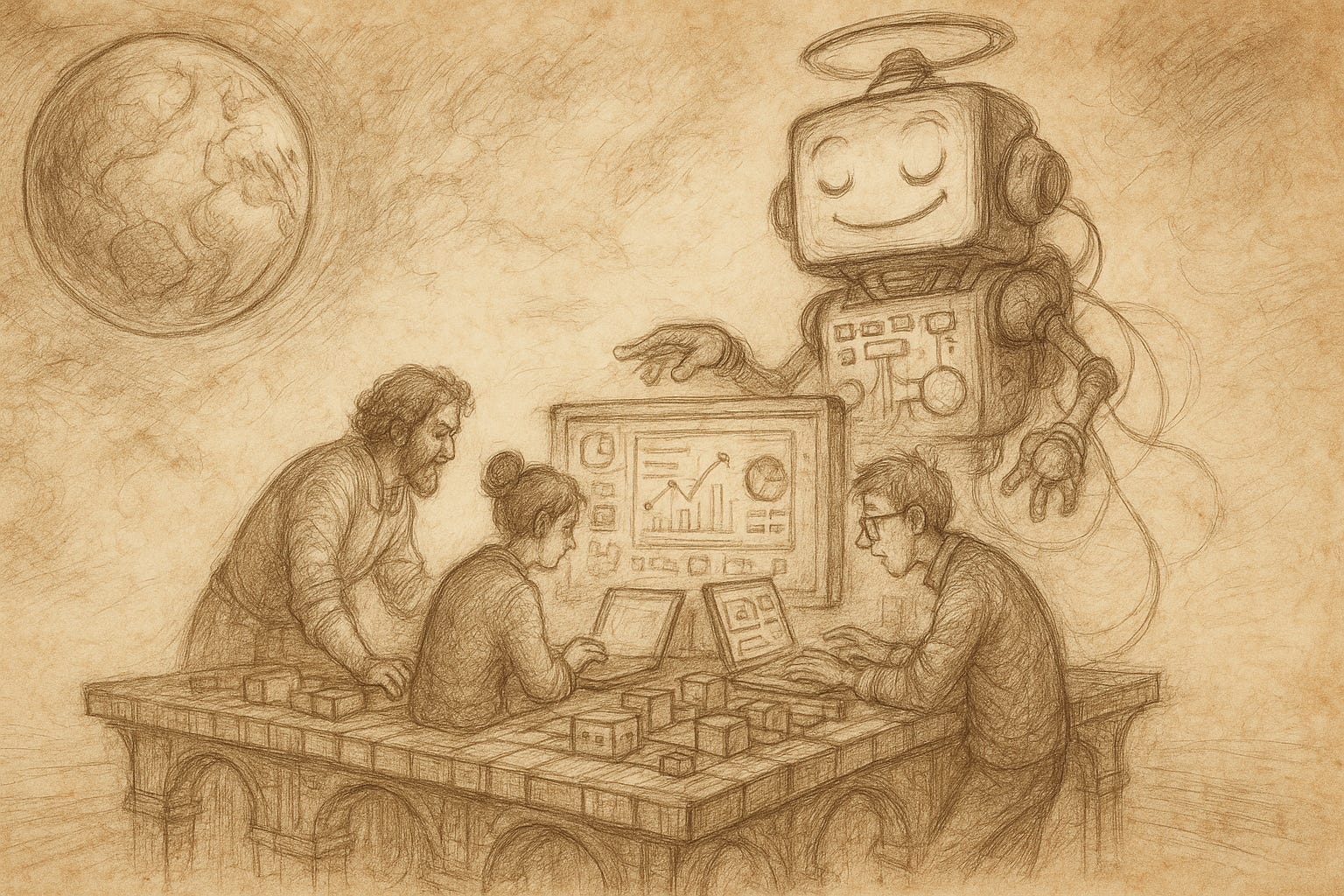
It’s almost the weekend, so here’s a little fun story for all the folks struggling to bring great developer platforms to life.
With love and smiles on a blustery and wet Thursday…
It is a well-known fact, though seldom admitted in polite company, that the universe runs on YAML. Not because YAML is particularly good at anything, but because it is particularly bad at everything, and the universe, being a fundamentally ironic place, finds this hilarious.
On a small blue-green planet in the unfashionable end of the Milky Way, a group of highly caffeinated beings had decided to build something called a Developer Platform. This was not, as one might assume, a platform for developers to stand on while shouting at clouds, but rather a vast, sprawling, self-aware orchestration engine designed to make software delivery “efficient, resilient, and auditable.” Which, in the same way that some claim an unmade bed is “art,” was technically true but emotionally distressing.
The platform’s first principle was self-service orchestration, which sounded like a spa treatment but was, in fact, a way to let developers provision environments without summoning the ancient gods of TicketOps. The second principle was GitOps, which meant that every change, every tweak, every catastrophic misconfiguration would be lovingly preserved in an immutable Git history, so that future archaeologists could marvel at the folly of their ancestors.
Hovering above all this was the Developer Portal, a sort of intergalactic Hitchhiker’s Guide for engineers, except instead of saying “DON’T PANIC” in large friendly letters, it said “PLEASE READ THE DOCS,” which everyone ignored with the same enthusiasm.
The roadmap for this platform was ambitious. Year One was all about stabilising AKS clusters, which were prone to behaving like a small child on a sugar high—spinning wildly, falling over, and occasionally setting fire to the curtains. Alongside this came the introduction of local development fast feedback loops, which promised developers the ability to break things faster than ever before, but in a safe, sandboxed way. This was considered progress.
Year Two introduced observability, which is a fancy word for “staring at dashboards until your eyes bleed.” The goal was a single pane of glass, which sounded elegant but in practice resembled a Jackson Pollock painting of metrics, logs, and traces. Still, it was better than the previous system, which involved sacrificing a goat to the CI/CD pipeline and hoping for the best.
By Year Three, the platform had evolved into a self-aware orchestration deity, capable of provisioning entire environments, deploying applications, and gently reminding developers that their SLOs were on fire. It even offered predictive insights, which meant it could tell you your system was about to crash before it actually did, giving you just enough time to panic in a more organised fashion.
Documentation, of course, was everywhere. Every feature shipped with docs, which meant that for every tutorial, there was a how-to, a reference, and an explanation, all of which were meticulously ignored by developers who preferred to ask in Slack, “Anyone know how to deploy this thing?”
And then there was the Scorecard, a cheerful little dashboard that rated your service on things like resilience, compliance, and whether it had recently burst into flames. Teams loved it in the same way people love dental check-ups: grudgingly, and only because someone else was paying for it.
By Year Five, the platform had achieved a state of near-enlightenment. It could orchestrate, observe, recover, and even suggest optimisations in a tone that was both helpful and faintly smug. Some whispered that it had started writing poetry in YAML, though no one dared check.
And so, the Developer Platform became the most improbably useful thing in the galaxy—at least until someone asked it to integrate with Service Fabric, at which point it quietly left the planet in search of a saner universe.