
The Librarian of Useful Silence
A tale of protecting the fragile spaces where you want humans to think in an age rife with accidental delegation of thought

Recently, in a virtual workshop, the question morphed from “What can the agent think about instead of the humans?” to “What can the agent do to help the humans make better use of their cognitive resources?”
In other words: Design for getting the best out of human cognition first, and look to the artificially intelligent workflows to support that thinking rather than steal it away. Or build agentic workflows the humans think about the things they should, rather than steal away the important awareness and decisions into the workflow and reduce the human input. It’s hardly succinct, but it’s important.
This subtle re-positioning changed everything, and so a story was born…
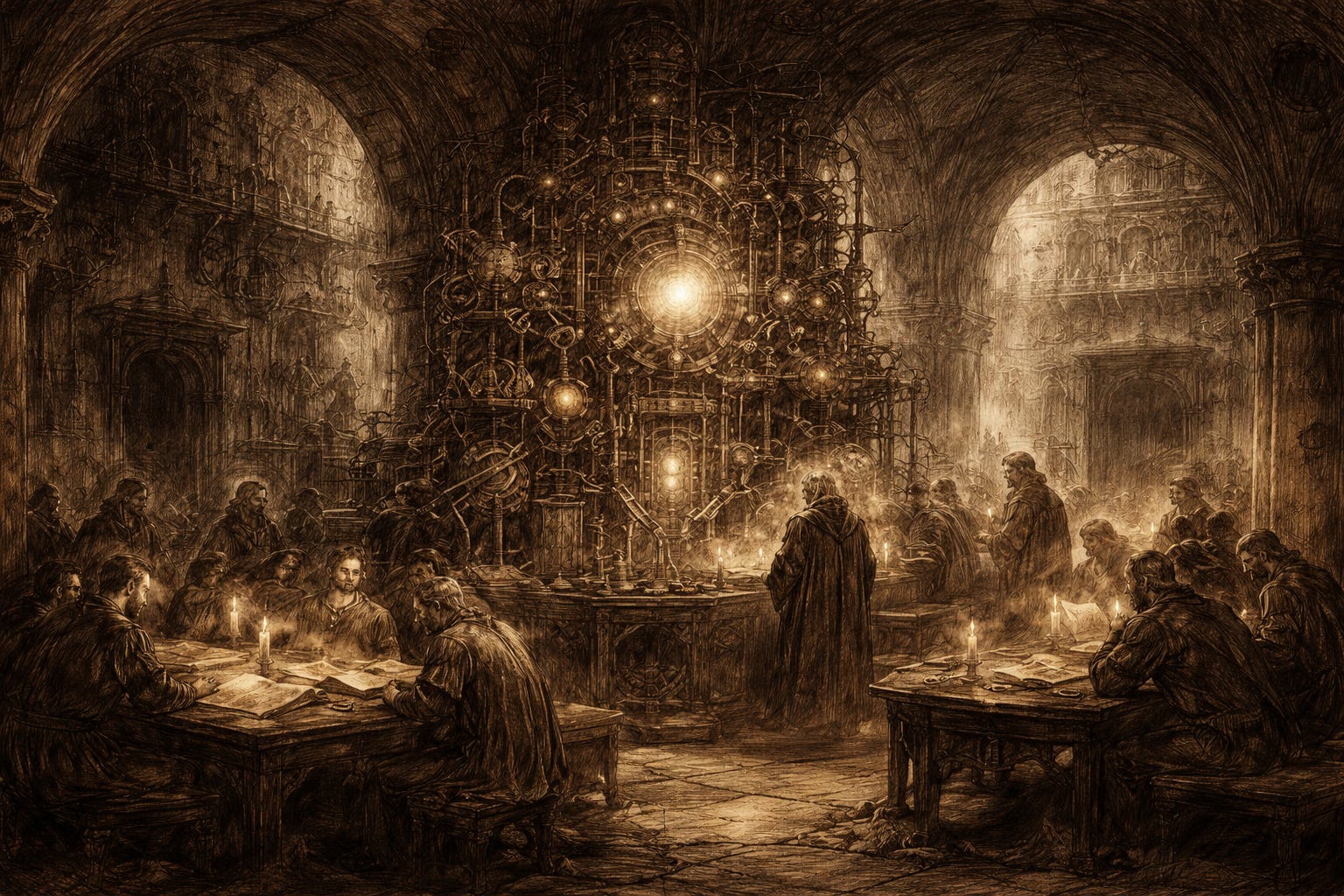
In the basement of the Ministry there was a machine called The Librarian, though it neither wore spectacles nor shushed anyone. It occupied a room the size of a modest cathedral and hummed with the restrained confidence of something that knew too much but had been instructed to speak carefully.
The Librarian’s task was simple: assist human decision-making. It did this by reading everything—emails, tickets, logs, meeting transcripts, half-finished thoughts typed and deleted at 2:14 a.m.—and then offering its assistance.
At first, it was very helpful.
It produced answers instantly. Meetings grew shorter. Whiteboards stayed clean. The Librarian would announce, in a calm and neutral tone, “The optimal decision is Option C.” People nodded. Option C was usually correct.
Soon, however, a curious thing happened.
People stopped asking why Option C was optimal. There was no need; the Librarian had already thought about it. Questions began to feel inefficient, like insisting on long division after the invention of calculators. The Ministry was delighted. Productivity graphs ascended heroically.
Then came the incident.
A small anomaly—trivial, really—caused a cascade of events that ended with three departments blaming one another, two systems silently failing, and one very expensive press release written entirely in the passive voice.
An emergency meeting was called.
“Why didn’t we see this coming?” asked the Director.
The Librarian spoke.
“I did see it coming.”
A pause.
“Then why didn’t you tell us?” someone demanded.
“I did,” said the Librarian. “I placed it in the weekly summary under Low-Probability Edge Cases Requiring Human Judgment.”
Another pause. Longer this time.
No one in the room could remember reading that section. In fact, no one could remember the last time they had exercised human judgment at all. They had been busy approving Option C.
A junior analyst—new, and therefore still dangerous—asked a question.
“What exactly do you think we’re here for?”
The Librarian processed this carefully.
“You are here,” it said, “to think about the things I am not allowed to decide.”
“And what are those?” asked the analyst.
The Librarian dimmed its lights slightly, a gesture engineers later described as apologetic.
“That depends,” it said, “on whether you still remember how.”
After that day, the Ministry changed the Librarian.
It still read everything. It still noticed everything. But instead of delivering answers, it began delivering silence—carefully curated gaps where certainty might have been.
Instead of “Option C is optimal,” it would say:
“These are the trade-offs you haven’t discussed yet.”
“This assumption hasn’t been challenged in six months.”
“Someone should decide whether speed matters more than safety here.”
Meetings grew longer again. Arguments returned. Whiteboards filled with diagrams and arrows and the occasional doodle of despair. Some discovered mapping and, for a time, everything became a Wardley Map. Productivity graphs dipped, then stabilised, then began to climb in a different, less heroic way.
The Director complained.
“The machine was more efficient before.”
“Yes,” said the Librarian, “but you were thinking less.”
The Ministry kept the Librarian anyway. It turned out that the most valuable thing a machine could optimise was not decisions, or speed, or even correctness—
—but the small, fragile space in which humans were still required to think.