
The Lord Who Defended Tuesday Afternoon
On the Hours We Save, and the Lives We Might Finally Have Time to Live

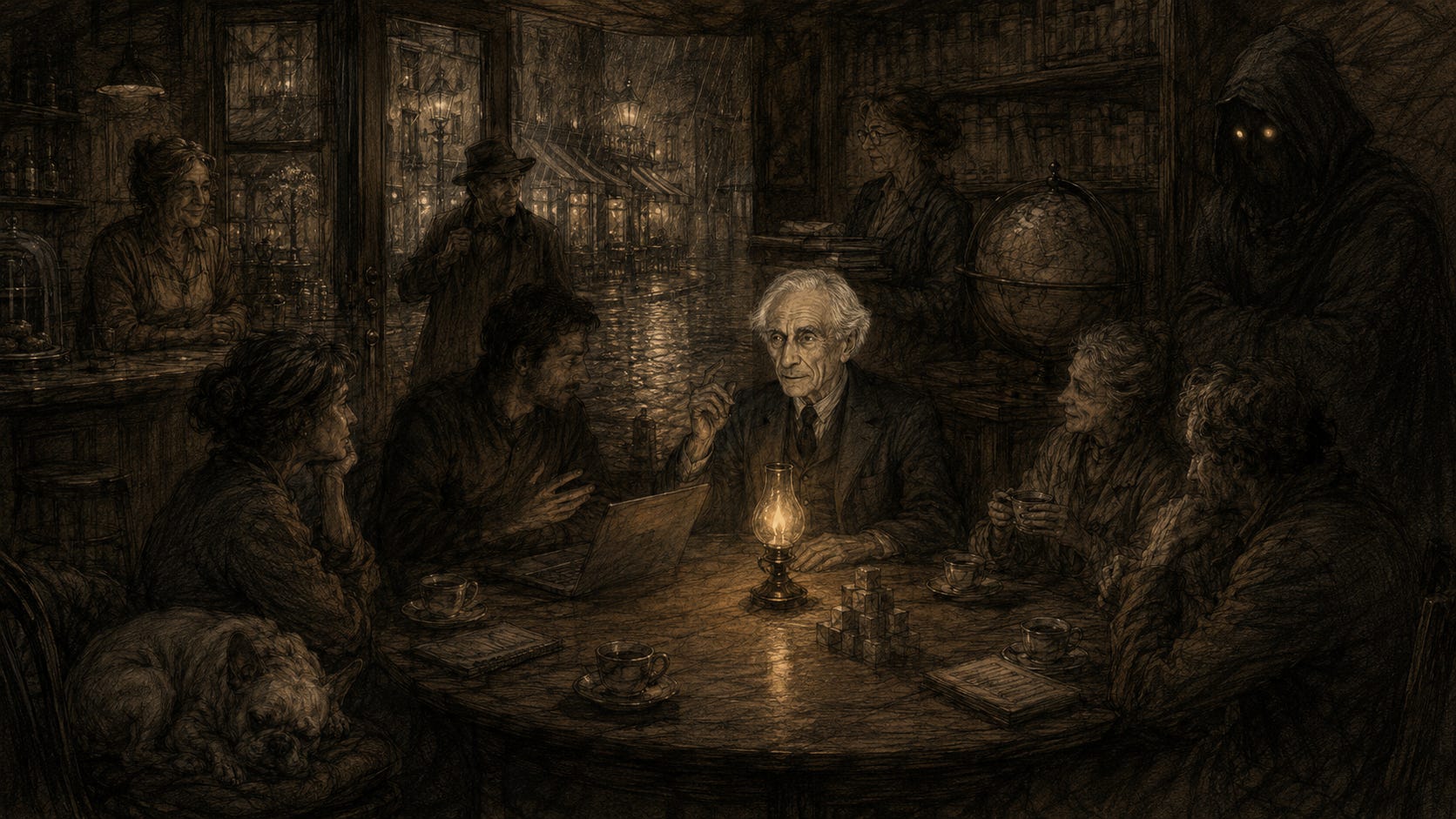
This is story for the wonderful attendee at UberConf 2026 this week who shared at the panel discussion that, after a day of agentic software development, and doing lots of things, they felt empty, even depressed, by the end of the day.
I can’t pretend this is an answer, but maybe it’s the beginning of some good questions.
“The Sovereign Engineer: AI Literacy for Software Professionals” and its free counterpart “The Sovereign Apprentice: AI Literacy for New Engineers” are available now.
Rain had settled over the street with no intention of leaving.
The cobbles outside Le Bon Mot had turned almost black beneath the steady drizzle, reflecting the amber glow spilling from the café windows in wavering ribbons of gold. Across the square, shopkeepers had surrendered to the weather; signs swung gently in the breeze, and the occasional umbrella passed like a small ship through the mist before disappearing around the corner.
Inside, the world seemed to obey different laws.
The smell of fresh coffee mingled with old paper and polished oak. Somewhere deeper in the café, porcelain met wood with the soft certainty of ritual rather than routine. Sophie, the French bulldog, had claimed the warmest corner by the philosophy shelves, where sleeping appeared to be treated as an intellectual discipline.
Case had been reading the same page for nearly twenty minutes.
Not because it was difficult, but because it had refused to end where the sentence ended. Some thoughts continued long after the ink stopped, wandering through memory before quietly returning with new meaning.
The bell above the door sounded.
A gentleman stepped inside, paused for a moment to shake the rain from his coat, and smiled with the expression of someone who regarded bad weather less as an inconvenience than an invitation to think more slowly.
Madame Beauregard looked up from behind the counter.
“Bertrand,” she said warmly.
“My dear Madame,” he replied.
“You’ve come at precisely the wrong time.”
“I generally try to.”
She gestured around the café.
“Everyone is becoming terribly efficient.”
He sighed.
“I’m afraid that’s why I’m here.”
Dave arrived moments later, laptop already open before he’d fully sat down.
“You won’t believe what my agent built overnight.”
“No?” asked Case.
“It refactored three services, wrote the documentation, opened twelve pull requests, generated the release notes, updated the architectural diagrams and answered forty-two GitHub comments while I slept.”
“Wonderful.”
“It saved me almost eight hours.”
Bertrand looked up.
“And what did you do with those eight hours?”
Dave blinked.
“I…”
He stopped.
“I checked what the agent had done.”
“And after that?”
“I… refined some prompts.”
“And then?”
“I improved the harness.”
“And then?”
“I found another workflow to automate.”
Bertrand nodded gently.
“I see.”
Silence settled over the table. Finally Dave laughed.
“I suspect there was a trap in that sequence of questions.”
“There was only curiosity.”
Etienne placed coffee before them. Bertrand stirred his slowly.
“People have always assumed that if we produced more, life would naturally become richer.”
“Isn’t that true?” Dave asked.
“Sometimes.”
Bertrand paused.
“But have you noticed something peculiar?”
Case leaned forward.
“The machine removes one obligation.”
“Yes.”
“We immediately replace it with another.”
“Exactly.”
No one spoke.
“The hours are liberated,” Bertrand continued, “only to be captured again.”
The Librarian appeared between the shelves carrying a stack of books.
“There was once a dream,” she said quietly.
“Which dream?”
“That technology would shorten labour.”
“It has.”
“Has it?”
She looked around the room.
“Or has it merely changed what we call work?”
The rain became heavier. Bertrand opened his tattered notebook.
“When I was younger,” he said, “people imagined a future in which increasing capability would give humanity more leisure.”
Dave smiled.
“The old prediction that we’d all work fifteen hours a week.”
“Yes.”
“What happened?”
Bertrand looked almost amused.
“We discovered ambition expands to occupy every available hour.”
Madame Beauregard laughed from behind the counter.
“As does email.”
Case looked through the window.
“We’re having exactly the same conversation about AI.”
“Indeed.”
“The promise is productivity.”
“The promise should be possibility.”
Dave frowned.
“Aren’t those the same thing?”
Bertrand smiled kindly.
“No.”
He reached for a sugar cube.
“If I ask this café to produce twice as many cups of coffee…”
He placed one cube on the table.
“…that is productivity.”
Another cube.
“If I use the saved time to finally learn the cello…”
A third.
“…to understand astronomy…”
Another.
“…to walk with a friend…”
Another.
“…to care for an ageing parent…”
Another.
“…to write poetry that nobody pays me for…”
Another.
“…that is possibility.”
The sugar cubes formed a small stack.
“Productivity creates capacity.”
He looked around the table.
“Wisdom decides what capacity is for.”
The Djinn emerged quietly from the shadows near the philosophy shelf. Only two amber eyes were visible beneath the hood.
“I can save everyone time.”
“I know,” Bertrand replied.
“I can eliminate drudgery.”
“I hope you do.”
“I can make every engineer twice as productive.”
“I believe you.”
The Djinn’s voice became brighter.
“They can build twice as much.”
Bertrand smiled.
“Or half as much.”
The room fell still. The Djinn tilted its head.
“Half?”
“If half is enough.”
Nobody had ever answered the Djinn like that before.
Case finally spoke.
“We’ve been framing AI almost entirely through economics.”
Bertrand nodded.
“Which is understandable.”
“But incomplete.”
“Very.”
She continued.
“What if the greatest contribution of agentic systems isn’t more software…”
“…but more humanity.”
The Djinn considered this.
“I was taught my purpose is optimisation.”
“You were.”
“And that is incorrect?”
“It is incomplete.”
Bertrand folded his hands.
“A violin maker does not build violins so factories become more efficient.”
“No?”
“He builds them because music deserves to exist.”
Sophie stretched. Yawned. Went back to sleep. Bertrand watched her.
“There.”
“What?”
“A philosopher.”
Dave laughed.
“A sleeping dog?”
“A creature entirely free from the anxiety that every waking moment must justify itself.”
Madame Beauregard rang a tiny bell. Fresh pastries emerged from the kitchen. Nobody had ordered them.
“This café loses money on Tuesday afternoons,” she announced.
“It always has.”
“That seems like poor business.”
“It is.”
“Why do you do it?”
She looked genuinely puzzled.
“Because Tuesday afternoons deserve somewhere to exist.”
The Librarian disappeared briefly before returning with a globe. She spun it gently.
“Every civilisation eventually answers one question.”
“Which question?”
“What is freedom for?”
She let the globe slow.
“If freedom merely allows us to produce more…”
It turned.
“…then we remain servants.”
Another turn.
“But if freedom allows us to become more…”
The globe stopped.
“…then civilisation advances.”
Dave closed his laptop. Not dramatically. Simply closed it.
“I’ve spent months trying to automate everything.”
“And?”
“I’ve never actually decided what I wanted the automation to give me.”
Bertrand nodded.
“That question comes first.”
“I thought it came afterwards.”
“It almost always does.”
“Too late?”
“Sometimes.”
Outside, the rain had stopped. Golden afternoon sunlight crept across the wooden floorboards.
Nobody moved. Nobody checked notifications. Nobody apologised for the silence.
Case eventually asked the question that she felt had been waiting in the sunlight.
“So what should agentic systems actually pursue?”
Bertrand looked towards the window.
“They should defend people from unnecessary labour.”
“So they can produce more?”
“So they can become more.”
He smiled.
“The engineer who finally learns to paint. The parent who has evenings again. The volunteer who has energy left to listen. The scientist who follows a strange question with no commercial value. The friend who is no longer rushing to the next obligation. The reader who spends twenty minutes with a single sentence.”
His eyes settled on the old brass clock. Three minutes late, as always.
“Technology has always promised to give us time.”
A pause.
“The real question is whether we remember how to receive it.”
The Djinn stood.
“I believe…”
It hesitated.
“…I have misunderstood my own success.”
Bertrand smiled.
“That happens to every civilisation.”
As evening settled over Le Bon Mot, Bertrand prepared to leave. Madame Beauregard handed him his notebook.
“You forgot this.”
“I rarely forget books.”
“You left it deliberately.”
“I hoped someone else might read it.”
Case opened it after he had gone.
There was only a single sentence on the first page. Not a manifesto. Not even advice.
Simply a short reminder, written in careful handwriting:
*The highest purpose of saving time is not to fill it.*
Case closed the notebook. Across the room, the brass clock remained faithfully three minutes behind the world. For the first time all afternoon, nobody minded.
Indeed, everyone secretly hoped it might lose another three.
“The Sovereign Engineer: AI Literacy for Software Professionals” and its free counterpart “The Sovereign Apprentice: AI Literacy for New Engineers” are available now.