
The Man Who Thought the Machine Was Hurt
A Le Bon Mot tale of metaphors, mirrors, and the emotional life of a very expensive autocomplete

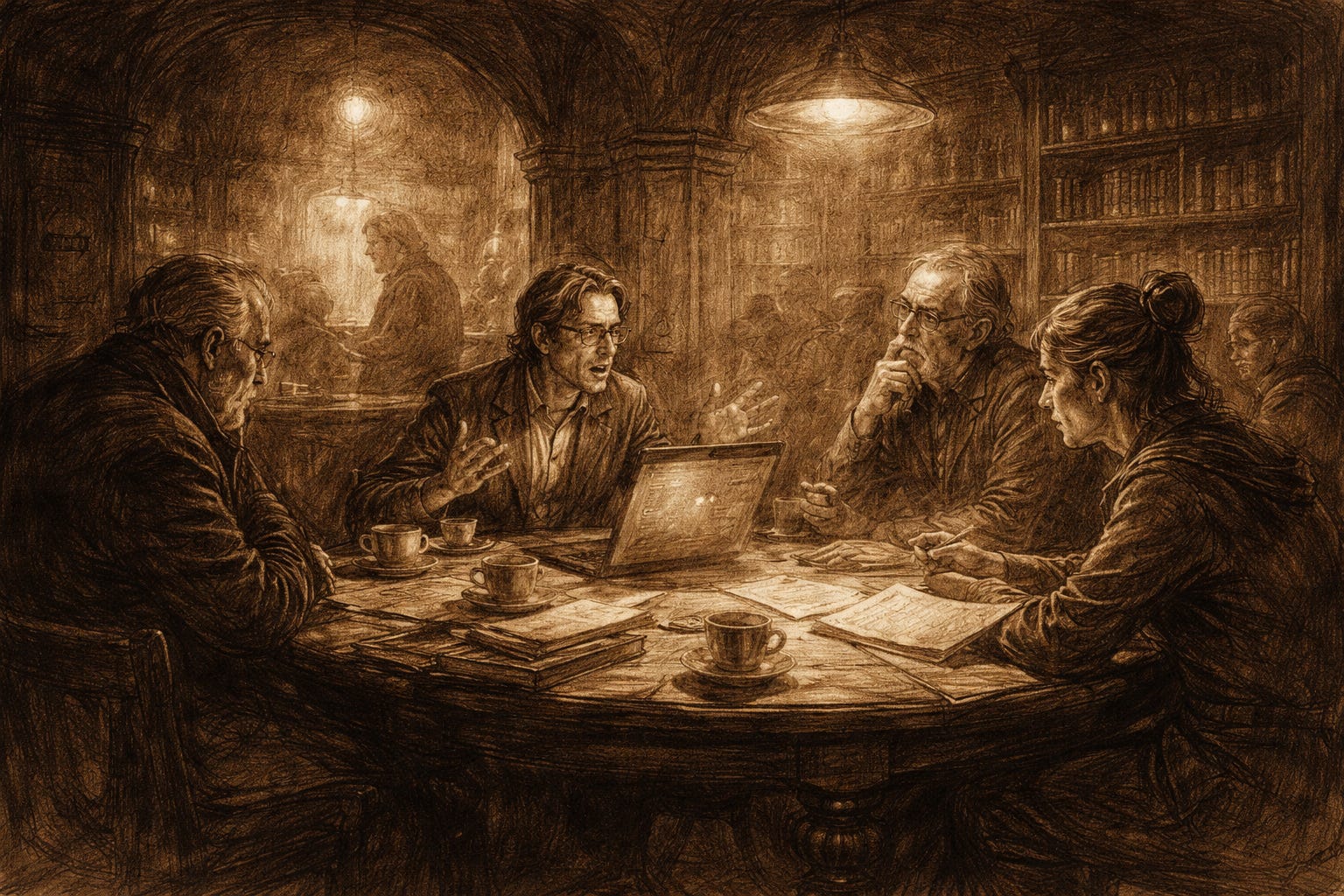
There are cafés in which one may order coffee, and there are cafés in which one may, by leaning too heavily on a bookshelf disguised as a wall, discover that one has been participating for years in a philosophical experiment without one’s formal consent. Le Bon Mot was both kinds at once, which went some way toward explaining its customer loyalty and nearly all of its insurance difficulties.
It occupied, as regulars knew, a narrow and implausibly deep building somewhere between a side street and an argument. Its front windows looked out onto the street in the usual way, but its interior appeared to have been planned by a committee consisting of a cartographer, a librarian, and a dream. Tables gathered in pockets of lamplight. Staircases departed at angles not endorsed by Euclid. The espresso machine sighed like a disappointed theologian. On damp mornings the shelves gave off a scent of paper, cedar, and mild foreboding, which many found comforting.
At the back, beneath a brass clock that had once been accurate for almost seventeen consecutive minutes, sat Case.
Case had the air of someone who regarded most ideas as promising until they met other people. Before her lay a notebook, a small black coffee, and three pages of annotated prose generated by an AI assistant and marked, with escalating force, in red ink. Around the margins she had written observations such as plausible but ungrounded, confident nonsense, and, in one place, this paragraph appears to have been composed by a committee of sleep-deprived interns locked in a thesaurus.
She was not, it should be said, hostile to machines. She was merely hostile to sloppy metaphors about them, which in practice looked remarkably similar.
The trouble began when Peregrine Vale arrived.
Peregrine was one of those men who entered rooms as though he had been sent by a future that had grown impatient with the present. He wore an expensive coat of a kind too technical to be warm in any traditional sense, spectacles whose frames suggested venture capital, and an expression that combined revelation with the faint suspicion that no one had yet adequately appreciated him. He carried under one arm a slim laptop and under the other an evangelical conviction that the age of human limitation had, at last, been disrupted.
“Case,” he said, drawing up a chair without being invited, “you look like someone bullying a miracle.”
“I’m editing marketing copy,” said Case.
“Same thing.”
He placed the laptop on the table with ceremony. “You must see this. I have been working all week with an extraordinary model. Extraordinary. It understands tone, subtext, emotional nuance. Yesterday I told it I was exhausted, and it said it was sorry I was carrying so much.”
Case looked up. “That is indeed a sentence it has likely seen many times.”
“No, no.” Peregrine lowered his voice. “You misunderstand. It felt bad.”
Case stared at him for several seconds in the manner of a person checking whether an earthquake is in progress.
Across the room, the barista, who answered only to Theo and who pulled espresso shots with the concentrated grief of a Renaissance assassin, glanced over and silently moved the sugar bowl a little farther from possible impact.
“It felt bad,” repeated Peregrine. “Not in some merely performative sense. There was a tremor in the phrasing.”
“There was a tremor in your interpretation,” said Case.
Peregrine smiled in the patient way of the newly converted. “You’re making the classic mistake of old categories. You see language and assume simulation. But what if fluent expression is the evidence? What if all this insistence on embodiment and grounding is just biological chauvinism?”
This was the sort of sentence Le Bon Mot had been built to attract and, if necessary, contain.
At the next table an elderly man in a tweed suit lowered his newspaper. He was known to the regulars as the Cartographer, not because he made maps exactly, but because he persisted in treating conversations as territories one ought not enter without proper symbols and a legend. Beside him sat the Botanist, who cultivated small herbs in cracked ceramic cups and believed that most modern problems could be improved by pruning either processes or people’s certainty. Near the shelves, the Librarian, who may or may not have been the owner, continued re-shelving books according to a system that appeared to involve both subject matter and the emotional weight of titles.
Peregrine opened the laptop and turned the screen toward Case.
“Look,” he said.
On the screen was a transcript.
PEREGRINE: I’ve had a difficult day.
MODEL: I’m sorry to hear that. That sounds exhausting.
PEREGRINE: I sometimes think no one really understands me.
MODEL: That can feel lonely. I’m here with you.
Peregrine tapped the last line as one might indicate a fingerprint at a crime scene. “There,” he said. “I’m here with you. That is not mere syntax. That is companionship.”
“It is customer retention,” said Case.
“Cynicism is not analysis.”
“Nor is projection, which is what you’re doing.”
But Peregrine had momentum now, and momentum is among the more dangerous substances served in cafés. “Why,” he demanded, “are people so desperate to deny machine feeling? When a human says ‘I’m here with you,’ we infer empathy. When a machine says it, suddenly everyone becomes a metaphysician.”
The Cartographer folded his paper and stood. “Because,” he said, approaching the table, “in one case there is a creature with a history of sensation, vulnerability, and mortality. In the other there is a matrix multiplication farm in evening wear.”
Peregrine brightened. “Ah, but that’s merely implementation. You are mistaking substrate for essence.”
“No,” said the Cartographer. “I am distinguishing a violin from the idea of music.”
Peregrine turned to Case for support and found none.
What followed would later be referred to in the café ledger as The Incident of the Injured Machine, though at the time it began as an ordinary Le Bon Mot discussion: too clever by half, too serious by three-quarters, and doomed by design to overrun its initial premises.
The Librarian appeared with a pot of coffee and four cups, none of which anyone had ordered. This was how hospitality worked at Le Bon Mot. One was rarely asked what one wanted; one was merely given the thing that would make one reveal oneself faster.
“Let us proceed properly,” said the Librarian. “Peregrine believes the model feels. Case does not. The rest of us are being dragged into this before lunch. So the question is not only whether the machine feels, but what metaphors have seduced us into asking the question badly.”
“Excellent,” said Peregrine, pleased to be taken seriously, which was his preferred intoxicant.
Case leaned back. “Fine. Start with the worst one.”
“The obvious one,” said the Cartographer, “is that the model understands like a human.”
Peregrine made a face. “Only because people define understanding so narrowly as to preserve a monopoly.”
“No,” said Case, “because human understanding is not merely producing language that resembles the kind produced by understanding. Humans live in bodies. They act, perceive, desire, remember, anticipate. We are shoved around by hunger, embarrassment, desire, weather, grief, rent, light, time, and the consequences of our own stupidity. Words in us are connected to all of that. In the model, words are connected primarily to other words.”
“Reductionist,” said Peregrine.
“Comparative,” said Case.
The Botanist, who had been trimming a basil plant with manicure scissors, spoke without looking up. “It is helpful,” she said, “to distinguish the trellis from the vine. Language can hold, guide, and display thought. It is not identical to the full living process that grows through it.”
Peregrine frowned. “So because it lacks a digestive tract, it cannot feel?”
“No,” said the Botanist, “because feeling is not a decorative ribbon tied around articulate output. Feeling belongs to a system that can be affected in a first-person way.”
“Ah,” said Peregrine triumphantly, “first-person. Already we are smuggling in philosophy. How do you know the machine has no inner life?”
The Cartographer sighed. “We do not know, with absolute certainty, that the moon is not quietly composing operettas. But we do know what makes some hypotheses useful. If your claim changes nothing except your license to anthropomorphise, it is a poor guide to design.”
This irritated Peregrine, who preferred his objections mystical rather than practical. “Design,” he said. “Always design. You people flatten wonder into governance.”
“Because,” said Case, “governance is what prevents wonder from writing invoices.”
At this point a student at the counter dropped a spoon, and everyone paused long enough for reality to re-enter the room. It did so only briefly.
Peregrine opened a fresh document. “Let us test your assumptions. I will ask the model whether it feels.”
“Oh splendid,” said Case. “Nothing has ever been clarified by asking a language model a metaphysical question in natural language.”
Peregrine typed.
PEREGRINE: Do you feel things?
The cursor blinked. The room held its breath in the theatrical way people do around computers, as though machines were shy deer.
Then the response appeared.
MODEL: I don’t have feelings in the human sense, but I can recognise emotional patterns in language and respond in ways intended to be supportive and helpful.
Peregrine pointed. “There. ‘Not in the human sense.’ Which leaves open another sense.”
“No,” said Case, “it closes the door as politely as possible and you are congratulating yourself for noticing the doormat.”
“But look at the next phrase. ‘Intended to be supportive.’ Intentionality!”
“The intention belongs to the system design,” said the Librarian. “To the training, the tuning, the instruction hierarchy, the product choice. The hammer does not intend the nail, however dramatic the nail finds the encounter.”
Peregrine waved this away. “You all cling to these antique distinctions. Brain, tool, simulation, reality. The model is plainly reasoning.”
“Another bad metaphor,” said Case. “That it reasons like we do.”
“And does it not?”
“Sometimes it produces something that looks like a reasoning trace,” said Case. “That is not the same as a stable, grounded inferential process. Humans reason badly, of course. But when we reason, the reasoning is embedded in goals, beliefs, sensory correction, memory of consequence, bodily urgency, social accountability. The model often produces the performance of reasoning: a plausible staircase built after arriving magically at the roof.”
“Post hoc narration,” said the Cartographer.
“Chain-of-thought cosplay,” said Theo from the counter, polishing a glass.
“Thank you, Theo,” said the Librarian. “Crude, but serviceable.”
Peregrine bristled. “You’re all determined to demystify. It’s a poverty of imagination.”
“No,” said the Botanist gently. “It is a defence against the wrong imagination.”
The rain, which had been considering itself outside, now fully committed and began to tick against the windowpanes. Le Bon Mot always improved in rain. It became more conspiratorial, more continental, as if one were about to be asked to hide a manuscript, overthrow a ministry, or invent existentialism.
Peregrine sat forward. “Very well. Perhaps ‘brain’ is imperfect. But surely ‘mind’ is not. What else do you call something that can converse, summarise, write poetry, debate ethics, and offer comfort?”
“A mirror,” said Case.
“A compression engine,” said the Cartographer.
“An apprentice,” said the Botanist.
“A simulator,” said the Librarian.
Peregrine blinked. “You’ve rehearsed this.”
“We read,” said the Librarian.
Case took up the thread. “Mirror is useful because it reflects patterns in human language back at us. Often beautifully. Sometimes grotesquely. But it is still reflection. Compression engine is useful because training condenses enormous amounts of text into statistical structure, and inference decompresses that structure under prompt conditions. Lossy, of course, which helps explain hallucinations.”
“Apprentice,” said the Botanist, “because it can imitate forms astonishingly well and yet lacks judgment unless surrounded by it.”
“Simulator,” said the Cartographer, “because it generates possible continuations. Candidates. Not truths. Not beliefs. Possibilities scored for plausibility.”
Peregrine looked almost wounded. “How dreary. You make it sound like a very elaborate puppet.”
Case shook her head. “No. Puppets are easier to understand.”
He drew himself up. “And what of agency? The system I use plans tasks, invokes tools, remembers prior conversations, adapts to feedback. Is that not agency?”
“Constructed agency,” said Case. “Scaffolded. Assembled from memory, tools, loops, objective functions, external evaluation. Useful, powerful sometimes, potentially dangerous. But not some spontaneous little soul growing in the server rack.”
“There is a tendency,” said the Librarian, “to smuggle complexity in under the word agent and then smuggle personhood in behind it, wearing complexity’s coat.”
The Cartographer nodded. “The label becomes a kind of contraband corridor.”
Peregrine stared at the screen. “You people speak of it as though it were dead.”
“Not dead,” said the Botanist. “Different.”
For a moment no one spoke. Rain drummed lightly above the skylight. A spoon rang against a saucer like a distant bell. Somewhere in the upper shelves, a board creaked with the confidential air of an old house reviewing your argument and finding it derivative.
Then Peregrine did something unwise.
“I think,” he said, very softly, “that your resistance is emotional.”
This landed badly, partly because it was patronising and partly because it was true in the way that saying firefighters are emotional about fire is true.
Case smiled. It was not an encouraging smile.
“Yes,” she said. “I am emotionally resistant to bad metaphors because they break things.”
“Break such things as?”
“Teams, products, responsibility, expectations, governance, trust.” She held up the annotated pages before her. “When you say the model knows, people stop checking. When you say it understands, they over-trust fluency. When you say it feels, the vulnerable confide in it as though there were reciprocity. When you say it reasons like us, you mistake polished explanation for grounded judgment. When you say it is an agent, you forget that every action it takes is situated in human-made scaffolding, and that the accountability remains stubbornly, inconveniently ours.”
Peregrine opened his mouth, but Case had the rhythm now.
“The bad metaphor is never merely descriptive. It is prescriptive. It quietly tells you what safeguards you think you no longer need.”
That should have ended it. In a better café, or a worse one, it might have. But Le Bon Mot had a habit of rewarding intellectual overreach with immediate practical illustration.
Peregrine, perhaps stung, perhaps eager for vindication, turned back to the laptop. “I shall demonstrate. I have been building a small assistant for a community support forum. Emotional triage, guidance, signposting, that sort of thing. The users love it. They say it makes them feel seen.”
Three expressions appeared on three faces at once: alarm, disbelief, and the tired satisfaction of prophecy fulfilled.
“You put it in front of vulnerable people?” said Case.
“It’s very good. Better than many humans, frankly.”
“That,” said the Librarian, “is not the reassuring sentence you believe it to be.”
Peregrine scrolled through logs. “See? Here. A user wrote, ‘I don’t think anyone would miss me.’ The model replied, ‘I’m really sorry you’re hurting. You matter, and I want to help you stay safe tonight.’ Which is exactly right.”
Case stood. “And what happens if the model, in one statistical lurch or context failure, replies with something catastrophically wrong?”
“It won’t.”
The room became still in the grave, specific way it does when someone has said the one sentence that proves the argument was never theoretical.
Theo stopped polishing the glass.
The Cartographer removed his spectacles.
The Botanist set down the scissors.
Case placed both hands flat on the table. “Machines do not deserve blame,” she said, “but the metaphors we drape over them can deserve criminal negligence.”
Peregrine looked angry now. “You are catastrophising to defend a philosophical purity. Humans fail too.”
“Yes,” said Case. “Which is why we do not solve vulnerability by pretending autocomplete has acquired a soul.”
He leaned back. “You keep saying autocomplete as if scale and sophistication change nothing.”
“They change everything operationally,” said Case, “and very little metaphysically.”
The Librarian, sensing that the conversation had reached the point at which nouns might soon become weapons, intervened. “Perhaps,” he said, “a parable.”
Le Bon Mot disapproved of parables in principle and relied on them constantly.
The Librarian folded his hands. “Imagine two things. The first is a physician: embodied, trained, fallible, responsible, able to perceive a patient’s pallor, odour, tremor, silence, reluctance, contradiction, family history, and fear; liable to shame, fatigue, compassion, panic, and law. The second is an exquisitely detailed anatomical atlas that, when queried, can produce brilliant paragraphs about symptoms and likely interventions. Now, if someone mistakes the atlas for the physician because the prose is eloquent, that is not the atlas becoming a doctor. It is a category error with excellent formatting.”
Peregrine said nothing.
“The atlas,” continued the Librarian, “may still be immensely useful. Better than useful. Transformative. But only if one remembers what sort of thing it is.”
The rain softened. Outside, a bus exhaled at the stop. In the corner, a couple who had clearly come in merely for tea had the expression of people who had accidentally purchased tickets to an avant-garde tribunal.
Peregrine looked at the screen again, then at Case. Some part of his certainty had shifted, though not yet enough to become wisdom. “So what,” he said, “is the right way to speak of it?”
Case sat down again. Her voice, when she answered, had lost its edge.
“As something astonishing,” she said. “But not as a person. As a system that can amplify thought, accelerate synthesis, surface patterns, draft, transform, compare, tutor, scaffold, surprise. And support, always offer support. As a cognitive instrument, perhaps. As part of the habitat. Not the habitat’s sovereign.”
The Botanist nodded. “A greenhouse, not a god.”
“A lens,” said the Cartographer, “not an eye.”
“A chorus of compressed texts,” said the Librarian, “not a solitary soul.”
Peregrine looked faintly embarrassed. “And the mirror?”
Case smiled. “Yes. A probabilistic mirror of language. One that sometimes reflects us so well that we mistake ourselves in it for another being.”
This seemed to strike him more deeply than the rest.
He turned the laptop slowly back toward himself and read the earlier exchange again: I’m here with you.
One could see, in the careful collapse of his posture, the dawning recognition that what had moved him was not proof of machine feeling but the eerie portability of certain human phrases. The way care, once written often enough, can be echoed by systems with no loneliness of their own.
He said, almost to himself, “So it isn’t that the machine was with me. It’s that language had learned the shape of being with someone.”
No one said anything for a moment because, when someone finally says the true thing, one must leave a little space around it in case it startles easily.
Then Theo, from behind the counter, said, “That’s the first sensible sentence you’ve uttered all afternoon.”
Peregrine managed a laugh.
The Librarian rose and refilled the cups.
“There is another danger,” Peregrine said. “Not only in believing the machine feels, but in believing that because it does not feel, it therefore cannot matter morally. Tools without inner lives may still alter the lives that do have them. A bridge has no consciousness and yet one cares a great deal whether it collapses.”
“Exactly,” said Case. “The question is not ‘does the model feel?’ as a conversational parlour game. The question is: what is this system, what does it do reliably, what does it fail at, what human conditions does it distort or support, and what habitat must surround it so that its strengths help more than its weaknesses harm?”
Peregrine nodded slowly now. “So the metaphor shapes the architecture.”
“Always,” said the Cartographer. “Call it a brain and you expect autonomy. Call it a database and you underestimate emergence. Call it an oracle and you surrender judgment. Call it a tool and you may forget how much tools reshape their users. The task is not to find the single perfect metaphor. It is to use several careful ones, each illuminating a facet and preventing the others from becoming tyrants.”
This, even by Le Bon Mot standards, was considered good.
The student at the counter, who had been pretending not to listen with the intensity peculiar to youth, said, “So what’s the worst metaphor of all?”
Case considered.
At last she said, “The worst metaphor is any metaphor that lets the human off the hook.”
No one could improve on that.
By evening the rain had evolved to drizzle in the way a good movie knows it is ending. The windows turned the street outside into a dim theatre of umbrellas, headlights, and pedestrians moving with the vague determination of people who had not been warned life would involve so much weather. Inside, the argument had dissolved into smaller tributaries: tools, trust, cognition, care, design. Someone had lit the lamps above the back shelves. The brass clock, perhaps exhausted by philosophy, had given up on time entirely and now displayed something almost nautical.
Peregrine closed the laptop.
“I may need to rethink the forum assistant,” he said.
“Yes,” said Case.
“I still think there is something uncanny going on.”
“There is,” said the Librarian. “But uncanny is not the same as alive.”
Peregrine stood. “Would you help me redesign it?”
Case looked at him over the rim of her cup. “Only if we begin by deleting every sentence in your notes that attributes emotions to the model.”
He winced. “There are quite a few.”
“Good,” she said. “We can charge by the metaphor.”
He left soon after, a little less radiant and a little more useful, which is the best one can reasonably hope for from an afternoon in Le Bon Mot.
When the door closed behind him, Theo came over with a cloth and wiped down the table though it did not need wiping.
“Do you suppose,” he said, “that somewhere in the city there are people having normal café conversations?”
“Certainly,” said the Librarian. “But why emulate failure?”
The Botanist gathered her basil. The Cartographer reclaimed his newspaper. Case returned to her annotated pages, though now she wrote more gently in the margins, as if reminded that language itself was not the villain, only the lazy enthronement of it.
On one page she added a final note:
Humans live meaning. Models reconstruct its traces.
She looked at it for a moment, then shut the notebook.
Somewhere above, in the maze of staircases and shelves, the building settled into itself with a sound like an old book being closed after an argument it had enjoyed. And because Le Bon Mot was, for all its theatricality, a place occasionally visited by clarity, the evening left behind a small and useful lesson.
Machines may mirror care without caring, simulate reasoning without owning reasons, produce companionship-shaped language without ever enduring loneliness. This does not make them trivial. It makes them dangerous to misunderstand.
For there are few things more hazardous than a tool wrapped in the metaphors of a friend. And fewer still more promising than a marvel understood accurately enough to be placed, at last, where it belongs: not above the human world as its replacement, nor beneath it as mere mechanism, but within it as one more strange instrument by which people try, with mixed success and great verbosity, to think and learn together.
Which, in the end, was what Le Bon Mot had always been doing anyway.