
The Map that Refused to Stay Still
A Sunday Story exploring the fact that the system is not what we design but what people do.

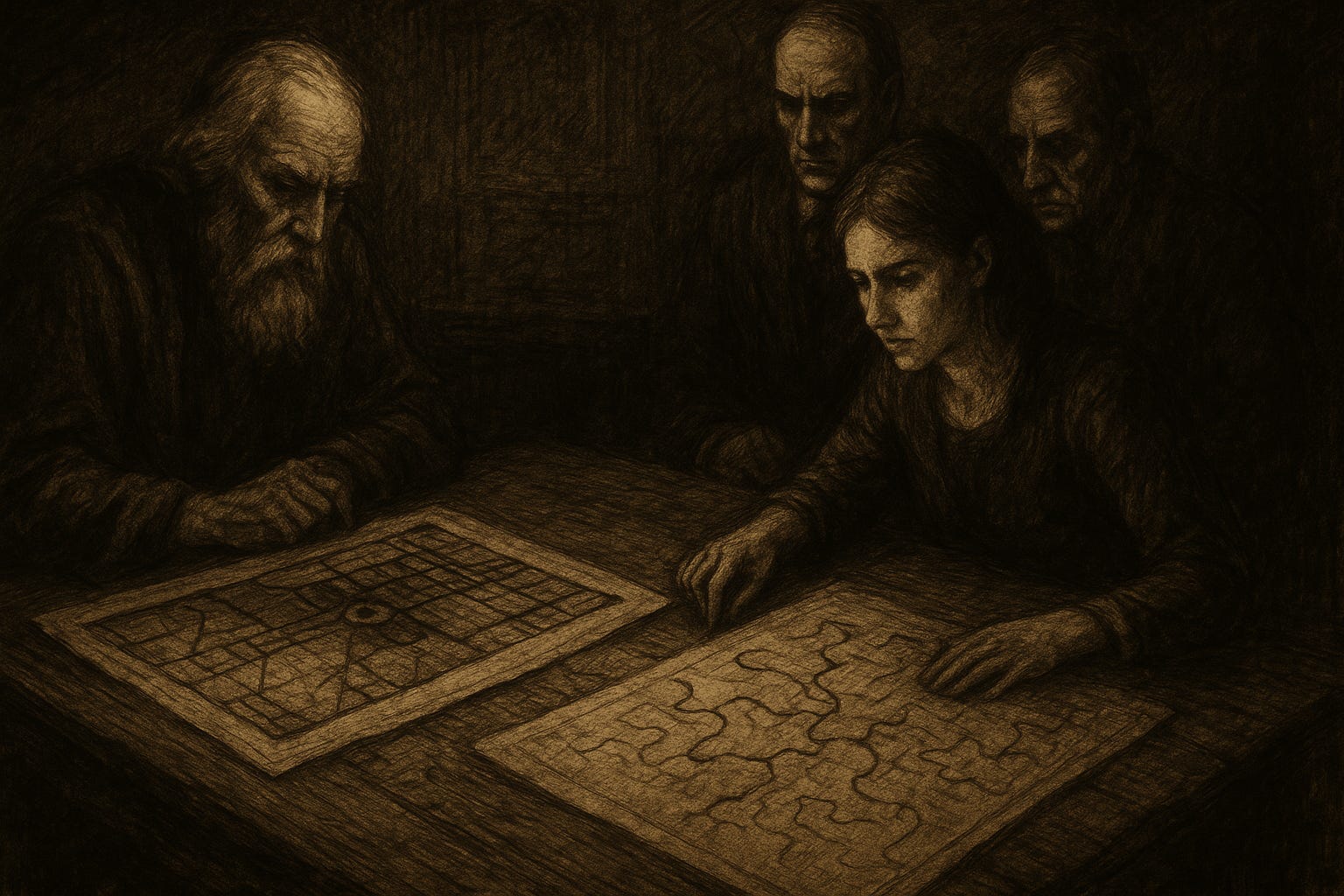
The trouble began, as trouble often does, in the Documentation Hall of the Department of Efficient Possibilities.
The Hall was a majestic space—vaulted ceilings, infinite shelves, and a faint smell of despair masked by lemon-scented optimism. Here, the Ministry stored every documented process for how work should be done in the Vast and Slightly Bewildered Organisation, Inc. Every procedure, every workflow, every compliance step, every “golden path”—all laid out with the geometric confidence of people who had never actually done any of it.
Somewhere inside this labyrinth lived the Map of Work As Imagined.
It was an elegant document, embossed with gold leaf, signed by Important Individuals, and framed behind glass so nothing messy—truth, for example—could touch it. It depicted a world where software glided smoothly from ideation to deployment as if ushered along by angels with excellent backlog grooming habits.
Developers followed the steps. Security approved the thing. Compliance nodded sagely. Release pipelines hummed like well-fed bees.
And the system worked. At least, on the map.
The trouble began when an intern—whose name was either Emilia or Emilian or possibly both, depending on which version of the HR directory you consulted—discovered another map hidden in a drawer no one had opened since the last reorg.
It was dusty. A bit stained. And titled, in shaky handwriting:
“Work As Done (Provisional, Incomplete — Please Stop Judging Me)”
This map did not resemble the official one.
Instead of straight lines, it had loops. Instead of clear steps, it had annotations like:
“At this point Jorge runs a script he swears he didn’t write.”
“Retry until it works (definition of ‘works’ varies).”
“Ask Sarah. If Sarah is on holiday, abandon hope.”
Where the golden path was wide, luminous, and serenely empty, the real map showed narrow, muddy tracks where humans were clearly improvising, coping, and occasionally weeping. What made Emilia/Emilian gasp wasn’t the messiness—it was that the real map moved.
Every time they looked, new lines appeared. Old ones vanished. Whole regions folded themselves into tiny creases, like administrative origami. It seemed to be alive, adapting itself not to the intended design, but to the gravitational pull of human behaviour.
Emilia/Emilian, being an intern with admirable curiosity and dangerously little to lose, reported the discovery. A meeting was convened.
In the Ministry, meetings had long ago replaced the actual work they were meant to coordinate. They were spatial distortions in which time, enthusiasm, and clarity went to die. Nevertheless, the Senior Architect, the Director of Intangible Compliance, the Head of Procedural Conformity, and an assortment of middle managers who wouldn’t be missed gathered around the two maps laid on the table.
They stared. They frowned. They harrumphed in productive-sounding ways.
“It’s wrong,” said the Senior Architect.
“It’s real,” said Emilia/Emilian.
“Worse,” added the Head of Compliance. “It’s observed.”
The Ministry could not decide which map was true.
In the abstract, Work As Imagined was perfect and therefore indisputable. In practice, Work As Done was undeniable and therefore inconvenient.
The Director of Conformity proposed a compromise:
“We declare the imagined map True and the real map Incorrect But Charming.”
This failed to address the fact that the real map kept updating itself. And, more worryingly, it was starting to influence the imagined one.
Lines on the official map began to bend. Boxes shifted. New arrows grew like ivy creeping across the architectural façade.
“Impossible,” whispered the Senior Architect.
“Predictable,” said Emilia/Emilian. “People follow the real paths, so the system is adapting to them.”
The Ministry, having no procedural category for self-modifying truth, panicked (which sounds like silence but with more paperwork).
Then the shift happened. Not a mystical shift, though it felt like one. A practical shift.
Teams began using the real map openly, not surreptitiously. They spoke about friction. They revealed workarounds without shame. They admitted that much of the system functioned only because certain individuals—like Sarah—held the organisation together by sheer tacit knowledge and exasperated competence.
The platform teams listened. They observed. They replaced brittle steps with honest ones. They automated the rituals everyone pretended not to rely on. They turned workarounds into capabilities, and capabilities into habits.
For the first time, the two maps grew closer. The imagined map lost its gold embossing and gained humility. The real map lost some of its chaos and gained stability.
And gradually, beautifully, even dangerously, the maps began to overlap. This, of course, alarmed the Ministry.
“What happens,” asked the Director of Compliance, “if the imagined and the real map become the same?”
Emilia/Emilian smiled in the annoyingly serene way only people with a full night’s sleep can manage.
“Then,” they said, “we finally know where we are.”
And in a universe where most organisations wander through their own internal landscapes without a compass, that was no small miracle.
The last line of this story is taken from a Post-It note found on the desk of Sarah (who had, by then, been promoted, cloned metaphorically, and given an assistant):
“The system is not what we design. The system is what people do.”
Some say the note was written by Sarah.
Some by an AI.
Some by someone else who had just had enough of pitying them all.
No one can confirm. The real author, predictably, has never taken credit. Which is only fitting.
For in any living organisation, the truth—like the map—belongs to everyone.