
The Meeting Golem
A Short Developer Horror Story on a cold Monday Morning in November

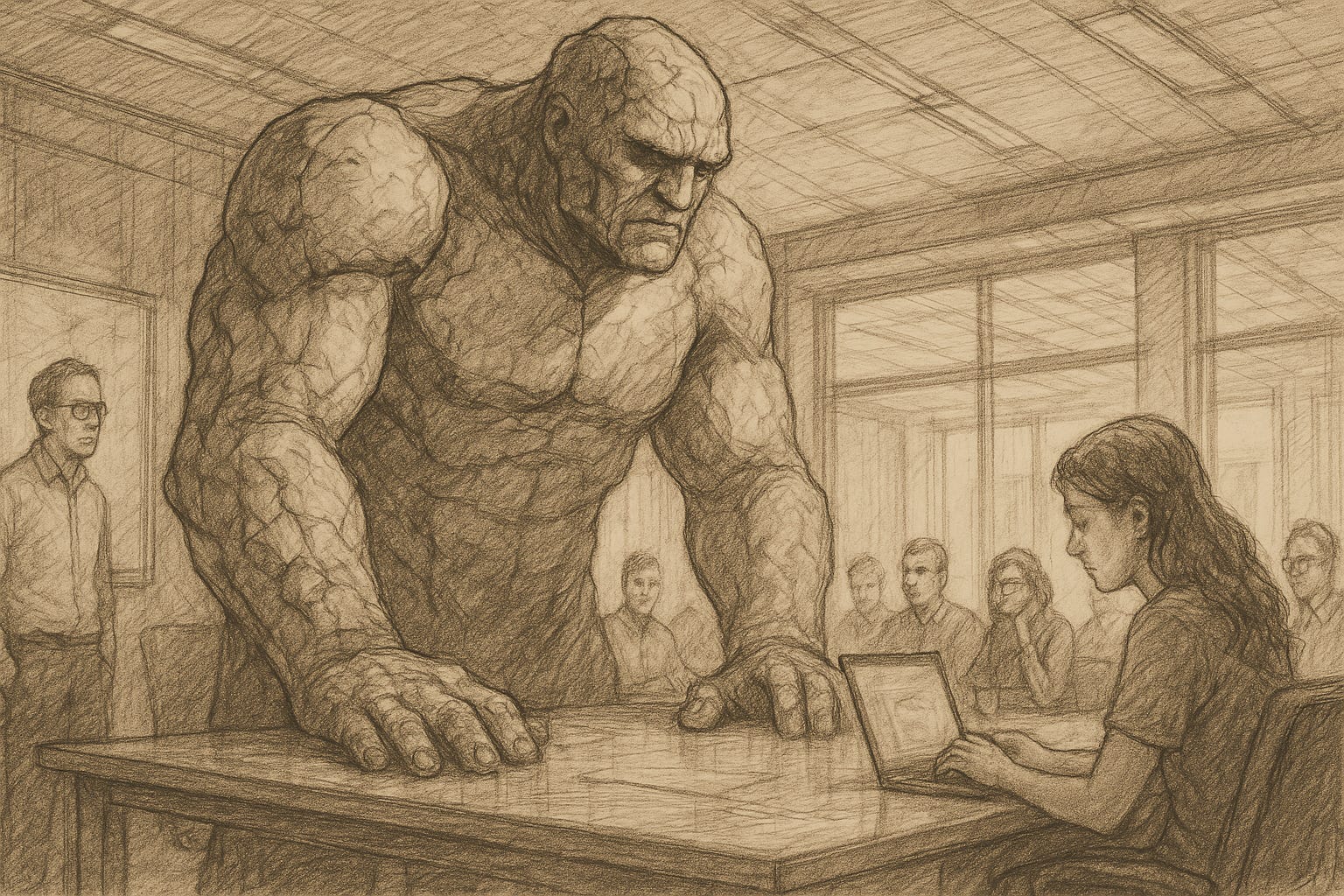
In a glass tower overlooking a fog-bound estuary, there lived a software organisation that had long ago forgotten why it built software at all. The teams were earnest and intelligent, the leaders impeccably dressed, and the office coffee machine capable of producing seventeen varieties of disappointment. Yet projects stalled, delivery slowed, and the architecture had begun to resemble a bowl of existentially confused spaghetti.
Naturally, senior management concluded the problem was insufficient meetings.
So they created a creature.
Not intentionally, of course. No great organisational horror ever is. It emerged accidentally, summoned from a swirl of Outlook invites by a Head of Transformation who sincerely believed that momentum, like yoghurt, would only remain viable if kept constantly agitated.
One morning — precisely at 9:15 AM, between a quarterly business alignment hour-long stand-up and a cross-functional pre-retrospective ceremony — the Meeting Golem announced itself by appearing on every employee’s calendar simultaneously. It had no form, no face, no agenda, but each invite carried a strange description:
“To ensure alignment on the need for alignment.”
At first, people assumed it was an error. A joke; the date was checked. A stray auto-generated invite maybe. A glitch in the calendaring system. A new regulatory requirement. Something to do with the auditors.
But the Meeting Golem persisted.
Every time someone declined it, two new invites appeared. If someone accepted it, the meeting expanded to fill the next available slot. If anyone suggested that perhaps the meeting was unnecessary, the Golem forwarded the invite to three additional managers, each of whom added “just a few more people who should be aware.”
The creature fed on availability.
A developer named Hale was the first to notice the deeper pattern. She observed that as the Golem grew, her ability to focus shrank proportionally. Once, she had spent three deeply satisfying hours building a concurrency helper. Now she spent entire days discussing the possibility of scheduling a discussion about whether a concurrency helper might be valuable — assuming capacity, alignment, sponsorship, and pre-read availability.
Nobody wrote code anymore. They wrote agendas.
The Nature of the Beast
As the Golem strengthened, its effects became undeniable:
Stand-ups expanded until they stood up entire afternoons.
Steering committees multiplied like panicked rabbits until they were all fighting over the same steering wheel.
A weekly governance call (originally framed as optional) now required attendance from Engineering, Security, HR, Legal, Facilities, Community Outreach, and once, by accident, the man who delivered the sandwiches.
The Meeting Golem acquired mass simply by accretion: every meeting contained within it the promise of future meetings, which themselves contained sub-meetings, which themselves contained breakout sessions, which themselves required—inevitably, inexorably—follow-up meetings.
It was a fractal of obligation. It was a bad idea with excellent administrative support.
An Accidental Hero
Hale, exhausted and slightly delirious, decided to probe the creature’s heart. She clicked “Join” on the Golem’s meeting one morning, expecting the usual tableau of weary faces and muted microphones.
Instead she found nothing.
Just a blank screen — a void of pure calendrical potential. The Golem had no centre. It lived only in the anticipation of itself. In that moment Hale realised, with the clarity of a person who has not slept properly in months, that the Meeting Golem could not be slain by force. It could only be starved.
So she performed the forbidden act. She toggled her status to Focus Mode.
For a brief instant, the organisation paused. The tides of the estuary held their breath. Sun felt long forgotten reserves rally against the fog. A dozen managers felt unexplained discomfort. The Golem shivered.
Hale wrote some code. Real, functioning, marvellously un-meetinged code.
Engineers nearby saw what she had done and followed. Focus spread quietly, like a benevolent infection. Calendars emptied. Deliveries accelerated. A product manager cried tears of joy upon seeing a working feature appear without a single alignment workshop.
Within a week, the Meeting Golem shrank to a small, wilted placeholder on a single director’s calendar titled “Catch-up (tentative).”
Nobody attended.
Epilogue
To this day, the organisation tells the story of how a creature born from fear, uncertainty, and overzealous scheduling once ruled their lives. How they reclaimed their craft not with rebellion but with a toggle. How momentum returned not through orchestration but through quiet.
And how the Golem, deprived of attention, dissolved into legend.
Some say it still lurks in the depths of the calendar system, waiting for a new transformation initiative or an especially enthusiastic consultant to summon it again. But as long as the engineers remember Hale’s lesson, that “real momentum is built, not booked”, the Meeting Golem remains powerless.
You can also catch me on the road at various conferences and events