
The Myth of the Perfect Architecture
Perfection versus the Best Simple System for Now when building habitable and valuable software systems

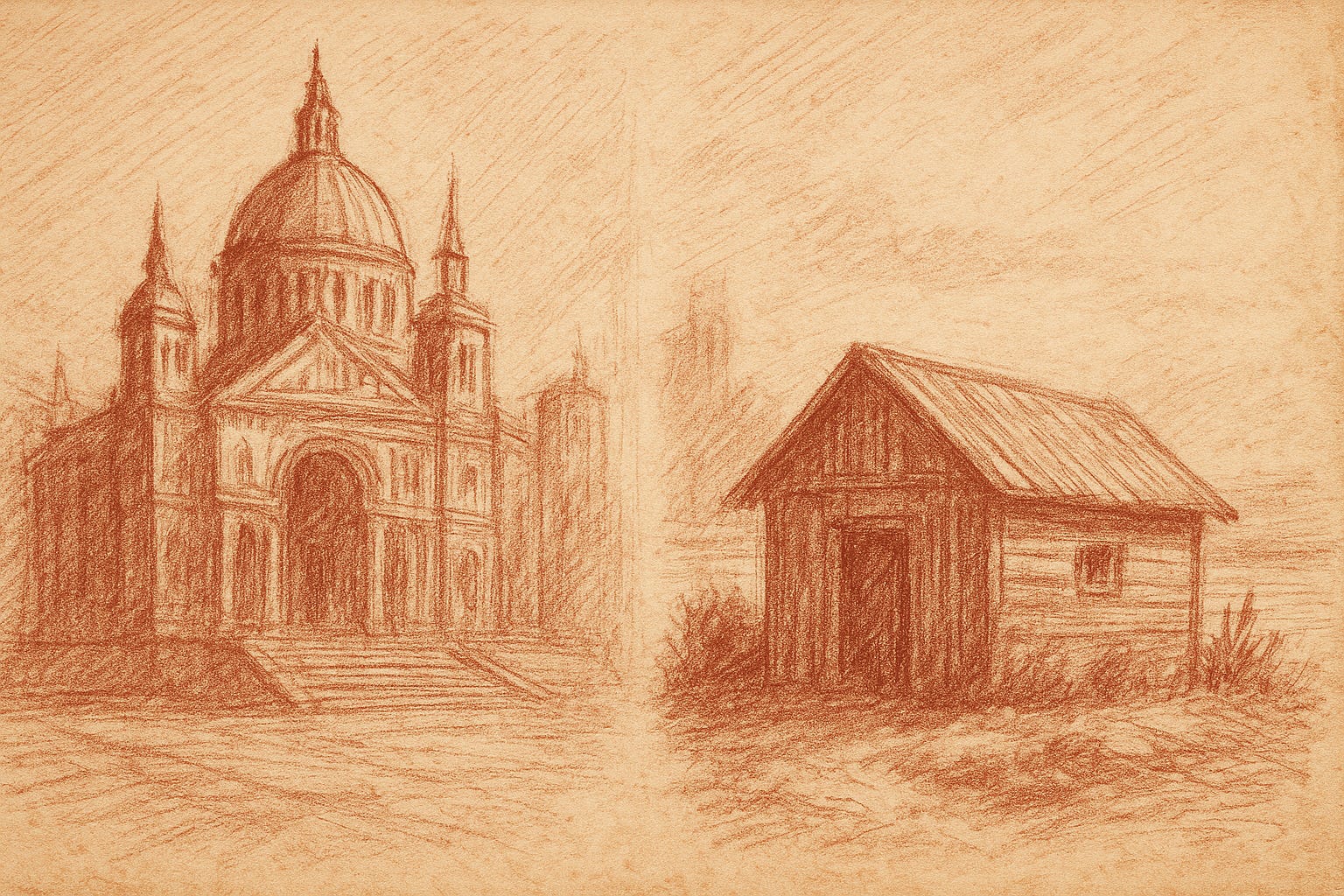
The Cathedral of Perfect Form …
They called it Project Elysium. Twelve architects, six diagrams, one vision: a system so perfect it would never need to change.
They built for the ages — layers upon layers of abstraction, immaculate domain boundaries, messaging patterns that would make angels weep. They spoke in UML tongues. They held daily rituals before the whiteboard, arguing about purity, cohesion, and whether dependency inversion was a sin or a sacrament.
For a while, it worked. The first release gleamed like marble. Users admired it — briefly — before asking for small changes. Nothing major: a new report, a faster path, an extra field. But the perfect system resisted them. Every modification cracked the marble.
The team began to patch and compromise. Abstractions multiplied. The diagrams aged faster than the code. The documentation lost itself in links. In their reverence for permanence, they had built not a living system but a tomb.
When the audit came the auditors were impressed. The architecture documents were flawless. The system, however, was dead.
They gathered one last time in the empty project room. On the whiteboard, someone wrote a single line before turning out the lights:
“We believed in the myth, and the myth believed in us.”
Their myth had “run out of meaning” — it had hardened from metaphor into dogma. They had mistaken their imaginative framework for truth itself, and reality had come for their jugular.
…& The Shed by the Sea
At the other end of town, a small team worked in a shed that still smelled of salt and oil. Their architecture wasn’t much to look at: one API, two background jobs, a single database that everyone swore they’d outgrow “soon.”
Every Friday, they’d gather with mugs of tea and ask the same question:
“Is this still the best simple system for now?”
Sometimes the answer was yes. Sometimes it was no, and they’d redesign and refactor over the weekend. They didn’t chase purity. They chased usefulness.
When the product grew, they didn’t rebuild from scratch. They split what hurt, automated what bored or pained them, and replaced what broke. Their diagrams were pencil sketches, easily erased. Their principles were simple: be kind to the next person, and leave things slightly better than you found them.
One evening, a visiting executive asked to see their architecture. They pointed at the whiteboard, where someone had scrawled:
“It works. For now.”
He frowned. “That’s not very future-proof.”
They smiled. “Neither are we.” And yet their system survived every storm, every pivot, every surprise. Because it wasn’t built to last — it was built to learn and adapt.
They had replaced one myth with another — not the myth of perfection, but the myth of stewardship. They lived by a story that honoured time, context, and change, seeing “the imaginative patterns that hold our thought together.”
And it worked. For now. But then again, isn’t now all we are promised?
Where the first team worshipped Form, the second practised Care. Where one sought immortality, the other cultivated renewal.
One myth ossified; the other breathed. The lesson is not to banish myth, but to choose better ones — stories that help us act wisely within our limits.
As Mary Midgley wrote:
We cannot live without myths, but we can live without bad ones.”
And as Daniel Terhorst-North might add,
Just build the best simple system — for now.”
The Attraction of the One True… Architecture
We tell ourselves a familiar story every few years. The names change — CORBA becomes SOA, SOA becomes microservices, microservices become functions, ad nauseum — but the myth remains constant: somewhere out there lies the right way to build software. One pattern to rule them all. One elegant architecture that, if we could only find and follow it, would banish complexity forever.
This is the architectural equivalent of the Holy Grail — always almost within reach, always just one whitepaper away, and just as likely to be nonexistent. It flatters our intellect, promising a moral order to our craft: that cleverness and discipline will save us from entropy. It’s also profoundly comforting. Believing in a perfect form spares us the anxiety of ambiguity. It suggests that architecture and design can be solved, rather than continually lived with.
But software does not exist in the abstract. It exists in time, in a dynamic complexity of organisations, cultures, competition, commerce and constraints. Every architecture is a compromise between the past we’ve inherited, the present we inhabit, and the future we imagine. It is a snapshot of trade-offs — performance against maintainability, autonomy against consistency, elegance against delivery speed. What was “clean” yesterday becomes “legacy” tomorrow, not because the code changed, but because the context does.
This is not a failure of logic, but a feature of human meaning-making. In The Myths We Live By, Mary Midgley argues that myths are not falsehoods to be debunked but frameworks that help us see the world. They are “imaginative patterns, networks of powerful symbols that suggest particular ways of interpreting the world.”
The myth of the Perfect Architecture is exactly such a pattern: a story that helps engineers make sense of uncertainty, giving shape to their hopes of mastery and control. Like any powerful myth, it simplifies a complex world — but when mistaken for literal truth, it becomes very, very dangerous.
From Myth to Practice: The “Best Simple System for Now”
Here’s where Daniel Terhorst-North’s Best Simple System for Now (BSSN) offers an antidote to mythic perfectionism. Instead of seeking the One True Form, North invites us to choose the best simple system for now — an approach that accepts context, change, and impermanence as the natural conditions of our work.
Midgley wrote that myths “are the matrix of thought,” and that new myths don’t replace old ones so much as grow beside them, offering fresh metaphors for the same human needs. BSSN is one such modern myth — a humbler, more grounded story we can live by. It replaces the fantasy of eternal perfection with a narrative of pragmatic evolution: design as care, not conquest.
Through a BSSN Lens Darkly: Some Lessons
“For Now” — The myth of perfection imagines architecture as timeless; BSSN reminds us that for now is the most honest design horizon we have. Dan notes that engineers often over-engineer for imagined futures, when the world will have changed anyway. The wise architect embraces temporality: building for what’s true today, and preparing to learn when tomorrow arrives.
“Simple” — The myth equates sophistication with virtue. BSSN reclaims simplicity as an act of discipline; the courage to stop adding, to resist abstraction. Simplicity isn’t poverty; it’s precision. Midgley warned that our “scientific myths” can lead to hubris — the belief that more theory, more complexity, will save us. In architecture, as in science, simplicity often reveals what arrogance obscures.
Best — “Best” is not the same as “ideal.” It means fit for purpose — a judgement rooted in empathy and context. The “best” system honours the limits of the team, the constraints of the environment, and the fluidity of time. As Midgley might say, wisdom lies not in chasing universality, but in “seeing things whole,” connecting technical, social, and moral dimensions of our craft.
Don’t chase the perfect architecture; build the best simple system for now
The Perfect Architecture myth comforts us with the illusion of finality. Midgley showed us that myths like this are interpretive lenses, not absolute truths.
Daniel’s BSSN gives us a replacement myth, one of continuous discernment rather than eternal design. Architecture becomes less about purity and more about stewardship: caring for what works, pruning what doesn’t, and accepting impermanence as the default condition.
Some practices to consider
Regularly ask: “Is this still the best simple system for now?”
Document trade-offs and expiration dates of architectural choices.
Prefer “good enough and evolvable” over “comprehensive and brittle.”
Design for residuality: explore what remains valuable when the context shifts. Maybe take a walk around your architecture to explore it through this powerful lens.
Build mechanisms for reflection as much as execution — retrospectives, post-mortems, and design reviews that ask what myths we might be serving unconsciously.
Some things to avoid
Treating current, or even past, architectural choices as timeless doctrine (or dogma).
Over-engineering for imagined futures (“What if we have ten thousand users?” when you have ten).
Mistaking simplicity for naivety or lack of rigour.
Ignoring the cultural and emotional work of architecture — the shared story that makes technical decisions intelligible.
In the end, the myth of the Perfect Architecture isn’t really about technology — it’s about fear.
The fear of mess, of impermanence, of being wrong. It’s the same fear that drives us to over-design, over-think, and even over-promise.
But as Mary Midgley reminds us, myths only have power when we stop recognising them as myths. The moment we see them for what they are — stories we tell ourselves to make sense of uncertainty — we reclaim our agency. Architecture stops being theology and becomes what it was always meant to be: a conversation between intent and reality, guided by curiosity rather than control.
Maybe the wiser act isn’t to perfect, but to persist. To build systems that are good enough to live in and simple enough to change. To treat architecture not as a monument to certainty, but as a kinder habitat for learning and adaption.
The cathedral will crumble; the shed by the sea will stand as long as it needs to. The best architectures, like the best myths, aren’t eternal — they’re useful. And then, when the tide changes, they quietly make way for what comes next.
Further Reading
The Myths We Live By — Mary Midgley
Best Simple System for Now — Dan North
Patterns of Software — Richard P. Gabriel
Residuality Theory — Barry O’Reilly