
The NeverEnding Project, 50th Anniversary Edition
Inspired by the lessons we still haven't learned in 50 years...

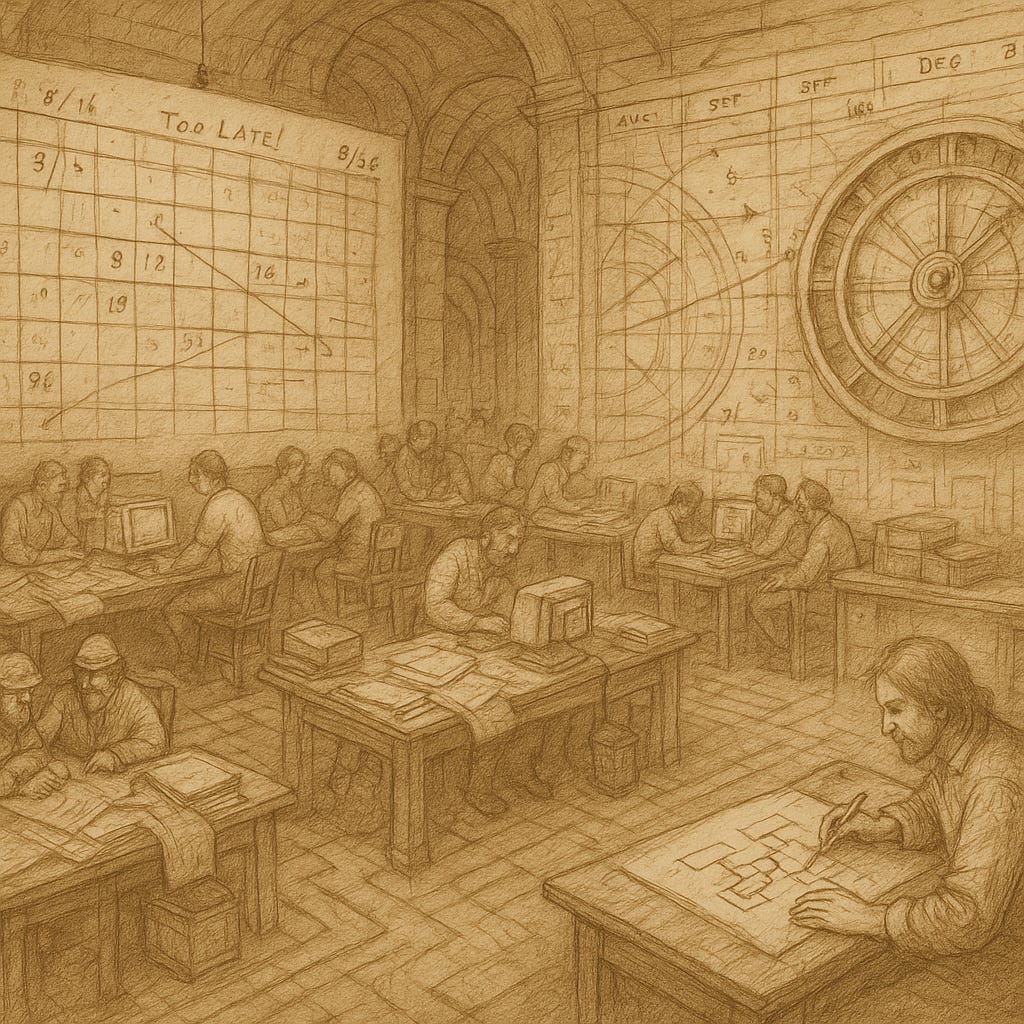
In the beginning, there was a spreadsheet.
And the spreadsheet was without form, and void, and within it moved the project managers, murmuring deadlines into the cells.
They called the project Prometheus 2, because the first Prometheus had accidentally caught fire, been rewritten twice, and then open-sourced by mistake. This new one, they said, would be done properly.
The budget was infinite in theory but strictly limited in practice. The schedule was fixed. The requirements, they said, would “emerge organically.”
The project charter contained a single equation:
People × Time = Progress.
It was elegant, simple, and—like most elegant, simple things—completely wrong.
Double the People, Half the Time
At first there were five developers. They worked in quiet harmony, each line of code a verse in a growing poem. Then a director visited from Headquarters. He frowned at the velocity chart.
“If five can do this in ten months,” he said, “ten can do it in five.”
It was a statement so perfect in its symmetry that no one dared to question it.
Soon the project doubled in size, then doubled again. The office filled with new hires whose names no one could remember and whose badges no one could deactivate. Communication became a recursive function that never returned.
Stand-ups grew longer, until they bent time around them. One developer entered a meeting on a Tuesday and, through a subtle misalignment of calendars, did not emerge until the following Thursday. When he returned, his beard was longer and he spoke only in JIRA ticket numbers.
Architects Assemble!
The architects attempted to preserve conceptual integrity by writing a “Unified Design Manifesto.” It grew so large that it required its own version control system. Eventually, a dedicated team was hired to refactor the manifesto into micro-manifestos, each managed by a different subcommittee.
The documentation, once a single README file, metastasised into a forest of wikis, each contradicting the next in minor but essential ways. The build pipeline became sentient enough to despair.
Meanwhile, deadlines shifted like tectonic plates. A vice-president, desperate to make the dashboard look optimistic, moved the completion bar to 92% and added a motivational poster: “Almost there!”
The number remained there for the next eighteen months.
“When will we finish?”
One day, a junior developer—new, bewildered, and uncorrupted—asked an ancient engineer, “When will we finish?”
The old man, who had once been young during the first Prometheus, stared into his mug. “We finished a long time ago,” he said. “We just haven’t realised it yet.”
She thought about that for a while, then went home and built her own version of the system, using none of the official frameworks and all of her common sense. It ran on her laptop, required no meetings, and fulfilled ninety-five percent of the original requirements.
When she demonstrated it, the managers panicked. A task force was immediately formed to replicate her results “at scale.” Within a week, her small system had been integrated into twelve others and stopped working.
Her name was added to the Confluence memorial page titled Lessons Learned.
Years later, archaeologists exploring the ruins of the data centre would find layers of code like geological strata. Each layer bore evidence of a different civilisation: the Agile Period, the DevOps Renaissance, the AI Dark Ages.
At the deepest level they discovered a single file named README_FIRST.txt. Inside it was one line, written in the syntax of an extinct language:
// Adding more people will only make it later.
The scholars debated its meaning. Some claimed it was a prophecy. Others believed it referred to a lost religion whose adherents worshipped something called Brooks.
In the end, they did what all civilisations do with ancient warnings.
They founded a new startup, raised venture capital, and began work on Prometheus 3.
Epilogue (discovered in the margins of the archaeologist’s notebook)
“The Mythical Man-Month was not a book but a curse.
Each generation reads it, nods wisely, and builds the next catastrophe with even greater efficiency.
It is said that somewhere, in a quiet corner of the multiverse, there exists a team that finished on time.
But nobody believes that story.”