

“The Sovereign Engineer: AI Literacy for Software Professionals” and its free counterpart “The Sovereign Apprentice: AI Literacy for New Engineers” are available now.
It had rained in the night. Not heavily. Just enough to leave the city washed and reflective, the gutters murmuring and the paving stones outside Le Bon Mot shining beneath a reluctant morning sun.
Across the little square, three council workers stood regarding a path. It was a handsome path. Newly laid pale stone ran from the gate beside the pharmacy, curved politely around the young plane tree, and arrived at the crossing in a sweep that seemed almost calligraphic.
Beside it, cutting directly across the wet grass, was a streak of mud. Dave stood at the window with his coffee.
“They’ve ruined it.”
Case did not look up from her book.
“Who?”
“The pedestrians.”
That was enough to make her look. Dave pointed through the glass. A man in a blue coat had just left the pavement, ignored the new path entirely, and was making his way across the grass. His shoes disappeared briefly into the mud with every step.
“Look.”
They watched him reach the opposite pavement, wipe one shoe against the back of his trouser leg, and continue towards the station.
Case returned to her book.
“Seems to have worked.”
“The path is there.”
“So is he.”
Dave frowned.
“The council spent a fortune putting that in.”
“Perhaps nobody told him.”
“Very funny.”
The bell above the door rang. A man entered carrying what appeared to be several months of paperwork. He was in his late forties, expensively but unhappily dressed, with the expression of someone who had spent the morning being held responsible for something everyone else had agreed to.
He put a thick black folder on the counter. Madame Beauregard looked at it. Then at him.
“Coffee?”
“Double espresso.”
She continued looking at the folder.
“Triple.”
“Ah.”
She turned towards the machine. The man carried the folder to the large table near the philosophy shelves and sat heavily. The Librarian appeared from somewhere amongst Ethics.
“You’ve brought work.”
“I’ve brought evidence.”
“More dangerous.”
The man looked at him.
“I’m Julian.”
The Librarian nodded as though Julian had confessed to something minor. Case closed her book. Julian noticed the gesture.
“I’m sorry. Am I disturbing you?”
“Not yet.”
Madame Beauregard placed the espresso in front of him.
“Give it time.”
The folder contained a specification. It was, Julian explained, the specification for a new system his company had spent the better part of a year building.
“Four hundred and twelve pages.”
Dave looked impressed. The Librarian did not.
“Requirements?”
“Requirements, workflows, business rules, integrations, interface definitions, acceptance criteria. Everything.”
“Everything?”
“Everything they asked for.”
Case noticed the last four words.
“And?”
Julian drank half the espresso.
“And yesterday we showed it to them.”
“The customer?”
“Senior operations people. Product. Finance. Two directors. Everyone who matters.”
“And?”
Julian looked at the folder.
“They hate it.”
Dave winced. Julian opened the folder as though preparing his defence before a tribunal.
“That’s the thing. They can’t hate it. We built what they asked for.”
He pulled out a page.
“Here. Approved.”
Another.
“Approved.”
Another.
“Approved.”
He turned several pages at once.
“All of it approved. Workshops. Sign-offs. Change control. We spent three months making absolutely certain we understood what they wanted before engineering started.”
“And did you?”
“Did we what?”
“Understand what they wanted.”
Julian tapped the papers.
“It’s all there.”
Case leaned towards the document.
“No. Their signatures are all there.”
Julian’s expression hardened.
“They told us exactly what they wanted.”
“Apparently not.”
“They signed it.”
“That’s not the same thing.”
For a moment, only the coffee machine spoke. Julian pushed the folder away.
“Yesterday one of them actually had the nerve to say, ‘Yes, that’s what we asked for, but now that I can see it, it isn’t what we need.’”
Case smiled. Julian stared at her.
“You find that amusing?”
“A little.”
“We’ve spent nine months and several million pounds.”
“That’s the part I don’t find amusing.”
The Librarian pulled out a chair.
“When was the last moment at which being wrong was cheap?”
Julian turned towards him.
“What?”
“When was the last moment at which being wrong was cheap?”
“I don’t understand the question.”
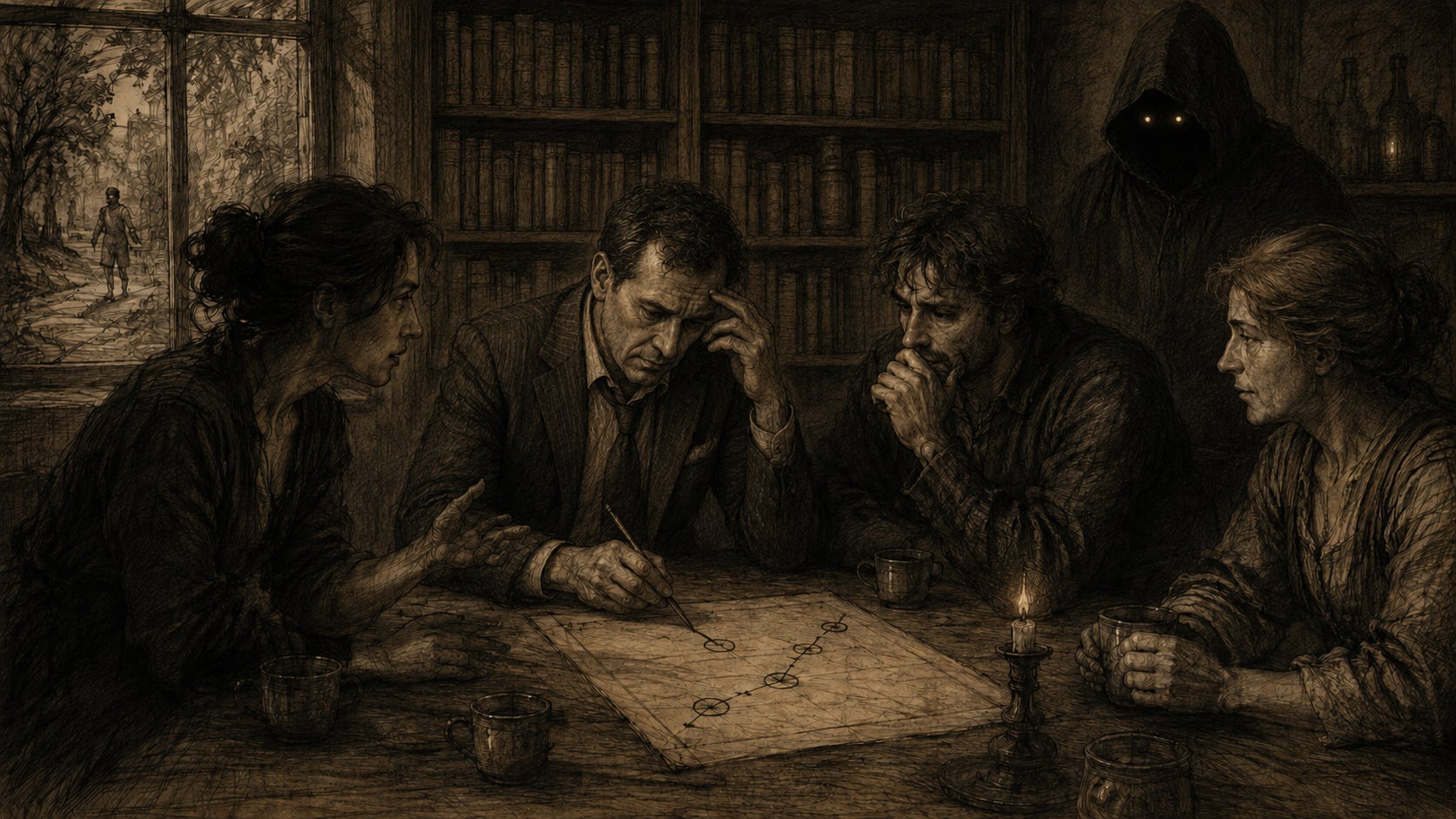
The Librarian took a paper napkin from the holder. He borrowed Case’s pencil and made five marks.
A — B — C — D — E
“At A, you believed something about what they needed.”
“Yes.”
“You made some decisions.”
“Obviously.”
“Then more?”
“Yes.”
He touched B.
“And more?”
C.
“Yes.”
D.
“Yes.”
E.
“Yes.”
The Librarian put down the pencil.
“When did you discover the first decision might have been wrong?”
Julian looked at the marks.
“Yesterday.”
The Librarian tapped E.
“Here.”
“Yes.”
“And when could you first have discovered it?”
Julian didn’t answer.
Outside, a woman pushing a bicycle took the muddy shortcut. Dave watched her.
“The funny thing,” he said, “is that if they’d just asked people where they wanted the path—”
“No.”
Case said it sharply enough to stop him.
“No?”
“That’s the other mistake.”
Dave looked back towards the square.
“People clearly want to walk diagonally.”
“Now they do.”
“What does that mean?”
“It means you’re assuming the pedestrians knew where the path should be before they walked across the square.”
Dave considered this. Case got up and joined him at the window.
“Imagine asking everyone six months ago. Where should the path go? Someone would draw a straight line. Someone else would want it around the tree. Someone would insist it needed to pass the bench. Someone would remember the market on Thursdays. Someone in a wheelchair would notice a gradient nobody else had considered.”
“The council would gather requirements,” said Julian.
“Exactly.”
“And eventually somebody would have to decide.”
“Exactly.”
“So what are you suggesting? That nobody builds anything because nobody knows anything?”
Case shook her head.
“That you build because nobody knows everything.”
Julian looked at her. Outside, another pedestrian entered the square. She began along the new path. Halfway down she stopped, checked something on her phone, stepped off the paving and crossed the grass towards the bus stop.
Case pointed.
“She didn’t know where she was going either.”
The Djinn had been sitting in the darkest corner of the café for long enough that nobody could remember him arriving. Two small glowing eyes appeared beneath the hood.
“I know.”
Julian turned.
“Sorry?”
“I know what your customer requires.”
The voice had the calm certainty of a locked door. Julian laughed.
“You haven’t even met them.”
“I do not need to.”
Something pale appeared on the table before him. A document. Then another. Then another. Documents accumulated with impossible speed. Workshop transcripts. Emails. Support tickets. Process maps. Meeting notes. Customer interviews. Financial projections. Previous specifications. Incident reports. Strategy presentations. Every sentence anyone had ever committed to a system about the system seemed to gather beneath the Djinn’s hands.
“I can reconcile every contradiction,” he said. “Resolve every ambiguity. Infer every unstated dependency. I can produce a complete specification.”
Julian looked at the growing pile.
“How complete?”
“Entirely.”
Dave gave a low whistle.
Case walked over.
“Will it be right?”
The eyes beneath the hood brightened.
“It will be complete.”
“That wasn’t my question.”
Silence. The Djinn’s hands rested upon the documents.
“It will represent everything currently known.”
Case nodded.
“That’s the problem.”
Julian looked from one to the other.
“How can more knowledge be a problem?”
“It isn’t.”
She picked up the first page of his original specification.
“Confusing what we know with what is can be.”
She let the page fall.
“Your customer learned something yesterday.”
“That they don’t like our system.”
“More than that. They learned something about what they need.”
“By looking at the wrong thing.”
“Yes.”
Julian stared at her.
“Then being wrong taught them something.”
“Now you’re getting somewhere.”
Dave took the Librarian’s napkin.
“So instead of A to E, we make smaller decisions.”
Case tilted her head.
“Not necessarily.”
“You just spent ten minutes saying—”
“Small enough to test. Large enough to mean something.”
She took the pencil. Around A and B she drew a loose circle.
“A decision has to be cohesive.”
“Cohesive?”
“If you ask me whether I like the handle of a cup before you’ve shown me how I’m supposed to hold it, you haven’t learned very much.”
Dave nodded slowly.
“So not tiny for the sake of tiny.”
“Exactly.”
Julian was looking at the napkin now. Case continued.
“You make the smallest set of decisions that lets the customer encounter something meaningful.”
“And then?”
“You put it in front of them.”
“And ask if it’s right?”
“No.”
Julian frowned.
“Why not?”
“Because they may not know.”
“Then what do you ask?”
Case thought for a moment.
“Does this make something better?”
Julian said nothing.
“Does it help? Does it remove a problem? Does it reveal another one? What surprised you? What becomes possible now? What have we learned that we couldn’t have learned from another meeting?”
The Librarian slid the napkin back towards Julian.
“And then you decide again.”
Julian looked at the marks.
“That’s going to feel terribly inefficient.”
“Compared with what?”
Case nodded towards the black folder.
Madame Beauregard had been listening while polishing glasses.
“How many iterations do you have left?”
Julian looked over.
“Iterations?”
“In your project.”
“We have thirty-seven two-week sprints in the revised plan.”
“After which one can they stop?”
He blinked.
“Stop?”
“Yes.”
“They can’t stop halfway through.”
Madame Beauregard put down the glass.
“Why not?”
“Because they’d only have part of the system.”
“Would that part be useful?”
“Not really.”
“The next one?”
“No.”
“The one after?”
“Not by itself.”
She frowned.
“Then you haven’t divided the work.”
Julian waited.
“You’ve divided the calendar.”
Dave laughed. Julian did not, although something in his expression suggested he wanted to.
Madame Beauregard picked up another glass.
“If I bring you the saucer today, the cup next Thursday and the coffee two weeks after that, I have not served you coffee incrementally.”
Case grinned.
“Although Finance would be delighted by the throughput.”
Madame Beauregard ignored her. Julian looked again at the Librarian’s five marks.
“So every step should deliver something useful.”
“Useful enough,” said Case.
“Complete?”
“No.”
“Finished?”
“Perhaps.”
“Those sound contradictory.”
“They aren’t. Complete describes your imagined destination. Finished can simply mean this step stands on its own.”
The Librarian nodded.
“Enough value that stopping is a legitimate choice.”
That seemed to trouble Julian more than anything else.
“But we don’t want them to stop.”
“Why?”
“Because we’re building the system.”
Case shook her head.
“You’re trying to improve something in their world. The system is merely your current theory about how.”
Julian became very still. Outside, sunlight had begun to find the wet paving stones.
“The system is a theory,” he repeated.
“One you can test.”
“And if they stop needing it?”
“Stop.”
“If something else turns out to work better?”
“Stop.”
“If half of it produces most of the value?”
“Perhaps stop.”
Julian looked genuinely appalled.
“No programme board in the world is going to like this café.”
“That,” said Madame Beauregard, “is why we don’t offer corporate rates.”
They ordered another round. The folder remained closed. Julian had begun drawing his own sequence on the napkin.
“What you’re describing sounds like stumbling forward.”
“Yes,” said Case.
He looked up, expecting resistance.
She offered none.
“That’s not a compliment.”
“Why not?”
“Because professionals aren’t supposed to stumble.”
“Professionals aren’t supposed to fall.”
“What’s the difference?”
Case stood. She took two deliberately exaggerated steps across the café, shifting her balance slightly with each one.
“This.”
Dave looked bewildered.
“Walking?”
“Walking is controlled falling.”
The Librarian smiled. Case returned to her chair.
“You move beyond your stable position. Discover where the ground is. Recover. Do it again.”
“That’s not stumbling.”
“It is when you don’t know the terrain.”
Julian looked towards the square. Case followed his gaze.
“Your problem wasn’t that you stumbled.”
She tapped the black folder.
“You tried to make one enormous step.”
The words remained between them. Then the Librarian said, “Motion produces information.” Julian looked back at him.
“About the customer?”
“About everything. The customer. The system. The constraints. Your own assumptions. Things nobody could have told you because nobody had encountered them yet.”
“Motion creates clarity,” said Dave.
“And clarity?”
Case picked up the pencil and added another arrow to the napkin.
“Enables the next motion.”
Julian stared at the little sequence.
“So we stumble towards the right thing.”
Case nodded.
“Carefully.”
“That still doesn’t sound very professional.”
“No,” she said. “Pretending you already know where you’re going sounds much more professional.”
This time Julian laughed.
By late afternoon, the square had dried. The council workers had returned. One was lifting several stones from the new path. Another had a wheelbarrow. The third was standing in the grass.
Dave noticed first.
“They’re moving it.”
Everyone gathered at the window. But they weren’t paving the muddy track. Instead, the workers laid four temporary slabs across one section of grass. Then they stopped.
Julian frowned.
“Why only four?”
As they watched, a man crossed them. Then a woman. A cyclist avoided them entirely. A mother with a pushchair used the first two before turning towards the crossing. The worker in the grass made a note on a clipboard.
Julian smiled.
“They’re watching.”
Case nodded.
“Why don’t they just finish the path now? They know where people are walking.”
“Do they?”
Another pedestrian entered the square and chose a route none of the others had taken.
Julian watched him.
“Apparently not.”
The Librarian returned to his shelves. Madame Beauregard collected the empty cups. Julian closed the black folder and tucked the napkin carefully inside it. At the door he stopped.
“So that’s agility?”
Case looked at him. Outside, people continued crossing the square, each making tiny accommodations to puddles, bicycles, other people and whatever destination mattered to them.
“Not knowing?”
“No.”
“Changing your mind?”
“No.”
“Going faster?”
“Certainly not.”
He waited. Case looked towards the four temporary stones.
“Finding out.”
Julian opened the door. Sophie, who had slept through the entire conversation beneath Case’s chair, suddenly woke, stretched, and trotted past him into the square.
She ignored the beautiful new path. She ignored the muddy track. She ignored the four experimental stones. Instead she wandered to the plane tree, investigated it carefully, changed her mind, and headed towards the pharmacy. They have dog treats behind the desk there.
Madame Beauregard watched her go.
“Of course,” she said, “one shouldn’t become doctrinaire about it.”
Julian laughed again and stepped outside. He had no idea precisely where his project would end. For the first time that day, this did not seem like a failure. It seemed like the situation.
Everything changing and adapting. Situation normal, after all.
“The Sovereign Engineer: AI Literacy for Software Professionals” and its free counterpart “The Sovereign Apprentice: AI Literacy for New Engineers” are available now.