
The Protocol River
A (Very) Short Story on the Tao of Platform Architecture

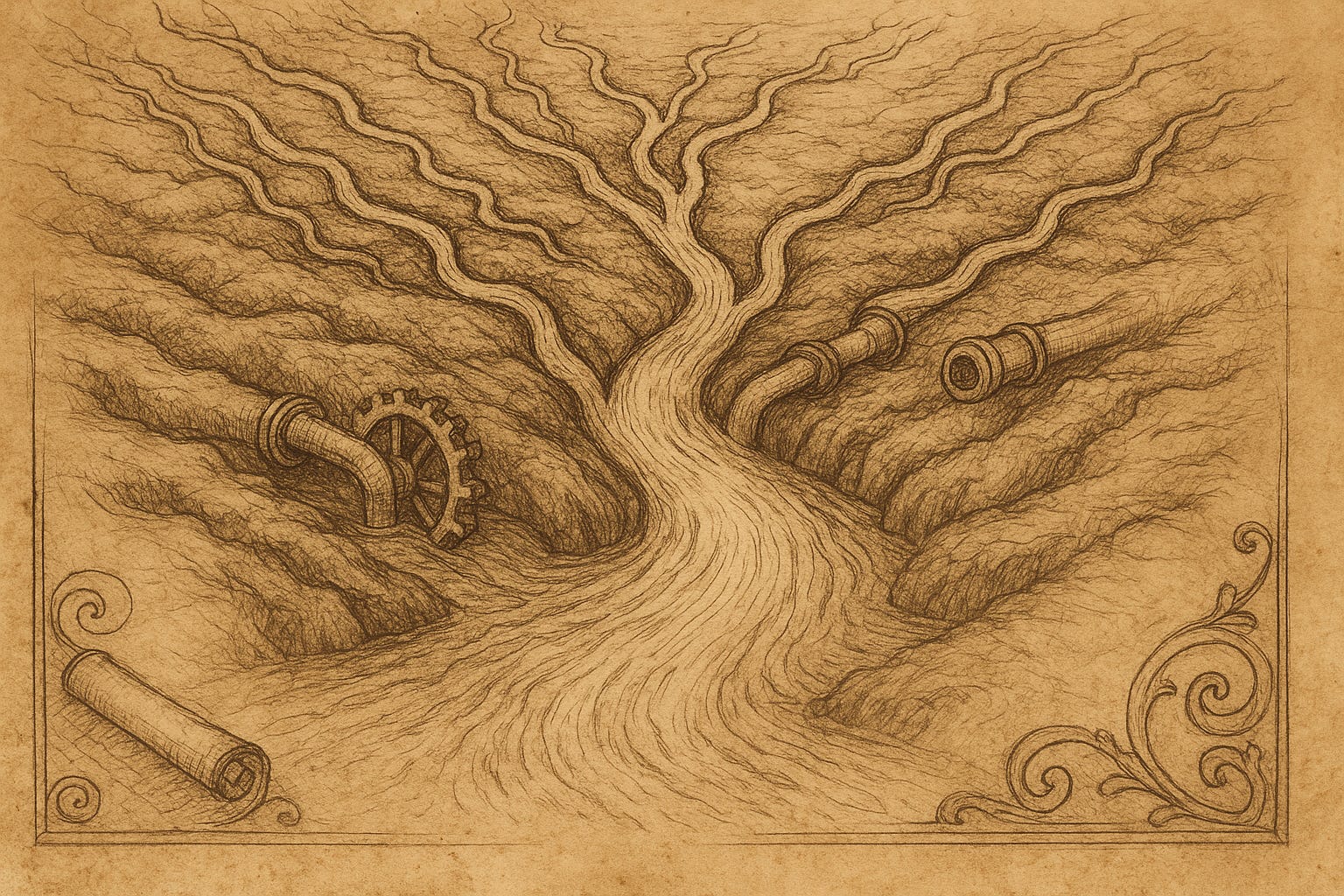
In the archives of a forgotten digital civilisation there is said to exist a map.
Not a map of places, but of flows. It charts how ideas, code, and conversations move — sometimes smoothly, sometimes like treacle through bureaucracy. Scholars call it The Protocol River.
No one remembers who first drew it, though some attribute it to a mythical engineer-philosopher who, bored and frustrated, once said:
“When the system loses its way, it invents documentation.”
This person was the chief architect of the Unified Development Environment of All Things, a platform that connected the known world’s software guilds. The goal was to bring harmony: one pipeline, one truth, one blessed YAML to rule them all.
For a moment so brief you couldn’t even make a tea, it worked. Teams flourished. Services sang in polyphonic uptime. But then came The Governance, and with it — despair wrapped in process.
They introduced approval rituals, mandatory empathy workshops, and a sacred “API gateway” that required the correct sequence of tokens, oaths, and retries. No one was quite sure what the gateway did anymore, but everyone agreed it was “central to our platform vision.”
The Bureau of Goodness
When the system began to slow, the principals convened a Bureau of Goodness. They printed banners: “Culture is Our Competitive Advantage!”
They held retrospectives on the importance of kindness in logging formats. They hired consultants to measure “developer joy.” Still, the pipelines gurgled and jammed. Deployments failed with messages like:
“Error 42: Insufficient Moral Alignment.”
So the principals added more governance. And when that failed, they added subcommittees. By the end of the age, every release required nine signatures, three philosophical disclaimers, and one burnt offering to the Load Balancer.
The Rediscovery of the Tao
Centuries later, an intern named Lila found the old Protocol River Map at the bottom of an unindexed S3 bucket. It was brittle with metadata, but still legible.
The annotations fascinated her. They didn’t describe permissions or policies — only relationships. Streams joining streams. Tiny tributaries connecting modules that had long since been deprecated.
At the bottom, in faint ink, was a note:
“The system works only if you let it.”
Lila, who was bright and a little careless in the way only true innovators are, began to rebuild the system — not from documentation, but from intuition. She removed every rule that couldn’t explain itself. She opened every interface that fought to be closed.
The platform, to everyone’s horror and astonishment, began to work.
Code merged itself. Pipelines healed. Developers stopped attending meetings because they didn’t need to. Governance evaporated — not through decree, but disinterest.
And so it was discovered that the secret of great platform architecture was not control, or culture, or even kindness, but hydraulics.
Ideas, like water, prefer not to be told where to go. You can dam them, bottle them, or brand them with inspirational slogans, but sooner or later they find their own level.
In the ruins of the Bureau of Goodness, a plaque was found. It read, somewhat bitterly:
“Please log all enlightenment events in triplicate.”
No one ever would.
(To be continued, and probably clarified, in “The Tao of Platform Architecture”)