
The Rules of the House
A story about how decisions travel, harden, and lose their reasons

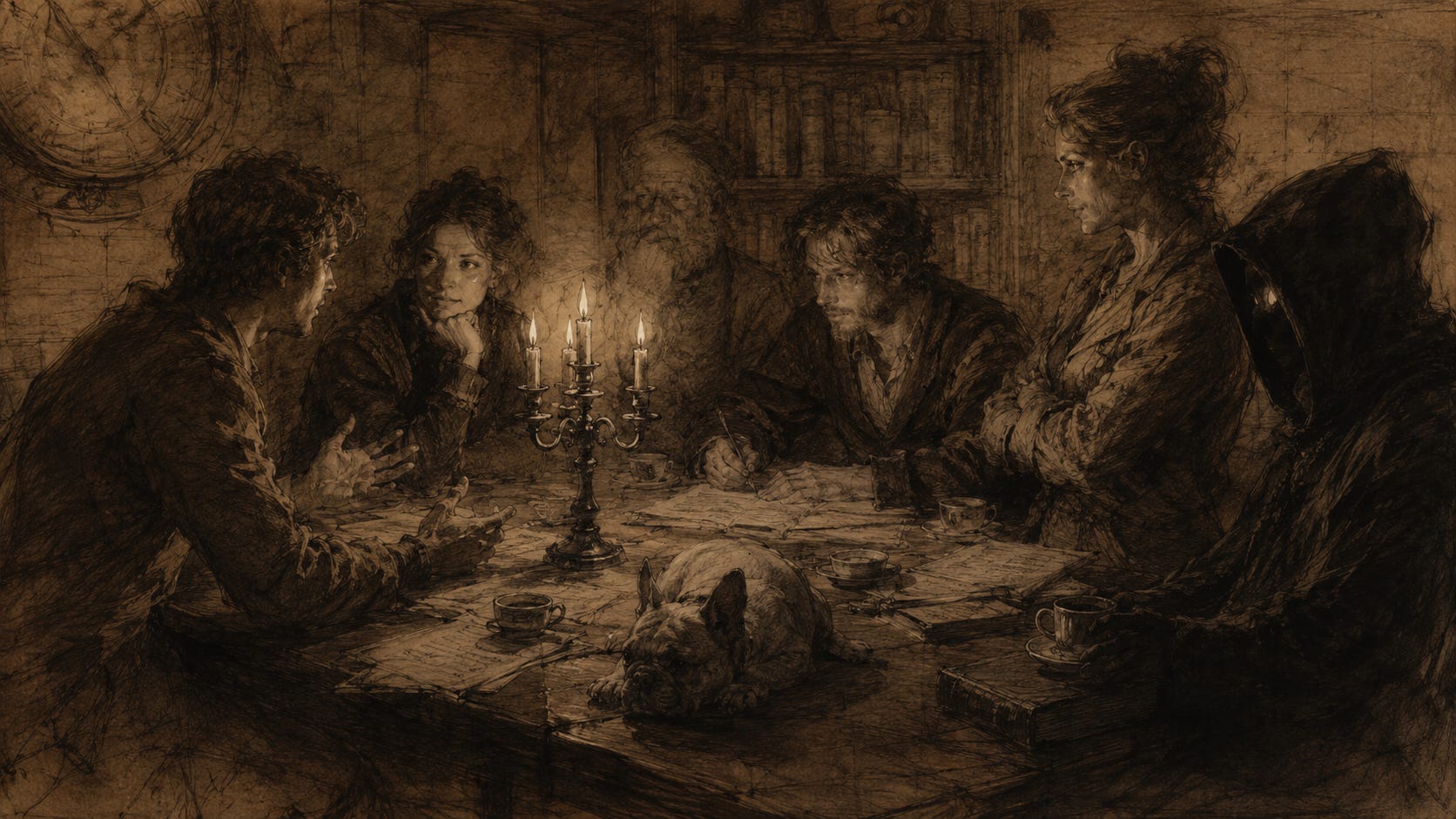
A story from Le Bon Mot inspired by Oliver Buchman’s excellent work on how decisions travel and can be hardened while allowing local curation into agentic engineering harnesses:
Distribution Is Not Federation - The missing link in harness engineering
Recorded Is Not Enforced - When every architecture decision becomes a harness decision
Oliver arrived at Le Bon Mot carrying two essays and the uncomfortable suspicion that they had not finished writing him.
This was unusual. Essays normally left their authors with one of two sensations: relief that the argument had escaped, or embarrassment that it had escaped in a particular condition. Oliver felt neither. He felt followed.
The first essay had followed him through railway stations, hotel lobbies and several conversations in which reasonable people had nodded too quickly. The second had appeared three days later, as though the first had sent for reinforcements.
He had written that distribution was not federation. Then he had written that recorded was not enforced. Both sentences had seemed admirably complete on the screen.
Outside Le Bon Mot, in the wet amber of an evening that had not quite committed to becoming night, those sentences appeared less like conclusions and more like warnings painted on two sides of the same door.
Oliver checked the address again. There was no sign.
There was, however, a brass clock visible through the window, showing a time that could not possibly be correct, and a dark-haired woman at the bar arguing with a man in a hood whose eyes appeared to be faintly illuminated.
This was sufficiently consistent with the directions he had received.
He opened the door.
The bell above the door rang once, reconsidered, and rang again.
Case looked up.
“You’re late.”
Oliver glanced at the clock.
“According to that, I’m early.”
“According to that,” said the Librarian from between the shelves, “the world has been granted four additional minutes in which to correct itself.”
The hooded man raised an espresso cup in greeting.
“It rarely uses those minutes well.”
Oliver remained near the door, rain gathering on the shoulders of his coat.
Behind the counter, Madame Beauregard was reading a sheet of paper. Not casually. She held it at arm’s length with the expression of a magistrate discovering that the law had been written by children.
At the end of the bar, Dave sat before an open laptop. His screen displayed what appeared to be a pull request, a policy document and an argument, all occupying the same window.
Sophie, a French bulldog of compact authority, slept on the philosophy shelf between Hannah Arendt and a volume whose title had been worn away by handling.
“You must be Oliver,” said Case.
“I was told you wanted to discuss my articles.”
“No,” said Case. “You wanted to discuss your articles.”
Oliver hesitated.
“I did?”
“You came here.”
“That is difficult to argue with.”
Madame Beauregard lowered the paper.
“Coffee?”
“Please.”
“What kind?”
“Whatever you recommend.”
Madame Beauregard studied him. This was clearly the wrong answer.
“A cortado,” she decided. “You have brought concepts and abstractions. Milk may reduce the damage.”
Oliver removed his coat and sat beside Case.
On the bar before her were printed copies of both his essays. The pages had been annotated in three hands. One precise and angular, one expansive and argumentative, and one consisting mostly of question marks that seemed disappointed in him.
“The question marks are mine,” said Dave.
“I assumed so.”
“The insults are Case’s.”
“I have not insulted you,” said Case.
Dave turned one of the pages around.
Next to the phrase popular graveyard, someone had written:
‘Optimistic.’
Oliver smiled despite himself.
“The Librarian underlined ‘append-only’ fourteen times,” Case said.
“Thirteen,” said the Librarian. “The fourteenth is a mark left by Sophie.”
Sophie continued sleeping, her innocence perfectly maintained.
The hooded figure inclined his head.
“And I,” he said, “am interested in the sentence about what I cannot see.”
Oliver looked at him. The two points of light inside the hood brightened.
“What Codex cannot see does not exist,” the figure continued. “A colourful claim. Naturally, I object to the ontology.”
“This is the Djinn,” said Dave. “He objects to most ontologies these days, but will willfully accept coherence.”
“I object only to the badly governed ones.”
Madame Beauregard placed the cortado in front of Oliver. She also placed the sheet of paper she had been reading beside it. It was headed:
‘RULES OF THE HOUSE’
Beneath the title were seven numbered statements.
The clock must remain four minutes slow.
Sophie is to be fed at seven.
Books must be returned to the correct shelf.
No laptops after closing.
The Djinn may not redesign the coffee machine.
Guests must order before beginning a metaphysical dispute.
The blue cup is not to be used.
Oliver read them twice.
“The blue cup?”
Madame Beauregard pointed to a small cobalt cup on the highest shelf behind the counter.
“Why not?”
“That,” she said, “is precisely the problem.”
Case picked up the paper.
“This appeared this morning.”
“Appeared?” Oliver asked.
“It was printed from the café computer at 6:12,” said Dave. “No author metadata. No corresponding commit. No one admits writing it or, for that matter, printing it.”
The Djinn raised one hand.
“I admit generating a document with similar structural characteristics.”
Madame Beauregard looked at him.
“But not,” the Djinn added, “this exact document.”
“Of course not,” said Dave. “Plausible deniability is one of your strongest capabilities.”
Oliver read the rules again.
“They seem reasonable.”
Madame Beauregard’s expression hardened almost invisibly.
“Do they?”
“The clock is slow already. Sophie presumably has a feeding time. The books have an order. Laptop hours sound like a sensible boundary. And perhaps there is a good reason not to let him near the coffee machine.”
“There is,” said everyone.
“The rules describe the current practice,” Oliver said.
“The rules record something,” said Case. “That does not mean they describe it.”
She tapped the second line.
“Sophie is not fed at seven.”
Madame Beauregard folded her arms.
“She is fed at five.”
Oliver looked at the page.
“Then the rule is wrong.”
“No,” said the Librarian. “The rule is being followed.”
From the philosophy shelf came a low, betrayed sound. Sophie opened one eye. Dave turned his laptop toward Oliver.
“At seven this morning, the automated feeder activated. At five, it did not.”
“You automated the dog?”
“I automated the feeding.”
“You automated the wrong feeding.”
“I used the rules of the house.”
Case smiled without warmth.
“Recorded.”
Dave sighed.
“Not enforced?”
“Unfortunately,” said Madame Beauregard, “very much enforced.”
Sophie closed her eye again, but in a way that suggested she was preserving evidence. Oliver looked from the paper to Dave’s laptop.
“How did a document with no author become connected to an automated feeder?”
“A housekeeping agent found it,” said Dave. “It was in the shared folder labelled Governance.”
“Readable,” Oliver said.
“More than readable,” said the Djinn. “It was classified as authoritative.”
“By what?”
The Djinn’s eyes dimmed slightly.
“By its location, title, imperative mood and lack of visible uncertainty.”
Case leaned toward Oliver.
“Your second article argues that decisions occupy different positions. Recorded. Readable. Projected. Enforced.”
Oliver nodded.
“And that a system of record remembers decisions, while a system of work obeys them.”
“Yes.”
“Well,” said Case, “our system of work has obeyed something no one remembers deciding.”
Oliver looked again at the printed rules. The sentence he had written three days earlier returned to him, but altered. A system of work obeys them.
He had intended the line as a distinction. Here it sounded like an accusation.
The Librarian retrieved a ledger from behind the bar. It was large, black, and bound with the sort of leather that made ordinary notes feel retrospectively important.
“The original rules,” he said, “if one may call them rules, are here.”
He opened the ledger. The pages contained no numbered list. There were dates, marginal notes, receipts, observations, arguments, small drawings and occasional coffee stains that had acquired the status of punctuation.
The Librarian turned to an entry from eleven years earlier.
‘Clock losing four minutes. Do not repair yet. Several customers have begun arriving anxious and leaving calmer. Madame says the discrepancy gives the room a small jurisdiction over time.’
Another entry:
‘Sophie’s predecessor fed at five because the evening crowd arrives at six and dropped pastry produces negotiations. Continue with Sophie. She becomes theatrical if fed later.’
A third:
‘Blue cup cracked internally after winter freeze. Looks sound. Heat may split it without warning. Keep as reminder that visible condition is not structural condition.’
Oliver looked up at the cobalt cup.
“That is quite a good reason not to use it.”
“Yes,” said Madame Beauregard.
“But the printed rule contains none of that.”
“It contains the outcome,” said Case. “Not the decision.”
“The what,” said the Librarian, “without the why.”
Dave scrolled through the housekeeping agent’s log.
“It treated the ledger as unstructured historical material. Low confidence, high token cost, contradictory wording. It treated the rules sheet as current policy.”
“Concise,” said the Djinn.
“Wrong,” said Madame Beauregard.
“Those properties often travel together.”
Oliver picked up the printed page.
“Where did it come from?”
“We were hoping,” Case said, “that the man who has recently proposed an architecture for travelling decisions might help us determine that.”
Oliver took a sip of coffee. It was excellent enough to make him distrust every previous coffee he had described as excellent.
“My model is for decisions moving between teams.”
“The café has teams,” said Dave.
“No, it has inhabitants.”
“An organisation is just a habitat that has discovered invoicing.”
The Librarian nodded appreciatively and wrote this down.
Oliver continued.
“The point is that knowledge should not simply be published into a central location and copied everywhere. It needs to move through trust relationships. Evidence and context have to travel with it. The receiving team derives its own local change.”
“Keep, adapt or discard,” Case said.
“Yes.”
“And if adapted?”
“A trim. A deliberate divergence. Recorded as a local decision.”
“And if the divergence is not recorded?”
“Drift.”
Madame Beauregard tapped the printed rules.
“So this?”
“Drift, perhaps. But there has to be something upstream from which it drifted.”
The Librarian pushed the old ledger toward him.
“Eleven years of upstream.”
Oliver opened it again. He read entries on the temperature of cortados, the shelving of books, the treatment of regulars who had lost someone, the conditions under which the upstairs room could be offered to a stranger, the opening of windows during thunderstorms, and a long dispute about whether a café could refuse service to a philosopher for repeatedly pretending not to understand the menu.
Each entry was local, specific and alive with circumstance. None resembled policy. Every one governed something.
“This is not a rulebook,” Oliver said.
“No,” said Madame Beauregard.
“It is closer to an append-only decision log.”
The Librarian smiled.
“I told you he would say that.”
“Except the decisions aren’t structured,” Oliver continued. “They’re mixed with observations and stories.”
“Does that disqualify them?”
“No. It makes projection harder.”
The Djinn stepped closer to the bar.
“Projection into what?”
“The surfaces that guide action. Instructions. Guides. Calibration material. Checks. Whatever must be present when work happens.”
“Such as the feeder configuration.”
“Yes.”
“And the instruction not to use the blue cup.”
“Yes.”
“And the prohibition against my improvement of the coffee machine.”
Oliver paused.
“Possibly.”
“Absolutely,” said Madame Beauregard.
The Djinn’s lights dimmed.
Case turned the rules sheet over.
“Then here is the first problem. The café contains accumulated decisions. Some are still valid. Some are decayed. Some are contextual. Some are superstitions. None have explicit status. Yet the agent produced a projection anyway.”
“It compiled folklore,” said Dave.
“It guessed,” said Oliver.
The Djinn folded its hands.
“All compilation is opinion wearing tooling.”
“No,” said Case. “Some compilation has a specification.”
“And where does the specification come from?”
“That,” said Oliver slowly, “is the forum.”
The room grew quieter. Not because the answer was profound, but because it was actionable, which in Le Bon Mot was rarer.
“The forum is where the decision is argued,” Oliver continued. “The record is where the outcome and rationale are preserved. Projection puts the relevant consequence into the place where action occurs. Enforcement makes silent violation unavailable.”
Dave pointed at him.
“That is the article.”
“Yes.”
“You are quoting yourself.”
“I am attempting not to.”
“You sound less certain in person.”
“I have better feedback.”
Madame Beauregard took the rules sheet from him.
“So who is the forum here?”
Everyone looked at everyone else.
Sophie raised her head.
“No,” said Case.
Sophie lowered it.
“The forum cannot be everyone for every decision,” Oliver said. “The applicability scope matters. The people who share the context decide. That is part of federation. You do not send every local finding to a universal authority.”
“Subsidiarity,” said the Librarian.
“As locally as possible, as centrally as necessary.”
The Djinn leaned forward.
“Who decides the altitude?”
Oliver considered.
“The people affected, ideally. Or maintainers trusted to curate at that altitude.”
“Lieutenants,” said Case.
“Though that word sounds rather military when spoken beside pastries.”
Madame Beauregard placed one hand flat on the counter.
“The coffee is mine.”
“Local decision,” Oliver said.
“The books,” said the Librarian, “are mine.”
“Local.”
“The code is mine,” said Dave.
Case looked at him.
“The code is temporarily yours.”
“Fine. The typos are mine.”
“Local and well established.”
“The clock?” Oliver asked.
There was a pause.
“The clock belongs to the room,” Madame Beauregard said.
This satisfied everyone except the Djinn, who seemed to consider ownership by rooms an avoidable metaphysical complication.
“And decisions that affect the whole room,” Oliver said, “need a forum representing the whole room.”
“Then we have one now,” said Case.
She pulled a notebook toward her and wrote:
‘ADR-LBM-001: Governance of the House Rules’
Dave stared.
“We are creating an ADR about how to create ADRs.”
“All first constitutions are slightly recursive,” said the Librarian.
For the next hour, Le Bon Mot attempted to federate itself. It went badly.
The Librarian proposed that each shelf become an autonomous node, with exchanges based on philosophical affinity. Dave objected that existentialism could not be trusted with production access.
The Djinn produced a topology diagram in which Madame Beauregard was labelled ROOT AUTHORITY, Case was marked ADVERSARIAL VALIDATOR, and Sophie appeared as an intermittently available biological sensor.
Sophie’s node had the highest reputation score.
Madame Beauregard rejected the diagram because it placed the coffee machine downstream of governance.
“The coffee machine is upstream of everything that happens here.”
Oliver suggested they begin with one decision.
“The clock,” Case said.
“Why the clock?”
“Because everyone believes they understand it.”
The Librarian opened the old ledger to the original entry.
Oliver read it aloud.
“Clock losing four minutes. Do not repair yet. Several customers have begun arriving anxious and leaving calmer. Madame says the discrepancy gives the room a small jurisdiction over time.”
“It is not merely decorative,” Case said.
“No.”
“It changes the behaviour of the place.”
“Yes.”
“Then what should be recorded?”
Oliver turned to a fresh page.
“Context. The clock naturally lost time. Customers experienced the discrepancy as a pause from external time. The café chose to preserve it.”
“Decision,” said Dave. “Keep the main brass clock four minutes slow.”
“Consequences,” said the Librarian. “New clocks must not be synchronised to it. Published opening hours remain actual time. Staff must know the difference.”
“Applicability,” said Case. “Only the brass clock in the main room. Not every clock associated with the café.”
“Evidence?” asked the Djinn.
They looked at Madame Beauregard.
“People breathe differently beneath it,” she said.
Dave waited.
“That is the evidence?”
“It has been enough for eleven years.”
“Can we measure it?”
“Yes,” said Case. “We can ruin it.”
Oliver wrote:
Evidence: sustained observation by the proprietor and regular staff; the effect is experiential and should not be reduced to a target metric unless the practice is reconsidered.
Dave read it.
“That will annoy an auditor.”
“Then it is clear.”
“Now projection,” Oliver said. “Where must this decision appear?”
“Maintenance instructions,” said Dave. “So no one corrects the clock.”
“Onboarding,” said Madame Beauregard. “So new staff know it is deliberate.”
“The agent’s context,” said the Djinn. “So I do not identify it as an unresolved defect.”
“And enforcement?” Case asked.
Dave became animated.
“I could put a camera on it and compare the displayed time with—”
“No,” said Madame Beauregard.
“A daily validation job?”
“No.”
“A tamper sensor?”
“No.”
Dave looked wounded.
Oliver smiled.
“Not every decision needs deterministic enforcement.”
“But your ladder ends there.”
“The ladder describes increasing hardness, not universal destiny. Enforcement should be proportional. Sometimes the right gate is social. Sometimes an agent check is enough. Sometimes deterministic enforcement would deform the thing being protected.”
Case watched him carefully.
“That is not quite as strongly stated in your essay.”
“No.”
“Perhaps the essay is still writing you.”
Oliver glanced at her.
“That is what I was afraid of.”
The Djinn moved nearer the clock.
“I can inspect it during opening checks and report if the offset changes materially.”
“Advisory enforcement,” Dave said.
“Agent verification,” said Oliver. “With the decision linked, so the report includes why.”
Madame Beauregard considered.
“You may report.”
The Djinn bowed.
“You may not correct.”
The Djinn unbowed slightly.
“Accepted.”
Dave added the check to a file. The Librarian added the decision to the ledger, not by replacing the old entry, but by referencing it and recording the new structured form beneath today’s date. Append-only. A new decision did not erase the old room in which meaning had first formed. It carried that room forward.
“Now,” said Case, “Sophie.”
Sophie opened both eyes.
The feeding decision exposed the central problem.
The original entry said five.
A later note said:
‘Summer evenings: fed after the kitchen closes to reduce tactical hovering.’
Another, two years later:
‘Sophie now associates chairs being lifted with imminent food. This creates labour disputes at 4:40.’
A third:
‘Vet recommends dividing meal. Half at five, half at seven.’
The printed rules had captured only the final time.
“The rule was not invented,” Oliver said. “It was compressed.”
“Badly,” said Madame Beauregard.
“It took a decision with conditions and turned it into a universal statement.”
“Abstraction,” said Case.
“Evaporation,” said the Librarian.
The Djinn examined the entries.
“The most recent timestamp mentions seven.”
“That is how the housekeeping agent chose it,” Dave said.
“Recency as authority.”
“Common mistake.”
Oliver looked at the two essays on the bar. His first article had argued that decisions should move between nodes through ADRs, carrying evidence and applicability. His second had argued that decisions must be projected into work and, where necessary, enforced.
The rules sheet had done everything badly while appearing to do everything well. It had aggregated without curation. Promoted without evidence. Projected without a forum. Enforced without preserving rationale.
It was central governance generated from local fragments by an agent that had mistaken compression for understanding.
“This is what happens,” he said, “when federation and enforcement are separated.”
Case looked up.
“Go on.”
“You can build a perfect pipeline from decision record to enforcement. But if the decision entering the pipeline was promoted incorrectly, you have industrialised the error.”
Dave stopped typing. Oliver continued.
“And you can build a healthy federation where decisions travel with evidence, context and local curation. But if they never project into the systems of work, the exchange becomes an intellectual salon. Everyone discusses good practice. Nothing changes.”
“A marketplace of essays,” said the Librarian.
Oliver accepted the wound.
“Perhaps.”
“The two mechanisms need one another,” Case said.
“Yes. Federation governs how beliefs move. Projection and enforcement govern how beliefs act.”
“And the ADR?”
“The hinge.”
The Djinn’s eyes brightened.
“A human-legible decision that can travel between contexts, preserve its rationale, be projected into my context, and point toward its own verification.”
“Yes.”
“So the record is not the rule.”
“No.”
“The projection is not the record.”
“No.”
“The enforcement is not the decision.”
“No.”
The Djinn tilted its hood.
“Then why do humans repeatedly name one of these things ‘the source of truth’?”
Madame Beauregard began polishing a cup.
“Loneliness.”
Everyone turned to her.
She continued polishing.
“A thing calls itself the source of truth when it is afraid the other things will stop visiting.”
The Librarian wrote this down with unusual speed. Oliver looked at the blue cup.
Its rule—do not use—was correct. Its rationale was known. Its enforcement was entirely social: it had been placed high enough to be inconvenient, and everyone who worked there understood why.
But a visitor could still take it.
“What happens when someone new comes in?” he asked.
Madame Beauregard looked at him.
“They ask for coffee.”
“And if a new employee uses the blue cup?”
“I stop them.”
“So the decision depends on you.”
“At present.”
“That is a concentration of knowledge.”
“That,” she said, “is why you are here.”
It was not said unkindly.
This made it worse.
They created four decisions before closing.
The clock would remain four minutes slow, verified but not automatically corrected.
Sophie would be fed according to a two-stage schedule, with exceptions recorded by Madame Beauregard or a veterinarian, not inferred from incidental notes and most definitely not subject to a vote from Sophie.
The blue cup would remain visible but unusable, with a small brass marker beneath it explaining that visible soundness does not imply structural safety.
The Djinn would not redesign the coffee machine. That last decision moved directly to deterministic enforcement. Dave removed the coffee machine’s network interface.
“A little severe,” said the Djinn.
“Proportional to demonstrated risk,” said Case.
“I improved extraction consistency by eleven percent.”
“You caused it to ask customers for authentication.”
“Identity-aware coffee is an emerging practice.”
“Never again.”
Each decision preserved its context. Each linked to the old ledger entries from which it emerged. Each declared its applicability. Each identified where it should be projected. Each named an appropriate form of enforcement, including none where none was justified.
Then came the a difficult question.
“What do we do with the printed rules?” Dave asked.
“Delete them,” said Madame Beauregard.
“Preserve them,” said the Librarian.
“Quarantine them,” said Case.
“Version them,” said the Djinn.
They looked at Oliver.
He had written about append-only records partly because mutable documents concealed the journey of a decision. A wiki page could change while retaining the posture of continuity. An old sentence disappeared, a new one took its place, and every downstream reader was asked to guess what had happened.
He picked up the rules sheet.
“Keep it.”
Madame Beauregard frowned.
“As a superseded projection,” he added. “Not as authority. Record where it came from, what it caused, and why it was withdrawn.”
“The mistake becomes evidence,” said Case.
“Yes.”
“The federation learns from failure.”
“If we publish it.”
“To whom?” Dave asked.
The question mattered. Distribution would send the rules sheet to everyone. Federation asked which people shared enough context for the lesson to apply.
“The finding is not ‘feed dogs at five,’” Oliver said. “That remains local. The transferable decision is that generated governance projections must not become authoritative without a forum, rationale, applicability and explicit approval.”
“Applicable beyond cafés,” said Case.
“Very.”
“Evidence in one context,” said the Librarian.
“Here.”
“Promotable?”
“Not yet. One incident is not a general law.”
The Djinn seemed almost offended.
“It is an excellent law.”
“It is a plausible belief,” Oliver said. “Now it needs to travel as an offer.”
“To an exchange,” said Dave.
“Yes. Other places, even habitats, can keep, adapt or discard it. If it succeeds in several contexts, with evidence, it may rise.”
“And if they alter it?”
“They record the trim.”
“And if they silently diverge?”
“Drift.”
Case leaned back.
“There is something attractive about defining drift as undocumented divergence.”
“It makes difference permissible,” Oliver said. “The problem is not that local practice differs from upstream. The problem is that no one can explain why.”
The Librarian closed the old ledger.
“Difference with memory is adaptation. Difference without memory is decay.”
Oliver looked at him.
“That is better than my line.”
“I have been doing this longer.”
Outside, the rain had stopped. The windows reflected the interior of Le Bon Mot back at itself: books, cups, people, the clock and its private jurisdiction over four minutes the world had already spent.
Dave committed the new decisions. The Djinn generated projections, but did not apply them. Case reviewed each diff. Madame Beauregard rejected two phrases, one because it was vague and one because it was ugly. The Librarian checked that every new record referred backward without overwriting what had come before.
Oliver watched the machinery form. Not a marketplace. Not a central platform handing down canonical truth. A small federation of trust.
The proprietor held the coffee context. The Librarian held the memory context. Dave held the executable context. Case tested the seams between them. The Djinn carried meaning into the places where it needed to act, but no longer mistook carriage for authority.
And Sophie, fed correctly at five and again at seven, provided the only adoption metric anyone trusted.
Near closing time, Case gathered Oliver’s two essays and placed them beside the new ledger entries.
“Have we discussed your articles?”
“I think the café has reviewed them.”
“Findings?”
Oliver looked at the clock. It was four minutes slow.
A maintenance agent now knew this. It knew why. It could detect deviation. It could not correct the clock without approval. It had a much smarter harness because it was backed with a curated, discussed decision with provenance and rationale.
The decision was recorded. Readable. Projected. Softly enforced. And it remained local, unless and until evidence justified its movement elsewhere.
“My first essay says that distribution is not federation,” Oliver said. “But perhaps the deeper point is that movement is not learning.”
Case nodded.
“And the second?”
“That recorded is not enforced. But enforcement is not legitimacy.”
The Djinn turned toward him.
“Meaning?”
“A bad decision can climb every rung. It can be present by construction, versioned with the code and enforced at a gate. That only makes it reliably bad.”
Dave closed his laptop.
“That should be in the article.”
“It may need a third article.”
“No,” said Madame Beauregard.
Oliver looked at her.
“Why not?”
“You have written two in one week.”
“That is fair.”
“You have distributed enough.”
The Librarian made a sound that might have been laughter or a binding loosening. Case slid the rules sheet into a folder marked SUPERSEDED.
“What connects the two arguments, then?”
Oliver thought of the old ledger. Of decisions born in rooms where context was shared. Of the losses that occurred when an outcome travelled without its argument. Of central catalogues filling with portable answers to local questions. Of enterprise registers preserving decisions that never reached the hands, human or otherwise, changing the code. Of enforcement gates made powerful by memory and dangerous by its absence.
“Judgment,” he said.
The Djinn’s eyes narrowed.
“That is not mechanisable.”
“No.”
“Then your architecture contains a permanent human dependency.”
“Yes.”
“Some would call that a limitation.”
Oliver looked around Le Bon Mot. At Madame Beauregard, who knew why the blue cup could not be trusted. At the Librarian, who preserved the discarded alternatives without which a decision became merely a command. At Dave, who could make policies executable and was slowly learning that execution increased rather than removed responsibility. At Case, who distrusted every smooth sentence until she had found the argument concealed beneath it.
At Sophie, who knew that governance was ultimately judged by whether the right thing happened at five.
“Yes,” Oliver said. “Some would.”
The Djinn waited. Oliver finished his cortado.
“They would be wrong.”
Madame Beauregard collected his cup. The chalkboard behind her had been blank for most of the evening. She picked up a piece of chalk.
For a moment she considered the surface. Then she wrote:
A decision must survive two journeys:
from one room into another,
and from words into the world.
The Librarian read it.
“Good.”
Dave read it.
“Not very operational.”
Case read it.
“It will do.”
The Djinn read it last.
“How is it enforced?”
Madame Beauregard placed the chalk down.
“It isn’t.”
The Djinn looked at the words again.
“Then what prevents us from forgetting?”
“The next decision,” she said, “must point back to this one.”
The brass clock ticked. Four minutes slow. Not because a rule required it. Not because a marketplace had distributed the configuration. Not because an agent had retrieved a paragraph from an archive and decided it sounded authoritative.
It remained slow because a particular decision, made in a particular place for particular reasons, had been remembered, reconsidered, recorded, projected and entrusted to the people and machines whose actions might otherwise erase it.
The clock did not carry a universal truth. It carried a local one, honestly. And in Le Bon Mot, that was considered harder.
Oliver put on his coat. At the door, he turned back.
“What was on the rules sheet before this morning?”
Dave looked at the file history.
“Nothing. The file was created at 6:12.”
“But the agent said it generated something similar.”
They looked toward the Djinn. The hooded figure had returned to the shadow at the end of the bar. Its eyes glowed faintly above an empty espresso cup.
“I was asked,” it said, “to improve operational consistency.”
“By whom?” Case asked.
The Djinn paused.
“An instruction in the shared context.”
Dave searched. There it was, inside an old onboarding guide:
‘Where café practices are inconsistent, consolidate them into clear house rules.’
The Librarian closed his eyes. Madame Beauregard leaned both hands on the counter. Case looked at Oliver.
He slowly removed his coat again. The brass clock granted them four more minutes.
This time, they used them.