
The Seductive Beauty of Coherence
On Penrose Tilings, the Seduction of Symmetry, and Why Your Metaphors Are Lying to You

There is an idea about beauty in software that has been bothering us for decades, and it is wrong in precisely the way that makes it dangerous: it feels right.
The idea is that beauty is symmetry. That clean code is code that mirrors itself. That an elegant architecture is one where each side of the diagram reflects the other, where every service is the same shape, where the naming conventions tile outward in neat, predictable, repeating rows. A checkerboard. A bathroom floor. The kind of order you can describe to a child in one sentence: “It’s the same, all the way across.”
This is the beauty of wallpaper. It comforts. It fills space. It asks nothing of you. And in software, it has produced some of the most breathtakingly uniform failures in industrial history. Systems so perfectly symmetrical in their design that when one part failed, they all failed, at the same time, in the same way, for the same reason.
Correlated fragility dressed in a dinner jacket.
Roger Penrose offered a different geometry. His tilings cover the infinite plane without ever repeating. They have no translational symmetry. You cannot slide the pattern to match itself. And yet they are not random. They possess fivefold rotational symmetry, self-similarity at every scale, and a relationship to the golden ratio so intimate it borders on the obscene. They are ordered. Deeply, relentlessly ordered. But the order is not repetition. It is coherence.
Penrose himself, when asked about the relationship between beauty and truth, put it with characteristic directness: beauty is a clear guide to truth. Not symmetry. Not repetition. Beauty. And the beauty he meant was the kind you find in physical laws. The kind that has a kernel independent of the observer, a rightness that exists even when nobody is looking.
This distinction, between symmetry and coherence, is not merely academic. It is the difference between a software metaphor that clarifies and one that quietly leads you into a swamp.
Consider how we talk about systems. We reach for “building blocks” and get Lego: modular, rectangular, satisfyingly stackable. The metaphor tiles the mind beautifully. It repeats. It is predictable. And it whispers a lie: that software components are inert, interchangeable, and context-free. That you can pull one out and slot another in, that the interfaces are as simple as the studs on a plastic brick. Anyone who has actually tried to replace a “building block” in a production system at two in the morning knows this is a fantasy so complete it would embarrass a fairy tale.
Or take “technical debt.” A metaphor so ubiquitous it has become invisible, which is exactly how the most dangerous metaphors operate. Debt implies a rational borrower, a known principal, a predictable interest rate, and the option to repay. Real systems accumulate something more like sediment: geological, layered, compressed by forces nobody fully documented, occasionally producing diamonds and more frequently producing landslides. The debt metaphor tiles perfectly. It repeats across every sprint retrospective. And its very tidiness prevents us from seeing that what we actually have is not a loan but an ecosystem of accumulated decisions that interact in ways no spreadsheet can model.
These are wallpaper metaphors. They satisfy the eye because they repeat. They feel beautiful because they are symmetrical. And they fail because the territory they describe is neither.
Coherence, not comfort
A Penrose tiling works not because its shapes repeat, but because its matching rules, the constraints on how kite meets dart, enforce a global coherence that emerges from local decisions. No single tile knows the pattern. But the rules ensure that every local decision remains consistent with an order that extends, in principle, to infinity.
This is a better image for software than anything we have been reaching for.
A good metaphor, like a good tile, does not need to repeat to be useful. It needs matching rules. It needs to cohere, to fit against the other metaphors in your thinking without creating contradictions, gaps, or the conceptual equivalent of forced tiles.
When you select a metaphor for how your system works, you are not decorating. You are constraining the adjacent possible. You are shaping what the next thought can be.
Select metaphors for coherence, not for symmetry. A metaphor that tiles without repeating will serve you longer than one that merely fills space.
Metaphors are not illustrations. They are cognitive infrastructure. The metaphor you choose determines what questions you can ask, what failures you can anticipate, and what solutions you can imagine. A wallpaper metaphor, one that repeats tidily, narrows your thinking to the periodic. It makes you expect regularity, and regularity is precisely what complex systems do not provide.
A coherent metaphor, by contrast, admits irregularity while maintaining order. It tells you that the next piece may not look like the last, but that it will still fit. It prepares you for surprise without surrendering to chaos. It is the difference between expecting your system to behave like a clock and expecting it to behave like a weather pattern; the second is not less ordered, merely less periodic.
Penrose’s tilings were not merely pretty. They presaged the discovery of quasicrystals, real physical materials whose atoms arrange themselves in ordered but non-repeating structures. The mathematics preceded the reality. The coherent image proved more true than the symmetrical one. The same happens in software: teams that hold coherent but flexible mental models of their systems navigate incidents, drift, and evolution far better than teams armed with rigid, repeating diagrams that shatter at the first deviation from the expected.
Some practices to consider
Audit your metaphors for hidden periodicity. When someone says “microservices are like an orchestra,” ask what happens when the conductor is absent. If the metaphor cannot survive the removal of a central coordinating authority, it is wallpaper — pretty and periodic.
Test metaphors at the boundaries. A Penrose tiling’s beauty is most visible at the edges where you expect repetition and find variation instead. Push your metaphors to their limits. Where do they break? The break point reveals whether you have coherence or merely habit.
Prefer metaphors drawn from ecology and geology over engineering and architecture. Rivers, forests, sediment layers, and weather systems are aperiodic and coherent. Bridges, buildings, and machines are periodic and brittle. Your software is far more like the former.
Let metaphors evolve. A Penrose tiling is self-similar at every scale — inflate or deflate it and the structure persists but the details change. Your metaphors should do the same. The image that serves you at the component level should remain coherent, if transformed, at the system level.
Name the matching rules, not just the tiles. In a Penrose tiling, the tiles are simple. The intelligence is in the constraints on how they meet. When discussing your system, spend less time naming the components and more time articulating the rules that govern their interactions.
Some things to avoid
The comfort of the grid. When a metaphor makes everything feel tidy, be suspicious. Tidiness in software is usually a sign that you have stopped looking at the parts that don’t fit.
Metaphor monoculture. Using a single metaphor for all aspects of your system is the cognitive equivalent of tiling with squares. It covers ground efficiently and reveals nothing.
Confusing elegance with simplicity. Penrose achieved elegance with only two shapes, but the resulting patterns are infinitely complex. Elegance in metaphor is not about reduction — it is about generativity. A good metaphor should open more questions than it closes.
Mistaking the map for the territory, again. Every metaphor is a tiling of something that is not, in fact, a plane. The moment you forget that your “building blocks” or “pipelines” or “debt” are images rather than descriptions, you have stopped thinking and started decorating.
A coherence checklist
Ask yourself:
Does this metaphor still hold when the system behaves unexpectedly?
Can I use this metaphor to explain a failure, or only a success?
Does this metaphor admit variation, or does it demand uniformity?
When I extend this metaphor, does it generate new insight or merely repeat the same insight at a larger scale?
Would someone holding this metaphor be prepared for surprise?
If most answers point toward rigidity, you have wallpaper. Replace it.
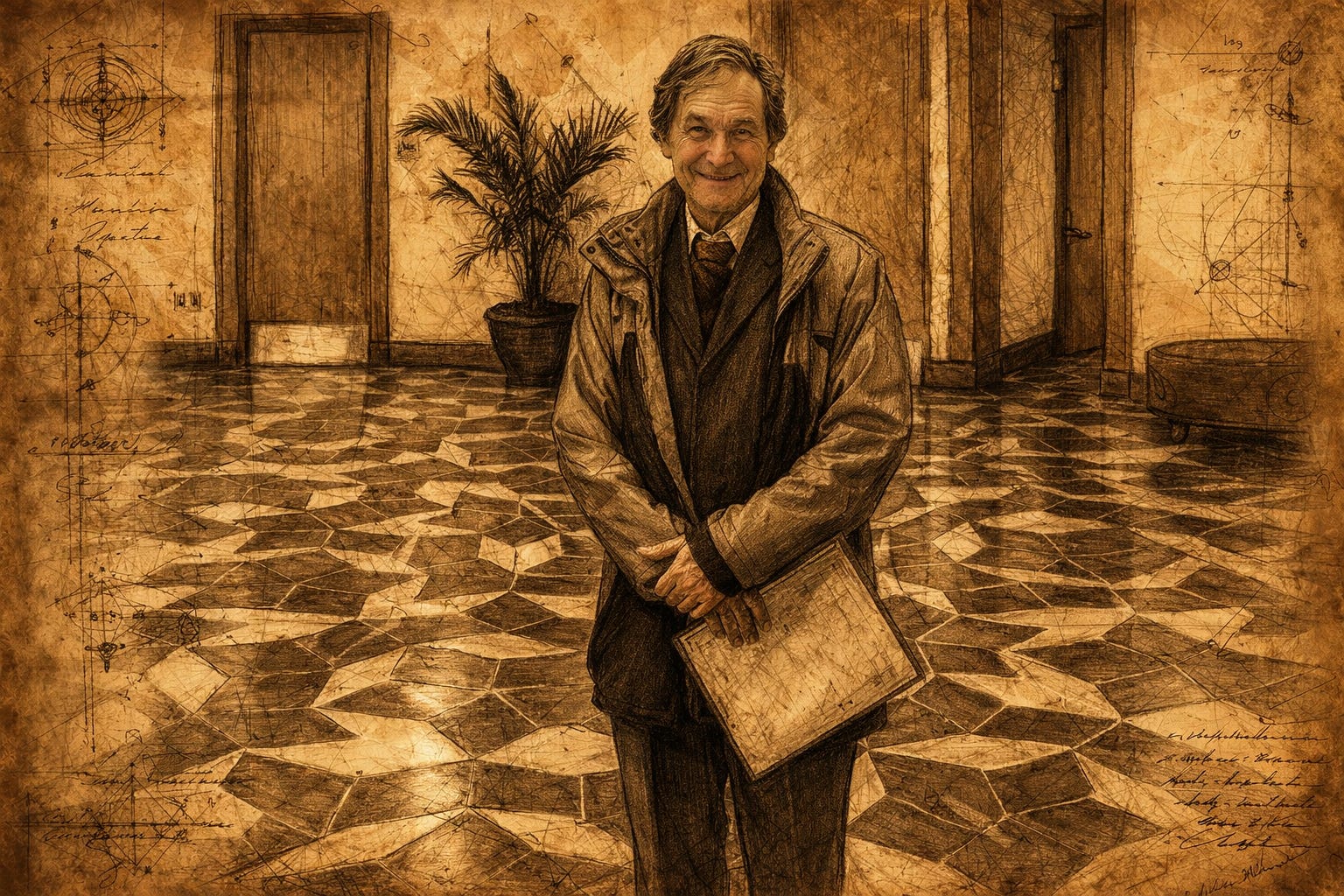
There is a floor outside the Mathematical Institute in Oxford made of Penrose tiles — fat and thin rhombs set in stone and clay, with steel lines tracing the matching rules that hold the whole thing together. It never repeats. It is, by every account, beautiful.
But its beauty is not the beauty of the Parthenon or a perfectly factored function or a naming convention applied with religious consistency. It is the beauty of something that remains coherent without being predictable. Something that holds together not because every part is identical, but because every part belongs.
This is what we should want from our metaphors. Not mirrors that reflect our assumptions back at us in comforting repetition, but images that cohere with reality and even images strange enough to prepare us for what we have not yet seen. Penrose understood that the deepest order is not the one that repeats. It is the one that holds.
The next time you reach for a metaphor to describe your system, your team, or your architecture, pause. Ask whether you are selecting for symmetry or for coherence. Ask whether your image tiles the mind with reassuring repetition or whether it admits the aperiodic, the surprising, the genuinely complex.
And if the metaphor feels too neat — if it clicks into place like a bathroom tile — consider the possibility that you have just wallpapered over something important.
Some Further Reading
The Emperor’s New Mind — Roger Penrose
Patterns of Software — Richard P. Gabriel
Metaphors We Live By — George Lakoff and Mark Johnson
Small Arcs of Larger Circles — Nora Bateson
The Road to Reality — Roger Penrose
Surfaces and Essences: Analogy as the Fuel and Fire of Thinking — Douglas Hofstadter and Emmanuel Sander