
The Tailor of Unnecessary Commitments
A short tale of hats, haircuts, and tattoos in the Realm of Platform Engineering

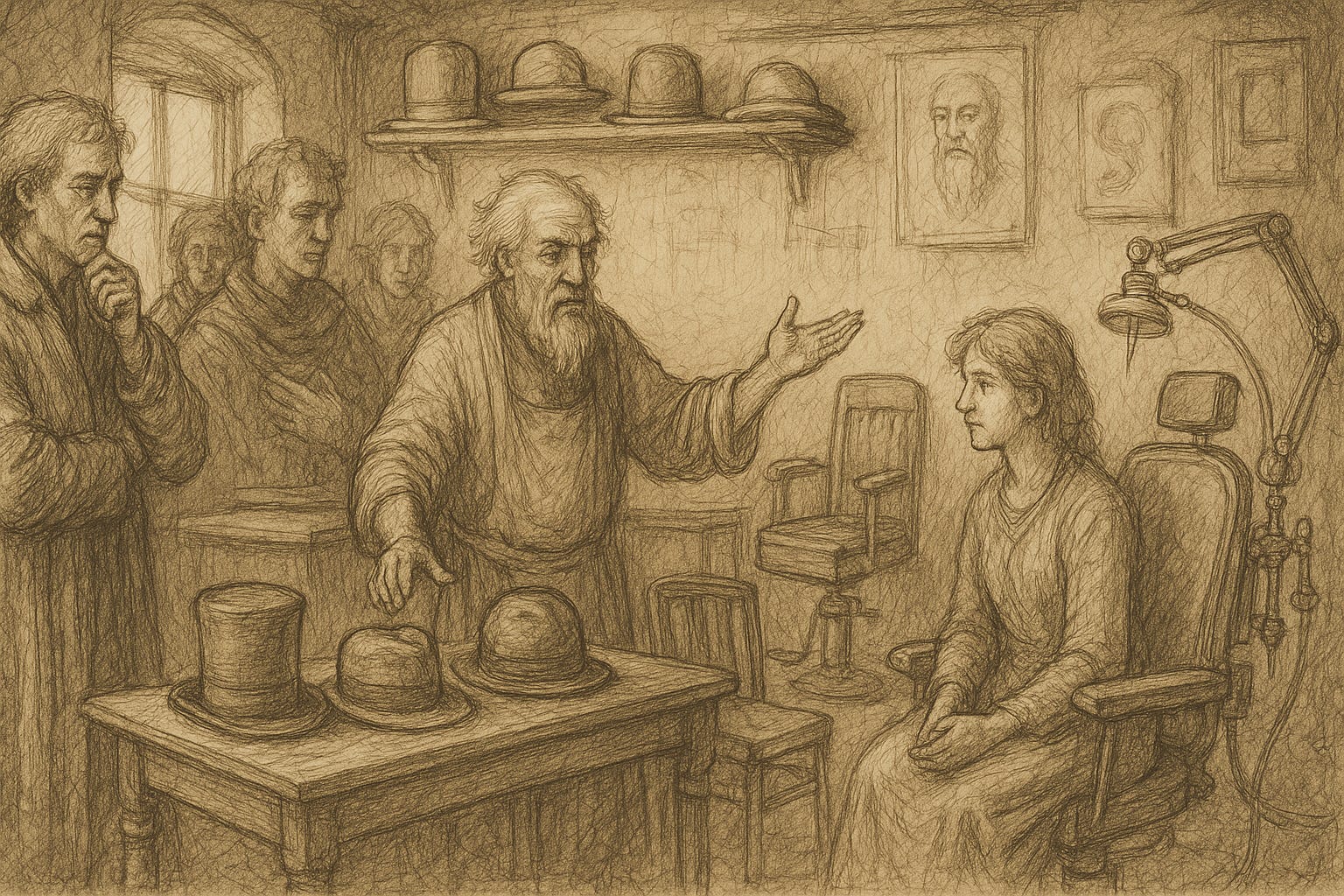
No one ever meant to visit the Tailor. Not really. He was one of those figures spoken about in corridors and retrospective meetings using the tones normally reserved for ancient curses or enterprise architects.
But the Tailor remained in business because every platform team, at some point, stumbled into a decision so baffling, so inexplicably overcommitted, that someone would sigh and mutter: “We should probably go see him.”
The Platform Guild of Complication Incorporated—which, depending on who you asked, was either a frontier of innovation or a communal hallucination maintained through Slack—found itself in that exact predicament. They had a roadmap. By which I mean: a scroll of well-intentioned delusions, dotted with initiatives whose origins no one remembered, and written in a font that seemed to grow more accusatory with each passing quarter.
At the top of the scroll was their problem: The Great Pipeline Reformation. No one knew whether this should be a small tweak, a major restructuring, or a total existential rewrite. Everyone had an opinion, and all those opinions had teeth.
Reluctantly, they went to see the Tailor.
He lived in an office so narrow it looked like it had been squeezed between two realities. The windows were dusty; the sign above the door read simply: HATS · HAIRCUTS · TATTOOS. Which would have been fine, except the Tailor offered none of these in the literal sense. Inside, bolts of fabric hung next to mirrors that reflected things you hadn’t done yet. Scissors lay alongside inked needles that hummed faintly with the scent of irreversible decisions.
The Tailor did not look up when they entered. “Roadmap trouble?” he said, as though greeting the inevitable.
The guild nodded.
“Good,” the Tailor said. “Let me guess. You’ve convinced yourselves that you’re choosing between options. You’re not. You’re choosing the type of choice.”
He gestured to three stations.
At the first lay a collection of hats—bowler, trilby, top hat, and something that looked like a Kubernetes operator wearing a beret. “A Hat,” he said, “is a reversible experiment. You try it on. You walk around. You learn how it fits. Remove it when it doesn’t.”
At the second station was a barber’s chair surrounded by hair on the floor. “A Haircut,” he said, “changes how you look and how people respond to you. It grows back. Eventually. But there will be an awkward phase, and everyone must agree to tolerate it.”
At the third station was a tattooist’s chair, complete with needles that hummed the way legacy systems hum—slightly ominous, slightly needy. “A Tattoo,” he whispered, “is identity. Structure. A choice with a shadow. Make these rarely, and only after the hats and haircuts have taught you something you could not have learned any other way.”
The guild looked at each other.
One of the engineers cleared her throat. “We thought the pipeline changes were… well… just a hat.”
The Tailor laughed the dry laugh of one who has watched many people permanently alter their architecture by accident. “Ah, yes. The classic failure mode: mistaking a tattoo for a hat. Happens all the time. People try a ‘small tweak’ and accidentally rewrite their delivery philosophy.”
He lifted their roadmap scroll. “This thing here is not a plan. It is a list of your fears wearing the masks of your aspirations. But the mask slips when you classify the work.”
He snapped his fingers. The scroll rewrote itself.
Next to each item appeared one word: Hat, Haircut, or Tattoo.
Some were obvious. Some were deeply unsettling. Some caused arguments that would require entire retrospectives to resolve.
But one thing became clear: The Great Pipeline Reformation was not a hat. It was barely a haircut. It was, in fact, an enormous, neck-and-face-spanning tattoo of commitment—the sort done by people who have very strong feelings about DevOps but not always the corresponding patience.
“We’re not ready for a tattoo,” the guild lead murmured.
“Few are,” the Tailor said. “Start with a hat. Learn. Let the haircut come later. The tattoo will reveal itself if it is truly required.”
They left the Tailor’s shop lighter, roadmap amended, egos bruised. The world outside seemed kinder for the simple reason that they no longer had to pretend they knew everything. They could try things. They could learn. And they could choose which changes deserved ink.
Behind them, the Tailor locked his door and whispered, as he always did:
“Most disasters begin when someone reaches for a tattoo because they were too impatient to try on a hat.”
And somewhere in Complication Incorporated, the roadmap breathed out—relieved to finally be a map of experiments instead of a catalogue of accidental commitments.