
The Team Who Lost Tuesday
A Tale from Le Bon Mot for the Software Enchiridion

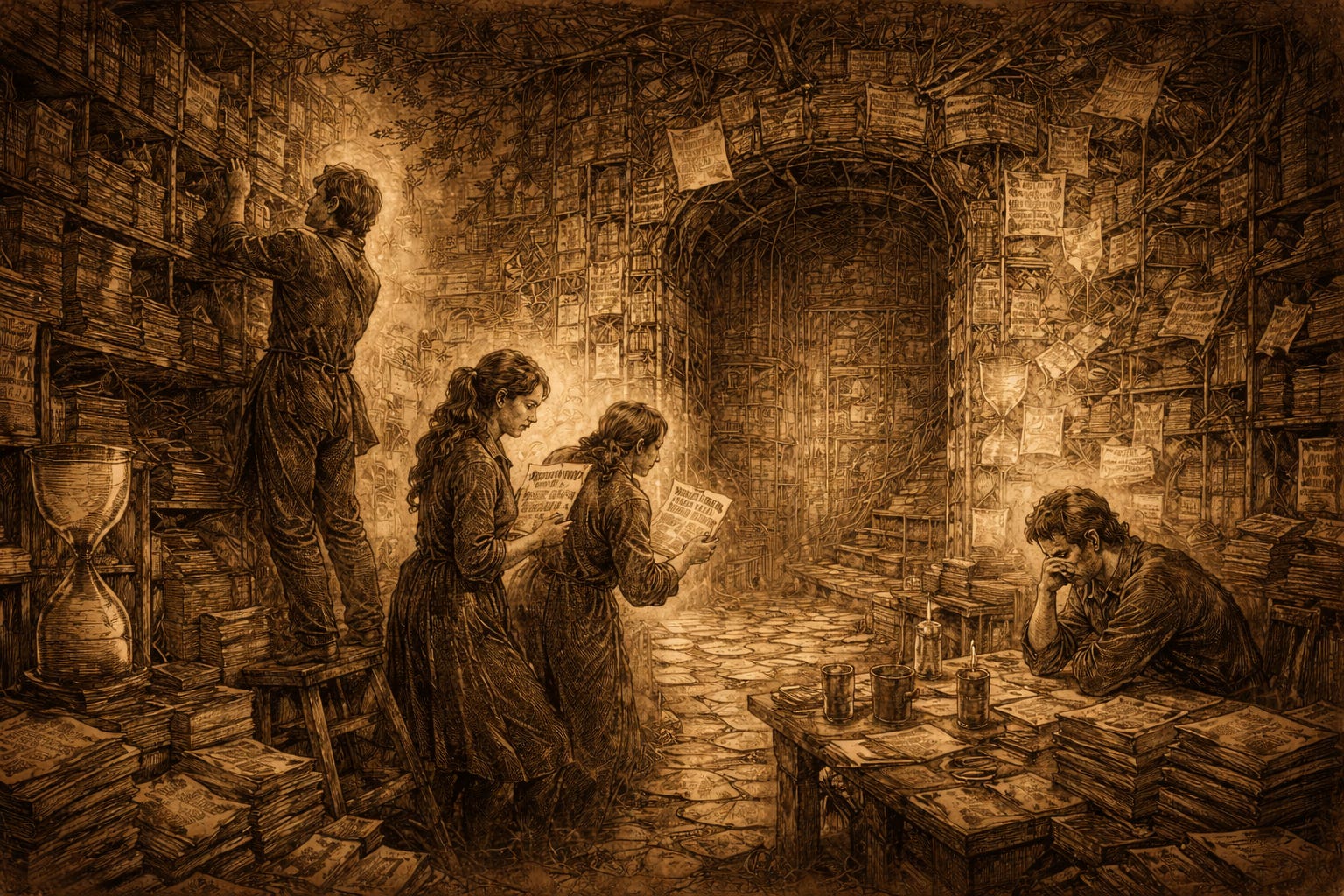
Le Bon Mot was not, strictly speaking, a café. It only appeared to be one.
From the lane — that narrow, indecisive stretch of cobbles that could not decide whether it belonged to the sea air or the inland dust — Le Bon Mot presented itself modestly. A chalkboard. A door with a bell that rang in an uncertain key. Windows crowded with books that seemed to lean toward one another in conspiratorial posture.
Inside, however, there was rebellion.
Shelves ran too long. Corridors returned you to places you were certain you had not yet visited. Tables shifted allegiance. Stairs that only went anywhere on the weekend. Doors that moved faster than patrons. An espresso machine that sighed like a philosopher who had seen empires fall.
And at its centre, usually with a cup of something dark and a notebook that never appeared to fill, sat Case.
Case was retired from software development, which meant she now spent more time thinking about software than she ever had when paid to do so. She possessed the unnerving calm of someone who had survived multiple architectural migrations and lost precisely none of her curiosity. Her code, in its youth, had been described as “beautiful.” This had less to do with minimalism and more to do with mercy. Her code did not surprise its reader.
On the morning that Tuesday went missing, three engineers arrived breathless.
They did not at first notice that Tuesday was gone.
The three engineers ordered flat whites. They argued about a deployment. They placed a laptop on the central oak table. A table that had once hosted a poet, two failed philosophers, and a chess game that never concluded because the black queen refused to move.
Then one of them , a tall man named Daniel who wore urgency like an ill-fitting blazer, frowned.
“Wasn’t there a door there yesterday?”
Case did not look up.
“There are always doors here,” she said. “The question is whether you remember them.”
The wall before them was composed of books. Manuals, treatises, pamphlets, atlases of systems no longer extant. Where Daniel was certain a narrow archway had stood — leading, he swore, to the Section of Payment Retries — there was now shelving.
“Where’s the Billing Annex?” asked Priya, who had inherited it six months earlier and had since aged approximately three years.
“It’s still billing,” Case said. “The annex is what has drifted.”
They exchanged looks that suggested caffeine would not be enough for this.
“We deployed a change yesterday,” Daniel began. “Minor. A retry tweak.”
“There is no such thing,” Case murmured.
“…and this morning no one can quite explain why it works.”
“That is common,” Case replied.
“No,” Priya insisted. And, pausing for effect, “We can’t explain why it ever worked.”
The bell above the door rang again, though no one entered. The shelves trembled. Somewhere in the far stacks, a ladder rolled itself a few inches to the left, as if making space for a book that had not yet been written.
Case closed her notebook.
“Ah,” she said. “You’ve misplaced Tuesday.”
Daniel blinked.
“It’s Wednesday.”
“Yes,” Case agreed. “That is precisely the problem.”
Le Bon Mot had long suffered from a peculiar affliction: when understanding decayed, the architecture responded.
Shelves would shift. Sections would blur. A biography might migrate into speculative fiction if its subject’s motives had grown unclear. Entire corridors had once vanished during a particularly opaque re-platforming tragedy.
Case called it ecological feedback. The engineers called it disconcerting.
“Explain,” Priya demanded.
Case stood, brushing invisible dust from her coat.
“You changed something small,” she said, walking toward the shelving that denied the existence of the Billing Annex. “But small changes in poorly understood systems are like footnotes in a good novel. They alter the entire text.”
“We have tests,” Daniel said defensively.
“Tests confirm behaviour,” Case replied. “They do not guarantee comprehension.”
She ran her fingers along the spines. Several titles shimmered and reassembled. On the Reliable Repetition of Historical Accidents became Retry Logic and Other Folk Tales.
Priya swallowed.
“Are you saying the café moves when we don’t understand our own system?”
“I am saying,” Case said, “that shared mental models are load-bearing walls. When they erode, architecture compensates.”
At that moment, a patron at a distant table attempted to locate the restroom and instead discovered a symposium on monads. He did not complain. Le Bon Mot discouraged complaints through topology.
They searched. The three engineers navigated aisles that seemed longer than memory allowed. They found fragments of their past reasoning. Scribbled notes pinned between volumes, diagrams that almost aligned with reality.
On a high shelf, Daniel found a ledger titled Why We Added the Third Retry. It was empty.
“That can’t be right,” he whispered.
“It is entirely right,” Case said from below. “You inherited the retry logic. You did not cultivate it.”
Priya located a brittle pamphlet wedged behind a collection of Kafka.
Incident #47: The One With the Silent Timeout.
It described a production failure from two years prior. The fix had been implemented at 2:17 a.m. by someone who had since left for a vineyard.
“Here,” she said. “This explains it.”
Case shook her head.
“It explains an event. It does not explain the architecture.”
The shelves shuddered again. A narrow passage opened briefly to the left. They glimpsed it — the Billing Annex, intact but dim, like a memory recalled through water.
“Go,” Case said.
They moved quickly, as though Tuesday might close permanently.
Inside the annex, diagrams floated in mid-air. Retry flows looped gracefully, then tangled, then looped again. Margins were filled with annotations in at least four handwriting styles.
Daniel stared.
“Why didn’t we know this?”
“You knew pieces,” Case said gently. “But no one knew the whole.”
Priya traced a path with her finger.
“We changed this threshold yesterday.”
“And in doing so,” Case said, “you altered an assumption none of you consciously held.”
Daniel sat heavily on the floor.
“So this is cognitive debt?”
Case smiled.
“One manifestation.”
The diagrams flickered.
“You moved quickly,” she continued. “Your system evolved. But your shared understanding did not keep pace. The habitat adjusted.”
Priya looked around.
“The café is our mental model?”
“The café,” Case said, “is what happens when mental models are externalised.”
A volume fell from a shelf. Its title read: Velocity Without Cartography. Daniel exhaled.
“So how do we get Tuesday back?”
Case crouched beside him.
“You reconstruct the story.”
They began not with code, but with narration.
Why did the retries exist? What failure were they guarding against? What assumptions had been made about idempotency? About downstream tolerance? About timing?
As they spoke, the diagrams steadied. Annotations aligned. The dimness lifted. Outside the annex, shelves rearranged with a sound not unlike relief.
Patrons at distant tables found their essays concluding more coherently than expected.
After an hour, Priya leaned back.
“I think I understand it,” she said cautiously.
Daniel nodded.
“So do I.”
Case said nothing.
The annex brightened fully. The passage back to the main hall remained open.
And somewhere, deep in the stacks, a thin book titled Tuesday slid back into place between Monday’s Assumptions and Wednesday’s Consequences.
They returned to the central table and the espresso machine hissed approvingly. Daniel looked at Case.
“So the café isn’t punishing us.”
“Certainly not,” she replied. “It is informing you.”
Priya closed her laptop.
“We need to write this down.”
Case raised an eyebrow.
“Yes,” she said. “But more importantly, you need to keep telling it.”
The bell above the door rang again. This time admitting a new patron who glanced around in mild confusion.
“Is this a café?” he asked.
Case resumed her seat.
“It depends,” she said, “on whether you are here for coffee or comprehension.”
The engineers laughed. Not because it was especially funny, but because it was precisely correct.
Outside, the lane remained undecided between sea and land. Inside, the shelves held.
Tuesday, restored to its rightful position in the week, made no announcement of its return. It simply existed again — inhabitable, navigable, understood.
For now.