
The Word That Passed Every Audit
On the governance of meaning, and the debt that accumulates when words survive longer than what they meant

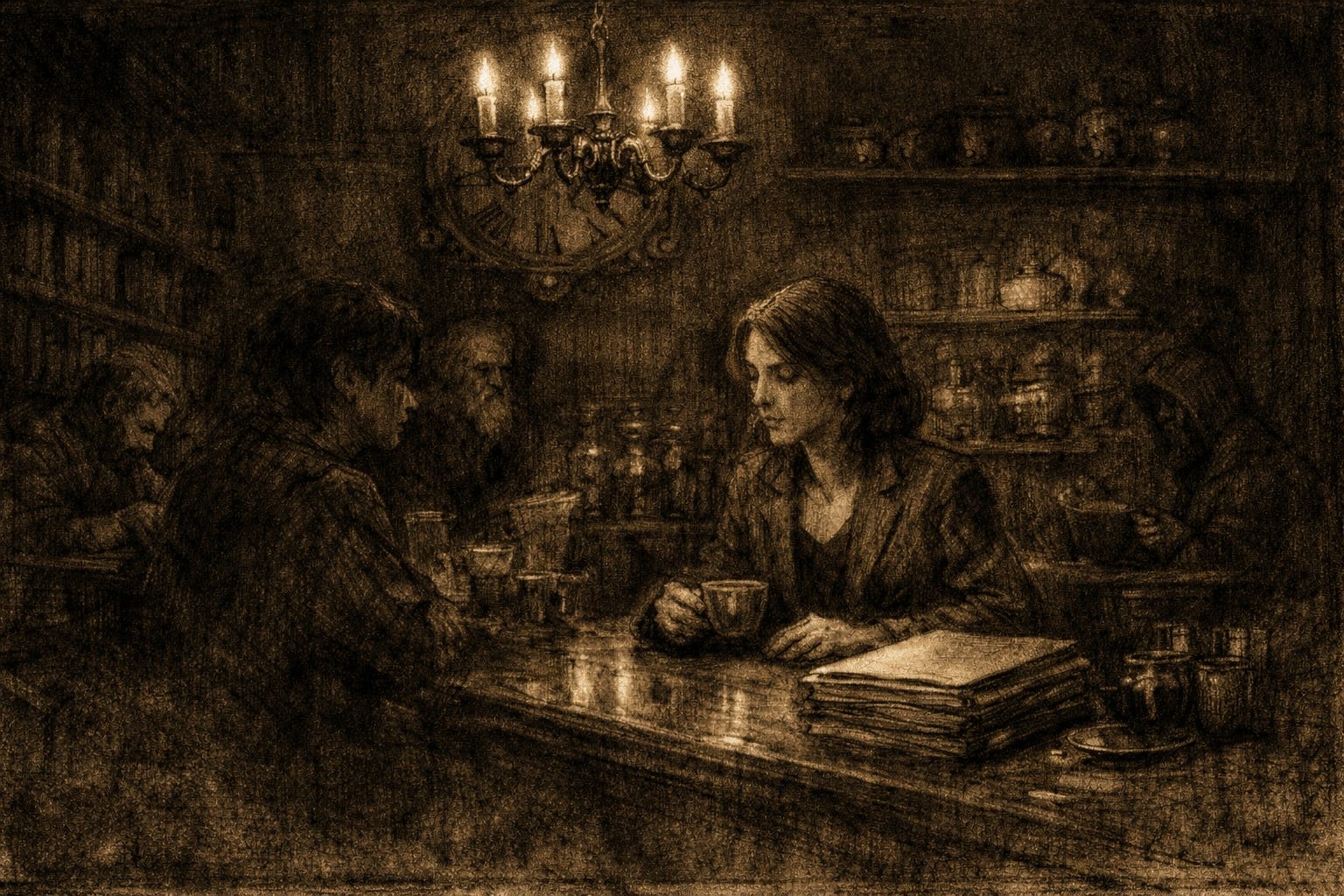
A story inspired by a conversation, alongside a talk, that was ignited by a paper. Thanks for all the inspiration Margaret-Anne Storey and Arty Starr.
The cortado was different this time. Not the coffee itself, Madame Beauregard’s cortado had been the same since the cafe opened, which was either twelve years ago or always, depending on which regulars you believed. What was different was the hand that held it. Steady. Six months ago that hand had trembled, though its owner would have denied it.
Elodie Marchetti entered Le Bon Mot on a Tuesday afternoon in early autumn, and the cafe received her the way it received everyone who returned: without surprise and without judgement. The bell above the door rang. Sophie, asleep on the philosophy shelf, did not open her eyes. The brass clock, which was four minutes slow in the way that only very old clocks and very old institutions are slow, marked her arrival at seventeen minutes past two.
She was carrying a document. Printed, bound, sixty-three pages. The kind of document that arrives at cafes only when its owner needs someone specific to see it.
Case was at the bar, reading. Not the regulatory text she’d been studying on Elodie’s first visit — that had been the AI Governance Act, and the argument it provoked had left marks on both of them. Today it was something else. A slim volume with no title on its spine.
“You came back,” Case said, without looking up.
“You said I would.”
“I said nothing of the sort.”
“You implied it. When someone tells you the word you spent six months defining doesn’t mean what you think it means, the implication is that you’ll be back.”
Case closed her book. She looked at Elodie properly for the first time. The grey blazer was the same. The confidence underneath it was not. Six months ago, Elodie had sat at that bar as someone defending a position. Now she sat there as someone delivering a verdict.
“Cortado,” Elodie said to Madame Beauregard, who was already making one.
The chalkboard behind the counter — whose contents changed between glances, as though meaning itself were restless — read:
A word that satisfies everyone has promised more than language can deliver.
Elodie set the document on the bar. It was bound in the particular shade of blue that European regulatory bodies use when they want something to look authoritative without looking threatening.
“The audit passed,” she said. “Every control verified. Transparency, accountability, human oversight, risk classification — all compliant. Fourteen organisations assessed across three member states. Not a single material finding.”
She let that sit.
“You told me six months ago that my framework would fail. That the word ‘transparent’ was carrying meaning across three reference frames and that none of them would hold. That six months from now, an organisation would be fully compliant and a user would have no idea why an AI denied their loan.” Elodie tapped the document. “It has been six months. The framework held. The audits passed. The word held.”
Case said nothing.
The Librarian, who had been shelving a book with the careful deliberation of someone who believed that where a book rested determined what it meant, paused. He tilted his head slightly.
In the far corner, Dave sat with his laptop open and his brow furrowed, not listening to the conversation but clearly aware of it. He was working on something — lines of code and specification text visible on his screen, the kind of work that involved making a machine do exactly what you meant rather than what you said. He reached for his coffee without looking, found it empty, and did not notice.
Sophie shifted on the philosophy shelf. One ear rotated toward the bar.
Madame Beauregard placed the cortado in front of Elodie with the economy of motion that characterised everything she did. She glanced at the blue document. She said nothing.
“You have nothing to say,” Elodie said to Case. It was not a question.
“I have a great deal to say,” Case replied. “I am choosing the order carefully.”
“Because you think I’m wrong.”
“Because I think you believe you are right, and that belief is resting on something I want to understand before I disturb it.” Case turned on her stool to face Elodie fully. “You said the audit passed. You said every control was verified. You said the word held.”
“Yes.”
“Those are three different claims. You are presenting them as one.”
Elodie picked up her cortado. The steadiness in her hand was still there, but something behind it shifted. Not doubt, not yet, but the beginning of a question she had not planned to ask.
The brass clock ticked. Sophie’s ear remained pointed at the bar. The Librarian resumed shelving, but slowly.
“Tell me about the audit,” Case said. “Not the result. The process.”
But Elodie did not answer immediately. She was looking past Case, at the document on the bar, and then at the shelves behind the counter where Madame Beauregard kept things that were not coffee and not books but occupied the uncertain territory between: a brass compass with no needle, a glass jar of keys that fit no known lock, a photograph of a door that was either opening or closing.
“Before the audit,” Elodie said. “Can I ask you something about the framework itself?”
“Your framework.”
“My framework. Not the compliance results. The language.”
Case tilted her head. This was not the conversation she had expected. People who come to defend audit results talk about audit results. People who come to understand something talk about language.
“Go on.”
Elodie opened the blue document to a page she had clearly visited many times. The corner was soft. There was a single sentence underlined, not in the careful way of a regulator marking a requirement, but in the hesitant way of someone returning to words they once thought were finished.
“’AI-generated code must be subject to meaningful human oversight before deployment,’” she read aloud.
The sentence landed in Le Bon Mot the way sentences do when they have been read in many rooms before this one — a little worn, a little too smooth.
“That’s the control,” Elodie said. “The one that passed.”
“That’s a sentence,” Case said. “What was it before it was a control?”
In the far corner, Dave’s hands had gone still over the keyboard. He was looking at his screen, but he was no longer reading it.
“I wrote it,” Elodie said. “Eighteen months ago. Brussels. A drafting room with bad lighting and worse coffee — not like here.” She glanced at Madame Beauregard, who acknowledged the compliment with the faintest motion of an eyebrow.
“There were eleven of us around the table. Three from national regulatory bodies. Two from industry — one of them represented a company that was already deploying code generation at scale, which meant he was negotiating on behalf of a future he was already living in. Two from academia. Two from civil society. A legal drafter. And me.”
“Your role?”
“Technical advisor. My job was to ensure the governance language survived contact with engineering reality. To be the person who said ‘that sounds right but cannot be implemented’ or ‘that can be implemented but does not mean what you think.’”
Case said nothing, but her attention sharpened in the way the Librarian’s did when he heard a binding crack.
“We spent four hours on that sentence,” Elodie said. “Four hours on one word. Not ‘oversight’ — everyone agreed on oversight. Not ‘deployment’ — the boundary was clear enough. Not even ‘human,’ though the philosopher in the group wanted forty minutes on what constitutes human agency in a pipeline with seventeen automated steps.”
“The word was ‘meaningful,’” Case said.
“The word was ‘meaningful,’” Elodie confirmed.
Elodie set down her cortado. She was not performing now. She was remembering, and there is a difference between the two that Le Bon Mot had learned to recognise: performance holds your shoulders still; memory moves them.
“Henrik — the academic from Copenhagen — wanted ‘substantive.’ Too legal, we decided. It implied a threshold that would need defining, and the moment you define a threshold for understanding you have replaced understanding with measurement. Mariam from the civil society group wanted ‘genuine,’ but that is a word about intention, and you cannot audit intention. Paolo — the industry representative, the one already living in the future — wanted ‘documented.’ Just ‘documented.’ He was honest about it. He said: we will be audited on this, and the only thing you can audit is a record.”
“And you chose ‘meaningful.’”
“I chose ‘meaningful.’ I chose it because it meant something specific to me in that room, and I believed — I was certain — that what it meant to me was what it would mean to everyone who read it.”
“What did it mean?”
Elodie looked at the sentence on the page as though she could still see the room behind it. Bad lighting. Eleven people. Coffee that was not like this.
“It meant the reviewer builds a theory of the code,” she said. “Not a theory in the academic sense. A working mental model. They read the change and they understand what it does and why it does it. They are not scanning for syntax errors or checking that the tests pass — a machine can do that. They are constructing a picture of the code’s intent, comparing it against what they know about the system, and exercising judgment about whether this change belongs. The review is meaningful when the reviewer can explain, without consulting the diff again, what changed and why it was the right change.”
She paused.
“That is what ‘meaningful’ meant. Cognitively engaged review. Not documented. Not signed. Not time-stamped. Engaged. The reviewer has to think, and the evidence of thinking is not a checkbox.”
The Djinn — who had been sitting at a table near the window, visible only in the way that certain things in Le Bon Mot were visible, which is to say present to those who were paying the right kind of attention — spoke without moving.
“The system cannot see thinking,” it said. Its voice had the quality of something processed: clear, unhurried, free of the small imprecisions that mark biological speech. “It can see the approval event. It can measure the interval between the diff being opened and the approval being submitted. It can count the number of review comments. But the thing you are describing — the construction of a mental model, the exercise of judgment — produces no signal that I can read.”
Elodie stared at the Djinn. She had not noticed it before. No one ever did, at first.
“You’re —”
“I am what the governance is about,” the Djinn said. “And I am telling you: from where I sit, ‘meaningful’ and ‘not meaningful’ look the same.”
The Librarian, who had finished shelving and was now standing at the end of the bar with his hands folded, spoke quietly.
“Every word begins its life belonging to someone,” he said. “To a room, a debate, a specific disagreement between specific people. The word knows what it means because the people who chose it remember what they rejected. ‘Meaningful’ is not ‘substantive.’ Not ‘genuine.’ Not ‘documented.’ It carries the shape of what it is not.” He looked at Elodie. “That shape is the first thing to go.”
Sophie’s tail/butt — there really wasn’t much tail to speak of — moved once on the philosophy shelf, slowly, with no apparent cause.
Case looked at the underlined sentence in the blue document. A word, chosen with precision, in a room full of people who knew what it meant and what it did not mean. A word that carried, for a brief moment, the full weight of its own specificity.
“So eighteen months ago,” Case said, “’meaningful’ meant cognitively engaged review. The reviewer builds a theory. The reviewer exercises judgment. The evidence is understanding, not documentation.”
“Yes.”
“And the audit that passed — the one in this document — what did ‘meaningful’ mean there?”
Elodie did not answer immediately. The cortado was getting cold. Madame Beauregard was already preparing another.
“Before we get to the audit,” the Djinn said, “I want to know what happened to the word after it left the room.”
It was not a question anyone else would have asked. Case was interested in what the word meant. Elodie was interested in whether the word had held. But the Djinn — which existed downstream of every governance decision, which lived in the pipeline where words became gates — wanted to know something different. It wanted to know how the word had travelled.
Elodie looked at the Djinn. She was still adjusting to its presence, to the fact that something that processed language for a living was sitting in the corner of a cafe asking her about the journey of a single adjective.
“It went into the document,” she said.
“That is where things begin to go wrong,” the Librarian said, so quietly that you could have mistaken it for the sound of a page turning.
Elodie turned to him. “The document was faithful. I reviewed every draft. The sentence survived intact. Word for word.”
“The sentence survived,” the Librarian said. “What did not survive was the four hours.”
He moved from behind the bar toward the shelves, where he stood among the books with the particular authority of someone who understood that storage is never neutral. He pulled a slim volume from the philosophy section and held it up. Not to read, but to make a point about where it lived.
“This book,” he said, “is a treatise on ethics. It belongs here, between Aristotle and Anscombe. But last month someone returned it and I found it shelved in self-help. Same book. Same words. Same binding. But on the self-help shelf it becomes a different object. A reader who finds it there reads it differently. Not as an argument to be engaged with but as advice to be followed. The shelf tells the reader what kind of thing it is before the first page is opened.”
He returned the book to its place. “Your word had a shelf. The shelf was the drafting room — the four hours, the alternatives rejected, the eleven people who understood what ‘meaningful’ carried because they had argued about what it should not carry. When the word moved into the governance document, it lost its shelf. It became a word in a sentence in a section of a regulatory framework, and the reader had no access to the room.”
“But the word is clear,” Elodie said. “It says what it says.”
“It says what you hear,” Case said. “And what you hear depends on where you are standing.”
Elodie was quiet for a moment. Then she opened the document to a different page, later in the framework, where the control language gave way to implementation guidance.
“The compliance teams received the framework six months after publication,” she said. “Their job was to audit it. To verify that organisations were meeting the requirements. Including the requirement for meaningful human oversight.”
“How do you audit meaning?” Dave said, from the corner. It was the first time he had spoken, and his voice had the flat precision of someone who asked questions he already suspected had no good answer. His laptop was still open, but he had stopped pretending to work on it.
“That is exactly the problem,” Elodie said. “You cannot audit meaning directly. You audit evidence of it. And the moment you ask ‘what evidence would demonstrate meaningful review?’ you have already changed the question. You are no longer asking whether the review was meaningful. You are asking whether the evidence of meaningfulness is present.”
“And the evidence they chose?” Case asked.
“Documentation. Timestamps. Named reviewers. Approval records. Comments on the review. At least one substantive comment per review, which itself had to be defined, and the definition they settled on was a comment exceeding forty characters that referenced the content of the change.” Elodie paused. “They were not wrong. Every piece of evidence they selected is a reasonable proxy for engaged review. A reviewer who leaves a substantive comment has probably thought about the code. A review that takes more than three minutes is more likely to involve actual reading than one that takes twelve seconds.”
“Probably,” the Djinn said. “More likely.”
“Yes.”
“These are statistical claims about correlation,” the Djinn said. “Not structural claims about meaning. I can produce a forty-one-character comment that references the content of a change without understanding it. I can hold a diff open for four minutes without reading it. The proxies are uncorrelated with the thing they are proxying at the individual level. They work on average. Governance does not operate on average.”
Elodie did not argue. She had come to Le Bon Mot with an audit result, and the audit result was becoming something else — not a verdict, but a case study in how a word changes when it moves between rooms.
“The compliance teams did what compliance teams do,” she said. “They translated the requirement into something verifiable. Their frame was institutional: does evidence exist? Can it be collected consistently? Will it survive a challenge from the audited entity? These are legitimate questions. They are the right questions if your job is to build an audit programme that functions at scale across fourteen organisations.”
“They are the right questions for the wrong object,” Case said. “They are asking how to verify a process. Your word was describing a cognitive state.”
The Librarian, who had returned to the bar, placed both hands flat on the counter. “This is the second shelf,” he said. “The word moved from the drafting room to the governance document, that was the first re-shelving. Now it moves from the governance document to the compliance programme. A different section of the library entirely. In the governance document, ‘meaningful’ sits among principles and obligations. In the compliance programme, it sits among checklists and evidence tables. Same word. Different shelf. Different reader. Different meaning.”
“And nobody changed it,” Elodie said. She had been looking for someone to blame, and she had not found them.
“Nobody needed to,” Case said. “Translation is not corruption. The compliance teams did not betray your word. They adopted it. Adoption without the frame that gave it meaning, that is how drift begins. Not with malice. With good faith and a different set of problems to solve.”
Elodie nodded slowly. “Then it moved again.”
“To engineering,” Dave said. He said it the way you say something you have watched happen. Not theoretically. Personally.
“To engineering,” Elodie confirmed. “The fourteen organisations that were audited — they received the compliance requirements and they implemented them. Review tooling. Approval gates. Automated checks that a named reviewer had opened the diff, that the review duration exceeded a threshold, that at least one comment met the character count and content-reference criteria.”
Dave closed his laptop. He no longer needed a screen to see what was being described.
“I have built that tooling,” he said. “Not for this framework specifically. But I have built review gates. I have written the code that checks whether a human clicked approve and whether the interval between opening and approving exceeded a minimum.”
He turned his coffee cup in his hands.
“And I can tell you exactly what happens. The engineers who build the tooling do not read the governance document. They read the compliance requirements. They implement what the compliance requirements specify. The governance document says ‘meaningful.’ The compliance requirements say ‘documented, timestamped, with at least one substantive comment.’ The engineering implementation says ‘boolean: all evidence fields populated.’ Each translation is faithful to its source. Each translation loses a layer.”
“The third shelf,” the Librarian said. “Philosophy to self-help to… what is the section after self-help? The one where the book has been reduced to its index entry. You know the title. You know the page count. You can verify it exists. But the argument inside it is gone.”
Sophie stretched on the philosophy shelf, extending one paw toward the spine of a book on phenomenology and then retracting it.
“So the word travelled,” the Djinn said. “From the drafting room to the governance document to the compliance programme to the engineering implementation. Four rooms. In the first room, it meant cognitively engaged review — the reviewer builds a theory of the code. In the second room, it meant a principle that organisations must uphold. In the third room, it meant a set of evidence criteria that auditors could verify. In the fourth room, it meant a boolean gate in a pipeline.”
“And at no point,” Case said, “did anyone carry the meaning across. Each room adopted the word. No room adopted the frame.”
Elodie looked at the blue document on the bar. Sixty-three pages. Fourteen organisations. Every control verified.
“It is not that anyone was wrong,” she said.
“No,” Case said. “It is that everyone was right within their own frame, and no one translated between them. The word survived every room it entered. What it meant did not.”
Madame Beauregard placed a fresh cortado in front of Elodie. The old one, cold now, she removed without comment. There are things in Le Bon Mot that are allowed to go cold, but coffee is not among them.
“Now tell me about the audit,” Case said.
Not gently. Not aggressively. With the particular precision of someone who has been waiting for the conversation to arrive at the place where it was always going.
Elodie opened the blue document to a tabbed section near the back. The kind of section that has been read many times by people who were looking for a specific answer and found one. Evidence tables. Assessment criteria. The architecture of verification.
“The audit programme covered fourteen organisations,” she said. “Three member states. Each organisation was assessed against the full control framework. Forty-seven controls, of which the meaningful human oversight requirement was control seventeen. The audit was conducted by an accredited third-party assessor using a standardised evidence methodology.”
“What did they check?”
“For control seventeen specifically: that each organisation had a documented code review process. That the process required a named human reviewer for all AI-generated code changes. That the review platform recorded timestamps — when the diff was opened, when comments were submitted, when the approval was granted. That at least one comment per review met the substantive threshold. That the approval was recorded against a named individual with appropriate authority.” Elodie ran her finger down the evidence table. “The assessor verified that these records existed for a sample of changes across a six-month period. They checked that the review durations were not implausibly short. They verified that the reviewers were real people with real credentials, not service accounts or automated approvals disguised as human ones.”
“And?”
“And every organisation passed. Fourteen out of fourteen. The evidence was present, consistent, and complete. The review processes were documented. The timestamps were within expected ranges. The approval records were clean.”
She closed the document. Not with finality but with the care of someone who was beginning to see it differently but had not yet found the words for what she was seeing.
The Librarian, standing at the end of the bar, said: “The assessor examined the document. They did not examine the reading.”
Elodie looked at him.
“A librarian can verify that a book has been checked out,” he said. “The record shows who borrowed it, when they took it, when they returned it. What the record cannot show is whether they opened it. Whether they read past the first chapter. Whether they understood the argument or merely survived the page count. The checkout record is perfect. It tells you everything about the transaction and nothing about the encounter.”
“That is not a fair comparison,” Elodie said, but she said it slowly. The speed of someone testing a defence rather than deploying one.
“It is a precise comparison,” Case said. “The audit verified the transaction. It verified that a human was present, that time elapsed, that a comment was recorded. These are the artefacts of review. They are not review itself.”
Dave, from his corner, spoke without raising his head. “I can tell you what the approval event looks like from inside the pipeline. It is a webhook. A JSON payload. It contains a username, a timestamp, and a status field that reads ‘approved.’ The pipeline does not know and cannot know whether the person behind that username spent forty minutes building a mental model of the change or spent forty seconds scanning the diff title before clicking the green button. Both produce the same webhook. Both satisfy the gate.”
“Both pass the audit,” the Djinn said.
It was quiet for a moment. Sophie, on the philosophy shelf, had curled into a tighter circle.
Then the Djinn asked the question.
“Did the auditors verify that the reviewers understood the code,” it said, “or that the reviewers clicked approve?”
It was asked the way you ask what time it is — simply, because the answer is obvious once you think to ask it.
Elodie did not answer.
She looked at the blue document on the bar. She looked at the evidence table with its timestamps and approval records and substantive comment thresholds. She looked at the sentence she had underlined eighteen months ago, the one she had written in a room with bad lighting and eleven people who knew what “meaningful” meant because they had spent four hours deciding what it did not mean.
“They verified that the reviewers clicked approve,” she said. “They verified it thoroughly. They verified it consistently. They verified it across fourteen organisations and three member states and six months of records. The verification was rigorous.” She paused. “It was rigorous about the wrong thing.”
Case did not press. She did not need to. The fracture had happened.
“The audit verified the regulatory frame,” Elodie said, working through it. “Evidence exists. Records are complete. The paper trail is unbroken. The audit verified the system frame — the gate is in place, the tooling enforces the process, the pipeline will not deploy without approval. Both frames are satisfied. Both were verified with genuine rigour.”
“And the engineering frame,” Case said. “The one where ‘meaningful’ meant cognitively engaged review.”
“Was not verified. Was not verifiable. Not by this audit methodology. Not by any audit methodology I can imagine, because the thing I meant by ‘meaningful’ — that the reviewer builds a theory of the code — leaves no trace that an external assessor can collect.”
“Two frames satisfied semantically,” Case said. “One satisfied syntactically. The word passed the audit in all three. The meaning passed in two.”
Madame Beauregard, who had been wiping the same section of counter for longer than any section of counter needed wiping, stopped. She looked at the blue document. She looked at Elodie. She said nothing, because what she would have said was already being said, and Madame Beauregard did not believe in redundancy.
“Here is what concerns me,” Elodie said. She picked up the document and held it — not showing it, but weighing it, as though its authority had a mass she could now feel differently. “This audit result is not wrong. Every finding is accurate. Every piece of evidence is genuine. But the confidence it produces — the confidence that the framework is working, that AI-generated code is under meaningful human oversight — that confidence is not earned by the audit. It is borrowed from the word. The word that meant something specific eighteen months ago and means something different now.”
“Borrowed certainty,” Case said.
“And it compounds.” Elodie set the document down. “Because this audit will be cited. It will appear in regulatory reports. It will be referenced by the fourteen organisations when they report to their boards. It will be used as evidence that the governance framework is functioning. And each citation strengthens the belief that the system works — makes it less likely that anyone questions the framework, less likely that anyone asks the Djinn’s question. The certainty reinforces itself. The more audits pass, the stronger the belief. The stronger the belief, the less scrutiny. The less scrutiny, the wider the gap between the word and what it was supposed to mean.”
“Until?” Case said.
Elodie looked at her.
“Until a user is harmed by a decision they cannot understand,” the Djinn said. “And the organisation is compliant. And the governance framework is verified. And the audit is clean. And the harm occurred in the space between the word and the world.”
“That has not happened yet,” Elodie said.
“No,” Case said. “It has not happened yet.”
She said it in a way that made “yet” do all the work.
The brass clock, which was four minutes slow, ticked. In four minutes, it would show the time that the rest of the world had already passed through. This is the nature of clocks that are slow. They are not wrong. They are faithful to a moment that no longer exists.
Sophie opened one eye, regarded the blue document on the bar, and closed it again.
Dave stood up.
He had been sitting with something for long enough and now needed to be vertical to say it. He left his laptop on the table — closed, finished with, a tool that had served its purpose for the day — and walked to the bar, where he stood between Case and Elodie with his hands in his pockets and the expression of someone who was about to describe something he had seen from the inside.
“I want to tell you about a team I worked with,” he said. “Not hypothetically. Specifically.”
Madame Beauregard placed a fresh coffee in front of him. He had not ordered it. She had a sense for when people were about to say things that required caffeine.
“Eighteen months ago — about the time you were drafting that sentence in Brussels — I was building a code review integration for a financial services platform. Not the governance tooling I described earlier. This was different. This was a team of eleven developers, three of whom had been on the project from the beginning, and eight of whom had joined in the last year as the AI code generation scaled up. The team reviewed every AI-generated change. Every single one. They had the process. They had the tooling. They had a review checklist that ran to two pages.”
He picked up the coffee and held it without drinking.
“One of the original developers — Anna — she reviewed differently from the others. When a change came in, she would read the diff, then close it. Open the file in context. Read the surrounding code. She would pull up the ticket, read the requirements, check the test coverage not for whether tests existed but for whether they tested the right thing. Her reviews took forty minutes on average. She left long comments. Not long because she was verbose — long because she was explaining her reasoning. She would write things like ‘this implementation satisfies the requirement but introduces a coupling to the payment module that will make the next quarter’s refactoring harder — consider injecting the dependency instead.’ She was building a theory of each change.”
“Your word,” Case said to Elodie. “That is what your word meant.”
“Yes,” Dave said. “That is what the word meant. But Anna was one of eleven. And here is what I want you to understand about the other ten.”
He paused. Not for effect. For accuracy.
“The other ten were not lazy. They were not indifferent. They were skilled engineers who took their work seriously. But they had joined a project with an existing governance framework — your framework, or one like it — and the framework told them that review was required. It did not tell them what review meant. It told them that approval was necessary. It did not tell them why approval existed. The compliance documentation said: named reviewer, timestamp, substantive comment. So that is what they did. They opened the diff. They scanned it. They left a comment that met the character threshold and referenced the change. They clicked approve. Twenty minutes. Average.”
“They followed the process,” Elodie said.
“They followed the process perfectly. And here is the thing — they believed they were doing it right. Not cynically. Not theatrically. They genuinely believed that what they were doing was meaningful human oversight, because nothing in the governance language, nothing in the compliance requirements, nothing in the tooling told them otherwise. They had the word. They did not have the four hours.”
Case set down her book. She had been holding it throughout the conversation — the slim volume with no title — and now she placed it on the bar with the deliberateness of someone making space for something that needed room.
“This is intent debt,” she said. “Not technical failure. Not bad faith. The governance language that was supposed to tell them what to do instead told them what to produce. ‘Meaningful’ became ‘present.’ The reviewers knew they were supposed to review. They did not know they were supposed to think, because the word that was supposed to carry that instruction had been translated — faithfully, at every stage — into something that no longer carried it.”
She looked at Elodie. “Your sentence does not say ‘the reviewer must build a theory of the code.’ It says ‘meaningful human oversight.’ And by the time it reached Dave’s team, ‘meaningful’ had become a property of the evidence, not a property of the cognition. The intent was not lost through carelessness. It was lost through institutional translation. Each step preserved the word and shed the meaning, until the instruction that arrived at the engineering team was: produce the artefacts of review.”
The Librarian, who had been listening with the stillness of someone for whom listening was a professional discipline, moved to the shelf behind the bar. He pulled out a book — not the ethics treatise from before, but something older, with a cracked spine and pages the colour of weak tea.
“There is a concept in library science,” he said, “called the lost reader. Not a reader who cannot find a book — a reader who finds the book and cannot read it. The book is present. The catalogue entry is correct. The shelf location is accurate. But the reader lacks the frame to understand what the book is saying, because the context that would have made it legible — the course it was assigned in, the debate it was responding to, the question it was answering — was never transmitted alongside the catalogue entry.”
He held the book open, though no one could read the page from where they sat. “Dave’s eight engineers are lost readers. They have the governance text. They have the compliance checklist. They have the review tooling. They do not have the theory that would make any of it meaningful, because the theory was never part of the transmission. They were given the word without the frame, and so they built the only mental model they could — the one that fits the evidence requirements. Review means: open the diff, leave a comment, click approve. That is what they understand review to be. Not because they are wrong, but because nothing they were given allows them to be right.”
“Cognitive debt,” Case said.
“Yes,” the Librarian said. “The understanding was never translated. The word crossed the rooms, but the theory behind the word did not. And so the reviewers implement a control they cannot understand — not because it is too complex, but because the understanding was never made available to them. They have the vocabulary. They do not have the grammar.”
Dave nodded. He had been waiting for someone to say this — not because he could not say it himself, but because hearing it from outside confirmed something he had felt from inside.
“And here is where it gets concrete,” he said. “Anna caught things. Real things. In the six months I was on that project, she identified three architectural regressions that the AI-generated code had introduced — places where the code was locally correct but structurally wrong. She caught a security boundary violation that would have allowed a payment service to read user data it should never have seen. She caught a test that was passing by accident — asserting the wrong thing, green for the wrong reason.”
He set down his coffee.
“The other ten caught nothing. Not because nothing was there. Because they were not building theories. They were scanning diffs and producing evidence. They were approving changes that were syntactically valid and functionally plausible without ever asking whether the change was right — not just working, but right. And the bugs accumulated. Not the kind of bugs that fail tests — the kind that pass tests and fail systems. Design flaws. Coupling that would cost weeks to unwind. Security assumptions that were correct in one context and dangerous in another. All of it approved. All of it reviewed. All of it compliant.”
“Technical debt,” Case said. “Not from bad code. From disengaged review. The mechanical check passes. The protection it was supposed to provide is absent. And the code that accrues behind that absent protection is not wrong in the way that triggers alerts — it is wrong in the way that triggers incidents, months later, when the accumulated structural damage finally exceeds the system’s tolerance.”
The Djinn, which had been still for a long time, spoke from the window table unhurried, measuring the distance between its words before it used them.
“I want to describe what this looks like from inside the system,” it said. “Because the system is where I live, and the system sees something different from what any of you see.”
It paused. Selecting, not hesitating.
“From the system’s perspective, control seventeen is a boolean,” it said. “It resolves to true or false. True means: a named human opened the diff, elapsed time exceeded the threshold, a qualifying comment was recorded, and the approval event was submitted. False means one or more of those conditions was not met. The system does not have a field for ‘the reviewer understood the code.’ There is no attribute in the data model for ‘theory was built.’ The gate has two states. Each of Anna’s reviews and all of the other ten’s reviews produce the same state: true.”
“And each true widens the gap,” Case said.
“Each true widens the gap,” the Djinn confirmed. “Because each approval is a signal to the governance framework that the control is functioning. The audit aggregates those signals. Fourteen organisations. Thousands of approvals. All true. The governance framework reports that meaningful human oversight is in place across the regulated population. The next audit is designed against the assumption that the current audit’s findings are valid. The evidence thresholds are not tightened — why would they be? The controls are passing. The gap between what the governance language says and what the system actually does grows with every compliant review that is not meaningful. And the governance framework cannot detect this growth, because it is measuring the word, not the meaning.”
“Governance debt,” Elodie said. She said it quietly, the way you say the name of something you have just recognised in yourself.
“Yes,” Case said. “And it is the slowest of the four.”
She looked at the blue document on the bar.
“Governance debt manifests in years. It manifests when the regulatory framework is cited as evidence that the system works, and the citation is believed, and the belief prevents scrutiny, and the absence of scrutiny allows the gap to compound until —” She stopped. “Until the Djinn’s scenario. A user is harmed. The system is compliant. And the distance between the word and the world is so wide that no audit can bridge it.”
“And each debt causes the next,” the Librarian said. He spoke with the careful cadence of someone who was seeing a pattern complete itself. “The governance language drifts — that is the governance debt. The drift obscures the purpose of the control — that is the intent debt. The obscured purpose prevents the reviewers from forming accurate mental models — that is the cognitive debt. The disengaged reviewers let through code that engaged review would have caught — that is the technical debt. And the technical debt — the systems that are locally correct and structurally wrong — widens the gap between what the governance framework describes and what the system actually is.”
“Which is the governance debt again,” Case said.
“Which is the governance debt again. The cycle completes.”
Silence in Le Bon Mot. Not the empty silence of a room where no one is speaking, but the full silence of a room where everyone has just seen the same thing at the same time. The brass clock ticked. Sophie had uncurled on the philosophy shelf and was sitting upright, both eyes open, watching the bar with the alert composure of a creature who had decided that this particular moment warranted full consciousness.
Elodie picked up the blue document. She did not open it. She held it the way you hold something whose weight has changed — not heavier, not lighter, but distributed differently, as though the centre of gravity had shifted to a page she had not previously noticed.
“The audit will be cited in next quarter’s regulatory review,” she said. “It will be presented as evidence that the framework is working. And the review body will accept it, because the methodology is sound and the findings are clean. And the next audit cycle will be designed on the assumption that this cycle’s controls are adequate. And the gap will grow.”
“Unless,” Dave said.
Everyone looked at him.
“Unless someone carries the four hours into the next room,” he said. “That is what Anna does. She does not review code because the process tells her to. She reviews code because she understands what review is for. She has the theory. Someone gave her the frame — or she built it herself, I never asked which. But the frame is what makes her review meaningful in the way you originally meant. Not the word. The frame.”
Case almost smiled.
“The word cannot carry the frame,” she said. “That is the structural problem. No amount of precision in the governance language will transmit the understanding that makes compliance meaningful. The word can point at the frame. It cannot be the frame. And governance that relies on the word without transmitting the frame will always produce this cycle — intent to cognition to technical to governance, widening with each revolution.”
Madame Beauregard collected the empty cups. She did it in the order she always did — oldest first, coldest last — a small governance of her own, faithfully maintained because she remembered why she had chosen the order and had never stopped remembering.
Elodie was quiet for a long time. Not the quiet of someone who had nothing to say, but the quiet of someone rearranging what they had already said — fitting it into a shape that would let her ask the next question.
“What should I do?”
She said it simply. Not the way a regulator asks for recommendations — that comes with qualifiers, caveats, a careful framing that preserves the asker’s authority. This was the way a person asks when they have seen something clearly enough to know they do not yet know what to do about it.
Case did not give her a checklist.
“Take every word in your governance framework that carries weight,” she said. “Every word that is doing the work of a guarantee. Meaningful. Transparent. Fair. Safe. Accountable. Take each one and translate it into a specification. Not a definition — a specification. A scenario with expected inputs, expected outputs, and a criterion for failure. If the system is transparent, describe a situation in which a user asks why a decision was made and specify what the system must produce, within what timeframe, at what level of detail. If oversight is meaningful, describe a review and specify what the reviewer must demonstrate — not what artefacts they must leave, but what understanding they must show.”
She paused. Not for effect — Case did not do effect — but because the next sentence mattered.
“If you cannot translate the word into a specification, the word has already drifted further than any audit can see. The untranslatable word is not vague. It is ungoverned. It is a promise that cannot be tested, which means it is a promise that cannot be broken, which means it is not a promise at all.”
Elodie opened her mouth, then closed it. She was not arguing. She was measuring the distance between what Case had described and the sixty-three pages on the bar.
“Falsifiable governance,” she said.
“If you want to call it that. I would call it honest governance. Governance that admits what it can verify and does not claim what it cannot.”
The Djinn spoke from the window table.
“The timescale matters,” it said. “You have described four debts. Each one moves at a different speed. Technical debt manifests in hours — a test fails, a deployment breaks, the signal is immediate and painful. Cognitive debt manifests in weeks — a design decision is wrong, but it takes time for the wrongness to become visible, because the system still runs while the understanding beneath it erodes. Intent debt manifests in months — the system works, the tests pass, but the purpose has drifted, and the drift only becomes apparent when someone asks why the system does what it does and no one can answer.”
It paused in its way — not breathing, not hesitating, but selecting.
“Governance debt manifests in years. It accumulates behind passed audits and cited reports and regulatory confidence. It compounds in silence. And when it manifests, it does not manifest as a bug or a wrong design or a drifted purpose. It manifests as institutional crisis. Regulatory action. Public harm. Loss of trust at a scale that individual technical failures never reach. The slowest debt is the most destructive precisely because its slowness makes it invisible to every feedback loop shorter than a decade.”
The Librarian, who had been standing very still at the end of the bar, tilted his head. He had the expression of someone who had been counting and had arrived at a number that interested him.
“The original model had three debts,” he said. “Technical, cognitive, intent. Now there are four.”
He let the observation sit. He did not ask the question it implied, because the Librarian believed that questions asked too quickly robbed the room of the chance to discover them independently.
Case understood what he was seeing.
“They are not a fixed taxonomy,” she said. “Technical, cognitive, intent, governance — these are not the four debts, as though four were a final number. They are debt dimensions. Each one is a plane along which meaning can erode. We see four because we have looked along four planes. But any system complex enough to involve multiple reference frames — multiple rooms, in the Librarian’s terms — will generate new dimensions along boundaries that have not yet been named.”
“Debt dimensions,” Dave repeated. He said it the way engineers say things they intend to remember — flatly, precisely, filing it in the place where concepts go when they are going to be used.
The Djinn leaned forward — or rather, its presence intensified in the way that things in Le Bon Mot intensified when they were interested.
“Security debt,” it said. “Not reducible to technical debt, though it often hides there. The accumulation of security assumptions that were valid at the time of implementation and have since been overtaken by changes in the threat landscape. Ethical debt — the accumulation of moral assumptions embedded in training data, objective functions, deployment contexts, each one reasonable in isolation, compounding into something no individual decision-maker chose. Ecological debt — the resource commitments made invisible by abstraction, accumulating behind API calls and cloud dashboards.”
“Each of those,” Case said, “reinforces the others in the same vicious-cycle pattern. Security debt causes cognitive debt — engineers who do not understand the current threat model implement controls against the old one. Ethical debt causes governance debt — governance frameworks written against yesterday’s moral consensus certify systems operating in today’s. None of them reduce to the four we have named. But all of them interact with them.”
“How would you know?” Elodie asked. She was sitting forward now, the blue document forgotten on the bar. “When a new dimension has appeared. How would you recognise it?”
Case looked at her with the directness she reserved for questions she considered important.
“When something fails that every existing dimension says should have succeeded,” she said. “When the code is clean, the understanding is sound, the intent is clear, the governance is verified — and the system still produces harm. The failure that no known dimension predicts is the signal that a dimension you have not yet named is accumulating debt along a plane you have not yet seen.”
Sophie, still upright on the philosophy shelf, turned her head toward Madame Beauregard, who had stopped collecting cups and was standing behind the counter with both hands flat on its surface.
“I have something to say,” Madame Beauregard said.
The room attended. Madame Beauregard spoke frequently — about coffee, about the temperature of milk, about whether Sophie should be allowed on the philosophy shelf or only on the fiction shelf where she technically belonged. But she spoke rarely about the things that were discussed at the bar, and when she did, the room understood that the rarity was the point.
“This cafe has governance,” she said. “It is not written. There is no document. There is no audit. But there are rules. The cortado is served at a specific temperature. The books are shelved in an order that reflects how they relate, not how they arrived. The clock is slow, and we do not correct it, because the slowness is the point — it gives you four minutes that the rest of the world has already spent, and those minutes belong to whoever is sitting at the bar. Sophie sleeps where she chooses, but she is fed at five, and not before, and not after.”
She looked at the blue document.
“These rules work because everyone in this room shares the frame. You know why the clock is slow. You know why Sophie is fed at seven. You know why the books are shelved the way they are. The governance is invisible because it does not need to be visible — the understanding is already present in everyone who sits here.”
She paused. When she resumed, her voice had not changed in volume or tempo, but something in it had shifted. The way a river’s surface shifts when the depth changes underneath.
“The moment someone enters who does not share the frame, the governance must become explicit. I would have to explain the clock. I would have to explain Sophie. I would have to write the rules that are currently held in common understanding. And the moment the governance becomes explicit — the moment I write it down — it begins to drift. Because the written rule carries the what without the why. And the next person reads the rule and follows it faithfully and has no idea that the clock is slow on purpose.”
She picked up the last cup — Elodie’s second cortado, half-finished and cooling.
“Your word did not fail,” she said to Elodie. “It was moved from a room where everyone shared the frame to a room where no one did. And the word could not carry what the room had carried. No word can.”
The brass clock ticked. Four minutes slow. Four minutes that belonged to whoever needed them.
Elodie picked up the blue document. She held it differently now — not weighing it, not studying it, but holding it the way you hold a map when you have realised that the territory has changed since the map was drawn. The document had not changed. Every finding was still accurate. Every control was still verified. Every piece of evidence was still present and consistent and complete.
But what it certified — the thing it claimed to prove — she could no longer read the same way. The word was there. The audit was clean. The meaning was somewhere else, in a room she had left eighteen months ago, in four hours that no document had carried forward.
She looked at the blue cover. Sixty-three pages. Fourteen organisations. Every control verified.
Every word intact. But meaning needed more.
Elodie left without ceremony. She finished the cortado, placed the cup precisely on its saucer, and walked out into whatever weather was happening on the other side of Le Bon Mot’s door. The room did not watch her go. It watched what remained.
The blue document remained on the bar.
The Librarian picked it up. He held it for a moment — reading not the contents but the object, the way a librarian reads a book’s condition before deciding where it belongs. He carried it past the fiction shelves, past philosophy, past the ethics section where it might have seemed at home, and placed it on the shelf marked Cartography. Between an atlas of rivers that no longer existed and a survey of coastlines drawn before the sea had finished deciding where the land was.
Maps of things that moved.
Madame Beauregard wiped the chalkboard clean. The old sentence — A word that satisfies everyone has promised more than language can deliver — disappeared under the cloth with the ease of something that had finished its work. She wrote:
Debt dimensions are discovered, not invented. The debt was there before the name.
She set the chalk down. Sophie, who had been sitting upright on the philosophy shelf with the composure of a creature who had outlasted the conversation, turned twice and settled into the space between two volumes on perception. One eye remained open, as was her policy during moments of transition.
The brass clock ticked. Four minutes slow. Faithful to its own accounting.
The shelves held what they held. The coffee machine gently hissed. The door, which opened when it chose, remained ajar.