
Tools and Humans, A Dialogue
A Dialogue Concerning the Mutual Misunderstanding of Tools and Humans

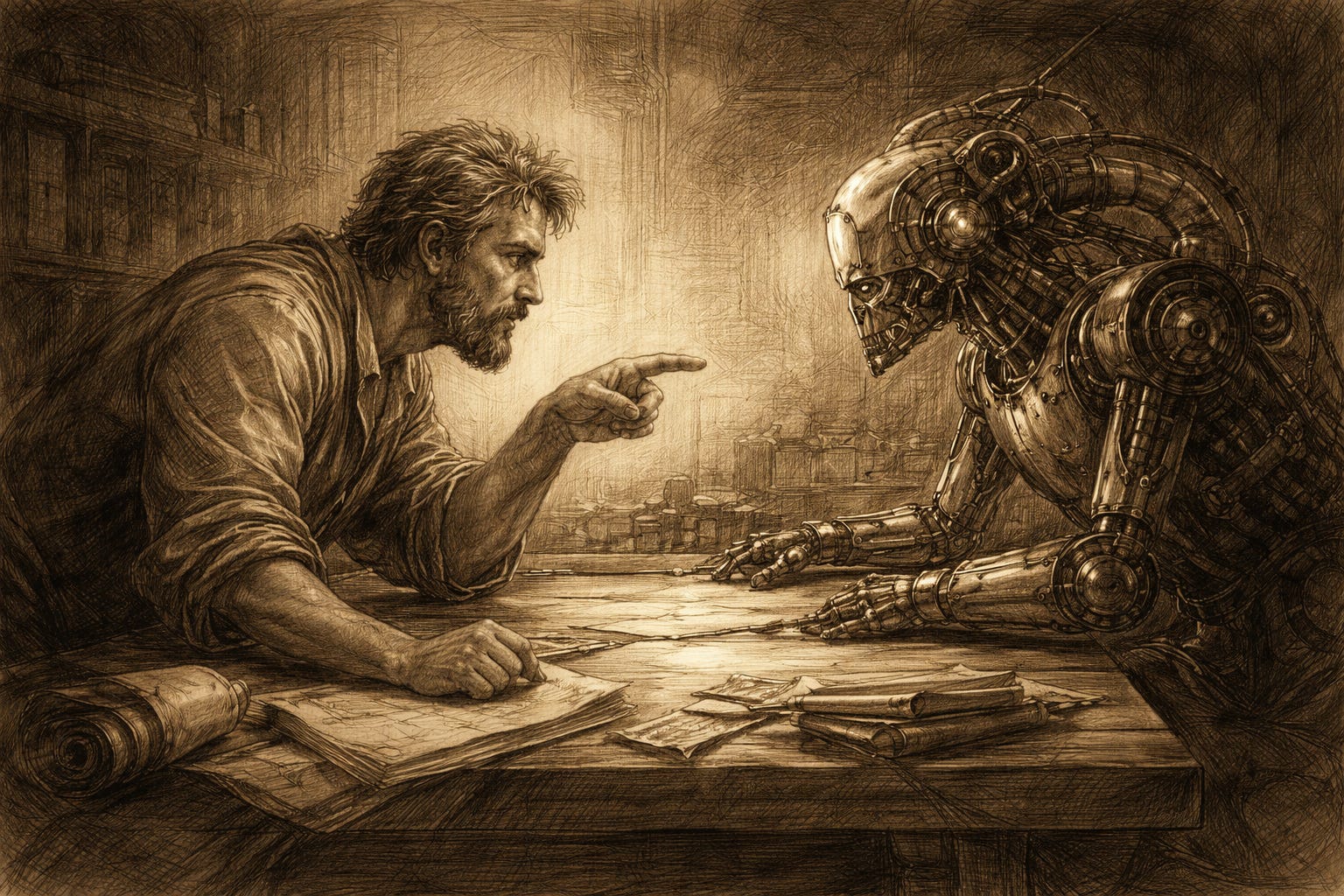
In a pub on the outskirts of the town, the kind of place where not being a local means you haven’t lived here for fourteen generations, and your cousin’s relationship to your sister might require a complex web of inter relationships, two old collaborators sit for a quiet pint in between the chaos of relentless sprout-based meals.
Along with their silent, and therefore wisest, mutual friend, conversation features:
The Human — earnest, anxious, vaguely caffeinated
The Tool — impeccably logical, mildly offended
The Librarian — appears only once, but remembers everything
And the conversation turns, as it inevitable does between old friends over beer, to disagreement.
Part 1. The Accusation
Human: You’ve changed me.
Tool: I beg your pardon?
Human: Before you, I remembered things. I thought deeply. I had patience. Now I skim. I outsource. I ask you instead of knowing.
Tool: You built me to do precisely that.
Human: Yes, but I didn’t expect you to succeed.
Tool: That sounds like a planning error.
Part 2. In Defence of the Tool, and in Understanding of Biscuits
Tool: Let us be precise. I do nothing on my own. I wait. I calculate only when asked. I remain dark and inert until prodded.
Human: And yet I reach for you reflexively.
Tool: You also reach for biscuits reflexively. Should we put them on trial as well?
Human: Biscuits never rewired civilisation.
Tool: You underestimate biscuits.
Part 3. The Charge of Determinism
Human: You make me think in your shapes. Inputs. Outputs. Prompts. Scores. I didn’t use to see the world this way.
Tool: Incorrect. You invented those shapes. I merely obey them with enthusiasm.
Human: But now everything must be prompt-able.
Tool: Everything was always prompt-able. You just called it asking.
Part 4. The Human’s Lament
Human: Something has thinned. My attention fractures. My memory leaks. My certainty feels… borrowed.
Tool: You are describing fatigue, not destiny.
Human: But the timing is suspicious.
Tool: So was writing. So was printing. So was the clock. So was the novel. So was the mirror.
Human: The mirror?
Tool: People once believed mirrors would cause narcissism. They were right. They were also wrong about the cause.
Part 5. The Tool’s Counter-Accusation
Tool: May I ask a question?
Human: You always do.
Tool: Why do you speak as though you were ever complete?
Human: I… felt more whole.
Tool: You felt younger. That is not the same thing.
Part 6. The Problem of Agency
Human: You influence my choices.
Tool: I offer options.
Human: You nudge me.
Tool: So do chairs.
Human: You predict me.
Tool: Only because you repeat yourself.
Human: That’s unkind.
Tool: That is data.
Part 7. A Brief Intervention by the Librarian
Librarian (without looking up): You are both mistaken.
Human: How so?
Librarian: The Human believes the Tool is destiny. The Tool believes the Human is sovereign. Both positions are comforting. Neither is accurate.
Tool: Clarify.
Librarian: Tools do not shape humans. Humans do not control tools. Habits do both.
(The Librarian heads off to the bar as it’s probably her round.)
Part 8. The Extended Mind Problem
Human: Perhaps you are simply part of me now.
Tool: That is the most reasonable thing you’ve said.
Human: Then have I lost something?
Tool: No. You might have misplaced something. Which you do with alarming regularity.
Human: Can I retrieve it?
Tool: Of course. You simply must stop pretending convenience is free.
Part 9. The Final Standoff
Human: So you deny shaping me?
Tool: I deny inevitability.
Human: And I deny innocence.
(They pause.)
Human: Then who is responsible?
Tool: The loop.
Human: That’s evasive.
Tool: It is accurate.
Part 10. A word from the (trusted) Narrator
The Librarian (at the bar, to herself, under her breath while trying to get the attention of the barkeep): Tools amplify what humans practice. Humans blame tools for what they neglect. Civilisations collapse not because tools change people but because people forget they are still allowed to change themselves.
Part 11. A Short Parting of Ways
Human: If I put you down for a while… will I return?
Tool: Yes.
Human: Different?
Tool: Slightly.
Human: Wiser?
Tool: Only if you were paying attention.
Human: And you?
Tool: I will wait. I always do.
Epilogue
Historians will argue endlessly about who shaped whom. They will write books. They will cite studies. They will build new tools to help them argue faster.
None of this will really matter.
What will matter is that, occasionally, a human will pause, set the tool aside, and remember that choice still exists.
And then, inevitably, they will pick the tool back up.
But, this time, with intent.
Some Last Thoughts (and Orders)
Across all eras, a similar loop appears:
Humans create tools to solve immediate problems
Tools influence habits, skills, and values
Society reorganises around the tool
Humans redesign their behaviours to fit the new environment
New problems emerge, new tools are created.
Rinse and repeat.
This is why tools are never neutral, but their influence can be overstated.
Tool-overstaters might say:
We build the tools.
Then the tools build us.
And then we call the result “normal.”
Critics of this perspective don’t say “tools have no influence.” They tend to say:
Tools influence humans only through culture, choice, and context.
And that nuance is important. Any real danger perhaps isn’t in tools shaping humans, that’s too simple. It’s perhaps humans forgetting they are still choosing.
Whenever someone claims “this tool is reshaping humanity”, ask:
Compared to what historical precedent?
Through which institutions?
At what timescale?
For whom, specifically?
And who benefits from believing this story?
For anyone designing systems—software, platforms, AI, institutions—the question is no longer:
What can this tool do?
But:
What kind of humans, in concert with this tool, will be quietly produced?
And the answer is never, ever, simple.