
Transparency, Trust, and Flow
The importance of the "Developer Experience + Self Service + Observability" triad when establishing a modern developer platform

In the beginning, there was the ticket.
Developers would raise one, wait, and hope. A human on the other end would fulfill their request, sometimes quickly, sometimes not. The result was rarely empowering. It was transactional. It was safe, predictable, but slow.
Then came automation — a brave new world of “self-service.” Suddenly developers could deploy, provision, and experiment without waiting. The friction seemed to vanish, but something subtler emerged in its place: fear. Because with great autonomy came great uncertainty. Was the service really up? Was my change deployed correctly? If it breaks, how will I know?
The pendulum swung between freedom and fear until a third element emerged: observability. By making the invisible visible, observability restored the missing ingredient — trust. It gave developers eyes. And with those eyes, they could once again move fast without breaking everything.
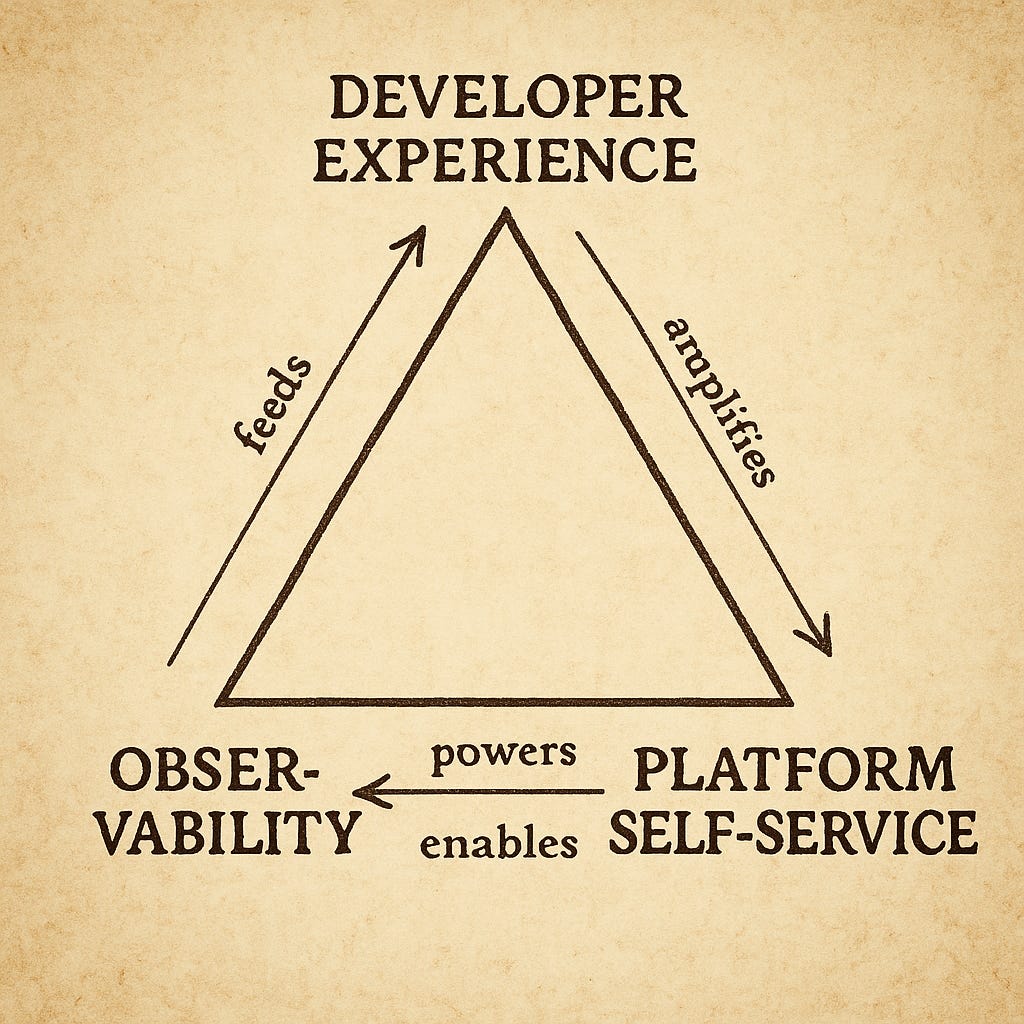
This is the triangle at the heart of every effective internal developer platform:
Developer Experience: the human interface — the way it feels to build and operate software.
Observability: the nervous system — sensing, reflecting, and explaining the state of the platform.
Self-Service: the muscles — acting independently, performing safely, repeating reliably.
Together they form a living system. Observability builds trust; trust unlocks self-service; self-service enriches DX; and good DX fuels better observability through better care, feedback, and empathy.
When any one side of this triangle is missing, the platform decays. A platform rich in automation but poor in visibility becomes a haunted house — full of ghosts no one dares disturb. A platform that measures everything but empowers no one becomes a bureaucratic panopticon. A platform that delights but conceals its workings creates illusions, not reliability.
To design for Developer Experience is therefore not to design for developers, but with them — using observability and self-service as the scaffolding through which confidence and flow can emerge naturally.
Don’t automate what you can’t observe
Without feedback, automation breeds anxiety and distrust. Developer Experience is perceived flow — it’s not what a platform does, but how it feels to use. Observability is informational empathy — it helps the platform explain itself clearly and honestly. Self-Service is operational empathy — it helps developers act without gatekeepers.
When harmonised, these reduce cognitive load, accelerate feedback loops, and create habitability — the sense that your platform is a place where developers can do their best work.
Practices
Embed telemetry into every golden path.
Pair self-service APIs with visible event streams.
Design DX through developer journey maps, not just portal screens.
Engage developers through surveys, observation and, yes, collaboration and communication
Things to avoid
Hiding complexity so well that developers lose agency.
Mistaking dashboards for observability.
Optimising for aesthetics over comprehension.
Observability builds and powers trust.
Self-Service enables autonomy.
Developer Experience builds belonging.
Together they form the anatomy of a living platform — one that not only works, but feels right. A platform is not a product of tools; it is a conversation between the system and its users. Observability gives the system a voice. Self-service gives the users agency. Developer Experience measures the quality of the dialogue between the two.
This triad forms a continuous feedback loop:
1. Observe → Developers see what happens.
2. Orient → They understand and gain confidence.
3. Decide → They take action autonomously.
4. Act → Self-service executes intent safely.
Each loop builds residual trust — the kind that remains even when things go wrong.
“The invisible must first be seen before it can be simplified; the simplified must first be trusted before it can be loved.”