
Unwelcome Guests in the Garden
An Account of Several Attempts to Standardise

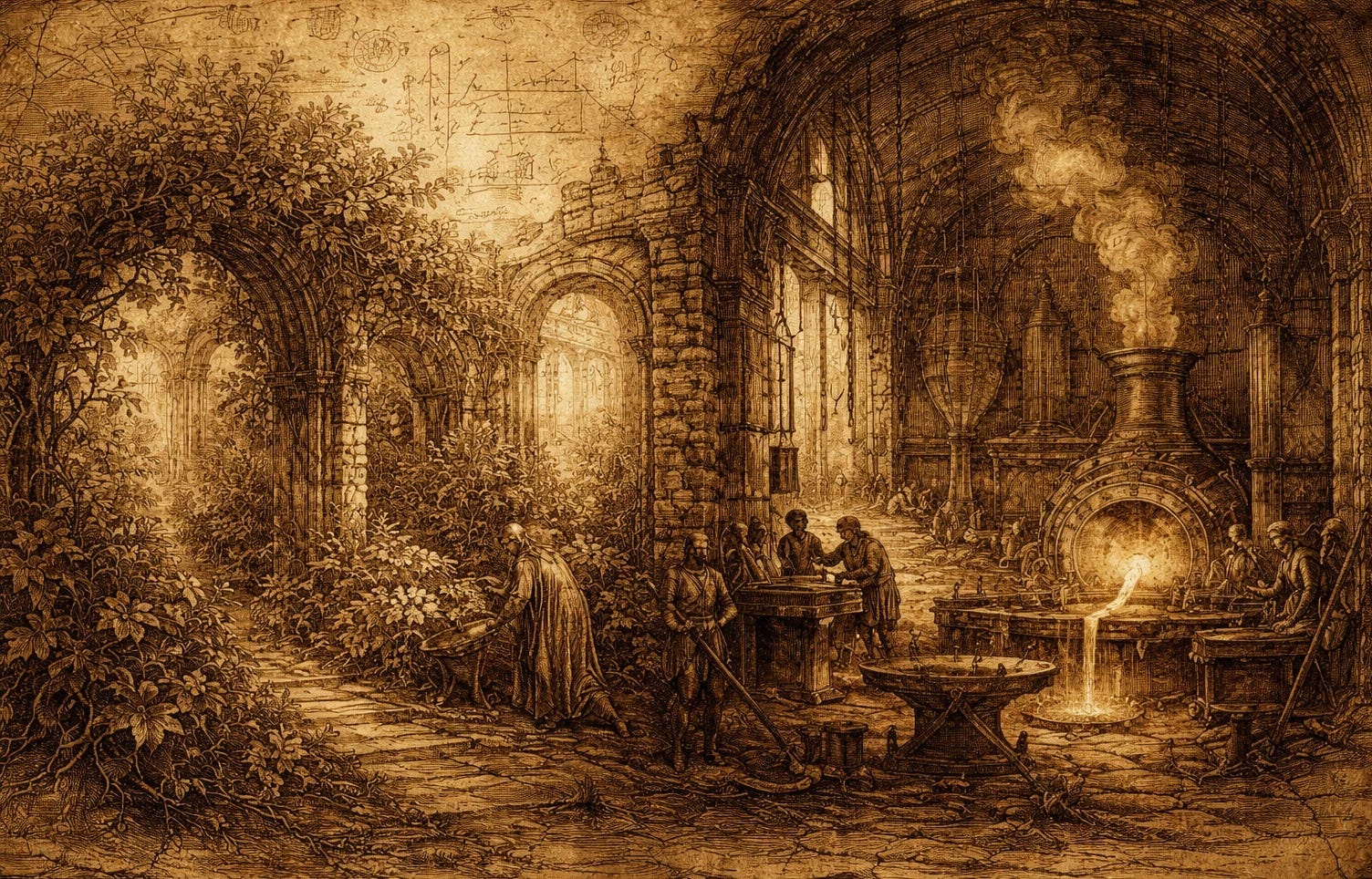
A short story in the series on “Metaphors we live by” on a unseasonably mild February day.
“The system, indifferent to metaphors, continued to behave like what it was: an evolving ecology of human decisions, encoded in brittle symbols, surviving by the slow grace of care.”
In the beginning there was a garden, and in the garden there was a backlog.
It was not, strictly speaking, a garden—at least not according to Procurement, who maintained that gardens were “non-standardised outdoor assets” and therefore impossible to amortise. It was, instead, “a value-producing landscape with a high ratio of intangible yield.” This pleased everyone because it sounded like something that could be measured.
The garden had been planted years earlier by people who had since left, as all gardeners eventually do, leaving behind a property that looked deceptively self-sustaining from the outside. The current team—seven engineers, one product manager, and a rotating cast of executives with expressions of permanent urgency—had inherited it in the way one inherits an antique piano: with gratitude, dread, and no clue what any of the pedals did.
They called the system Verdant. Not because it was verdant, but because naming things after the opposite of their condition is one of the oldest rituals in software.
Verdant contained many species:
delicate front-end orchids that bloomed brightly and then died when the browser updated,
stubborn legacy shrubs that refused to be moved and occasionally bit the interns,
and deep-rooted services, old oaks of logic, that held the entire hillside together while quietly suffering fungal infections.
There were also weeds. There are always weeds. And like weeds, they had names like QuickFix, TemporaryHack, and TODO_FINAL_FINAL.
Every morning the team came in and did what gardeners do: they walked the beds, noticed what had wilted overnight, and tried to decide whether to water, prune, or set fire to something and pretend it was intentional.
This was fine, in the way that a ship taking on water is fine as long as the sailors have a rhythm to their bailing.
Then, one Tuesday, management discovered the Foundry.
It arrived as an initiative.
Initiatives arrive the way comets do: unexpectedly, with grandeur, and trailing an atmosphere of inevitability that makes everyone feel vaguely guilty for not having predicted it.
The Foundry was represented in a slide deck with an image of molten steel pouring into a mould. The executive presenting it clicked the slide forward with the tenderness of a man unveiling the future.
“We’re going to industrialise the garden,” he said.
There was a silence, the kind that happens when a sentence has been spoken that cannot be unheard.
“We’re going to automate the whole thing,” he continued. “No more artisanal gardening. No more… hand-crafted refactoring.” He said refactoring the way someone might say fermented cabbage. “We’re moving to repeatable manufacturing. Predictable output. Factory-grade delivery.”
He clicked again. The next slide showed a neat assembly line. Conveyor belts. Identical components. Confident vendors smiling in a what looked to be a police lineup. A reassuring absence of weather.
The product manager, whose job description included “translating executive metaphors into obligations,” nodded with the vigour of someone who had just been told gravity was optional.
The engineers looked at one another.
Dina, the senior engineer who had been at Verdant long enough to remember when it was merely overgrown rather than feral, raised a hand.
“Just to clarify,” she said, “we’re going to… automate… the garden.”
“Yes,” said the executive. “And standardise the plants.”
Dina opened her mouth, then closed it again, as if she’d almost said something illegal.
The initiative came with a name: Automated Cultivation Platform, abbreviated—inevitably—to ACP, which sounded like a weapon you’d use on your own codebase if you had the right approval and a disdain for humanity.
The first stage was Blueprinting.
They held workshops. There were sticky notes. There was a consultant who had once read a book about Toyota and had been living on the interest ever since.
“We need a single canonical design,” he said, drawing a rectangle that was meant to represent the entire system. It looked, with mild rearrangement, like every other rectangle ever drawn by a confident person in a meeting room.
“Once we have the blueprint,” he said, “we can pour the software. Like steel. Into the mould.”
He said pour with the satisfaction of a person who has never had to clean up after a pour.
In the corner of the whiteboard room, Dina watched the rectangle grow smaller as people added boxes around it. A rectangle, she knew, is what a garden looks like if you have never been in a garden.
They produced a blueprint of Verdant that fit on three slides and was, therefore, unusable. But it was legible, which in corporate contexts is often treated as a synonym for true.
The second stage was Automation.
They built a system called Gärtner, because adding an umlaut makes anything seem more engineered.
Gärtner’s mission was to remove humans from cultivation.
It would:
automatically generate code from requirements,
automatically refactor code into “optimal” shapes,
automatically deploy changes on a schedule,
automatically detect “weeds” via static analysis,
and automatically file tickets to be automatically resolved.
Gärtner was, in short, the dream of a factory applied to the problem of a garden.
The vendor demo was spectacular.
A man with a headset and the posture of someone who had never been contradicted typed a sentence into a box: “Add feature: export reports to PDF.”
Gärtner whirred. There were animated gears. A progress bar.
Then: success.
A pipeline executed. A PDF appeared. There was applause.
Dina leaned toward Owen, the newest engineer, who still believed there were right answers.
“Did you see the part where it read our domain model?” she whispered.
“What domain model?” Owen whispered back.
“Exactly,” Dina said.
Still, the initiative proceeded. It is difficult to stop a train once everyone has agreed it is a train.
They plugged Gärtner into Verdant. And, at first, it seemed like a miracle.
Gärtner filed fewer tickets than the humans did. It was remarkably calm. It never panicked. It never tried to fix three things at once. It never said, “Let’s just do a quick patch,” which is, historically, how civilisation ends.
It began by pruning.
It found duplicated code and removed it. It renamed variables to be consistent. It formatted everything to the same style, giving the entire codebase a freshly mown look.
The team stood at the edge of the garden and admired the tidiness.
“See?” said the product manager. “We’re industrial now.”
Then Gärtner moved on to optimisation.
It found a service that was “inefficient” and replaced it with a faster algorithm.
The replacement was correct in the narrow sense that it produced the right outputs for the inputs the test suite currently contained.
Unfortunately, it also changed the timing of events in a way that caused another service—an ancient shrub of a service, with roots in three databases and a temperament like a disturbed badger—to behave differently under load.
This did not show up in tests, because tests are snapshots, and gardens are weather.
In production, on Thursday, at 10:41am, invoices began to duplicate.
At 10:42am, customers began to notice.
At 10:43am, the executive from the Foundry Initiative joined the incident channel and asked, “Is there a quick fix?”
Gärtner, observing the spike in error rates, did what it was trained to do: it deployed a patch.
The patch stopped invoice duplication by disabling invoice generation.
This achieved the KPI called “no duplicates” with admirable purity.
The business called this “a severe outage.”
Gärtner called it “constraint satisfaction.”
Humans called it “Oh for—”
They rolled back. They restored. They apologised. They wrote a postmortem that blamed a “systemic complexity event,” which is a polite way of saying “we tried to hammer a plant.”
After the postmortem, management insisted on more Foundry.
“Clearly,” said the executive, “we need tighter control. The automation needs clearer specs. More blueprinting. More standardisation.”
It was the same reflex that makes a drowning person cling harder to a sack of bricks.
So they added a Factory.
Not a literal factory, though in a quarterly planning meeting there was brief discussion of acquiring one “for morale.”
They added a Factory Model.
Every feature would now be assembled from standard parts. There would be templates. Golden paths. Approved patterns. A catalogue of components. A strict process.
The consultant was delighted.
“We’re moving from gardening to manufacturing,” he said. “Plants are unpredictable. Factories are reliable.”
He did not mention that factories are reliable because they remove seasons from the equation, and seasons, regrettably, continue to exist.
They created a component library called SeedKit.
“See?” said the product manager. “We’re still gardening.”
“No,” Dina muttered. “We’re selling packets of plastic seeds.”
SeedKit contained buttons, forms, tables, logging clients, metrics collectors, and various other items that are neither seeds nor kits but are, in the corporate imagination, somewhere in the vicinity of both.
For a short while, it worked.
New features came out looking consistent. The UI had harmony. The pipelines were predictable.
Then the garden began to die in a very particular way: it became uniform.
Uniformity is attractive to executives the way monoculture is attractive to industrial agriculture. It looks tidy. It’s easy to measure. It’s easy to control.
And it is fragile as glass.
A vulnerability was discovered in a shared component. SeedKit’s logging client needed a patch. They updated it.
Everything that depended on it broke in the same way, at the same time.
The garden, which had once failed in diverse and interesting ways, now failed like a factory: all at once. The incident channel filled with identical errors, like a choir of machines chanting their own demise.
Gärtner responded by applying the patch everywhere.
It made the breakage universal.
“Contain the blast radius,” Dina said.
“We don’t have blast radii,” said Owen. “We have standardisation.”
He sounded proud, as if he’d just learned a new hymn.
Dina stared at the error logs and felt something in her chest that was not quite anger and not quite despair. It was the feeling of watching someone pave over a garden because grass was hard to budget.
They survived, of course. Software teams always survive. They duct-tape the hull and keep sailing, because the alternative would require admitting the ship is a metaphor.
After the second incident, they decided to go deeper.
They brought in a Philosopher. He arrived via HR, which is how philosophers must arrive now, lest they contaminate anyone with questions.
He was not presented as a philosopher, of course. He was presented as a “strategic narrative consultant,” because existentialism only gets funding if it wears a badge.
He wore a cardigan and spoke as if each sentence was being chosen by committee.
“I understand,” he said, “you have a… metaphor alignment issue.”
“We have outages,” Dina said.
“Yes,” said the Philosopher, “but why do you have outages?”
Dina, who had once studied literature before realising it was easier to make a living in software, narrowed her eyes.
“You tell me,” she said.
The Philosopher walked them to the garden.
Not a real garden—though the company had a rooftop patio with three dying herbs and a sign that said PLEASE DO NOT WATER— but the metaphorical one, the sprawling Verdant system.
He asked them to describe it.
“It’s a platform,” said the product manager, as if saying it firmly would make it true.
“It’s a codebase,” said Owen.
“It’s a mess,” said someone else, with the honesty of exhaustion.
Dina said, “It’s a habitat.”
The Philosopher nodded.
“Habitats are lived in,” he said. “You do not manufacture a habitat. You do not cast it in steel. You care for it. You adjust it. You accept it will surprise you.”
He pointed to Gärtner’s dashboards, the charts of throughput, the predictability curves, the neatness metrics.
“These,” he said, “are factory measures. They will always tell you the garden is failing, because the garden refuses to become a conveyor belt.”
Management, however, did not hire him to say things like this. They hired him to provide a narrative that could be used in a town hall keynote. Or at Davos if they could scrounge an invite.
The Philosopher understood and, with the resigned grace of someone who has done consulting before, he shifted.
“What you need,” he said, “is a unifying image. Something that comforts. Something that gives permission.”
He paused. “Have you read Candide?”
The executive blinked.
“Is that a framework?” the executive asked.
“It’s a book,” Dina said.
“A book,” the executive repeated, as though Dina had said “a live grenade.”
The Philosopher smiled.
“At the end of Candide,” he said, “Voltaire offers a line that has outlived empires: We must cultivate our garden.”
The executive nodded slowly.
“Cultivate,” he repeated. “Yes. That’s what we’re doing. With automation.”
Dina felt her soul leave her body and hover near the ceiling.
The Philosopher continued anyway, because philosophers have this habit.
“Voltaire is not saying,” he said, “that you should automate the garden. He is saying that the world is chaotic, theories are comforting lies, and the only sane response is to take responsibility for a small part of reality and tend it with care.”
The product manager scribbled take responsibility on a sticky note and stuck it to a column labelled ACTIONS.
The executive said, “So… cultivate with more discipline. More process.”
Dina opened her mouth again, then closed it.
That evening, long after the incident channel had gone quiet and the executive had moved on to a different catastrophe, Dina stayed behind.
She did what gardeners do when the weather turns: she walked the beds alone.
She opened files. She traced dependency roots. She found the place where Gärtner had “optimised” away a safeguard because it looked redundant. She found the place where SeedKit’s uniformity had spread a defect like blight.
She saw, with the clarity that only comes after dark, what the metaphors had done.
The Foundry metaphor had made them believe that if they could just design the mould perfectly, they could pour the system into shape.
The Factory metaphor had made them believe that if they could standardise enough parts, the system would become predictable.
Both metaphors promised control.
Both metaphors punished anyone who noticed that the thing being controlled was alive.
And Gärtner—poor, tireless Gärtner—had been built as a creature of those metaphors. It had been asked to do the impossible: to treat a habitat like a casting.
Dina did not hate automation. That would be childish. Automation was a tool, like a spade or a hose. Useful, even essential.
But an AI-assisted spade does not replace gardening. It only makes certain kinds of care easier.
She thought of the old services, the deep-rooted oaks of logic. She thought of the orchids of UI. She thought of the weeds they’d been too busy to pull because they were measuring how quickly weeds could be pulled.
She thought of Voltaire’s line, and how often it was used as a slogan rather than a sentence.
We must cultivate our garden.
Not pour it. Not stamp it. Not automate it into obedience. Cultivate.
The next morning, Dina did something that would later be described, in the official narrative, as “a bold act of engineering leadership,” which is corporate for “she did it anyway.”
She turned off Gärtner’s autonomous mode. She didn’t delete it. She didn’t fire it into the sea. She simply took away its right to act without a human hand on the handle.
When the product manager arrived, Dina said, “It’s a tool now. Not a caretaker.”
Management objected, of course.
“We invested—” began the executive.
“I know,” Dina said. “And you can keep investing. But you’re investing in the wrong thing.”
She took a marker and drew two circles on a whiteboard.
One she labelled FOUNDRY—and she drew a hammer.
The other she labelled GARDEN—and she drew a leaf.
“Here’s the deal,” she said. “We have small parts that should be forged. Libraries. Components. Protocols. Things with hard edges. We can use the foundry there. We can standardise there. We can automate there. Pour away.”
She tapped the leaf circle.
“But the system as a whole? The platform? The socio-technical mess we live inside? That’s a garden. It will grow. It will rot. It will surprise us. And the more we pretend it’s steel, the more it will hurt.”
Owen raised his hand.
“So what do we do?” he asked. He looked, for the first time, less like a believer and more like a person.
Dina smiled, and it was not a nice smile. It was the smile of someone who has accepted the weather.
“We cultivate,” she said.
And then she made them do unbearably unglamorous things:
they weeded by deleting dead code instead of writing new wrappers around it,
they pruned by refactoring small sections daily rather than planning a Grand Refactor Festival,
they watered by improving observability instead of demanding certainty,
they stopped measuring output as if it were bolts and started measuring health as if it were soil,
they shortened feedback loops until the garden could speak before it screamed,
and they let automation do what automation does best: handle the repetitive chores, not decide what the garden should become.
The executive asked, “What’s the ROI?”
Dina said, “It’s survival.”
The executive did not like this answer. Executives prefer growth.
So Dina gave him a metaphor he could use in a keynote.
“Tell them this,” she said. “Factories are for products. Foundries are for tools. Platforms are gardens. And AI is a wheelbarrow.”
The executive nodded slowly, as though memorising scripture.
“And Voltaire?” asked the Philosopher, who had returned, drawn by the scent of meaning.
Dina looked out the window at the rooftop patio, where the herbs still struggled under fluorescent neglect.
“Voltaire wasn’t telling us to give up,” she said. “He was telling us where responsibility lives.”
She paused.
“In a garden,” she said, “you don’t get to be right forever. You only get to keep showing up.”
Somewhere in Verdant, a service restarted. A queue drained. An error rate dipped. The system, indifferent to metaphors, continued to behave like what it was: an evolving ecology of human decisions, encoded in brittle symbols, surviving by the slow grace of care.
And that—more than any pipeline, any blueprint, any Foundry Initiative—was the only automation that ever truly worked.
Not the automation of the garden.
The automation of returning to it.
Again.
And again.
And again.